An SBA repair is an agreement between SBA and a 7(a) lender "to deduct a specific dollar amount from the funds that SBA pays to the Lender for SBA's guaranty of a Loan", to compensate SBA for an actual or anticipated loss caused by the lender's actions or inactions. It is generally the dollar loss multiplied by SBA's guaranty percentage: SOP 50 57 4's own example is "$50,000 loss x 75 percent guaranty = $37,500 Repair". A repair is the lender's alternative to a partial denial of liability; a full denial withholds the whole guaranty. Which one a file gets depends on the evidence in the purchase package, and SBA's Inspector General found that SBA's own reviewers reached opposite conclusions on more than a third of the files they argued over. Botminds' SBA Guaranty Purchase Preparation reads each tab of the package the way an SBA reviewer will, estimates the likely repair, and leaves the choice to offer one with the bank.
Rules on this page are quoted from SOP 50 57 4, Chapter 25, and 13 CFR 120.524. Review outcomes come from SBA OIG Report 26-12 (August 27, 2026).
545 files SBA's servicing centers wanted to repair or deny, and what the final review decided
Final decisions, Oct 2021–Mar 2025
- Denial upheld · 45%
- Repair upheld · 19%
- Overturned, paid · 36%
32 overturns OIG sampled
- Supported · 50%
- Not supported · 50%
What is the difference between an SBA repair and a denial?
A repair is negotiated; a denial is imposed. When a lender's error caused a loss that "justifies a partial Denial of Liability by SBA", SOP 50 57 4 lets the lender agree "to allow SBA to deduct a specific dollar amount" instead, and SBA pays the rest. If the lender will not agree a repair "acceptable to SBA", the same loss becomes a partial denial. A full denial is reserved for the worst cases: a total or near total loss, a loan that was ineligible, or conduct "material to the soundness or integrity of the 7(a) Loan program".
The threshold for any of them is a material loss. "Generally, SBA will not deny liability on a 7(a) Loan guaranty unless the Lender's actions or inactions caused, or could cause, a Material Loss on the Loan." The exception is program integrity: SBA may deny without a loss "if the Loan was ineligible for SBA financing or the Lender failed to disclose or misrepresented a material fact to SBA". The legal basis is 13 CFR 120.524(a), which releases SBA from liability "in whole or in part" on ten events, from a material failure to follow a loan program requirement to failing to request purchase within 180 days after maturity.
Four outcomes for a guaranty in trouble, and what each takes away
When it applies: A lender error caused an actual or anticipated loss that would justify a partial denial, and the lender agrees to a deduction.
What the lender loses: A specific dollar amount, usually loss × guaranty %. The guaranty percentage and SBA's share of later expenses and recoveries stay the same.
When it applies: The same kind of loss, short of total, where the lender does not agree a repair acceptable to SBA.
What the lender loses: Part of the guaranty, decided by SBA rather than agreed.
When it applies: A total or near total loss caused by the lender, an ineligible loan, or conduct material to program integrity.
What the lender loses: The whole guaranty, and SBA can recover sums already paid "at any time".
When it applies: The lender asks SBA to end the guaranty before purchase. Not available once the guaranteed portion has been sold.
What the lender loses: The whole guaranty, by the lender's choice.
How is an SBA repair calculated?
Repair = the dollar loss the lender caused × SBA's guaranty percentage. The hard part is the first term. For collateral the loss "is based on the Recoverable Value of the collateral"; where the lender never obtained a required lien, SOP 50 57 4 asks it to estimate "the Recoverable Value that the property would have had at the time of liquidation if the Lender had obtained the required lien", with "a detailed explanation of how the Lender calculated" it. For a late site visit, the loss is the recoverable value of collateral that disappeared, or the amount by which it declined, because nobody went to look in time.
A repair, priced the way SOP 50 57 4 prices it
Loss
recoverable value lost through the lender's action or inaction
Collateral: what it would have fetched at liquidation; proceeds: the asset never bought
Liquidation officer
Guaranty %
SBA's guaranty percentage on the loan
Unchanged by the repair
From the authorization
Repair
loss × guaranty %
SOP example: $50,000 × 75% = $37,500
Agreed with SBA
Estimate in the package
acknowledge the error, show the working
Not binding on SBA; "will expedite" the review
Lender, signed by an officer
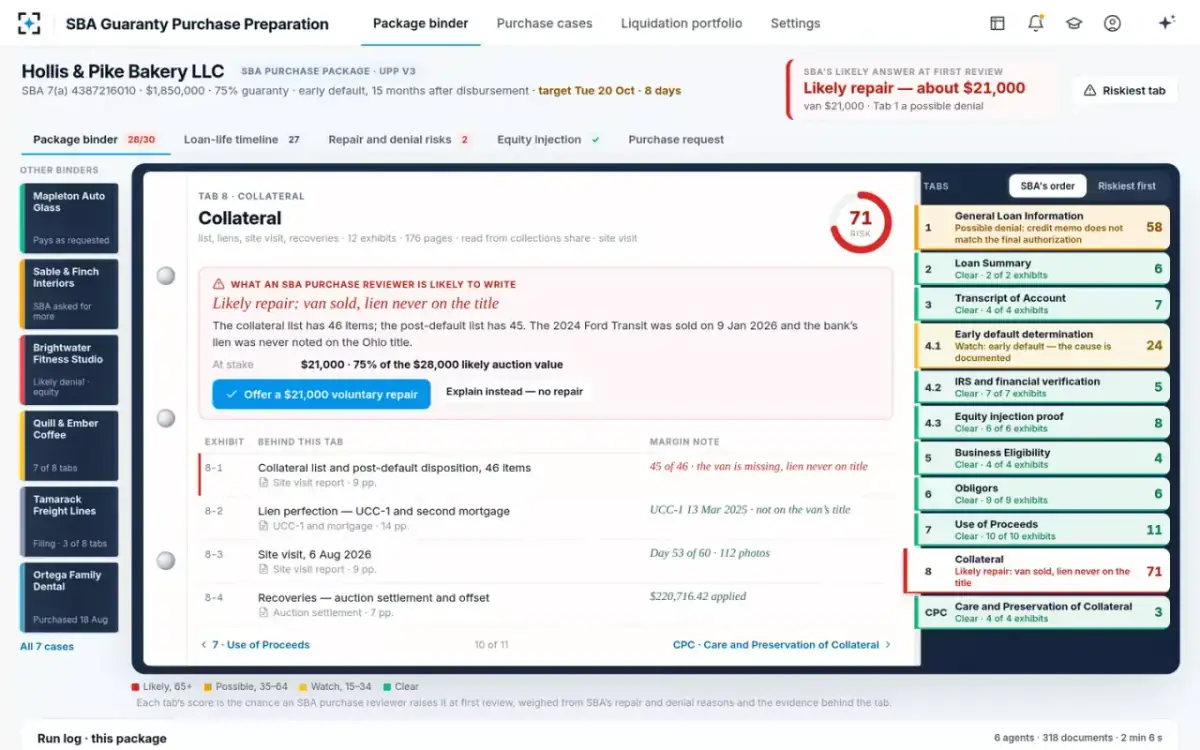
Take a fictional sample loan as it runs through SBA Guaranty Purchase Preparation: Hollis & Pike Bakery, a $1,850,000 7(a) loan with a 75% guaranty, in early default. Its approval list showed 46 collateral items; the post-default list showed 45. A 2024 delivery van had been sold in January 2026, and the bank's lien had never been noted on its title. The agents valued it at a likely $28,000 at auction, so the likely repair was $21,000. The liquidation officer chose to offer it up front, with the working shown, rather than argue the point. The company, people and numbers are invented; the method is SBA's.
A collateral repair, priced and offered by a person
When is a repair not appropriate?
SOP 50 57 4 names three cases. A repair is not appropriate where the lender's actions caused "a total or near total loss", because there is nothing left to deduct from, or where SBA "deems that the Lender's misconduct is material to the integrity and soundness of the 7(a) Loan program". Both of those point to denial. The third case runs the other way: no repair is due for collateral the lender abandoned properly.
The SOP's example is precise. Restaurant equipment on leased premises appraised at $12,000, with $10,000 to remove, transport, store and sell it, has a recoverable value of $2,000, below the SOP's $10,000 threshold for abandoning personal property, and removing built-in fixtures risks damage claims from the landlord. Abandoning it was prudent, so leaving it is not a lender error. The same arithmetic applies to the souvenir shop inventory in the SOP worth $10,000, with $5,000 of routine repossession cost and a further $3,000 for a replevin action: a repair would not be justified.
How often does SBA overturn repair and denial recommendations?
On the files that reach final review, more than a third of the time. When an SBA servicing center recommends a repair or denial and the lender disagrees, the file goes to SBA's Portfolio Management and Quality Control team for a final decision. From October 1, 2021 to March 31, 2025 that team decided 545 such files and overturned 197, 36%, "which resulted in SBA purchasing guaranties totaling approximately $168 million".
An overturn is not proof the lender's package was good. The OIG sampled 32 overturned loans from five high-risk categories and found that half were decided without enough evidence. Repayment ability was the worst category.
Overturned decisions OIG found unsupported, by the issue that started them
| Category | Loans reviewed | Not supported | Potential loss |
|---|---|---|---|
| Repayment ability | 6 | 5 | $4,875,975 |
| Other eligibility | 12 | 4 | $2,709,180 |
| Equity injection | 7 | 3 | $2,148,660 |
| IRS tax verification | 4 | 2 | $1,529,196 |
| Debt refinance | 3 | 2 | $279,958 |
| Total | 32 | 16 | $11,542,969 |
Two reviewers, two answers: what the cases show
The OIG's examples read like a list of packages that left the question open. On one early-defaulted loan the lender "did not provide SBA with evidence that it had addressed an existing $45,000 tax lien prior to approval", and said the loan failed because the borrower lost a major client, with "no evidence provided to justify this claim". On another, the seller of a business "stayed on as a key employee in violation of 7(a) change of ownership requirements"; four offices concurred in a denial, and leadership overturned it on an explanation that the employee was an unpaid volunteer, which the OIG found unsupported. On a third, the cash injection was not shown to have come "from a legitimate source, as required".
The OIG's diagnosis was about SBA, not lenders: SBA "did not have supplemental guidance, such as desk guides or manuals, to apply the criteria in complex, high-risk loan scenarios". For a lender that cuts in an uncomfortable direction. If SBA's own layers can read one file two ways, the lender cannot rely on a sympathetic second reading. The package has to leave one reading.
PMQC repair or denial review decisions are the final control for 7(a) guaranty purchases. Accuracy and consistency in this process is critical to ensuring taxpayer funds are not provided to lenders who do not comply with loan program requirements.
SBA OIG Report 26-12, Finding 1
How a lender makes the answer obvious
By doing in the package what the reviewer would otherwise have to do. SOP 50 57 4's practice tips are specific: submit a complete transcript, include "a written explanation for the omission" of any missing document, and, where a lender error caused a material loss, "acknowledge the error and provide an estimate of the amount needed to fully compensate SBA for the loss, including justification for the estimate". Lenders "are encouraged to include a Repair estimate in their Universal Purchase Package". None of it is binding on SBA, and all of it shortens the argument.
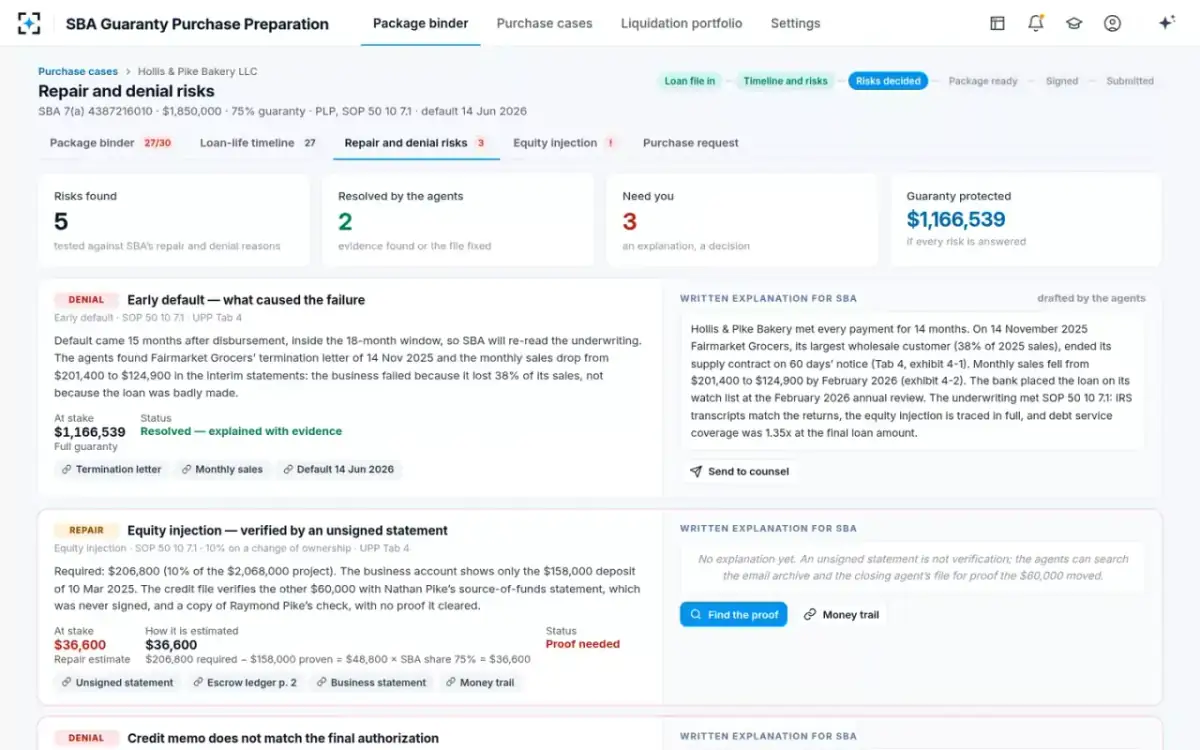
SBA's purchase center publishes the issues that most often lead to a repair or denial, and they sort into a short list a package can address head-on: liens not obtained or not perfected, proceeds used outside the authorization, a site visit too late to find the collateral, collateral released without a documented reason, insurance allowed to lapse, and, on early defaults, missing evidence of the equity injection and of IRS verification (SBA, Guaranty Purchase Process). Those two early-default items carry presumptions that can turn a repair into a full denial, explained in the SBA early default definition.
Each risk with its rule, its working and the explanation SBA will read
How long does an SBA repair or denial review take?
If the lender accepts the servicing center's first decision, the review closes there. If it disagrees, the final review has averaged well over a year. The OIG measured the steps: reviews were not started for almost a year on average, and a legal opinion, when one was asked for, took most of another.
Days to a final repair or denial decision, by what was measured
The cost of those days to the lender, in interest SBA does not pay and in years of exposure, is set out in what a late purchase package costs. The way to avoid most of them is a package that does not need a second reading. To see a binder scored tab by tab on your own loan, start from SBA Guaranty Purchase Preparation.
Questions people ask
Can a lender appeal an SBA repair or denial?
The first route is to disagree with the servicing center's initial decision. If the lender disagrees, the OIG describes the file being "routed to SBA's Portfolio Management and Quality Control (PMQC) team to review and make a final decision". That team upheld 64% and overturned 36% of the 545 files it decided from October 2021 to March 2025.
Does a repair reduce SBA's guaranty percentage?
No. SOP 50 57 4 says "A Repair does not reduce SBA's guaranty percentage nor SBA's pro-rata share of expenses and/or recoveries associated with the Loan." It is a fixed dollar deduction from the purchase payment; recoveries after purchase are still shared at the original percentage.
Should a lender offer a repair before SBA asks?
SOP 50 57 4 encourages it: lenders should acknowledge an error that caused a material loss and include a repair estimate with its justification, which "will expedite SBA's Repair analysis and guaranty purchase approval process". It is a business choice; an explanation without a repair is also possible where the lender believes no material loss occurred.
Can SBA deny a guaranty if there was no loss?
Yes, in narrow cases. SBA generally will not deny without an actual or potential material loss, but it may where the lender's conduct is material to program integrity, "for example, if the Loan was ineligible for SBA financing or the Lender failed to disclose or misrepresented a material fact".
Can SBA reverse a purchase it already paid?
Yes. 13 CFR 120.524(b) entitles SBA to recover what it paid plus interest if it determines "at any time" that a release event occurred. In 2026 the OIG recommended that SBA remedy or seek recovery on the 16 overturned loans it found unsupported; SBA partially agreed.