An SBA wrap-up report is the documentation a 7(a) lender must send the SBA loan center "within 30 calendar days after all Prudent Liquidation actions are completed", showing every liquidation action it took and assigning the note, personal guaranties and any judgments to SBA. It signals that "no further collection action will be pursued by the Lender", so SBA can reclassify the loan as SBA Uncollectible and refer the balance to the Treasury, or charge it off. After a guaranty purchase it is also bound by a second clock: under the prudent liquidation deadline in SOP 50 57 4, an acceptable wrap-up report is due no later than 24 months after SBA purchased the guaranty, unless SBA extends the deadline in writing. Botminds' SBA Guaranty Purchase Preparation builds the purchase package and keeps every post-purchase clock in view, so a purchased loan does not drift toward its deadline while the desk works the next default.
Rules on this page are quoted from SOP 50 57 4 (effective November 1, 2025), Chapters 21, 24 and 27, and 13 CFR Part 120. The examples use a fictional sample loan.
Purchase is not the end: four post-purchase clocks
24months
from SBA's purchase to resolve the loan: the prudent liquidation deadline
30days
after the last prudent liquidation action to file the wrap-up report
15days
business days to remit SBA's share of a post-purchase recovery through pay.gov
6months
between status reports once SBA has extended a deadline
What is an SBA wrap-up report?
SOP 50 57 4 defines it as "the documentation, whether or not it is titled 'Wrap-up Report,' that a Lender must provide in electronic format to the SBA Loan Center within 30 calendar days after all Prudent Liquidation actions are completed, for review and approval by SBA". Its content follows the template SBA posts on the National Guaranty Purchase Center and Commercial Loan Servicing Center websites. It ends the lender's collection work on the loan: once SBA approves it, the loan becomes "SBA Uncollectible", and SBA either refers the remaining balance and the obligors to the Treasury or, if no obligor is eligible for referral, charges the loan off.
It is not only a closing memo. SBA charges off a loan "after receiving, reviewing and approving a Lender Wrap-up Report in which the Lender confirms" it has exhausted recovery and found nothing more that is cost-effective. A wrap-up report that cannot support those statements invites the same scrutiny as a purchase package, after the money has been paid.
What an SBA wrap-up report must establish
- Every prudent liquidation action completed
voluntary payments on the note, liquidation of the collateral, compromise with remaining obligors, and legally enforced collection.
- No further cost-effective collection
the obligors cannot be found, or cannot or will not pay the balance.
- Or the balance is legally uncollectible
discharged in bankruptcy, barred by the statute of limitations, or another valid legal defense.
- The site visit report, or why there was none
unless it already went in with the purchase package.
- Assignment of the note, personal guaranties and judgments to SBA
on SBA's approved assignment form.
- The information in SBA's wrap-up template
from the National Guaranty Purchase Center or Commercial Loan Servicing Center website.
When is the SBA wrap-up report due?
Within 30 calendar days after prudent liquidation is completed, or when SBA asks for it, "whichever occurs first". After a guaranty purchase it must also arrive within the 24-month prudent liquidation deadline. A lender can file it earlier still: with the purchase request itself, if liquidation is already finished.
That last option has a price attached. If "a Wrap-up Report acceptable to SBA" goes in with the purchase request, SBA retains the lender's annual service fee "for a maximum of 120 calendar days"; if not, SBA retains the fee through the date of purchase. A lender that has finished selling the collateral before it files saves the difference, and closes the loan in one review instead of two.
What is the SBA prudent liquidation deadline?
Twenty-four months from the date SBA purchased the guaranty. Within that time the lender must resolve the loan and give SBA "sufficient evidence of resolution": the terms of an agreement returning the loan to regular servicing, a payoff with SBA's pro-rata share of the proceeds remitted, or an acceptable wrap-up report. SBA may extend the deadline "on a case-by-case basis" for extenuating circumstances such as judicial foreclosure, bankruptcy, or a loan that returned to liquidation after purchase, but only in writing, and lenders "should submit their requests no later than 30 calendar days prior to the expiration".
From purchase to closure: the deadlines a desk has to carry
| Clock | Starts | Length | Rule |
|---|---|---|---|
| Prudent liquidation deadline | Date SBA purchases the guaranty | 24 months, unless SBA extends it in writing | SOP 50 57 4 Ch. 24 E; missing it can mean repurchase and an enforcement referral (Ch. 24 G) |
| Extension request | As soon as a delay is apparent | No later than 30 calendar days before the deadline | SOP 50 57 4 Ch. 24 F.2 |
| Status reports | An approved extension | Every 6 months | SOP 50 57 4 Ch. 24 F.3 |
| Remittance of recoveries | Receipt of any post-purchase payment | 15 business days, through pay.gov, payment code 172 | SOP 50 57 4 Ch. 4 C.2 |
| Wrap-up report | Last prudent liquidation action, or SBA's request | 30 calendar days | SOP 50 57 4 Ch. 27 B; late filing can mean an OCRM referral and repurchase (Ch. 27 B.2) |
| Assignment of loan documents | SBA's written request | 5 business days, recorded locally | SOP 50 57 4 Ch. 27 D.2 |
Missing it is expensive. SBA "will require Lenders that fail to comply with the Prudent Liquidation Deadline for a 7(a) Loan to repurchase SBA's share of the remaining balance", and will refer them to its Office of Credit Risk Management "for possible enforcement action, including, but not limited to, restriction from future participation in the secondary market for 7(a) Loans and/or suspension of delegated authority". A late wrap-up report carries the same referral, and SBA may require repurchase of its participation interest.
How do you remit recoveries to SBA after purchase?
Through pay.gov, quickly. "Regardless of whether the Loan was sold on the secondary market, Lenders must remit SBA's share of any post-guaranty purchase Loan payment using payment code 172 in www.pay.gov within 15 business days of receipt." After a loan has been referred to the Treasury, recoveries the lender still receives go the same way, within 15 days.
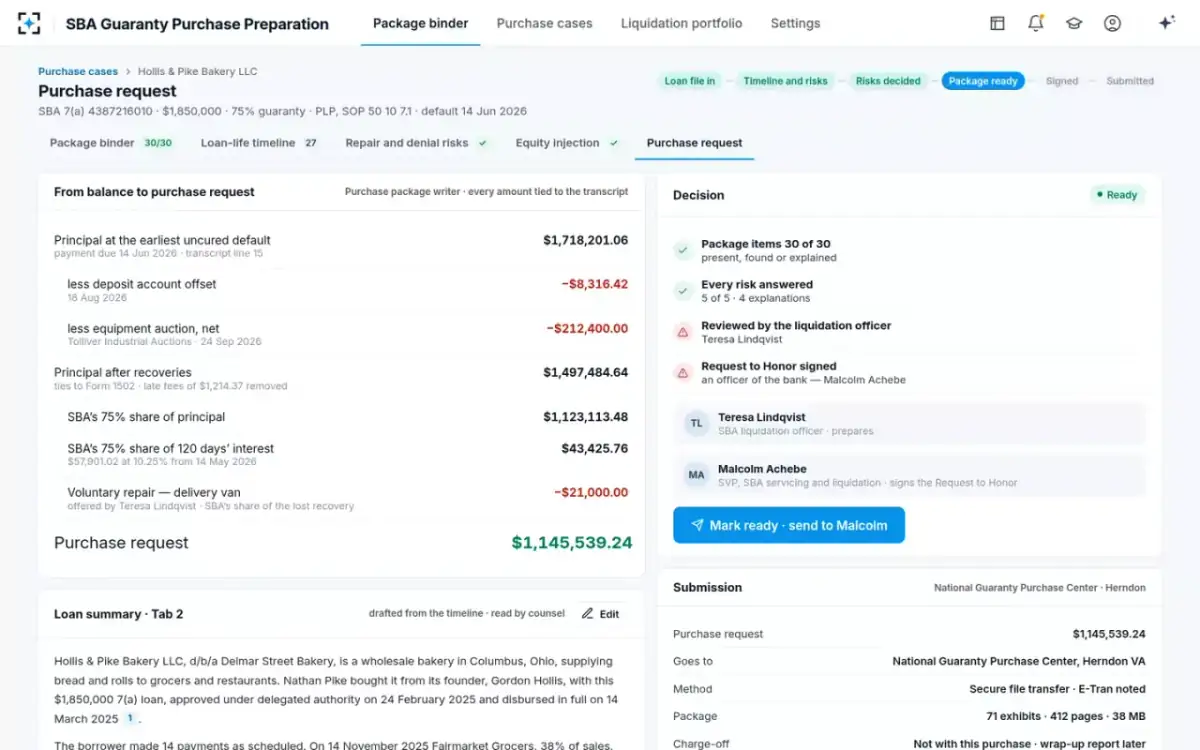
Recoveries before purchase are different: they reduce the balance SBA buys. Take a fictional sample loan as it runs through SBA Guaranty Purchase Preparation: Hollis & Pike Bakery's $1,850,000 7(a) loan, with principal of $1,718,201.06 at the earliest uncured default. Before the request went in, the bank applied an $8,316.42 deposit-account offset and $212,400 of net equipment auction proceeds, leaving $1,497,484.64, of which SBA's 75% share was $1,123,113.48. The package went in marked "wrap-up report later": collection was not finished. Every dollar recovered from here is shared at 75%, remitted within 15 business days, and accounted for in the wrap-up report.
The amount, with each recovery applied before purchase
What is an SBA litigation plan?
It is the plan and budget a lender must have SBA approve before it starts non-routine litigation on a 7(a) loan. 13 CFR 120.540 defines non-routine litigation broadly, and anything that is not routine needs approval first. Amendments need approval too where fees would rise by more than 15%, and SBA can take over litigation that could affect the program.
Routine and non-routine litigation under 13 CFR 120.540
Routine: no prior approval: Uncontested matters, such as non-adversarial bankruptcy matters and undisputed foreclosures.
Non-routine: litigation plan first: Any litigation where facts or law are in dispute and need adjudication.
Routine: no prior approval: Estimated legal fees not exceeding $10,000.
Non-routine: litigation plan first: Any case with legal fees estimated to exceed $10,000.
Routine: no prior approval: None.
Non-routine: litigation plan first: Any actual or potential conflict of interest between the lender and SBA.
Routine: no prior approval: Only the 7(a) loan is involved.
Non-routine: litigation plan first: The lender has a separate non-7(a) loan to the same borrower.
Routine: no prior approval: Fees still reviewed by SBA counsel for being necessary, reasonable and customary.
Non-routine: litigation plan first: Plan and budget approved first; increases over 15% need approval again.
Fees that SBA counsel finds unnecessary, unreasonable or not customary are deducted from the purchase request, or reimbursed by the lender if they were already taken from recoveries, SBA's guaranty purchase page warns (SBA, Guaranty Purchase Process). A litigation budget is therefore part of the wrap-up, not just the lawsuit.
What is an SBA offer in compromise?
It is "an offer made by an Obligor to pay less than what is owed in full settlement of the Obligor's obligation on their 7(a) Loan". SBA "will accept an offer in compromise if it reflects the Obligor's true ability to pay", and will reject it if the obligor can pay in full by lump sum or instalments, or if accepting it "would harm the integrity of the 7(a) Loan program". Compromising the principal balance is one of the actions that needs SBA's prior written approval.
Offer in compromise: the rules that shape a settlement
| Rule | What SOP 50 57 4 says | Why it matters for the wrap-up |
|---|---|---|
| When | After the business has closed and the collateral is liquidated; with a going concern only where the business's viability is at stake | A compromise is usually the last recovery before the wrap-up report. |
| Who | Each obligor is jointly and severally liable; a compromise with one does not release the others | Every remaining obligor must be pursued or explained. |
| Finality | Final and conclusive once SBA approves it in writing, unless obtained by fraud, misrepresentation or mutual mistake | The approval letter belongs in the wrap-up file. |
| Disclosure | Lenders must tell obligors a compromise is a loss to the federal government and may have tax consequences | Evidence the advice was given protects the lender. |
| Real estate | A deed in lieu or non-judicial foreclosure that extinguishes the balance is analysed as a compromise | Needs the same approval as a cash offer. |
What happens when SBA charges off a loan?
The loan's status changes, the debt does not. "SBA status change is an administrative action whereby SBA reclassifies a Loan from 'In liquidation' to 'SBA Uncollectible' or 'Charge Off' status. The SBA status change has no impact on an Obligor's liability for the Loan balance." Where collection is not legally barred, SBA refers the loan and the remaining obligors to the Treasury, after an automated notice giving them 60 calendar days to pay or agree a plan. The Treasury's tools include its offset program, which can take federal and state payments due to the obligor, and cross-servicing.
The lender's role narrows but does not end. After referral, "no one other than Treasury may take any further servicing or liquidation action on the Loan", and later litigation is handled by SBA District Counsel. The lender must still keep the loan file, for six years after final disposition if it is an SBA-supervised lender or as its own regulator requires, pass on any legal or bankruptcy notices, and help with collateral releases.
SBA can still look back after the wrap-up
A closed file is not a closed question. Under 13 CFR 120.524(b), SBA is entitled to recover any money paid on a guaranty "plus interest from the Lender" if it determines "at any time" that a release event occurred, and it may use offset. In 2026 SBA's Inspector General found 13 loans, about $5.4 million, where repair or denial had been recommended but the six-year statute of limitations ran out first, and recommended that SBA use administrative offset instead (SBA OIG Report 26-12). The wrap-up report is the lender's last account of the loan; it should read as if someone will check it in five years.
Purchased loans with a wrap-up still open, next to the ones still to file
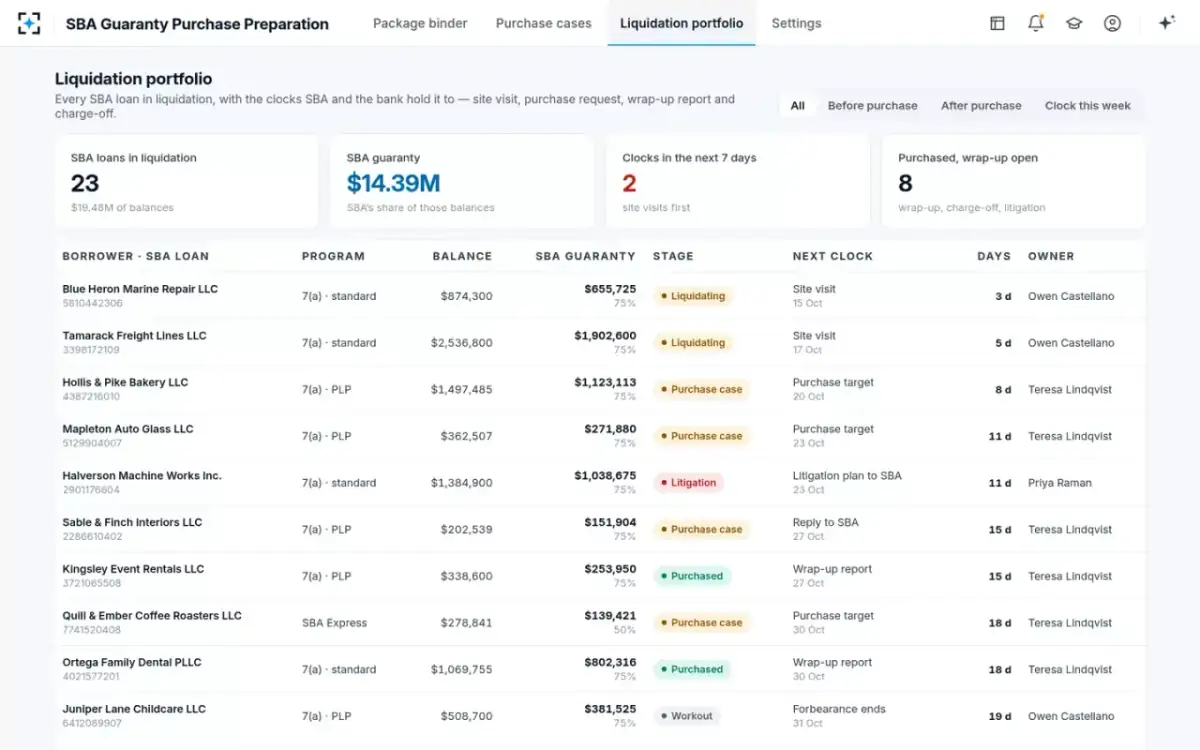
The work before purchase, and what each late day costs, is set out in what a late purchase package costs; the package itself is in the SBA guaranty purchase checklist. To keep every clock on your own SBA book in one place, start from SBA Guaranty Purchase Preparation.
Questions people ask
Can a wrap-up report be submitted with the purchase package?
Yes, if prudent liquidation is already complete. SOP 50 57 4 rewards it: with an acceptable wrap-up report filed alongside the request, SBA retains the annual service fee for at most 120 days rather than through the purchase date, and the site visit report need not be sent twice.
Who reviews the wrap-up report?
The SBA loan center that handles the loan: the National Guaranty Purchase Center for most 7(a) loans, or the Commercial Loan Servicing Center. It must approve the report before the loan's status changes to SBA Uncollectible or charge-off.
What if liquidation will take longer than 24 months?
Ask for an extension in writing, as soon as it is clear, and no later than 30 calendar days before the deadline. The request must describe the extenuating circumstance, include evidence of it, estimate when liquidation will finish, and attach a loan status report; SBA then sets a new deadline and expects status reports every six months.
Does charge-off end the borrower's liability?
No. SOP 50 57 4 says the status change "has no impact on an Obligor's liability for the Loan balance". Remaining obligors are referred to the Treasury for collection unless a legal defense, such as a discharge in bankruptcy or an approved compromise, bars it.
What are SBA charge-off tabs?
Lenders use the phrase for the documents that support a charge-off, which SOP 50 57 4 routes through the wrap-up report: the liquidation actions, the recoveries, the assignment of the note, guaranties and judgments, and the reason no further recovery is cost-effective. The template comes from the loan center that services the loan.