The SBA early default definition, in SOP 50 57 4, Chapter 2, is any of four events of default that occur "within 18 months of the initial disbursement of the Loan", or within 18 months of the final disbursement "if the final disbursement occurs more than six months after the initial disbursement", unless the borrower cures and then pays on schedule for 12 more months: a missed payment, a payment funded by selling collateral, a deferment or cure of more than three consecutive payments, or any other default that puts the loan in liquidation. It matters because an early default turns the guaranty purchase review back to origination. SBA reads the credit memo and the tax transcripts, and if the lender cannot document a required equity injection, SBA presumes the missing equity caused the default and may deny the whole guaranty. Botminds' SBA Guaranty Purchase Preparation applies the 18-month test under the SOP in force when the loan was approved, then looks for the documented cause of failure and the proof the presumptions demand.
The rules are quoted from SOP 50 57 4 (effective November 1, 2025), Chapters 2 and 25, and SBA's published Universal Purchase Package. One fictional sample loan is followed through it below.
The 18-month window: where it starts, and how a loan earns its way out
What is an SBA early default?
It is a default inside a defined window near the start of the loan's life, and SOP 50 57 4 says it applies "For SBA guaranty purchase reviews". The window is 18 months from initial disbursement, moved to 18 months from final disbursement when that came more than six months after the first. A loan escapes the label only if "the Borrower cures the Default and makes scheduled Loan payments without default for 12 months following the 18-month period". Four kinds of event count.
The four events that make a default early, if they happen inside the window
| Event | SOP 50 57 4 wording | What to look for in the file |
|---|---|---|
| Missed payment | Borrower failure to make a scheduled payment of principal and interest when due; on annual-payment loans, either of the first two annual payments | The transcript of account: the first installment not paid in full |
| Collateral-funded payment | Borrower use of collateral sale proceeds rather than cash flow from business operations to fund a scheduled payment | Payments that match an asset sale; servicing notes about sold equipment |
| Deferment or catch-up | Lender deferment or borrower curing of defaulted payments equal to more than three consecutive scheduled payments | Deferment approvals; Form 1149 payment types; a lump sum covering four or more months |
| Liquidation event | Any other event of default that requires the lender to classify the loan in liquidation status, e.g., bankruptcy | The 1502 status change; bankruptcy notices; the default letter |
How are the 18 months counted for an SBA early default?
From the date of initial disbursement, unless the final disbursement came more than six months later, in which case the count starts at the final disbursement. A revolving line of credit "is considered fully disbursed at initial disbursement", the Universal Purchase Package notes. The cure needs both halves: the default cured, and then 12 months of scheduled payments without default after the 18-month period ends, which the package's Tab 4 describes as 30 months in all.
Two traps sit in the counting. The first is the dates themselves: the initial and final disbursement dates belong on the settlement sheet and the transcript, and a package that gives the approval date or closing date instead invites the reviewer to work it out alone. The second is the annual-payment loan, where an early default "occurs if a Borrower fails to make either of the first two annual payments when due" and is cured only by making those two payments within 60 days of their due dates and the third on time.
Does a deferment count as an SBA early default?
A long one does. Event (c) in the definition is a "Lender deferment or Borrower curing of defaulted payments equal to more than three consecutive scheduled payments". So a lender trying to help a struggling borrower in its first year can create an early default by doing so: SOP 50 57 4 lets a lender defer up to six consecutive monthly payments on a loan it has not sold, but a deferment of four or more inside the 18-month window is itself an early default. On a sold loan the lender may grant only one deferment of up to three months without the investor's consent, which stays below the line.
That is a servicing decision with an origination consequence, and the reason a deferment request on a young loan deserves a second look from credit before anyone says yes.
What changes in the purchase review when the default is early
On an ordinary default SBA asks mainly whether the loan was closed, serviced and liquidated properly. On an early default it also asks whether the loan should have been made, because a business that fails within 18 months raises the question of whether it could ever have repaid. SBA's package says so in its instructions: if the loan was delegated, "attach the Lender credit memorandum and any/all documentation used and/or relied upon to justify loan approval", and attach the applicant's or seller's IRS tax transcripts for the last three years in operation.
The same purchase request, read two ways
Default after the window: Generally not re-opened unless another issue points to it.
Early default: Re-read: credit memo and everything relied on for approval, on delegated loans.
Default after the window: Reviewed as part of closing compliance.
Early default: Documentation required in the package; a material gap raises a rebuttable presumption that it caused the default.
Default after the window: Part of origination compliance.
Early default: Full denial justified without credible evidence the financials were compared with transcripts.
Default after the window: Context for the liquidation.
Early default: The lender's main defense: credible evidence the business failed for reasons unrelated to the lender's error.
Default after the window: Tabs 7 and 8 may be certified for balances of $100,000 or less.
Early default: No short form: use of proceeds and collateral documented in full.
What is the equity injection presumption on an early default?
It is a rule of evidence that shifts the burden to the lender. SOP 50 57 4 says a lender's "failure to properly document a material portion of any injection of cash or non-cash equity into the Borrower's business that was required by the Loan Authorization/E-Tran Terms and Conditions, or other loan documents raises a rebuttable presumption that the Early Default was caused by the absence of the required equity injection and justifies a full Denial of Liability on the SBA guaranty."
What counts as documentation is spelled out. Credible evidence is a check or wire "processed" with the funds deposited into escrow or the borrower's account before the initial disbursement, or proof the borrower received the funds before then, such as a signed third-party escrow settlement statement or the borrower's bank statement showing the deposit. What does not count is equally clear: "A promissory note, gift letter or financial statement on their own, are not credible evidence of a cash injection without corroborating documentation". The source matters too; SOP 50 57 4 calls verifying a legitimate source "essential in order to prevent 7(a) Loan fraud". The current origination rule, SOP 50 10 8.1, requires the same verification before any proceeds are disbursed.
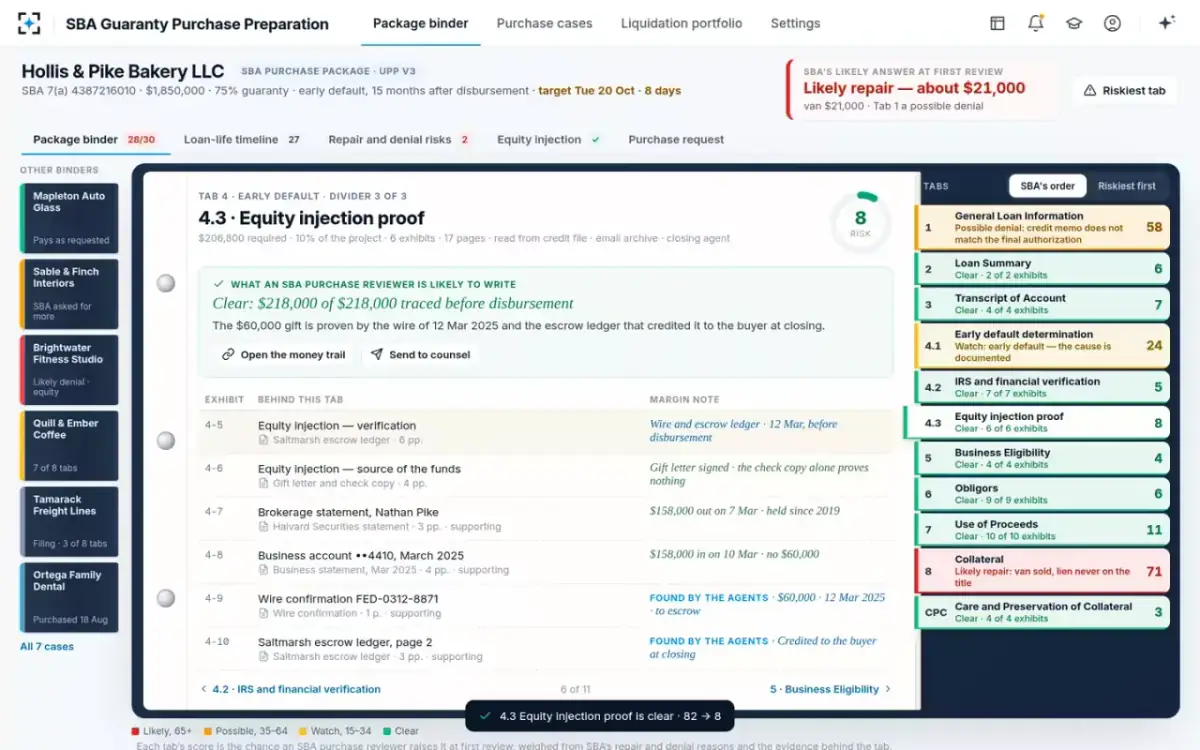
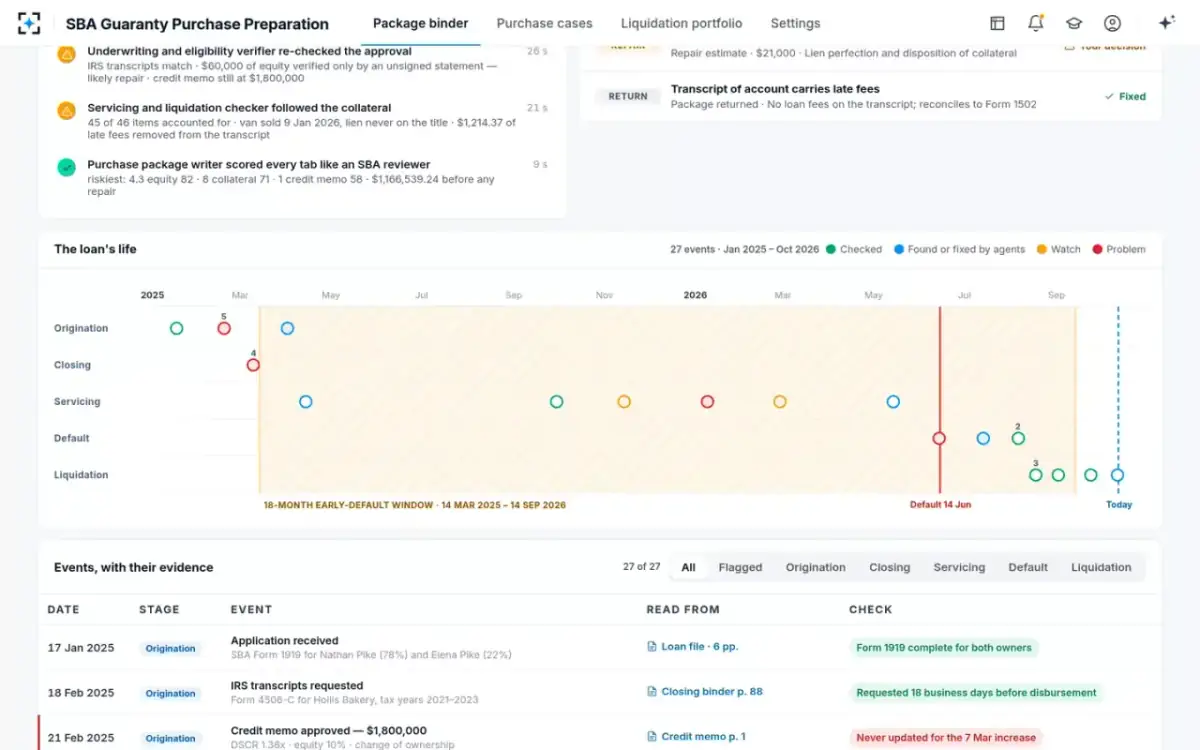
Take a fictional sample loan as it runs through SBA Guaranty Purchase Preparation: Hollis & Pike Bakery, a $1,850,000 change-of-ownership loan disbursed on March 14, 2025, whose earliest uncured default was the payment due June 14, 2026, 15 months later and inside the window. The required injection was $206,800. The business account showed $158,000 arriving on March 10; the other $60,000, a gift from the buyer's father, was supported in the credit file only by a copy of his check and the buyer's unsigned source-of-funds statement. That is the presumption's target exactly, and the tab scored 82, a likely repair or worse.
The presumption answered with evidence: $218,000 traced before disbursement
Can a lender rebut the early default presumption?
Yes, with "credible evidence that the primary cause of the Borrower's Default was something other than the lack of the required equity injection". SOP 50 57 4 gives two examples, "the death of an irreplaceable Key Employee or an uninsured natural disaster that destroyed the Borrower's business premises and customer base", and the same logic runs through its other early-default rules: a full denial for an underwriting failure is justified "unless the Lender provides credible evidence that the business failure was for unrelated reasons".
Credible means documented, dated and connected. On the sample loan the early default examiner found the cause in the servicing file: Fairmarket Grocers, 38% of the bakery's sales, ended its supply contract on November 14, 2025 on 60 days' notice, and monthly sales fell from $201,400 to $124,900 by February 2026. The termination letter, the interim statements and the watch-list memo went behind Tab 4 with a drafted explanation. Compare one of the files SBA's Inspector General criticized, where a lender "stated the loan defaulted due to the borrower's loss of a major client" and "There was no evidence provided to justify this claim". The claim was the same; the evidence was not.
Every date on the loan's life, with the window shaded
What happens if IRS transcripts were not compared on an early default?
SBA may deny the whole guaranty. SOP 50 57 4 says "A full Denial of Liability is justified if there was an Early Default on the Loan and the Lender failed to provide credible evidence that it verified the Borrower's financial information by comparing it to relevant IRS tax return transcripts as required by SOP 50 10 in effect at the time the loan was approved." Waiting on the IRS is not a defense: "delays in receiving transcripts from the IRS do not excuse a Lender from complying". The same rebuttal is open as for equity: a denial "may not be justified" if the failure came from factors the IRS check could not have revealed.
The underwriting failures SBA names for early-default denials
SOP 50 57 4 lists, as illustrations, the delegated-lender underwriting that justifies a full denial when it "contributed to or allowed an Early Default". Each is a check the package should answer before SBA asks.
Underwriting SBA treats as imprudent on an early default
- Projected expenses greatly exceeded projected revenues
and the borrower had no other source of income.
- A startup's projections never compared with a benchmark
no industry standard or the lender's own experience with similar businesses.
- A cash flow analysis that missed a foreseeable risk
the SOP's example is the owner's monthly draw.
- Unsound or overly optimistic revenue projections
such as 100% growth in year one against an industry maximum of 25%, unexplained.
- A material mathematical error in the cash flow
one without which the loan would not have been made, or not in that shape.
- A credit memo that does not match the loan that closed
not in SOP 50 57 4's list, but on the sample loan the memo still read $1,800,000 after the authorization rose to $1,850,000; recomputed, coverage was 1.35x against a 1.15x minimum.
When do SBA loans usually default?
Early in their lives, which is why the window sits where it does. Studying 7(a) loans, Glennon and Nigro found that "as a loan seasons, the likelihood of default increases initially, peaks in the second year, and declines thereafter" (Journal of Money, Credit and Banking, 2005). An 18-month window catches much of that peak. SBA's Inspector General targets the same place: its high-risk loan review program examined early-defaulted loans SBA had already paid, and in FY2019 found that five of eight, about $8.7 million, should have been denied (SBA OIG 19-22).
Early default rates on 7(a) loans differ by lender type
Default rates across the whole program, and what SBA's public loan file shows about a lender's own book, are in SBA 7a default rates. Which SOP governs a given loan's underwriting at purchase is in the servicing and liquidation SOP guide, and the full package is in the purchase checklist. To run the 18-month test and the equity trail on your own loan, start from SBA Guaranty Purchase Preparation.
Questions people ask
Is a loan still an early default if the borrower catches up?
Only a full cure followed by 12 months of on-time payments after the 18-month period removes it. A catch-up of more than three consecutive payments is itself one of the four early-default events. SBA's package asks the lender to explain how the cure happened if it claims one.
Does SBA review every early-defaulted loan more closely?
Its rules require more evidence on every early default: the package must include the equity injection documentation and, for delegated loans, the credit memo and everything relied on for approval. SBA's own FY2025 improper payment testing stratified its purchase sample by whether a loan was an early default.
Does the early default rule apply to SBA Express loans?
The definition in SOP 50 57 4 covers 7(a) loans, including SBA Express. Express loans are exempt from SOP 50 10 8.1's specific equity-verification documents at closing, but an early default still invites SBA to ask whether the loan was prudently made and closed.
Which SOP's underwriting rules apply to an early-default review?
The SOP 50 10 in effect when the loan was approved. SOP 50 57 4 says SBA applies that version "for loan making, loan closing, and loan modifications that took place on the date of or prior to full disbursement". On the sample loan, approved in February 2025, that is SOP 50 10 7.1.
Can a gift letter prove an equity injection?
Not on its own. SOP 50 57 4 says a promissory note, gift letter or financial statement is not credible evidence "without corroborating documentation", meaning proof that the funds were processed and deposited into escrow or the borrower's account before initial disbursement.