An SBA guaranty purchase checklist is the list a 7(a) lender works through before it asks SBA to honor its guaranty on a defaulted loan: first the timing conditions (an uncured payment default of more than 60 days, the loan reported in liquidation, business personal property liquidated), then the documents for each tab of SBA's Universal Purchase Package, then the officer's signature on the Request to Honor. It matters because SBA "will not purchase the guaranteed portion of a Loan from a Lender unless the Lender has submitted a complete Universal Purchase Package", and a gap in that package becomes a repair or a denial. Botminds' SBA Guaranty Purchase Preparation is software for that work: six agents file the loan file behind SBA's tabs and read each tab the way a purchase reviewer will, and the liquidation officer and an officer of the bank make every decision.
The rules below are quoted from SOP 50 57 4, SBA's 7(a) servicing and liquidation procedure in effect since November 1, 2025, and from 13 CFR Part 120. The examples come from a fictional sample loan, introduced where the agents appear.
The numbers that frame a purchase request
60+days
of uncured payment default before a lender may demand purchase
13 CFR 120.520
8tabs
in the Universal Purchase Package SBA publishes (version effective August 1, 2023)
120days
the most accrued interest SBA pays on its guaranteed share
loans approved on or after May 14, 2007
$2.1B
7(a) guaranty purchase outlays in FY2025
SBA Agency Financial Report
When can a lender request SBA guaranty purchase?
A lender may request purchase once the loan has an uncured payment default of more than 60 calendar days, it is reported "In Liquidation" on the monthly Form 1502, and, for loans approved on or after May 14, 2007, business personal property collateral with an aggregate recoverable value of $10,000 or more has been liquidated. Those are the three conditions SOP 50 57 4 lists in Chapter 24, Paragraph D, and they come from 13 CFR 120.520.
Three details catch lenders out. A bankruptcy filing changes the first condition: the regulation lets a lender file "once a period of at least 60 days has elapsed since the last full installment payment", and it lifts the duty to liquidate personal property first. A cure ends the right: "If a Borrower cures a default before a Lender requests purchase by SBA, the Lender's right to request purchase on that default lapses." And payments after the request do not move the clock. Under 13 CFR 120.523, the earliest uncured payment default date is fixed once the lender has asked, and later payments go to principal.
The latest date is a separate rule, and the one most often misquoted. It is not counted from the default. Under 13 CFR 120.524(a)(8) SBA is released from its guaranty if the lender fails to request purchase within 180 days after the loan's maturity, or, on a matured loan still in liquidation or collection litigation, within 180 days after that work ends. Where SBA has already bought the guaranteed portion from a secondary-market investor, the lender has 45 calendar days from that purchase to submit the package.
The timing tests, before a single document is gathered
| Test | The rule | Where it comes from |
|---|---|---|
| Earliest date to file | Uncured payment default of more than 60 calendar days (less if SBA agrees in writing) | 13 CFR 120.520(a)(1); SOP 50 57 4 Ch. 24 D.1 |
| Bankruptcy | At least 60 days since the last full installment payment; personal property need not be liquidated first | 13 CFR 120.520(a)(1); SOP 50 57 4 Ch. 24 D.4 |
| Status | Loan classified "In Liquidation" on the monthly SBA Form 1502 | SOP 50 57 4 Ch. 24 D.2 |
| Collateral first | Business personal property with aggregate recoverable value of $10,000 or more liquidated (loans approved on or after May 14, 2007) | SOP 50 57 4 Ch. 24 D.4.a |
| Sold loans | Repurchase through the fiscal transfer agent, or ask the National Guaranty Purchase Center to buy from the investor | SOP 50 57 4 Ch. 24 D.3 |
| After SBA buys from the investor | Complete package within 45 calendar days of that purchase | SOP 50 57 4 Ch. 24 D.5.b |
| Latest date in all cases | No later than 180 days after maturity, or after liquidation of a matured loan is complete | 13 CFR 120.524(a)(8) |
What goes in an SBA guaranty purchase package, tab by tab
The package is the Universal Purchase Package: SBA's index of eight tabs, each with the documents a reviewer needs to decide whether the lender made, closed, serviced and liquidated the loan by the rules. SBA's own instructions are blunt about presentation: "clearly labeling and presenting each document in the order outlined, will ensure an expeditious review of this package" (SBA Universal Purchase Package). The checklist below follows the version SBA publishes, effective August 1, 2023; check it against the instructions of the center you file with, which SOP 50 57 4 tells lenders to follow.
The eight tabs, and what a reviewer looks for behind each
- Tab 1, General Loan Information
The Request to Honor signed by an officer of the lending institution, the loan authorization or E-Tran approval and every modification, companion loans, wire instructions. The loan must already be in liquidation status.
- Tab 2, Loan Summary
The narrative of the loan from approval to default, and the SBA assignment form. It is the reviewer's map to the rest.
- Tab 3, Transcript of Account
A certified transcript, ideally on SBA Form 1149: every disbursement, payment and rate change, the paid-to date and the default date. No lender fees.
- Tab 4, Early Default
The 18-month test. On an early default: the credit memorandum, IRS transcripts compared with the financials, and proof the equity injection was made from a legitimate source.
- Tab 5, Business Eligibility
The eligibility determination, affiliation and size analysis, and the guaranty application and addenda.
- Tab 6, Obligors
Every borrower and guarantor, business and individual, with demands and what was recovered from each.
- Tab 7, Use of Proceeds
Each disbursement tied to its payee and purpose: settlement sheet, invoices marked paid, joint-payee checks. May be shortened for non-early defaults of $100,000 or less.
- Tab 8, Collateral Liquidation
The collateral list, the post-default site visit report, appraisals, sale reports and how every item was disposed of. May be shortened on the same terms as Tab 7.
Two items on that list carry more weight than their length suggests. The transcript is where SBA dates the default and checks the money: SBA renamed the Form 1149 column "DEFERMENT" to "TYPE OF PAYMENT" in 2024 because the old form "does not collect enough details about the type of loan payments" (Federal Register 2024-11642), and SOP 50 57 4 says lenders "must not add their Loan fees to the transcript of account". Tab 4 is the other. On an early default it is where the burden of proof turns against the lender, which the early default definition works through in full.
Where a lender's internal checklist runs to ten tabs, it is usually the same documents counted differently; the 10 tab checklist, mapped onto SBA's eight, shows how the pieces line up.
Where do you send it: the National Guaranty Purchase Center or the Commercial Loan Servicing Center?
Most 7(a) packages go to the National Guaranty Purchase Center (NGPC) in Herndon, Virginia; SBA Express, Export Express, Community Advantage and pilot loans that were not sold on the secondary market go to the Commercial Loan Servicing Center. SOP 50 57 4 lists the NGPC programs: "Standard 7(a), Small 7(a), CLP, PLP, CAPLine, Export Working Capital Program (EWCP), Working Capital Pilot, International Trade Loan Program", and several others. Packages go "in electronic form", and the lender must make sure every loan action that modified the terms is already up to date in E-Tran.
A purchase request is not the route for PPP loans, which go through SBA's PPP platform, or for 504 loans, which have their own servicing procedure. The checklist on this page is for 7(a).
What SBA reviewers find missing most often
SBA publishes its own list of what goes wrong. The NGPC's guaranty purchase page names the common errors in the order a reviewer meets them: a package with no tabs or out of order, "The transcript is not signed and/or is not in the SBA 1149 format", and on early defaults, "Evidence of equity injection is missing", settlement sheets without support, post-default UCCs missing, the credit memo missing on PLP loans, and IRS income tax verification "often missing or incorrect". Site visit reports and wire instructions make the list too (SBA, Guaranty Purchase Process).
Almost none of those is a credit judgment. They are documents that existed once, in some system, and did not make it into the package in the right place. That is why the same page's list of top reasons for repair and denial reads like a list of filing failures: liens not perfected, proceeds disbursed outside the authorization, a site visit that came too late to find the collateral, equity and tax verification missing on an early default.
SBA will not purchase the guaranteed portion of a Loan from a Lender unless the Lender has submitted a complete Universal Purchase Package to SBA, which SBA deems to contain sufficient, credible evidence that the Lender made, closed, serviced and liquidated the Loan in accordance with SBA Loan Program Requirements.
SOP 50 57 4, Chapter 24, Paragraph A
What the agents assemble, and what stays with a person
Agents can do the gathering, filing, dating, cross-checking and arithmetic; a person decides every repair, approves every written explanation and signs the request. That split follows the rule itself. The SOP asks the lender to "acknowledge the error" and estimate a repair where a lender error caused a material loss, and to "include a written explanation" for any missing document. Those are statements by the bank, so the bank makes them.
Take a fictional sample loan as it runs through SBA Guaranty Purchase Preparation: Hollis & Pike Bakery, a $1,850,000 7(a) loan with a 75% guaranty, approved under delegated authority and disbursed in March 2025, in default 15 months later. Its loan file arrived from five systems as 318 documents and 2,140 pages. The people, bank and borrower are invented; the rules applied to them are SBA's.
Six agents prepare the package; two people decide and sign
Agent
Loan file readerReads all 318 documents from the origination system, closing binder, servicing system, email archive and collections share, and files 69 exhibits behind SBA's tabs.
Never: Edits, re-dates or re-signs a document
Agent
Loan-life timeline builderDates 27 events, from application to auction, each tied to the page it came from.
Never: Fills a date it cannot cite
Agent
Early default examinerApplies the 18-month test under the SOP in force at approval and finds the documented cause of failure.
Never: Uses today's SOP on a 2025 approval
Agent
Underwriting and eligibility verifierTraces the equity injection to its source, compares IRS transcripts with the returns, checks the credit memo against the final authorization.
Never: Treats a check copy as proof the money moved
Agent
Servicing and liquidation checkerFollows each of 46 collateral items to its disposition; checks liens, site visit timing and the transcript against Form 1502.
Never: Reports collateral liquidated without a document
Agent
Purchase package writerScores each tab against SBA's repair and denial reasons, computes the amount and drafts the loan summary and explanations.
Never: Signs, submits or offers a repair
A person decides
Liquidation officerReviews every risk and explanation; chooses a voluntary repair up to her $10,000 limit or refers it up.
A person decides
SVP, SBA servicing and liquidationDecides repairs above the limit and signs the Request to Honor as an officer of the bank.
The file as it arrives: 318 documents, five places, not yet in SBA's order
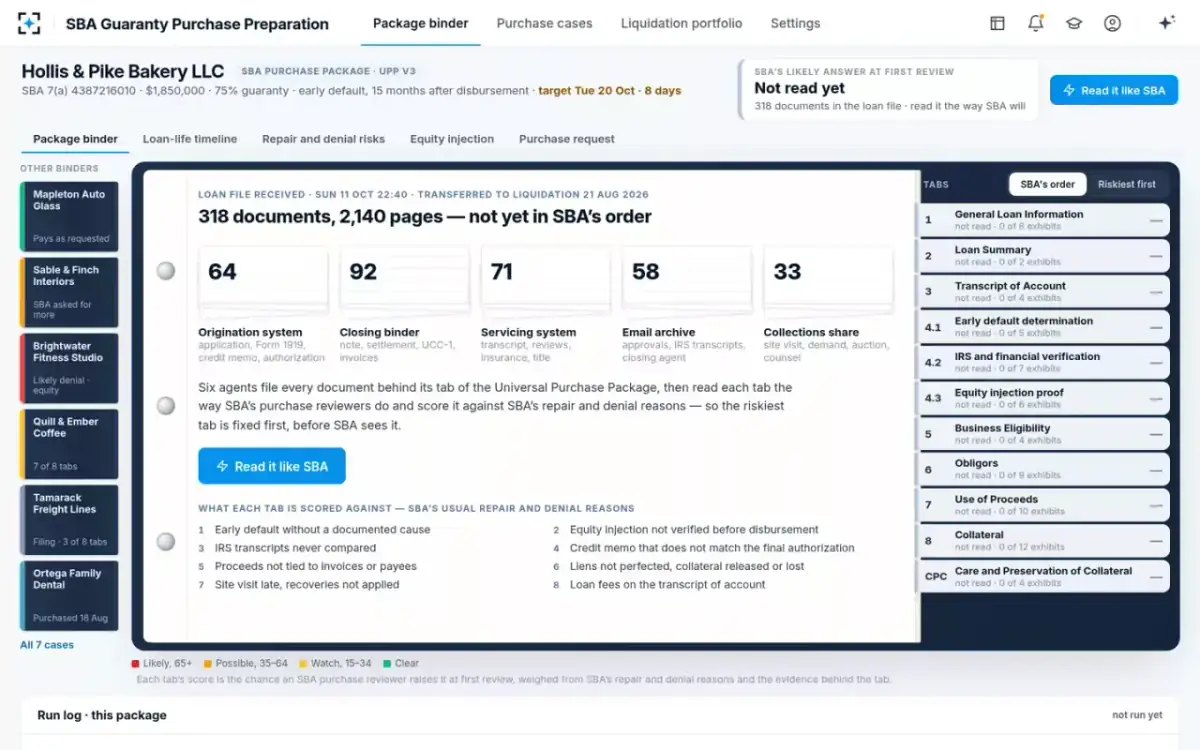
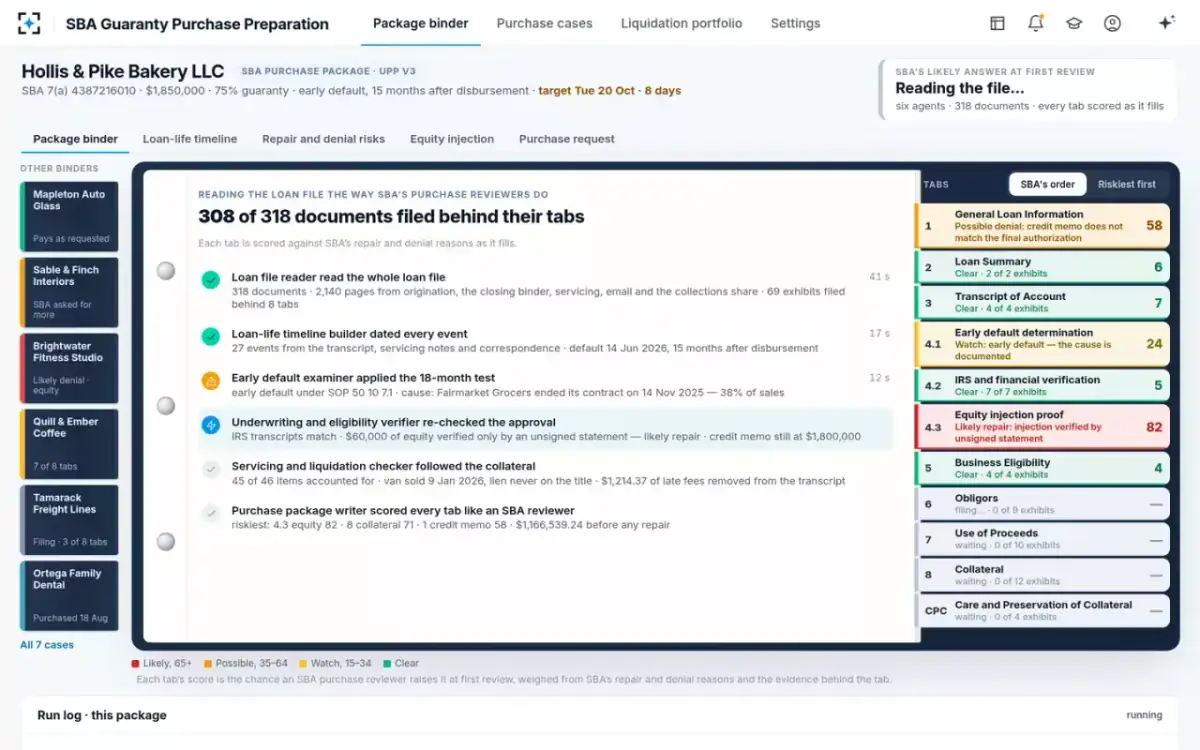
On the sample loan the run surfaced three things a purchase reviewer would have raised. The equity injection tab scored 82, a likely repair: $60,000 of the $206,800 required injection was supported only by a check copy and an unsigned source-of-funds statement, which SBA's rules say is not proof. The collateral tab scored 71: a delivery van had been sold without the bank's lien ever noted on its title. And the general loan information tab scored 58, a possible denial, because the credit memo still showed $1,800,000 after the authorization rose to $1,850,000.
The first was fixed with evidence, not argument: the agents searched the email archive and the closing agent's folder, found the wire confirmation and the escrow settlement entry that credited the $60,000 before disbursement, and the tab fell to 8. The second became a $21,000 voluntary repair, chosen by a person. The third became a written explanation recomputing coverage at the final amount, 1.35x against a 1.15x minimum. How those scores compare with what SBA actually decides is the subject of what an SBA repair is.
Every tab scored as it fills, riskiest first
How to judge software for the SBA purchase package
A tool for purchase packages should be judged on whether it makes the reviewer's answer obvious, not on how fast it stacks PDFs. The rows below are the questions worth asking any vendor, ours included, with the rule that makes each one matter.
What to ask of purchase package software, and why each answer matters
Ask: Does it read the whole loan file, across origination, closing, servicing, email and collections, or only what someone uploads?
Why it matters: Most missing evidence existed somewhere. An equity wire in an email archive is proof; the same wire nobody found is a repair.
Ask: Does every finding link to the document and page it came from?
Why it matters: SBA decides on "sufficient, credible evidence". A conclusion without its page is an assertion a reviewer will not accept.
Ask: Does it apply the SOP 50 10 in force at approval and the SOP 50 57 in force at each servicing action?
Why it matters: That is the rule SBA applies at purchase review (SOP 50 57 4, Ch. 24 A). Today's SOP on a 2024 loan gives wrong answers.
Ask: Does it apply the 18-month test with the final-disbursement and cure rules, and then the equity and IRS presumptions?
Why it matters: On an early default a missing equity injection is presumed to have caused the failure.
Ask: Does it compute the request from the transcript, cap interest at 120 days and strip lender fees?
Why it matters: SBA does not pay lender fees, and pays at most 120 days of interest on loans approved after May 14, 2007.
Ask: Who signs, who offers a repair, and is each decision on the audit trail?
Why it matters: An officer of the bank signs the Request to Honor. Software that signs or offers repairs on its own takes a decision away from the bank.
Ask: When a document is missing, does it say so and draft an explanation, or quietly omit the item?
Why it matters: SOP 50 57 4 asks for "a written explanation for the omission" in the package.
Where the solution fits: 7(a) loans in liquidation, standard, PLP and SBA Express, where the evidence exists somewhere in the bank's systems and the work is finding, filing and reading it. Where it does not: it cannot create proof that never existed, it does not decide whether to accept a repair, and it is not a substitute for counsel on a contested denial. It does not handle PPP purchase requests or 504 loans. It needs read access to the systems where the file lives; a bank whose closing binders are paper in a basement has a scanning project first.
The checks to run before the officer signs
The last pass is the one the bank cannot delegate. Before the package goes, someone with authority should confirm that every risk the review raised has either evidence, a written explanation or a chosen repair; that the amount ties to the transcript and to the last Form 1502; that the default date is the earliest uncured payment default and has not been advanced by a payment made after the request; and that the package will reach the right center well inside the 180-day limit after maturity, if the loan has matured.
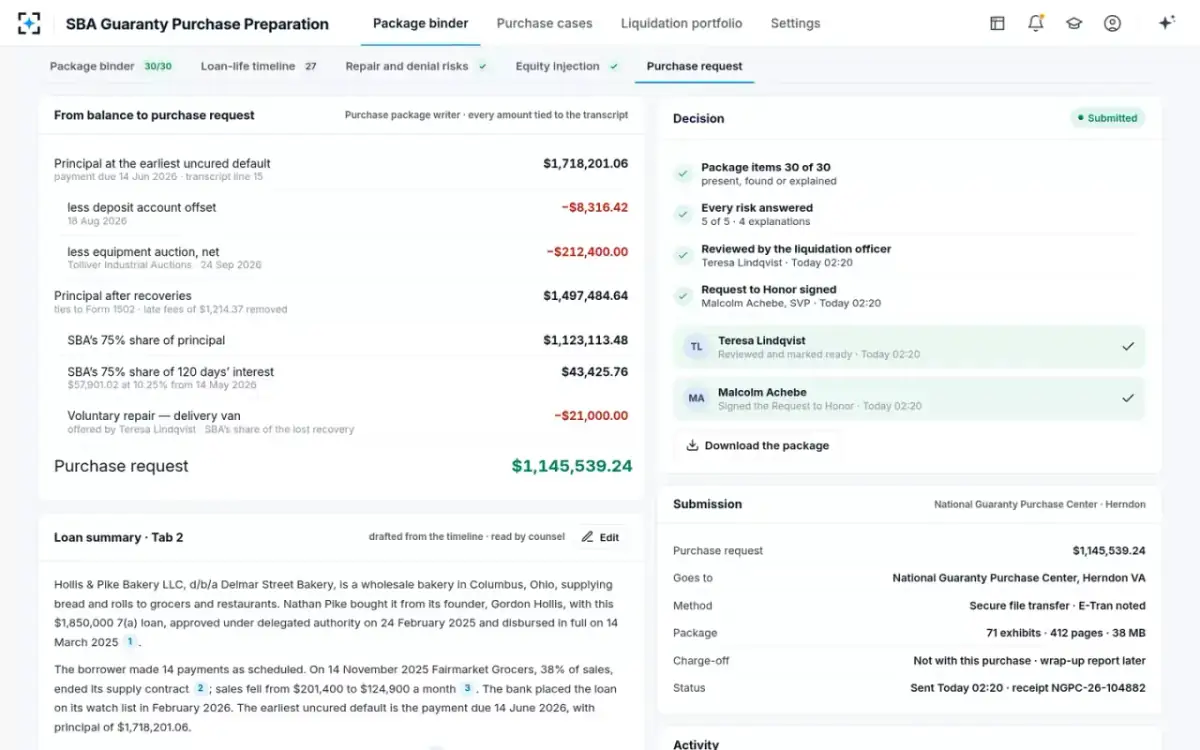
On the sample loan that pass ended with 30 of 30 package items present or explained, the solution's design target, and a predicted first-review answer of "pays as requested" at $1,145,539.24 after the $21,000 van repair. The SVP signed the Request to Honor and the package went to the NGPC by secure file transfer: 71 exhibits, 412 pages.
Signed by an officer of the bank, then submitted
A package that is complete is also a package that is on time, and the cost of the days in between is the subject of what a late purchase package costs. To see the binder on one of your own loans, start from SBA Guaranty Purchase Preparation.
Questions people ask
Who signs the SBA Request to Honor?
An officer of the lending institution. SBA's Universal Purchase Package puts the "Request to Honor SBA 7(a) Loan Guaranty signed by an officer of the lending institution" first in Tab 1. A lender service provider or a software tool may prepare it, but the signature, and the representations it carries, belong to the bank.
Is SBA Form 1149 mandatory for a purchase request?
No. SOP 50 57 4 says the Form 1149, the Lender's Transcript of Account, is recommended rather than mandatory, because it speeds up the review. The transcript itself is required and must be certified, and SBA's purchase center lists a transcript "not in the SBA 1149 format" among the common errors it sees.
Can a borrower payment after the purchase request change the default date?
No. Under 13 CFR 120.523, once the lender has requested purchase, "the earliest uncured payment default date does not change because the Lender has already exercised its right to request purchase". Later payments are applied to principal. Before the request, a payment that covers an installment in full moves the default date to the next unpaid installment.
Where is the SBA National Guaranty Purchase Center?
In Herndon, Virginia, at 1165 Herndon Parkway, according to SBA's Universal Purchase Package. It takes standard 7(a), Small 7(a), PLP, CAPLine and export working capital packages, among others. SBA Express, Export Express and Community Advantage loans not sold on the secondary market go to the Commercial Loan Servicing Center.
Do I have to liquidate collateral before requesting SBA purchase?
For loans approved on or after May 14, 2007, the lender must liquidate business personal property with an aggregate recoverable value of $10,000 or more first, unless the borrower is in bankruptcy. SOP 50 57 4 says lenders "should liquidate all the collateral" before filing; real estate may follow after purchase, within the 24-month prudent liquidation deadline.
Can AI prepare an SBA guaranty purchase package?
It can prepare it: read the file, sort it into SBA's tabs, date the events, check the equity trail and compute the amount, with every finding cited to its page. SBA has issued no guidance endorsing AI in purchase preparation, and nothing changes who is accountable: the lender's officer signs, and SBA judges the evidence, not the tool that found it.