SBA 7a default rates depend on which measure is meant, and SBA's own sources give several: SBA reported an average 7(a) delinquency rate of 1.15% for FY2025 through July and a 12-month charge-off rate of 0.68%; SBA's Inspector General measured a default rate of 9.79% for 7(a) loans made by banks and other lenders in FY2016–2023, against 14.97% for non-bank small business lending companies; and SBA's public loan-level file shows that 6.4% of FY2021–22 loans of $150,000 or less had been charged off by mid-2026, against 0.6% of loans over $1 million. When an SBA loan defaults, the lender's next job is the guaranty purchase package, and the rates decide how many of those a desk will build. Botminds' SBA Guaranty Purchase Preparation is software for that package: six agents file the loan file behind SBA's tabs and read each tab as SBA's reviewers will, so the volume the rates predict does not turn into repairs.
Rates on this page come from SBA's FY2025 Agency Financial Report, SBA OIG reports, and our own count from SBA's 7(a) loan file on data.sba.gov, labeled as ours where they appear.
Four measures, four different numbers
1.15%
average 7(a) delinquency rate, FY2025 through July
FY2024: 0.88%
0.68%
12-month 7(a) charge-off rate, July 2025
9.79%
cumulative default rate, FY2016–2023 loans by banks and other lenders
non-bank SBLCs: 14.97%
6.4%
of FY2021–22 loans of $150,000 or less charged off by June 2026
our count, SBA loan file
What is the SBA 7a default rate?
It depends on the clock and the denominator. A delinquency rate is a snapshot of loans past due today. A charge-off rate counts losses written off over a period. A cumulative default rate follows a group of loans from approval and counts how many ever defaulted. Each answers a different question, and mixing them is how a 1% figure and a 15% figure can both be "the SBA default rate".
Which SBA default measure answers which question
| Measure | Latest figure | What it tells a lender | Source |
|---|---|---|---|
| Delinquency rate | 1.15% average, FY2025 to July (0.88% in FY2024) | How much of the book is late now: next quarter's liquidation pipeline | SBA AFR FY2025 |
| 12-month charge-off rate | 0.68%, July 2025 | Losses actually written off; lags defaults by the length of liquidation | SBA AFR FY2025 |
| Cumulative default rate | 9.79% (banks and others), 14.97% (SBLCs), FY2016–2023 loans | How often a vintage ends in default over its life so far | SBA OIG 26-14 |
| Early default rate | 2.62% (banks and others), 5.38% (SBLCs) | Defaults inside 18 months, where SBA re-reads the underwriting at purchase | SBA OIG 26-14 |
| Charge-offs by loan size | 6.4% (≤$150K) to 0.6% (>$1M), FY2021–22 loans | Where losses concentrate in a cohort | Our count, SBA FOIA file |
SBA's own report puts the trend in plain words: the FY2025 delinquency rate "is higher than the FY 2024 average delinquency rate of 0.88 percent", though it "remained low throughout FY 2025 though, hovering around one percent every month despite generally trending slightly upwards". Charge-offs follow defaults only after liquidation, since unsold 7(a) loans "become a charge-off after all efforts to recover a delinquent balance were exhausted".
Where is SBA 7a loan data published?
On data.sba.gov, in the 7(a) and 504 FOIA dataset: a loan-level file of every 7(a) approval since FY2020 in its current release, with the gross approval, the lender, the processing method, the industry code, and a loan status such as paid in full, charged off or cancelled. Anyone can download it. The file we used, as of June 30, 2026, counts 78,078 7(a) approvals for $37.29 billion in FY2025 from 1,336 lenders.
It is a benchmark, not a verdict. The status field shows charge-offs only once SBA has written a loan off, so a loan purchased last month and still in liquidation does not yet appear as a loss, and young cohorts always look better than they will. Read cohort figures as "so far", and compare a lender's own loans with the same vintage and size band, not with the program as a whole.
What is the charge off rate for small SBA loans?
Far higher than for large ones. Of FY2021–22 7(a) loans not later cancelled, 6.4% of those of $150,000 or less had been charged off by June 30, 2026, against 0.6% of loans above $1 million. The smallest loans are also the most numerous: in FY2025, 68.8% of 7(a) loans were $350,000 or less, and they carried 18.4% of the dollars.
Charge-offs on FY2021–22 7(a) loans so far, by loan size
For a purchase desk the arithmetic cuts the other way from the risk. A small loan produces a small guaranty to claim and almost as many documents to assemble; SBA's published package lets a lender shorten two tabs only when the balance is $100,000 or less and there was no early default. A bank with a book of small 7(a) loans will build many packages for modest sums, which is where time per package decides whether the work pays.
Do non bank SBA lenders default more?
The ones SBA licenses as small business lending companies do. Of 7(a) loans approved and disbursed in FY2016–2023, "SBLCs' 7(a) loan portfolio default rate was 14.97 percent compared to 9.79 percent for other lender types (53 percent higher)", and their early default rate "was 5.38 percent, more than double the 2.62 percent early default rate" for other lenders (SBA OIG Report 26-14). SBLCs made 11,068 loans for $9.5 billion in that period, and there were 16 SBLC licenses in April 2025.
Default and early default rates, SBLCs against all other 7(a) lenders
The report traced much of it to two lenders, which made 69% of SBLC loans and more than 80% of their defaults and early defaults, and whose SBA reviews kept finding the same problems: IRS transcripts not requested and reconciled, liens not obtained, proceeds misused on refinancings, and incomplete forms. Those are purchase-package problems as much as origination ones, because they are exactly what a reviewer checks when the loan defaults. The OIG also noted that SBA had "not conducted safety and soundness examinations of SBLCs since April 4, 2023, due to contractual issues".
What the shape of the 7(a) book says about where purchases come from
Most 7(a) loans are made under delegated authority, so most purchase reviews are the first time SBA reads the underwriting closely. In FY2025, by our count, 64.1% of approvals went through the Preferred Lenders Program and 30.9% through SBA Express, against 4.2% processed by SBA. That is why early defaults matter so much at purchase: on a delegated loan, SBA's purchase reviewer is the first SBA reader of the credit memo.
FY2025 7(a) approvals: who decided, and how big
By processing method
- Preferred Lenders · 64.1%
- SBA Express · 30.9%
- SBA-processed · 4.2%
- Other · 0.8%
Loans by size
- $350K or less · 68.8%
- Over $350K · 31.2%
Dollars by loan size
- $350K or less · 18.4%
- Over $350K · 81.6%
Timing matters as well as volume. Glennon and Nigro, studying 7(a) loans, found that default likelihood rises after origination, peaks in the second year and then falls (Journal of Money, Credit and Banking, 2005). A bank that doubled its 7(a) originations in one year should expect its purchase desk to feel it about two years later, much of it as early defaults, where the early default rules put the burden on the lender.
What are SBA default rates by industry?
SBA's sources used on this page do not publish a current industry default table, but its loan file makes one possible. Each loan carries an industry code, so a lender can compute charge-off or purchase rates for the industries it lends to. Done carelessly, that produces confident nonsense, because many industry cells are small and young. The checklist below is how to do it so the result means something.
How to build an honest default benchmark from SBA's loan file
- Fix the cohort
compare loans approved in the same fiscal years; a 2025 loan has had no time to fail.
- Drop cancelled loans
a loan cancelled before disbursement cannot default, and leaving it in flatters the rate.
- Match size bands
charge-offs run ten times higher under $150,000 than over $1 million.
- Say what counts as default
charged off only, or also purchased and still in liquidation; the file shows status, not purchase dates.
- Set a minimum cell
an industry with 40 loans and two charge-offs is a 5% rate with a very wide margin.
- Compare like lenders
delegated with delegated, bank with bank; SBA weighs default, purchase and loss rates in judging lenders.
What is the SBA improper payment rate for guaranty purchases?
SBA estimated 1.07% for FY2025, "a significant reduction from the FY 2024 rate of 5.34 percent", on $2,115.5 million of 7(a) guaranty purchase outlays. It tested 240 loans from purchases in the year to March 31, 2025, with the sample stratified by servicing office and by whether the loan was an early default. The root causes it named included the source of equity injection funds not being provided, and the main reasons were "improper payment of expenses related to the care and preservation of collateral, failing to properly identify eligibility for debt refinance, and failing to adequately reconcile the purchase from the Secondary Market" (SBA AFR FY2025).
Treat the figure as SBA's estimate, not a floor. In FY2015 SBA reported a 0.9% rate on $880.2 million of purchases, and its Inspector General "statistically estimated the improper payment rate to be approximately four times the reported rate at 3.61 percent" (SBA OIG 18-07). For FY2025, the auditors working for the OIG found that the root causes SBA disclosed for 7(a) purchases "did not agree to the root causes disclosed in the accompanying materials" (SBA OIG 26-09). An improper payment found later is a purchase SBA may seek to recover from the lender.
Turning the rates into a desk plan
Rates become workload once they are applied to a lender's own book: delinquencies today are next quarter's liquidations, and liquidations become purchase requests after 60 days of uncured default and, usually, the sale of business personal property. Take a fictional sample bank as it runs through SBA Guaranty Purchase Preparation: 23 SBA loans in liquidation with $19.48 million of balances and $14.39 million of SBA guaranty, eight of them purchased with a wrap-up report still open. The bank, borrowers and figures are invented.
A liquidation book by stage and next clock
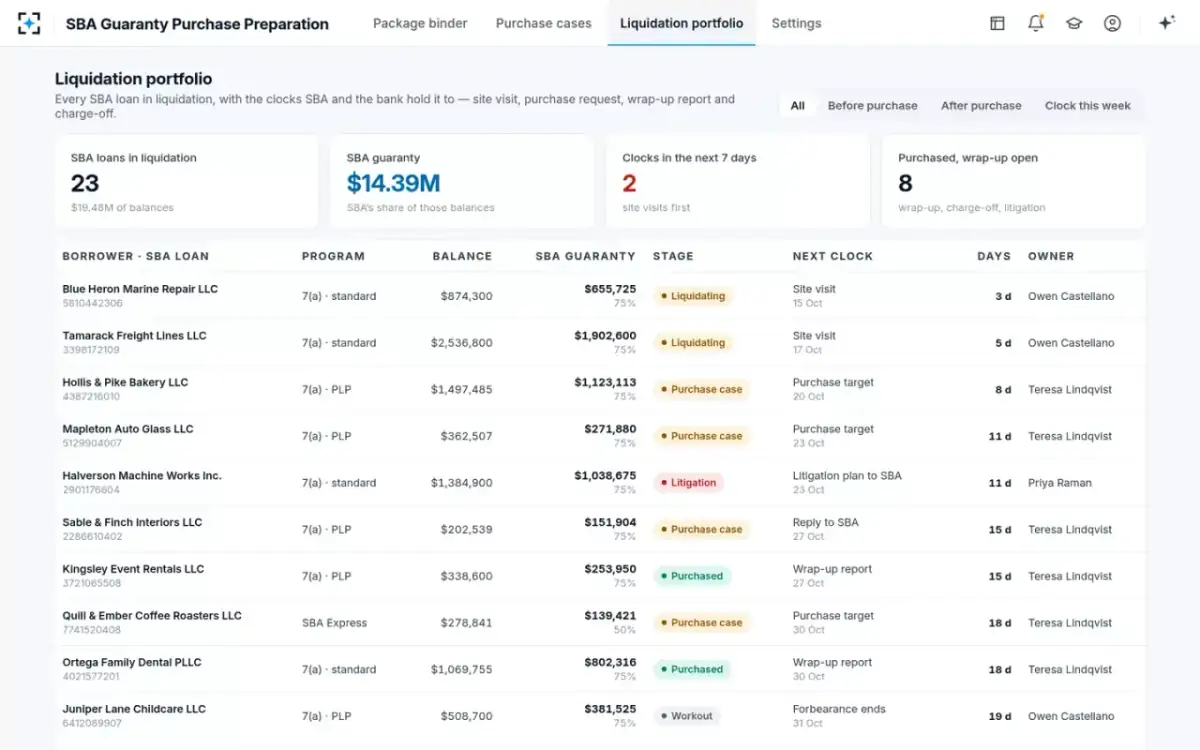
What the rates cannot say is how many of those packages will come back repaired. That depends on the files, and SBA's FY2025 testing shows the issues are the familiar ones: equity source, refinance eligibility, collateral expenses. A package that answers them before SBA asks turns a default into a paid guaranty. The sample loan in this series went from a predicted repair of about $57,600 to "pays as requested" once the evidence was found and a $21,000 repair was chosen up front.
One default, answered tab by tab before SBA reads it
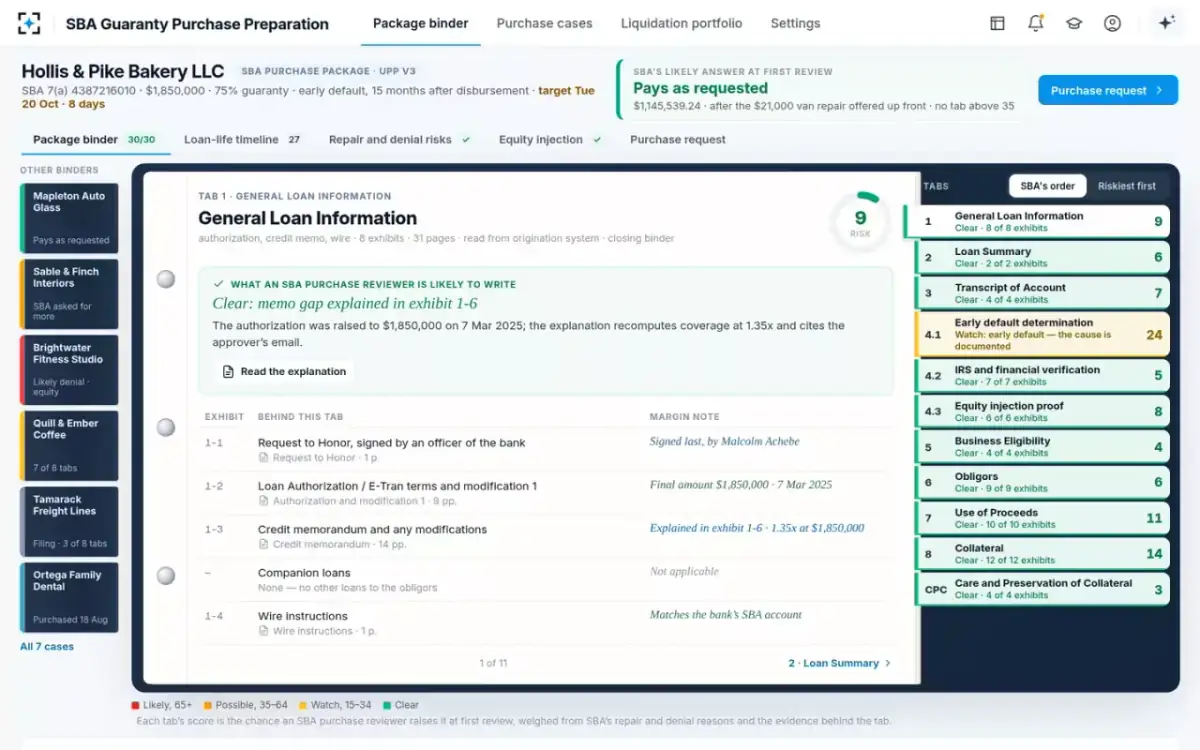
What each late package costs is in SBA guaranty purchase package delays, and how SBA decides between repair and denial is in what an SBA repair is. To see the clocks and packages on your own book, start from SBA Guaranty Purchase Preparation.
Questions people ask
Is the SBA 7(a) default rate rising?
Delinquency rose: SBA reported an FY2025 average of 1.15% through July against 0.88% for FY2024, while describing the rate as "hovering around one percent every month". The 12-month charge-off rate was 0.68% in July 2025, which reflects older defaults working through liquidation.
How many SBA loans are charged off?
By our count from SBA's loan file, 2,983 of the FY2021–22 7(a) loans had been charged off by June 30, 2026, out of 87,642 that were not cancelled: about 3.4%. The rate falls steeply with loan size, from 6.4% for loans of $150,000 or less to 0.6% above $1 million.
Do SBA Express loans default more than standard 7(a) loans?
SBA Express loans are smaller, and small loans charge off far more often, so their rates are higher on any size-blind comparison. A fair comparison holds size and vintage fixed; the FOIA file's processing-method field makes that possible.
What happens to the guaranty when a 7(a) loan defaults?
After more than 60 days of uncured payment default, with the loan in liquidation status and business personal property liquidated, the lender may ask SBA to honor the guaranty with a complete purchase package. SBA pays its share if the lender made, closed, serviced and liquidated the loan by the rules, and repairs or denies if not.
Does a high default rate affect a lender's standing with SBA?
It can. Under 13 CFR 120.410, SBA considers a lender's risk rating and "historical performance measures (like default rate, purchase rate and loss rate)" in judging whether its SBA performance is satisfactory, which is a condition of continued participation.