When a small business stops paying an SBA 7(a) loan, the lender sells what it can and then asks the Small Business Administration to pay its promised share of the loss. SBA pays only if the lender proves, document by document, that it made, closed, serviced and collected the loan by SBA's rules, sometimes years after the people who made it have left. That proof is the guaranty purchase package. A gap in it costs part of the guaranty, or all of it.
This guide is for anyone who builds, signs, reviews or pays for purchase packages: SBA liquidation and special assets officers, SBA servicing managers, the officers who sign the Request to Honor, lender's counsel, lender service providers, credit and compliance leaders, and the people deciding whether to automate the work. No background needed.
Imagine you are the SBA liquidation officer at a community bank in central Ohio. On October 12, 2026 you open the file for Hollis & Pike Bakery, a wholesale bakery. The bank lent its new owner $1,850,000 under SBA's 7(a) program to buy the business, with SBA guaranteeing 75%. The money went out on March 14, 2025. The bakery missed the payment due June 14, 2026, fifteen months later, after its biggest customer walked away. The loan file is 318 documents and 2,140 pages in five systems. Your bank wants the purchase request in by October 20.
Because the default came inside 18 months, SBA will re-read how the loan was made. The new owner had to put in $206,800 of his own money. The credit file shows only $158,000 reaching the business account, plus a copy of his father's $60,000 check and a source-of-funds statement nobody signed.
Credit file · equity tab
Required
$206,800
Bank statement
$158,000 in on Mar 10
The other $60,000
Check copy, unsigned statement
Proven
$158,000
Title company's file · email
Wire
$60,000 on Mar 12, 2025
Escrow statement
Credited to the buyer at closing
Before disbursement
Yes, two days
Proven
$218,000
$48,800 unproven: a likely repair$218,000 traced before the money went outa check copy counts only with proof of deposit.
SBA's procedure says a gift letter on its own is not evidence, and a check counts only with proof it was processed and deposited before the loan paid out. On an early default a missing injection is presumed to have caused the failure, which can cost the whole guaranty payment, about $1.17 million on this loan. The wire and the escrow statement existed all along, in the email archive. A delivery van sold without the bank's lien on its title is a second problem, worth a $21,000 repair the bank can offer up front.
Careful purchase preparation finds the missing proof, and prices the gaps that cannot be closed, before SBA's reviewer opens the package.
What an SBA guaranty purchase package is, and what SBA reads in it
The tabs, the clocks, the early default rules, the amount, repairs and denials, and what SBA's own reviewers and auditors found in 2025 and 2026, explained without selling anything. If you have never claimed an SBA guaranty, start here.
01 · In plain words
When a 7(a) borrower stops paying: how a lender asks SBA to honor its guaranty
In its main small business program, known as 7(a), the Small Business Administration (SBA) leaves the lending to banks, credit unions and other lenders and promises to cover a share of the loss if a borrower fails. That share is the guaranty; on the loan in this guide it is 75%. The promise has a condition attached: the lender must have followed SBA's rules from the day it approved the loan to the day it finished collecting what it could.
When a borrower stops paying, the lender demands payment, visits the business, sells the equipment or property that secured the loan, and chases the people who guaranteed it. Once the loan has been in default for more than 60 days and the business's personal property has been sold, the lender may ask SBA to honor its guaranty by buying the guaranteed share of what is still owed.1 That request is a guaranty purchase, and the evidence that goes with it is the purchase package.
SBA's form for the package is the Universal Purchase Package: a fillable index of eight numbered tabs, each asking for the documents that prove one part of the loan's life, from the loan authorization to the sale of the collateral.2 An officer of the lender signs the Request to Honor on top. SBA "will not purchase" its share unless the lender has submitted documentation that SBA "deems sufficient".1
The hard part is that the package defends decisions made years earlier. The loan officer who checked the buyer's down payment, the closer who filed the liens and the servicer who granted a deferment may all have moved on, and their evidence sits in an origination system, a closing binder, a servicing system, email and the collections share.
A purchase reviewer at SBA reads the package against the rules in force when each step was taken. Every gap becomes a question, and an unanswered question becomes a repair (a deduction from the payment) or a denial (no payment at all).3
Hollis & Pike's default, from missed payment to SBA's answer
The borrower defaultsHollis & Pike Bakery misses the payment due June 14, 2026, fifteen months after the loan was disbursed.
The lender liquidatesA site visit within 60 days, demand letters to the borrower and both guarantors, a deposit offset, an equipment auction that nets $212,400.
The lender builds the purchase package318 documents sorted into SBA's eight tabs, the amount computed, the gaps found and explained, the Request to Honor signed. This is where the missing equity proof is found, or missed.
SBA reviews and pays, repairs or deniesA purchase center reads every tab. If it recommends a repair or denial and the lender disagrees, a second SBA team decides.
Collection goes on after purchaseThe lender keeps collecting for SBA and files a wrap-up report, its final account of what it recovered, within 24 months of the purchase unless SBA extends it.
Step 3 is the subject of this guide. The bank, the bakery, the people and the figures in this example are fictional.
Four surprises about early defaults and SBA purchase reviews
The default date reopens the underwriting
If the loan defaults within 18 months of disbursement, SBA re-reads how it was made. A required down payment the lender cannot document is presumed to have caused the failure, which justifies a full denial unless the lender rebuts it.3
SBA's final reviewers overturned a third of disputed findings
Of 545 files SBA's purchase centers recommended for repair or denial, and that went to a final review from October 2021 to March 2025, the final reviewers overturned 197, or 36%.4
Interest stops after 120 days
SBA pays at most 120 days of accrued interest on its share. Liquidation often takes longer, as it did in this guide's example, and every later day is interest nobody reimburses.3
A paid guaranty can still come back
SBA may recover a purchase "at any time" if it later finds a release event, plus interest, by offset or in court.5 In August 2026 its Inspector General asked it to remedy or seek recovery on 16 paid loans; SBA re-reviewed them, stood by 15 and said it would pursue the sixteenth.4
Universal Purchase Package, Request to Honor, early default, repair
Universal Purchase Package
SBA's index for a purchase request: eight numbered tabs of evidence, plus separate tabs for collection expenses.
Request to Honor
The cover request, signed by an officer of the lender, asking SBA to buy its guaranteed share.
Early default
A default within 18 months of disbursement. It turns the review back to how the loan was made.
Repair
An agreed deduction from SBA's payment for a loss the lender caused: the loss times the guaranty percentage.
What SBA buys at guaranty purchase, and the four things a lender must prove first
In shortSBA buys the guaranteed share of the unpaid balance, plus limited interest, after the lender has collected what it could. It pays only when the package shows the loan was made, closed, serviced and liquidated by SBA's rules. The eight tabs map onto those four phases, and each tab answers one question a reviewer will ask.
The regulation, 13 CFR 120.520, and SBA's servicing and liquidation rulebook, Standard Operating Procedure (SOP) 50 57 4, set three conditions before a lender may ask: an uncured payment default of more than 60 calendar days, the loan reported "In Liquidation" on the monthly Form 1502 status report, and, for loans approved on or after May 14, 2007, all business personal property with a recoverable value of $10,000 or more already liquidated, unless the borrower is in bankruptcy.1,3 Real estate can be sold after purchase.
Then the evidence. SOP 50 57 4 says SBA reviews whether the lender made, closed, serviced and liquidated the loan "in accordance with SBA Loan Program Requirements", and it lists the events that release SBA from its promise in whole or in part.3,5
The regulation lists ten release events. Most are about evidence: a material failure to follow a program requirement, a loan not made, closed, serviced or liquidated prudently, an improper action that put SBA at risk, a material fact not disclosed or misrepresented. One is a deadline: no purchase request within 180 days after the loan matures, or after liquidation of a matured loan ends.5
The eight tabs, and which part of the loan's life each one proves
Tabs 1, 4 and 5 reach back to the approval; Tabs 2, 6 and 8 carry the collection years
Which phase of the loan each tab of the Universal Purchase Package is evidence for
NoSomeMain
MakingClosingServicingLiquidation1 · General loan informationMainSomeSomeNo2 · Loan summarySomeSomeMainMain3 · Transcript of accountNoSomeMainSome4 · Early defaultMainSomeNoNo5 · Business eligibilityMainNoNoNo6 · ObligorsSomeSomeNoMain7 · Use of proceedsNoMainNoNo8 · Collateral liquidationNoSomeSomeMain
Our reading of the sources3,2 · Tab names and contents from SBA's current form, version 5.3. The mapping is our reading of SOP 50 57 4, Chapters 24 and 25.
Show the numbers
Making
Closing
Servicing
Liquidation
1 · General loan information
Main
Some
Some
No
2 · Loan summary
Some
Some
Main
Main
3 · Transcript of account
No
Some
Main
Some
4 · Early default
Main
Some
No
No
5 · Business eligibility
Main
No
No
No
6 · Obligors
Some
Some
No
Main
7 · Use of proceeds
No
Main
No
No
8 · Collateral liquidation
No
Some
Some
Main
Tab
What goes behind it
The reviewer's question
1 · General loan information
Loan authorization and the terms in E-Tran, SBA's loan system, modifications, credit memorandum, companion loans, wire instructions; the signed Request to Honor
Is this the loan SBA guaranteed, on the terms SBA has on file?
2 · Loan summary
The lender's narrative: the business, why it failed, servicing history, liquidation, action against each obligor; SBA's assignment form
What happened, in order, and why?
3 · Transcript of account
A certified transcript, usually on Form 1149; the note; a change-in-terms summary
When did the default start, and does the balance tie to what was reported?
4 · Early default
The 18-month determination; if early: the credit memo and everything relied on, IRS transcripts, equity injection proof
Each business and personal guarantor, their guaranties and what was done to collect from them
Did the lender pursue everyone who owed?
7 · Use of proceeds
Settlement sheet, disbursement evidence, contracts, paid invoices, sale agreements
Did every dollar go where the authorization said?
8 · Collateral liquidation
Collateral list, site visit report, appraisals, environmental reports, security agreements, mortgages, life insurance
Was every piece of collateral secured, protected and sold sensibly?
Tab contents from SBA's current form, version 5.3; collection expenses go in separate care-and-preservation-of-collateral (CPC) tabs. The form asks the lender to explain any difference between the transcript's ending balance and the last Form 1502, and its equity worksheet sets required against actual injection by type.2
Lenders often say "the 10 tab checklist". SBA retired its older ten-tab package when the Universal Purchase Package arrived in August 2023.6 A ten-item checklist usually splits Tab 4 into credit memo, equity injection and tax verification. That is fine as long as every item lands behind SBA's own tab, in SBA's order: the purchase center lists "There are no tabs or the package is not organized in order of the checklist or authorization" first among the errors it sees.7
03 · The rules and their dates
Which rulebook SBA reads each document against, and what changed from 2023 to 2026
Status as of October 2026
In shortTwo procedures meet at purchase: SOP 50 10 for how the loan was made and closed, and SOP 50 57 for how it was serviced and liquidated. SBA judges making and closing under the version in force at approval, and each servicing action under the version in force on its date; lenders call this the vintage rule. Both changed several times since 2023, and so did the package form itself: SBA posted version 5.3 in August 2026.
Eleven dated changes a 2023–2026 loan may meet at purchase
Aug 1, 2023SOP 50 57 3 and the Universal Purchase Package
The single package replaces the older ten-tab set.
Dec 1, 2024SOP 50 57 3.1
Technical corrections to servicing and liquidation.
Apr 15, 2025Procedural Notice 5000-866946
Restores the vintage rule: each step judged under the SOP of its own date.
May 1, 2025Purchase package version 3
Credit memo with every request except Express; an equity injection worksheet.
Jun 1, 2025SOP 50 10 8
Origination tightened; a 10% minimum equity injection for start-ups and stricter proof of where equity came from.
Nov 1, 2025SOP 50 57 4
Current servicing and liquidation procedure, with the vintage rule written into its purchase chapter.
Dec 18, 2025Lender servicing matrix version 18
The list of actions a lender may take without SBA's consent.
Mar 3, 2026Purchase package version 5
As listed in a May 2026 lender-conference update.
Aug 12, 2026Purchase package version 5.3 posted
SBA's page dates it effective May 20, 2026; the form's own footer says August 10, 2026.
Aug 27, 2026Inspector General report 26-12
Half of 32 sampled overturns lacked sufficient evidence, it found; SBA disputes most of that.
Oct 1, 2026SOP 50 10 8.1
Updated origination rules for applications SBA receives from this date, under the September 25, 2026 notice.
SOP 50 57 4 puts it at the head of the purchase chapter: SBA "will apply the requirements of SOP 50 10 in effect when the Loan was approved for loan making, loan closing, and loan modifications that took place on the date of or prior to full disbursement and SBA will apply the requirements of SOP 50 57 in effect when the servicing action was taken for servicing actions taken after full disbursement."3
The line between the two is full disbursement. A modification made before the last dollar went out is an origination question; one made a day after is a servicing question.
The rule has a short and recent history. SOP 50 57 3, from August 1, 2023, had moved away from it. Procedural Notice 5000-866946, effective April 15, 2025, brought it back for every purchase and servicing decision SBA made from that date, including requests already pending;10 a trade association summary called the change a return to "the purchase standards that were in effect prior to August 1, 2023".17
The example loan, read against its own vintage
Action on the Hollis & Pike loan
Date
Rulebook SBA applies
Approval by the bank on SBA's behalf (delegated authority), equity injection required, credit memo
February 24, 2025
SOP 50 10 7.1 (loan number issued before June 1, 2025)
Authorization raised from $1,800,000 to $1,850,000
March 7, 2025
SOP 50 10 7.1: before full disbursement
Closing, lien filings, the single disbursement
March 13–14, 2025
SOP 50 10 7.1
Routine servicing in 2025, before November
Mar–Oct 2025
SOP 50 57 3.1
Watch list after the lost customer; default; site visit; demand; auction
Nov 2025–Sep 2026
SOP 50 57 4
The purchase request itself
October 2026
SOP 50 57 4, Chapter 24, and the form the center posts that day
Fictional example; the version dates are SBA's.8,18
Origination rulebooks
SOP 50 10 7.1 covers loan numbers issued through May 31, 2025, and SOP 50 10 8 loan numbers issued from June 1, 2025.18,12
SBA's notice of September 25, 2026 applies SOP 50 10 8.1 to applications "received by SBA on or after" October 1, 2026, and keeps SOP 50 10 8 for applications submitted through September 30; it replaced an August 14 notice that had keyed 8.1 to the loan number date.16,19 At purchase, SBA reads the SOP 50 10 in effect when the loan was approved.3
Under 7.1, SBA set a minimum injection only for a complete change of ownership, 10% of total project costs; otherwise lenders required and verified equity as they did for similar non-SBA loans, an approach practitioners called "do what you do".20 SOP 50 10 8 kept the change-of-ownership minimum, added a 10% minimum for start-ups and ended that approach to sourcing and verification.21,22
Servicing rulebooks
SBA's SOP 50 57 page lists version 4, effective November 1, 2025, as current, after 3.1 (December 1, 2024) and 3 (August 1, 2023).8 No later version had been published as of October 30, 2026. Routine actions a lender may take alone are listed in the lender servicing matrix; version 18 took effect December 18, 2025.13
The form changes more often than the rules. As of October 2026 SBA's package page carries version 5.3, posted August 12, 2026; the page dates it effective May 20, 2026 and the form's own footer says August 10, 2026. Version 3 took effect May 1, 2025, and a lender-conference deck dates version 5 to March 3, 2026.15,2,11,14 The eight tabs did not change. SOP 50 57 4 tells lenders to prepare the package "in accordance with the instructions issued by the SBA Loan Center" that will review it, so download the form on the day you start, and keep the copy you used in the file.3
73,302 loans will be read closely at purchase. From August 1, 2023 until June 1, 2025 SBA itself screened 7(a) eligibility through a "Risk Mitigation Framework". Its Inspector General found the framework did not screen three of six eligibility requirements (organized for profit, size, and ineligible business types) and recommended that SBA flag the 73,302 loans approved and disbursed under it from August 1, 2023 to December 31, 2024 for review at guaranty purchase. SBA agreed, and said it would seek recovery where appropriate and legally justified.23 A lender with loans from that period should expect those three points in Tab 5 to be read closely.
04 · The clocks
The deadlines around a purchase request, from the first missed payment to 24 months after SBA pays
In shortA lender may file once the default is more than 60 days old and business personal property is sold. Several clocks run at the same time: a site visit within 60 days, interest SBA pays for at most 120 days, 45 days after SBA buys a sold loan back from an investor, 180 days after maturity, and 24 months after purchase to finish collecting. Missing some costs money; missing others releases SBA altogether.
Clock
Rule
What missing it costs
Site visit
Within 60 calendar days of an uncured payment default; 15 days after a non-payment event such as bankruptcy; sooner if collateral could disappear3
A repair for collateral lost or worth less because nobody looked3
Earliest filing
More than 60 days of uncured payment default, "In Liquidation" on Form 1502, business personal property liquidated1
A request filed early is not a valid request
Interest
At most 120 calendar days of accrued interest on SBA's share, for loans approved from May 14, 20073
Every later day's interest on the guaranteed share; on a sold loan, SBA bills the lender for investor interest beyond 120 days3
After a secondary market buy-back
A complete package within 45 calendar days of SBA buying the guaranteed portion from the investor3
SBA has already paid the investor; missing documentation can lead to a recovery action against the lender1,2
Maturity
Request purchase within 180 days after maturity, or after liquidation or collection litigation on a matured loan ends5
SBA released from its guaranty
Prudent liquidation deadline
An acceptable wrap-up report no more than 24 months after SBA buys, unless extended in writing3
Repurchase of SBA's share; referral for enforcement, including loss of delegated authority or secondary market access3
The clocks on one loan
The interest SBA will pay ran out 39 days before the bank's own filing target
Hollis & Pike Bakery, days counted from the June 14, 2026 default (interest was paid to May 14, day −31)
SBA's clocksWhat the bank didThe bank's target
Interest SBA pays: 120 days from May 14
Site visit due within 60 days
Site visit done, day 53
Transferred to liquidation, day 68
Purchase may be requested, from day 61
Equipment auction, day 102
Purchase request target, day 128
May 14Jun 14Aug 13Sep 11Oct 20
Fictional example from this guide · Fictional example. Interest ran from the May 14 paid-to date, so SBA's 120 days ended September 11, before the auction.
Show the numbers
Activity
From
To
Interest SBA pays: 120 days from May 14
-31
89
Site visit due within 60 days
0
60
Site visit done, day 53
52
53
Transferred to liquidation, day 68
67
68
Purchase may be requested, from day 61
61
130
Equipment auction, day 102
101
102
Purchase request target, day 128
127
128
The example shows how a careful bank still overruns the interest cap. The bakery defaulted on June 14, but its interest was paid only to May 14, so the 120 days ended on September 11. The bank could not file before the equipment was auctioned on September 24. The bank made no mistake: selling a business's equipment usually takes more than four months. The cap is a reason to finish the package while liquidation is still running, so the request can go out the week the last business asset is sold.
Payments after the request do not move the default date. Before a lender asks, a payment that covers a full installment advances the earliest uncured default to the next installment. After it asks, the date is fixed and later payments go to principal.24,3 The date matters because it sets the interest rate SBA pays on a variable-rate loan.
05 · Where packages fail
Why Tab 4 and Tab 8 decide most purchase outcomes
In shortSOP 50 57 4 lists eleven situations where a repair or denial is justified. Seven of them are answered behind two tabs: early default (Tab 4) and collateral liquidation (Tab 8). SBA's purchase center names the same places in its list of top reasons. Tabs 1, 5 and 6 fail on mismatches instead: a modification never updated, an affiliate never analyzed, a guarantor never pursued.
Seven of SBA's eleven named grounds for repair or denial are answered behind Tabs 4 and 8
Examples in SOP 50 57 4, Chapter 25, Paragraph G, by the tab whose evidence answers them
Almost every item on both lists is a document that existed once, somewhere, and did not reach the right tab. Most of purchase preparation is finding those documents; writing the package comes after.
Four collateral problems, and what the SOP asks the lender to show
Problem
Evidence that answers it
If it cannot be answered
A lien never obtained or perfected
Recorded mortgage, filed UCC financing statement, or for a titled vehicle the lien noted on the certificate of title
Repair at the recoverable value the asset would have had with the lien, with the working shown3
An item missing at liquidation
The approval-time collateral list against the post-default list, item by item
The site visit report within the deadline, or the written reason none was needed
Repair for collateral lost or diminished in the meantime3,14
Collateral abandoned
Recoverable value below $10,000, or costs of removal and sale above it, documented
Prudent abandonment needs no repair; an undocumented one invites one3
In Ohio a lien on a titled vehicle is perfected by notation on the certificate of title, and a UCC filing is neither necessary nor effective for it.25 A bank that filed a UCC-1 for a delivery van and never sent the title to the clerk holds an unperfected lien, which is how the van in our example was sold without the bank's consent.
06 · Early default and equity
The 18-month line: how an early default puts the burden of proof on the lender
In shortAn early default is one of four default events within 18 months of disbursement. When it happens, SBA re-reads the underwriting, and two presumptions run against the lender: a required equity injection it cannot document, and IRS transcripts it did not compare, each justify a full denial. The lender can rebut both with documented evidence that the business failed for another reason.
The definition, in four events
SOP 50 57 4 defines an early default, "For SBA guaranty purchase reviews", as any of four events within 18 months of the initial disbursement, or of the final disbursement if it came more than six months after the first:3
A missed payment of principal and interest (on annual-payment loans, either of the first two annual payments).
A payment funded by selling collateral instead of from the business's cash flow.
A deferment or catch-up covering more than three consecutive scheduled payments.
Any other default that puts the loan in liquidation, such as bankruptcy.
The way out: the borrower cures the default and then pays on schedule for 12 months after the 18-month period, 30 months in all.
The third event catches lenders who try to help. A four-month deferment granted to a struggling borrower in its first year is itself an early default, so a deferment request on a young loan is a credit question as much as a servicing one.
The two presumptions
Equity injection
Failure "to properly document a material portion of any injection of cash or non-cash equity" that the authorization required "raises a rebuttable presumption that the Early Default was caused by the absence of the required equity injection and justifies a full Denial of Liability". The source must be legitimate too; SBA calls verifying it "essential in order to prevent 7(a) Loan fraud".3
IRS transcripts
A full denial is justified if there was an early default and the lender did not show it verified the borrower's financial information "by comparing it to relevant IRS tax return transcripts as required by SOP 50 10 in effect at the time the loan was approved". Slow IRS responses are no excuse.3
What counts as proof that the money moved
Credible evidence · SOP 50 57 4
Check or wire
Shown as processed, deposited to escrow or the borrower's account before initial disbursement
Escrow
A signed third-party settlement statement showing the funds
Bank statement
The deposit, before disbursement
Not evidence on its own
Promissory note
Without corroboration
Gift letter
Without corroboration
Financial statement
Without corroboration
SOP 50 57 4, Chapter 25: "A promissory note, gift letter or financial statement on their own, are not credible evidence of a cash injection without corroborating documentation".3
How lenders lose on equity: what SBA's Inspector General (OIG) found
Weak equity injection support appeared in four of the five early defaults the Inspector General said SBA should not have paid
Issues found in the five deficient loans of eight high-dollar early defaults reviewed (OIG Report 19-22, 2019); a loan can have several
Inadequate support for equity injection4
Inappropriate use of delegated authority2
Inadequate support for debt refinance1
Affiliate not considered for size1
Inadequate assurance of repayment ability1
Franchise, valuation, appraisal or projection issues1
Source26 · SBA had paid $10,845,848 on the eight loans; OIG recommended recovering $8,662,144.
Show the numbers
Issue
Loans
Inadequate support for equity injection
4
Inappropriate use of delegated authority
2
Inadequate support for debt refinance
1
Affiliate not considered for size
1
Inadequate assurance of repayment ability
1
Franchise, valuation, appraisal or projection issues
1
Early defaults run higher at SBA-licensed non-bank lenders, and they cluster in year two
SBA-licensed non-bank lenders' 7(a) loans defaulted early twice as often as other lenders' loans
7(a) loans approved and disbursed FY2016–2023, rates as of March 31, 2025
All other lender typesSmall business lending companies
Default rate9.79%15%
Early default rate2.62%5.38%
Source27 · Small business lending companies are non-bank lenders licensed by SBA; they made 11,068 of the loans in the period.
Show the numbers
All other lender types
Small business lending companies
Default rate
9.79%
15%
Early default rate
2.62%
5.38%
Research on 7(a) loans found that the chance of default "increases initially, peaks in the second year, and declines thereafter".28 An 18-month window sits across that peak, which is why an early default package is the one a desk should expect most often after a year of strong originations, and the one where the burden of proof is heaviest.
Rebuttal needs dates and documents. The SOP's own examples of another cause are "the death of an irreplaceable Key Employee or an uninsured natural disaster".3 A lost customer can do it too, if the file shows it. In one file the Inspector General criticized, a lender "stated the loan defaulted due to the borrower's loss of a major client" and "There was no evidence provided to justify this claim".4 The same claim with the termination letter, the dated sales decline and the servicing notes behind Tab 4 reads very differently.
07 · The purchase amount
How the purchase amount is worked out, and why every line must tie to the transcript
In shortTake the principal at the earliest uncured default, subtract what liquidation recovered, multiply by the guaranty percentage, add up to 120 days of interest on SBA's share, and subtract any repair the lender offers. Lender fees never go on the transcript. The total should reconcile to the balance the lender last reported to SBA on Form 1502.
Purchase request = (principal at earliest uncured default − recoveries) × guaranty % + guaranty % × interest for up to 120 days − voluntary repair
Line
Where it comes from
Amount
Principal at the earliest uncured default
Transcript: balance after 14 payments, default on the June 14, 2026 installment
Van sold without the lien noted: 75% of a likely $28,000 at auction
−$21,000.00
Purchase request
$1,145,539.24
Fictional example. Variable rate, 10.25% on the default date in the example; on a variable-rate loan SBA pays interest at the rate in effect on the earliest uncured payment default date.3 $1,214.37 of late fees had been posted to the servicing transcript in July 2026; they come off, because SBA "does not guarantee nor pay" lender fees and lenders "must not add their Loan fees to the transcript of account".3
Of $1.72 million owed at default, SBA's share of what liquidation left is $1.12 million
Hollis & Pike Bakery: the $1,718,201 of principal at the June 14, 2026 default, in three parts
SBA's 75% of the remaining principal$1.1M
The bank's 25% of the remaining principal$374.4K
Recovered before the request$220.7K
Fictional example from this guide · Interest and the repair are added and subtracted on top of SBA's share.
Show the numbers
Part
Amount
SBA's 75% of the remaining principal
$1.1M
The bank's 25% of the remaining principal
$374.4K
Recovered before the request
$220.7K
What a day of delay costs after the interest cap
After 120 days, unpaid interest on SBA's share grows by about $362 a day
Hollis & Pike Bakery: interest on the guaranteed share that SBA will not pay, by days since interest was last paid
$0$20K$40K$60K$43.4K
Day 060120180240
Fictional example from this guide · 75% × $1,718,201.06 × 10.25% ÷ 365 = $361.88 a day. If the guaranteed portion was sold, SBA bills the lender for any investor interest beyond 120 days.
Show the numbers
Interest SBA will not pay
Day 0
$0
30
$0
60
$0
90
$0
120
$0
150
$10.9K
180
$21.7K
210
$32.6K
240
$43.4K
Two smaller lines sit next to interest. SBA keeps its annual service fee out of the payment for at most 120 days if an acceptable wrap-up report goes in with the request, and through the purchase date if it does not.3 And if a significant loss is likely but not yet measured, the SOP expects the lender to withdraw the request and file again after liquidation, unless SBA has already bought the loan from an investor.3
08 · Repairs and denials
Repair, partial denial or full denial: what SBA takes back, and how often its reviewers changed their minds
In shortA repair is an agreed deduction, usually the loss times the guaranty percentage. A partial denial is the same loss imposed when the lender will not agree. A full denial takes the whole guaranty and is for an ineligible loan, a total loss the lender caused, or misconduct. When the lender disputes a recommended repair or denial, SBA's Portfolio Management and Quality Control team decides; it overturned 36% of 545 such files. The Inspector General found that half of the 32 overturns it sampled lacked sufficient evidence; SBA disputes most of that.
Repair = loss caused by the lender × SBA's guaranty percentage · SOP example: $50,000 × 75% = $37,500
SOP 50 57 4 defines a repair as an agreement "to deduct a specific dollar amount from the funds that SBA pays to the Lender", and adds: "A Repair does not reduce SBA's guaranty percentage nor SBA's pro-rata share of expenses and/or recoveries".3 Some older practitioner material describes a repair as a cut in the guaranty percentage; the current SOP says otherwise.29 A loss counts when it is material: $10,000 or more, alone or in total, for collateral.3
The lender may offer first
"Lenders are encouraged to include a Repair estimate in their Universal Purchase Package." Where a lender error caused a material loss, the SOP asks the lender to "acknowledge the error and provide an estimate", with its justification; acknowledging is optional and the estimate does not bind SBA, but providing both "will expedite" the review.3
When a repair is not on offer
Where the lender's actions caused "a total or near total loss", or SBA deems its misconduct "material to the integrity and soundness" of the program, the answer is denial. SBA may also deny without a loss when the loan was ineligible or a material fact was misrepresented.3
What happened to 545 disputed files
SBA's final review upheld 64% of repair and denial recommendations and overturned 36%
Final decisions by SBA's Portfolio Management and Quality Control team, October 1, 2021 to March 31, 2025
Denial upheldRepair upheldOverturned and paid
545 loans247101197
Source4 · The 197 overturns led SBA to buy guaranties of about $168 million.
Show the numbers
Denial upheld
Repair upheld
Overturned and paid
545 loans
247
101
197
From 545 disputed files to 16 payments the Inspector General found unsupported
SBA OIG Report 26-12, August 27, 2026
Final decisions on repair or denial recommendations545
Overturned: SBA paid the guaranty197
Overturns in high-risk categories119
Sampled by the Inspector General32
Decided without sufficient evidence16
Source4 · The 16 loans carried $11,542,969 of questioned costs. The 32 were a judgmental sample of 119 overturns in high-risk categories. SBA later found 15 of the 16 purchases appropriate.
Show the numbers
Stage
Loans
Final decisions on repair or denial recommendations
545
Overturned: SBA paid the guaranty
197
Overturns in high-risk categories
119
Sampled by the Inspector General
32
Decided without sufficient evidence
16
Repayment ability was the category SBA most often waved through without evidence
Overturned decisions sampled by the Inspector General, and those it found unsupported, by category
The Inspector General put the cause on SBA's side: the agency "did not have supplemental guidance, such as desk guides or manuals, to apply the criteria in complex, high-risk loan scenarios".4 It recommended that SBA remedy or seek recovery on the 16 loans. SBA partly agreed: it re-reviewed them, found 15 purchases appropriate, said it would pursue recovery on one by March 31, 2027 if legally supported, and argued that a documentation gap alone does not make a decision wrong.4
A lender should take no comfort from the overturns. A file that two layers of SBA read in opposite directions is a file that can be reopened later. The package that holds up leaves one reading only: each claim beside its document, each gap with a written explanation, each lender error priced as a repair.
09 · What goes wrong
The file gaps behind repairs and improper payments, and why they surface years later
In shortMost purchase problems are evidence that existed and was not found, or was never kept. SBA's own payment testing found improper 7(a) purchase payments fell from 5.34% in FY2024 to 1.07% in FY2025, with missing equity sources, collateral expenses, refinance eligibility and secondary market reconciliation among the causes. Fraud cases show the far end: purchase requests filed on loans that never met the rules.
SBA's estimated improper payment rate on 7(a) purchases fell to 1.07% in FY2025
Source9 · FY2025 tested 240 loans from purchases in the year to March 31, 2025, stratified by servicing office and early default. Improper payments: $74.52 million in FY2024, $22.55 million in FY2025.
Show the numbers
Fiscal year
Improper payment rate
FY2024
5.34%
FY2025
1.07%
An improper payment here is money SBA paid on a purchase that it should not have paid, in whole or in part. SBA named the root cause for FY2025 as purchase processors failing "to identify lenders' deficiencies", and named one statutory cause outright: "the source of equity injection funds was not provided".
The main reasons were "improper payment of expenses related to the care and preservation of collateral, failing to properly identify eligibility for debt refinance, and failing to adequately reconcile the purchase from the Secondary Market".9 Each found later is a recovery SBA may pursue from the lender.5
Why gaps appear, and why they appear late
The evidence lives in five places
The approval in the origination system, the wire in the title company's email, the lien in the closing binder, the deferment in servicing notes, the auction in the collections share. Nobody files for a purchase that may never happen.
The people have moved on
A loan defaulting in year two was made by an officer who may now be at another bank. Their reasoning survives only if the credit memo and file notes recorded it.
Checklists say "verified"
A closing checklist with a tick next to "equity verified" is a statement. SBA asks for the bank statement, wire or escrow settlement statement behind it.3
The rules moved underneath the loan
Three servicing SOPs and three origination SOPs since 2023 mean a checklist written for today can be the wrong checklist for half the actions on an older loan.8,18
When it is fraud
Most repairs are lapses. Some purchase requests rest on loans that should never have been made. In December 2021, four executives of Banc-Serv Partners, a lender service provider (LSP: a firm paid to do a lender's SBA work), were sentenced to between 28 and 68 months; prosecutors said they obtained SBA guaranties "knowing that the loans did not meet SBA's guidelines" and caused reimbursement requests for the defaulted loans, "shifting a majority of the losses on the ineligible loans to the SBA".30
Under SBA's rules a lender that relies on a provider answers for the work done in its name: the lender "itself, not the LSP, bears full responsibility".18 SOP 50 57 4 also requires lenders to report suspected application fraud, closing fraud, misuse of proceeds and conversion of collateral to the Inspector General.3
10 · The market
How many SBA guaranty purchases there are, and what SBA paid out in FY2025
In shortSBA's loan-level data count 78,078 7(a) approvals for $37.3 billion in FY2025, a record dollar year, and 56,130 for $32.4 billion in FY2026.31 SBA's 7(a) purchase outlays rose from $1.39 billion in FY2024 to $2.12 billion in FY2025. SBA estimates 15,000 transcripts of account a year, a rough count of purchase requests. With default risk peaking in a loan's second year, the large FY2025 vintage reaches the purchase desk in 2026 and 2027.28
SBA paid 52% more on 7(a) guaranty purchases in FY2025 than in FY2024
Outlays for 7(a) loan guaranty purchases
$1.4BFY2024
$2.1BFY2025
Source9 · From SBA's payment integrity reporting; the FY2025 measurement period ended March 31, 2025.
Show the numbers
Fiscal year
Outlays
FY2024
$1.4B
FY2025
$2.1B
About one in ten 7(a) loans from lenders other than SBLCs in FY2016–2023 had defaulted by March 2025
9.8 in 100
Default rate on 7(a) loans approved and disbursed FY2016–2023 by lenders other than small business lending companies (SBLCs), as of March 31, 2025
Default rate on 7(a) loans approved and disbursed FY2016–2023 by lenders other than small business lending companies (SBLCs), as of March 31, 2025
9.79 of 100
7(a) approvals fell by 28% in FY2026 after a record-dollar FY2025
7(a) loans approved
78,078FY2025
56,130FY2026
Source31,32 · SBA loan-level data as of September 30, 2026, including loans later canceled: $37.3 billion in FY2025, $32.4 billion in FY2026. SBA's release of September 30, 2025, issued before the year closed, counted 77,600 loans and $37 billion.
Show the numbers
Fiscal year
Loans
FY2025
78,078
FY2026
56,130
The 7(a) delinquency rate averaged 1.15% in FY2025 through July, up from 0.88% in FY2024, which SBA described as "hovering around one percent every month".9 Delinquencies today are next year's liquidations, and liquidations become purchase requests after 60 days of uncured default and the sale of business assets.
SBA's own paperwork estimate gives a sense of volume: it puts the Form 1149 transcript of account at 15,000 responses and 30,000 hours a year, two hours each for that one form.33 Dividing FY2025 outlays by that count gives about $141,000 per purchase. The two figures measure different things over different periods, so read the result as an order of magnitude.
What nobody publishes. There is no public figure for the hours a lender spends on one purchase package, the share of packages that come back repaired or denied across all lenders, or the average repair. SBA publishes final-review outcomes only for disputed files (Section 08). Your own purchase letters are the only baseline you can defend.
11 · How long SBA takes
How long a disputed purchase review takes, and why a slow answer is no safe harbor
In shortSBA publishes no standard turnaround for a clean purchase. For disputed files, the Inspector General measured an average of 808 days to a final decision, down from 1,156 days for files that entered before FY2022 to 362 days after. Thirteen files took between 8.8 and 20.8 years from default and were never repaired or denied because the time to sue had run out.
Final reviews of disputed files got faster: from 1,156 days to 362
Average days for SBA's final review to decide a repair or denial recommendation, by when the file entered the review
1,156 daysEntered before Oct 2021 (306 files)
362 daysEntered Oct 2021 or later (239 files)
Source4 · All 545: 808 days on average. Reviews waited 352 days on average to start; legal opinions took 305 days on average. SBA's own goal was one year.
Show the numbers
Group
Average days
Entered before Oct 2021 (306 files)
1,156 days
Entered Oct 2021 or later (239 files)
362 days
Thirteen disputed files took between 8.8 and 20.8 years from default to a final decision
Years from loan default to completion of SBA's final review, files never repaired or denied because the statute of limitations expired
Loan 120.8 years
Loan 220.6 years
Loan 319.8 years
Loan 418.7 years
Loan 514.4 years
Loan 613.9 years
Loan 712.8 years
Loan 811.6 years
Loan 911.2 years
Loan 1010.4 years
Loan 119.6 years
Loan 128.9 years
Loan 138.8 years
Source4,34 · The 13 files carried about $5.4 million. OIG Table 2; loan 1 spent 76% of its 7,594 days in the final review. OIG counted from the borrower's default, including time before the lender filed; SBA objects to that starting point.
Show the numbers
File
Years
Loan 1
20.8 years
Loan 2
20.6 years
Loan 3
19.8 years
Loan 4
18.7 years
Loan 5
14.4 years
Loan 6
13.9 years
Loan 7
12.8 years
Loan 8
11.6 years
Loan 9
11.2 years
Loan 10
10.4 years
Loan 11
9.6 years
Loan 12
8.9 years
Loan 13
8.8 years
A long review does not end the risk for a lender. The six-year limit on lawsuits does not stop SBA from collecting by administrative offset, withholding other federal payments due to the lender, which the Inspector General asked SBA to use.4 And the regulation lets SBA recover "any moneys paid on the guarantee plus interest from the Lender" if it finds a release event at any time.5
Every year a file stays open, the people who made, closed and serviced the loan drift further from it. A complete package that leaves no second reading is the cheapest way to close the question while the evidence is still at hand.
12 · Automation and AI
Software and AI in purchase preparation: what SBA, bank supervisors and the 2026 model guidance expect
Status as of October 2026
In shortSBA has no rule on AI in purchase work, and holds the lender responsible for every certification whoever prepared it. Bank supervisors replaced their model risk guidance in April 2026: arithmetic and fixed rules fall outside the model definition, and generative AI falls outside its scope, leaving third-party guidance and the bank's own AI policy to govern it. The useful tests are whether every finding cites its page and whether people make every decision that SBA treats as the lender's.
An article in NAGGL's 2026 7(a) Industry Review, written by a lender for lenders, sums up the position: "SBA guidance and requirements do not specifically address AI usage, particularly within the underwriting function", and lenders "are ultimately responsible for certifications and documentation", so standards are being set "at the institutional level".35 The purchase rules point the same way. The Request to Honor is signed by an officer of the lender; acknowledging an error and estimating a repair are the lender's statements; a written explanation for a missing document is the lender's account.3
For banks, one joint issuance of April 17, 2026, Federal Reserve SR 26-2, OCC Bulletin 2026-13 and FDIC FIL-15-2026, replaced SR 11-7 and OCC Bulletin 2011-12. The new guidance defines a model as a quantitative method based on "statistical, economic, or financial theories" and excludes "simple arithmetic calculations" and "deterministic rule-based processes"; a footnote puts generative AI, and AI that acts on its own, outside its scope.36,37,38 The third-party guidance keeps the responsibility with the bank that uses a provider's tool.39 Supervisors describe current practice as "usage generally limited to specific use cases with guardrails and human-in-the-loop accountability".40
The Treasury has warned that generative AI can produce "confidently stated but incorrect output".41 NIST's AI risk framework groups the work into four functions, govern, map, measure and manage; for a purchase package, measuring means a test against decisions SBA has already made.42
Most of a purchase-preparation tool sits outside the model guidance and inside your own policy
Which text governs each part of a tool bought from a vendor
NoYes
Model guidanceThird-party guidanceSBA rulesYour policyReading documents and filing them behind tabsNoYesNoYesDating events and testing the 18-month windowNoYesYesYesComputing the purchase amountNoYesYesYesScoring tabs for repair and denial riskYesYesNoYesDrafting the loan summary and explanationsNoYesYesYesOffering a repair and signing the requestNoNoYesYes
Our reading of the sources36,39,3,35 · Our reading for a tool bought from a vendor. A score built on statistical learning may fall inside the model guidance; your counsel and model risk team decide.
Show the numbers
Model guidance
Third-party guidance
SBA rules
Your policy
Reading documents and filing them behind tabs
No
Yes
No
Yes
Dating events and testing the 18-month window
No
Yes
Yes
Yes
Computing the purchase amount
No
Yes
Yes
Yes
Scoring tabs for repair and denial risk
Yes
Yes
No
Yes
Drafting the loan summary and explanations
No
Yes
Yes
Yes
Offering a repair and signing the request
No
No
Yes
Yes
How you would know a tool reads like a reviewer
A purchase decision is a test with an answer key. Loans SBA has already purchased, repaired or denied come with a letter that names each deficiency and the rule. Rebuilding a few of those packages from the original files, without telling the tool how they ended, and comparing its findings tab by tab with SBA's letter, answers the question a buyer needs answered: did it raise every issue SBA raised, on the right tab, with the right page?
Where the tool found evidence SBA never saw, read the file before deciding who was right; SBA's own reviewers disagreed on a third of the disputed files.4
Repair offers, the failure narrative and the officer's signature stay human
Whether to offer a repair, accept one, or argue with an explanation.
The written account of why the business failed, and its signature.
The Request to Honor, signed by an officer of the lender.
Whether to withdraw a request until a likely loss is measured.
Evidence that never existed. Software can find a wire in an email archive; it cannot create one.
13 · How teams do it today
How liquidation desks build purchase packages today: who does what, and where the days go
In shortA liquidation officer pulls the file from several systems, sorts it into SBA's tabs, re-checks what SBA reads hardest, works out the amount and writes the story; a special assets officer supplies the site visit and collateral record; counsel reads the explanations; an officer signs. Most of the time goes to finding and re-checking documents, before anyone decides anything.
Who builds a purchase package: liquidation, special assets, counsel
LO
SBA liquidation officer
Owns the purchase request: pulls the file, orders it into tabs, re-checks equity, transcripts and the credit memo, computes the amount, writes the loan summary and explanations.
Cares about: proving decisions other people made, years ago.
SA
Special assets officer
Site visits, collateral inventories, auctions and appraisals; keeps the post-default collateral list.
Cares about: every item on the list accounted for.
SM
SBA servicing and liquidation manager
Owns the pipeline, the repair and denial losses and the clocks; often the officer who signs the Request to Honor and decides repairs above the officer's limit.
Cares about: no surprise at SBA's first review.
LC
Lender's counsel
Demand letters, litigation plans for non-routine litigation expected to cost $10,000 or more, and the written explanations.3
Cares about: claims that cite a page.
SP
Servicing operations
The transcript of account, Form 1149, the monthly Form 1502 report, the wire instructions.
Cares about: a transcript that ties to the last report.
Where one loan file comes from
The closing binder and the servicing system hold half of this loan file
The 318 documents of the Hollis & Pike loan file, by the system they came from
318documents
Closing binder92
Servicing system71
Origination system64
Email archive58
Collections share33
Fictional example from this guide · Fictional example; 2,140 pages in all.
Show the numbers
Part
Value
Closing binder
92
Servicing system
71
Origination system
64
Email archive
58
Collections share
33
Four people a purchase package passes before it reaches SBA
A purchase package passes through four people before it reaches SBA
1Default and liquidation
Demand, site visit, Form 1502 status, sale of business assets.
Special assets officerWeeks to months
2File pulled
Origination, closing, servicing, email and collections, gathered into one place.
Liquidation officerDays
3Tabbed and re-checked
Every document behind its tab; equity, transcripts, memo, liens and proceeds re-checked.
Liquidation officerDays
4Amount and story
Transcript tied to Form 1502, amount computed, loan summary and explanations written.
Liquidation officer, counselDays
5Decided and signed
Repairs chosen, explanations approved, Request to Honor signed.
Officer of the lenderHours
6Filed
Uploaded to the reviewing center; E-Tran updated.
Liquidation officerHours
Illustrative · replace with your own numbers · Times are illustrative; no public source measures them.
Show the numbers
Step
What happens
Who
Time
Default and liquidation
Demand, site visit, Form 1502 status, sale of business assets.
Special assets officer
Weeks to months
File pulled
Origination, closing, servicing, email and collections, gathered into one place.
Liquidation officer
Days
Tabbed and re-checked
Every document behind its tab; equity, transcripts, memo, liens and proceeds re-checked.
Liquidation officer
Days
Amount and story
Transcript tied to Form 1502, amount computed, loan summary and explanations written.
Liquidation officer, counsel
Days
Decided and signed
Repairs chosen, explanations approved, Request to Honor signed.
Officer of the lender
Hours
Filed
Uploaded to the reviewing center; E-Tran updated.
Liquidation officer
Hours
Sixteen working days, most of them finding and re-checking documents
Finding and re-checking documents takes most of an early-default package done by hand
Working days for one 7(a) early-default package, an estimate
Pulling the file and tabbing itRe-checking equity, transcripts and the memoCollateral, liens and recoveriesAmount, explanations and sign-off
By hand, about 16 working days6 days4 days3 days3 days
Illustrative · replace with your own numbers · An estimate supplied with the solution described in Part B; no public source measures time per package. Time three of your own.
Show the numbers
Pulling the file and tabbing it
Re-checking equity, transcripts and the memo
Collateral, liens and recoveries
Amount, explanations and sign-off
By hand, about 16 working days
6 days
4 days
3 days
3 days
A liquidation desk, a lender service provider, counsel or software
In house
A liquidation desk at larger SBA lenders; at smaller ones, the SBA servicing officer builds the occasional package between other work. Knowledge of the file is close at hand; capacity is not.
A lender service provider
Many lenders contract liquidation and purchase work out. SBA requires a written agreement it reviews, and the lender "bears full responsibility" for the work.18
Counsel
Law firms handle contested repairs and denials, litigation plans and recovery, and some prepare packages.
Software
Origination and servicing platforms keep the loan's records. Tools that assemble the package itself, read each tab and draft the explanations are newer. Part C has questions to ask any of them.
Part B · See it working
Botminds SBA Guaranty Purchase Preparation at an Ohio bank with 23 SBA loans in liquidation
Part A described the work without naming a product. This part shows how Botminds does it, at a fictional community bank in central Ohio with 23 SBA loans in liquidation. Every bank, borrower, person, number and document in the screens is sample data.
14 · One loan, start to finish
The Hollis & Pike bakery loan: 318 documents behind SBA's tabs, a $21,000 repair and a signed Request to Honor
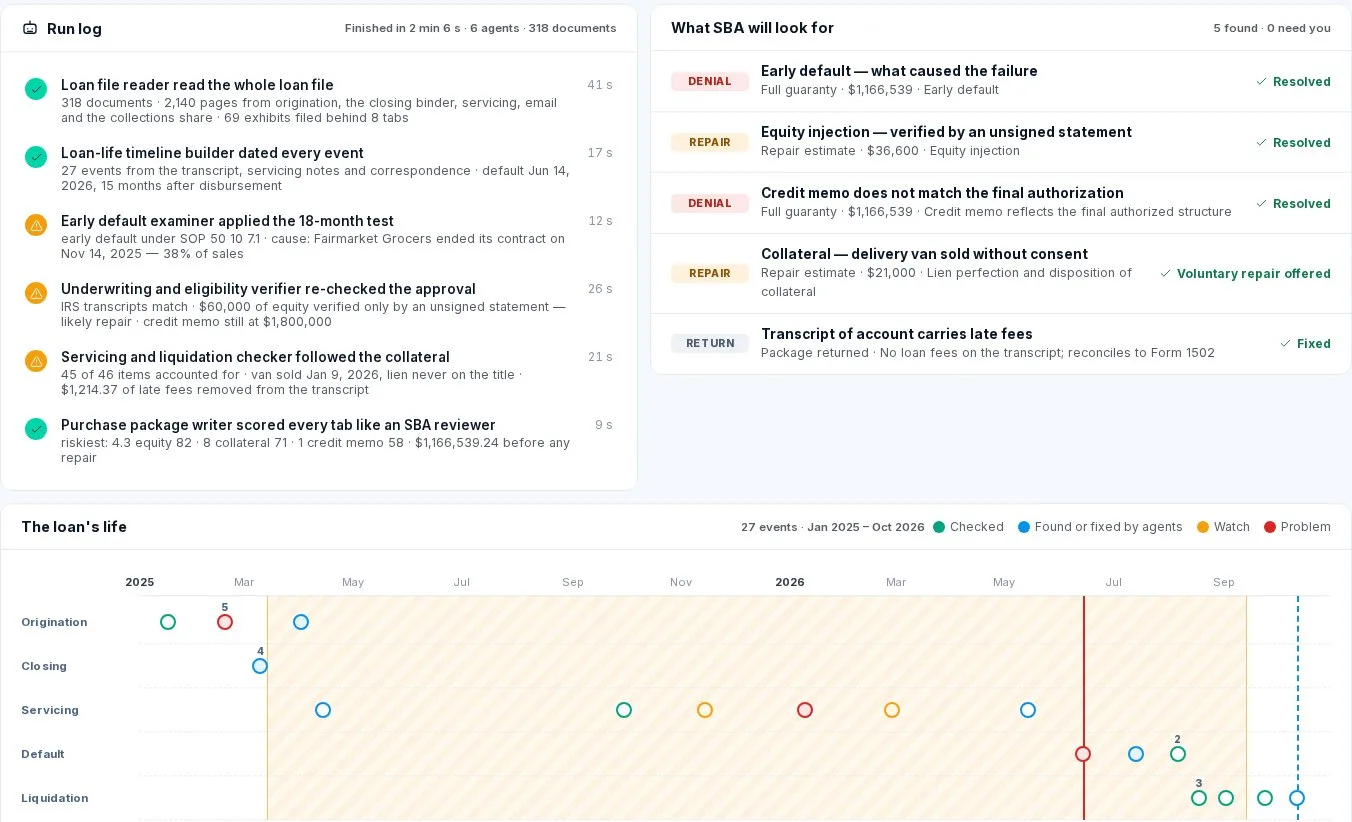
In shortThis is the example from the top of the page, inside the product. Six agents file all 318 documents behind SBA's tabs and score every tab the way a purchase reviewer would. Teresa Lindqvist, the SBA liquidation officer, works the riskiest tab first: the agents find the missing equity proof, she chooses a $21,000 repair for the van, approves an explanation for the credit memo, and Malcolm Adebanjo, the SVP, signs.
1
A loan file in five piles, and eight reasons SBA repairs or denies
The loan moved to liquidation on August 21, 2026. Its file arrived on Sunday night, October 11: 318 documents and 2,140 pages from the origination system, the closing binder, the servicing system, the email archive and the collections share. The binder's dividers are empty, and the predicted answer at the top reads "Not read yet".
Below the piles are the eight repair and denial reasons every tab will be scored against, from an early default without a documented cause to loan fees left on the transcript.
The loan file as it arrives. Five sources, 318 documents, SBA's tabs down the right edge, nothing read yet.
2
Read it like SBA: the riskiest tab turns red
Teresa presses Read it like SBA. The agents file 69 exhibits behind the tabs, date 27 events, apply the 18-month test and re-check the approval; on the sample file the run takes 2 minutes 6 seconds. Tab 4.3, equity injection proof, scores 82: the closing checklist relied on an unsigned source-of-funds statement and a copy of the father's $60,000 check.
The page says what a reviewer is likely to write, in red: "Likely repair: injection verified by unsigned statement". At stake: $36,600, 75% of the $48,800 not proven. The prediction at the top reads "Likely repair, about $57,600", with Tab 1 a possible denial.
The riskiest tab. The reviewer's likely words in red, the amount at stake, and each exhibit with a margin note.
3
Find the proof: the tab drops from 82 to 8
Teresa asks the agents to find the proof. They search the email archive and the closing agent's folder and find wire confirmation FED-0312-8871 of March 12, 2025 and the title company's escrow settlement page that credited the $60,000 to the buyer at closing, two days before disbursement.
Both are filed as exhibits 4-9 and 4-10, marked as found by the agents. $218,000 of $218,000 is traced, the tab reads "Clear", and the unsigned statement is withdrawn from the package.
The proof, found. The wire and the escrow settlement page, each marked as found, and the tab cleared.
4
A van sold without the lien: Teresa chooses a repair
Tab 8 scores 71. The approval-time collateral list has 46 items and the post-default list 45: a 2024 delivery van, sold by the borrower on January 9, 2026, whose lien was never noted on the Ohio title. The page prices it: $21,000, 75% of a likely $28,000 at auction.
The agents never offer a repair. Teresa chooses to offer the $21,000 up front instead of arguing it; it is above her $10,000 limit, so it goes to Malcolm with the package. She then asks for an explanation of the credit memo that still shows $1,800,000, and Tab 1 clears.
A priced gap. Offer a $21,000 voluntary repair, or explain without one; the lien exhibit shows the UCC-1 filed March 13, 2025 that never reached the title. A person decides.
5
Pays as requested, then an officer signs
With every tab answered and 30 of 30 package items present or explained, the prediction reads "Pays as requested": $1,145,539.24, after the van repair. The purchase request ties line by line to the transcript, with $1,214.37 of late fees removed, and the Tab 2 loan summary is drafted from the timeline for counsel to read.
Teresa marks the package ready. Malcolm Adebanjo, SVP of SBA servicing and liquidation, signs the Request to Honor, and the package goes to the National Guaranty Purchase Center by secure file transfer: 71 exhibits, 412 pages.
Signed and submitted. The amount line by line, the loan summary, two names, and the receipt from the purchase center.
Three tabs went from likely or possible repair or denial to clear once the officer worked them
Hollis & Pike Bakery: risk score per tab after the first read and after the officer worked the tabs (65+ likely, 35–64 possible, under 15 clear)
After the first readAfter the officer's decisions
4.3 · Equity injection proof828
8 · Collateral7114
1 · General loan information589
4.1 · Early default determination2424
7 · Use of proceeds1111
Fictional example from this guide · Fictional example. Tab 4.1 stays on watch: the early default is a fact, and its documented cause is the answer.
Show the numbers
After the first read
After the officer's decisions
4.3 · Equity injection proof
82
8
8 · Collateral
71
14
1 · General loan information
58
9
4.1 · Early default determination
24
24
7 · Use of proceeds
11
11
The solution's design targets are 30 of 30 package items present or explained before the package goes in, and about two days from a complete loan file to a signed purchase request. They are targets, to be measured on your own loans.
15 · Every screen
The rest of the purchase desk on screen: the money trail, the loan's timeline, the risk register and the caseload
In shortThe bakery loan showed one package from start to finish. These ten screens show the rest: the tabs filling as the file is read, the unsigned statement the agents flagged, the money trail, the credit memo the authorization outgrew, the binder with every tab clear, the loan's life on one timeline, the risk register with its written explanations, the cases and the portfolio, and the bank's rules.
The tabs filling. Each agent's step as it runs, with what it found and how long it took; each tab scored as it fills.
The unsigned statement. The document the closing checklist relied on, with the blank signature and the $60,000 marked.
The money trail. Each source to where it landed and to the closing, dated, beside SBA's equity injection worksheet.
A possible denial on Tab 1. The credit memo never caught up with the March 7 modification; left unexplained, SBA can read it as an underwriting failure.
Every tab answered. 30 of 30 items and the predicted first-review answer: pays as requested.
The loan's life. Origination, closing, servicing, default and liquidation in five lanes, the 18-month window shaded, every event tied to its document.
Repair and denial risks. Each risk with its rule, the amount at stake and the working, and the written explanation drafted for SBA and counsel.
Purchase cases. Every loan heading for purchase, ranked by guaranty at stake and the clock, with early defaults flagged.
Liquidation portfolio. Every SBA loan in liquidation with its next clock: site visit, purchase target, litigation plan, wrap-up report.
The bank's rules. The SOP by loan vintage, the clocks and the checks, versioned and on the audit trail.
Select a screen to open it larger. The bank, borrowers, people and figures are fictional. The screens label the package "UPP v3", the version effective May 1, 2025;43 SBA's current form, version 5.3, posted August 12, 2026, keeps the same eight tabs.15,2
Collateral and use of proceeds carry the most exhibits in the finished package
Hollis & Pike Bakery: exhibits behind each tab of the 71-exhibit package
8 · Collateral12 exhibits
7 · Use of proceeds10 exhibits
6 · Obligors9 exhibits
1 · General loan information8 exhibits
4.2 · IRS and financial verification7 exhibits
4.3 · Equity injection proof6 exhibits
4.1 · Early default determination5 exhibits
3 · Transcript of account4 exhibits
5 · Business eligibility4 exhibits
CPC · Care and preservation4 exhibits
2 · Loan summary2 exhibits
Fictional example from this guide · Fictional example; 412 pages in all.
Show the numbers
Tab
Exhibits
8 · Collateral
12 exhibits
7 · Use of proceeds
10 exhibits
6 · Obligors
9 exhibits
1 · General loan information
8 exhibits
4.2 · IRS and financial verification
7 exhibits
4.3 · Equity injection proof
6 exhibits
4.1 · Early default determination
5 exhibits
3 · Transcript of account
4 exhibits
5 · Business eligibility
4 exhibits
CPC · Care and preservation
4 exhibits
2 · Loan summary
2 exhibits
16 · Agents, and who signs
Who prepares the purchase package and who signs the Request to Honor: six agents, a liquidation officer and an SVP
In shortEach agent has one job and limits it does not cross. None of them signs, submits or offers a repair. The liquidation officer reviews every risk and every written explanation and may offer a repair up to $10,000; above that the SVP decides, and an officer of the bank signs the Request to Honor. Every step, by an agent or a person, is on the case's audit trail.
Six agents, from loan file reader to purchase package writer
Loan file reader
Reads every document from origination, the closing binder, servicing, email and collections, identifies its type, date, parties and amounts, and files it behind its tab in SBA's order.
Never edits, re-dates or re-signs a document. Reports any required item with no document.
Loan-life timeline builder
Dates every event, from approval and modifications through disbursement, payments, default, site visit, demand and recoveries, from the transcript, servicing notes and correspondence.
Never fills a date it cannot cite.
Early default examiner
Applies the 18-month test against the disbursement dates, and finds the documented cause of failure: a lost customer, a casualty, an illness, a market change.
Never calls a default "not early" against the dates.
Underwriting and eligibility verifier
Re-checks the approval as an SBA reviewer will, under the SOP of the approval date: the equity injection traced to its source, IRS transcripts against the returns, the credit memo against the final authorization, eligibility and required forms.
Never treats a check copy or an unsigned statement as proof the money moved.
Servicing and liquidation checker
Follows every collateral item from approval to its disposition and checks liens, insurance, site visit timing, demand on every obligor, recoveries, and the transcript against Form 1502.
Never reports collateral as liquidated without a document, or leaves loan fees on the transcript.
Purchase package writer
Scores every tab against SBA's repair and denial reasons, predicts the first-review answer, computes the amount, drafts the Tab 2 loan summary and the written explanations, and orders the exhibits.
Never signs or submits, offers a repair on its own, or shows a prediction without the evidence behind it.
The officer repairs to $10,000; an SVP signs the Request to Honor
DecidesSBA liquidation officerWorks the tabs, approves every written explanation, offers a repair up to $10,000, marks the package ready.
Second person, signsSVP, SBA servicing and liquidationDecides repairs above $10,000 and signs the Request to Honor as an officer of the bank, with the meaning and time recorded.
ReadsLender's counselReads each explanation next to the exhibits it cites before the package goes in.
The underwriting rules are read under the SOP 50 10 of the approval date and servicing actions under the SOP 50 57 of their own date, as a setting. Changes to the rules, limits and signers are versioned and on the audit trail.
Teresa Lindqvist's 23 loans in liquidation and who signs with her
Fictional, from the sample data
TL
Teresa Lindqvist · SBA liquidation officer
Works 23 SBA loans in liquidation, seven purchase requests in preparation.
"I'm proving decisions made by people who left the bank two years ago."
MA
Malcolm Adebanjo · SVP, SBA servicing and liquidation
Owns the purchase pipeline and the repair and denial losses; signs the Request to Honor.
"A denial costs us the whole guaranty. A repair we can live with if we chose it."
OC
Owen Castellano · special assets officer
Site visits, collateral and auctions.
"If it isn't on the post-default list, SBA assumes we lost it."
PR
Pallavi Raghunath · lender's counsel
Reviews demand letters, litigation plans and the written explanations.
"Say what happened, cite the page, and stop."
17 · What goes in and out
The loan records purchase preparation reads, and the Universal Purchase Package it assembles in SBA's tab order
In shortThe solution reads the loan file where it already lives and leaves behind a package in SBA's tab order with every exhibit labeled, a risk score and a written answer for every tab, the purchase amount tied to the transcript, a drafted loan summary, and a signed Request to Honor. Your systems of record stay where they are.
From the loan file
Application, eligibility forms, credit memo and SBA authorization with modifications
Collections and counsel filesSite visits, demand letters, auction reports
SBA submissionSecure file transfer to the reviewing center; E-Tran updated
Identity and accessRoles, repair limits, separation of duties
Audit and reportingCase history, the portfolio's clocks, exports
For each, check whether it has an API, a file feed, or only screens, and who owns it.
Every finding paged, rules by the loan's dates, an officer signs
1
Every finding carries its page
Exhibits, dates, risks and explanations open at the document and page they came from, for the officer, counsel and SBA.
2
The rules of the loan's own dates
Making and closing under the SOP 50 10 of the approval date; servicing under the SOP 50 57 of each action's date.
3
Agents prepare; people decide and sign
Agents file, date, check and draft. A named officer decides every repair and explanation, and an officer of the bank signs.
Part C · Are you ready to automate?
For SBA liquidation desks choosing purchase-package software: repairs, interest days and proof on decided loans
You build purchase packages, run the desk that does, or answer for the guaranties they claim. This part is written for you: what repairs, denials and late packages cost today, what automating the package could return, whether your desk is ready, and what to ask any vendor or service provider, including us.
18 · What gaps and delays cost
What an incomplete or late purchase package costs you: repairs, lost interest and years of exposure
In shortStart from your own purchase letters. Nobody publishes how often packages come back repaired across all lenders, or how long a package takes to build. A few published figures frame your numbers: SBA pays interest for at most 120 days, a disputed file has averaged 808 days to a final answer, and SBA paid $2.12 billion of 7(a) purchases in FY2025 while testing them for improper payments.
120 days
the most accrued interest SBA pays on its share of a 7(a) loan approved since May 14, 2007. Interest after that is the lender's, and on a sold loan SBA bills the lender for the investor's.3
SOP 50 57 4, Chapter 24
808 days
on average for SBA's final review to decide the 545 repair and denial files lenders disputed from October 2021 to March 2025.4
SBA OIG Report 26-12
$2.12B
of 7(a) guaranty purchases in FY2025, each a file SBA may still test, repair or recover from later.9,5
SBA Agency Financial Report FY2025
Most of the days in a hand-built package go before anyone decides anything
Working days for one 7(a) early-default package
By hand (estimate)With automation (design target)
Pulling the file and tabbing it6 days0.75 days
Re-checking equity, transcripts and the memo4 days0.5 days
Collateral, liens and recoveries3 days0.25 days
Amount, explanations and sign-off3 days0.5 days
Illustrative · replace with your own numbers · Neither column is a measurement: the first is an estimate supplied with the solution in Part B, the second its design target of about two days. Time three of your own packages.
Show the numbers
By hand (estimate)
With automation (design target)
Pulling the file and tabbing it
6 days
0.75 days
Re-checking equity, transcripts and the memo
4 days
0.5 days
Collateral, liens and recoveries
3 days
0.25 days
Amount, explanations and sign-off
3 days
0.5 days
What nobody publishes. There is no public figure for the hours a lender spends per package, the share of packages repaired or denied across lenders, the average repair, or the days between default and filing. SBA's final-review figures cover only files lenders disputed. Your own purchase letters, repair agreements and filing dates are the baseline.
Totaling three years of repairs and interest days past 120
Cost
Where it hides
How to find your number in a week
Repairs and denials
Deductions in SBA's purchase letters; denials written off as credit losses
Pull every purchase letter from the last three years; total the repairs and denied guaranties by reason
Interest past 120 days
The gap between interest paid-to date and the purchase date
For each purchase, days past 120 × daily interest on the guaranteed share
SBA's requests for additional documents after filing
Count requests per package and the days each added
Open exposure
Purchased loans with an open wrap-up or a dispute
List every purchase still open, with its 24-month deadline
Service provider fees
Per-package fees to an outsourced desk
Last year's invoices divided by packages filed
A full early-default denial and a purchase recovered years later
The full denial on an early defaultOne missing wire confirmation on a large loan can outweigh years of staff time.
A purchase recovered years laterSBA may recover at any time it finds a release event, plus interest.
Your standing with SBADefault, purchase and loss rates feed SBA's view of whether a lender keeps participating.
Knowledge that left with a personThe officer who knew why a deferment was granted is gone when SBA asks.
The next loan's underwritingEach repair names a gap in how loans are made and closed today.
19 · Your return
Staff hours, interest days and repairs avoided: putting a value on faster SBA purchase packages
In shortPut in your own numbers. The calculator values three things: staff hours released, interest days recovered by filing sooner, and repairs avoided because evidence was found or a gap was priced before SBA saw it. Every default is an assumption to replace; the average purchase size is our arithmetic on two SBA figures.
Staff hours, interest kept inside 120 days and repairs avoided
Staff time
Tabs filled before the officer opens the file
Every document filed behind its tab, every event dated, the officer works the riskiest tab first.
packages × hours saved × loaded hourly cost
Interest
Filed the week the last asset sells
A package ready while liquidation runs goes out sooner after the 120 days end.
packages × days sooner × daily interest on SBA's share
Repairs
Proof found, gaps priced
Evidence searched across every system; the gaps that remain explained or repaired by choice.
packages × average purchase × fall in repair rate
Rework
Fewer "please send more" letters
Every item SBA's index lists is present or explained before filing.
requests avoided × days each added
Exposure
Clocks kept for every loan
Site visits, filing targets, 180 days after maturity, 24 months after purchase.
missed deadlines × their cost
Oversight
Evidence for your own review
Every finding with its page; every decision with its name, for audit, examiners and SBA.
hours assembling support for reviews
Your staff hours, interest days and repairs on each purchase package
The average purchase default divides SBA's FY2025 purchase outlays, $2,115.5 million, by its estimate of 15,000 transcripts of account a year.9,33 Every input marked illustrative is an assumption to replace.
Your volume and costHours per packageInterest past the 120 daysRepairs and denialsYour cost
Illustrative yearly value
Staff time released, valued$0
Interest recovered by filing sooner$0
Repairs and denials avoided$0
After your yearly cost$0
Staff hours released a year0
Packages a year to cover your cost0
Formulas, per year: Staff time = packages × (hours today − hours with automation) × hourly cost Interest = packages × (days past cap today − with automation) × daily interest on SBA's share Repairs = packages × average purchase × (loss share today − with automation) ÷ 100 After your cost = the three together − yearly cost Break-even packages = yearly cost ÷ value per package
The default of 128 hours is an estimate for an early-default package; ordinary defaults take fewer. Daily interest on SBA's share is about the average purchase × the note rate ÷ 365: $141,000 × 10.25% ÷ 365 ≈ $40. Not counted: rework after SBA's questions, purchases recovered years later, service provider fees, and the value of staff time put to new loans.
The hours saved per package decide how many packages pay for the tool
Packages a year to cover $120,000 of yearly cost, with $800 of interest and $1,410 of repairs saved per package at $60 an hour
Saves 112 hours a package13.4 packages
Saves 60 hours a package20.7 packages
Saves 20 hours a package35.2 packages
Illustrative · replace with your own numbers
Show the numbers
Hours saved
Packages a year
Saves 112 hours a package
13.4 packages
Saves 60 hours a package
20.7 packages
Saves 20 hours a package
35.2 packages
A lender that files two dozen packages a year, many of them early defaults, covers the cost even on the first line's assumptions. A lender that files three a year, on small loans late in their life, will not; a good vendor should tell it so, and a well-briefed service provider may serve it better.
Start here20 · Readiness check
Readiness check for an SBA liquidation desk: score your volume, files, decided loans and sign-offs
In shortPick the answer closest to your desk today. Eight questions score 0 to 2; the last is for reflection. The meter adds up your score as you go, and each question says why it matters and what a strong answer sounds like.
1
Volume
How many SBA purchase packages does your desk file in a year?
Why it mattersVolume turns hours per package into capacity. The large FY2024 and FY2025 vintages reach their riskiest year in 2026 and 2027.31,28
A strong answer"About thirty, half of them early defaults, and rising."
2
Shape of your defaults
How many of your purchase requests are early defaults on loans you approved under delegated authority?
Why it mattersOn a delegated early default SBA reads the underwriting for the first time, and the presumptions run against you.3
A strong answer"Most of them: loans we approved ourselves under delegated authority, many changes of ownership with gift funds in the equity."
3
Your baseline
Do you know your repairs and denials by reason, your days from default to filing, and your hours per package?
Why it mattersNo public benchmark exists for any of them, so your own baseline is the only way to show an improvement.
A strong answer"$310,000 of repairs over three years, mostly liens and site visits; median 140 days from default to filing."
4
Where the file lives
Can software reach the origination system, closing binders, servicing system, email and collections files?
Why it mattersThe proof that saves a guaranty is often outside the credit file, as the wire was in the example.
A strong answer"All electronic since 2019; email archive searchable; closing agents send files to one inbox."
5
Decided loans to test on
Do you keep SBA's purchase, repair and denial letters with the original files?
Why it mattersA decided loan is an answer key: the fairest test of any tool or provider.
A strong answer"Every letter since 2021, filed with the loan, including two denials we disputed."
6
Approvals and limits
Are repair authority, explanation approval and the Request to Honor signer written down?
Why it mattersThose decisions stay with people; written limits become settings a tool enforces.
A strong answer"Officer repairs to $10,000, the SVP above; counsel reads every explanation; the SVP signs."
7
Owner and budget
Is there a named owner of the purchase pipeline with a budget to change how it is done?
Why it mattersPurchase work crosses liquidation, servicing operations, counsel, credit and IT. Without one owner it stalls.
A strong answer"The head of SBA lending owns repair losses and has budget that now pays a service provider."
8
Governance
Do you have a path to approve AI and outside providers in SBA work: vendor due diligence, a view on the 2026 model guidance, human sign-off and an audit trail?
Why it mattersSBA holds you responsible for every certification, and the 2026 model guidance leaves generative AI to your own framework.18,36
A strong answer"Vendor management and model risk have a path for AI tools, and every package needs a named signer."
9
Vision · for reflection
If SBA asked tomorrow for the evidence behind every tab of last quarter's packages, what would have to be true for you to send it within an hour?
Why it mattersYour answer lists the gaps. Each gap is a candidate job for software or a provider: finding, filing, dating, reconciling or drafting.
A strong answerA short, specific list, for example: "every document behind its tab, every finding with its page, every repair with its working."
Explore, rebuild five decided packages, or prepare every purchase
0–6
Explore
Build the baseline first: pull three years of purchase letters, total repairs and denials by reason, time the next three packages, and write down who may offer a repair and who signs. Start narrow, for example with equity and lien checks on every early default.
7–11
Ready to pilot
Rebuild five packages SBA has already decided, blind, and compare the findings tab by tab with SBA's letters. Add two live loans in liquidation, with your officers deciding and signing everything.
12–16
Ready to implement
Plan the desk: system access, your repair limits and signers as settings, the clocks for every loan in liquidation, counsel's review, and the evidence your auditors and SBA will ask for.
21 · Questions for any vendor
Seventeen questions for purchase-package vendors on reading like an SBA reviewer, the loan's own dates and page-cited findings
In shortAsk every vendor and every outsourced desk the same questions, us included. The answers show whether it reads a file the way an SBA reviewer does, applies the rules of the loan's own dates, ties every finding to a page, and leaves the bank's decisions with the bank.
Ask
A good answer
A warning sign
What it reads
Which of our systems does it read: origination, closing binders, servicing, email, collections?
All of them, where the files actually live
"Upload the credit file"
What does it do with a document it cannot place behind a tab?
Asks, and lists it; a required item with no document is reported
Files it somewhere plausible
Does it build the package to the form our reviewing center posts today?
Yes, with the form version recorded
A fixed template from an older version
The rules of the loan's own dates
Which SOP does it apply to each step?
SOP 50 10 of the approval date to making and closing; SOP 50 57 of each action's date after full disbursement
Today's SOP for everything
How does it decide whether a default is early?
The four events against the disbursement dates, with the cure test, citing the transcript
Months from closing, or from approval
What does it accept as proof of an equity injection?
A processed wire or check, an escrow settlement statement or a bank statement, before disbursement
A gift letter or a checklist tick
Evidence
Can every finding, date and amount be opened at its document and page?
One click, for the officer, counsel and SBA
A confidence score in place of a page
Does the purchase amount tie to the transcript and the last Form 1502?
Line by line, with lender fees removed and any difference explained
A total with no working
When a document is missing, what does the package say?
A drafted written explanation for a person to approve
Nothing
Decisions and signatures
Who offers a repair, approves an explanation and signs the Request to Honor?
Your named people, within your written limits
"The system submits when ready"
How does it estimate a repair?
Recoverable value × guaranty %, with the working shown
A risk score with no dollars
What is on the audit trail?
What was read and found, and who changed, decided or signed what, and when
Final package only
Your data, AI and responsibility
Which AI models do you use, where do they run, and does our data train them?
Named models, a region you choose, no training on your data, in writing
"Proprietary AI", no more detail
Are you a lender service provider under SBA's definition for this work?
A clear answer, and an agreement SBA can review if so
"We're just software"
Proof
Will you rebuild packages SBA has already decided, without seeing the letters?
Yes, blind, compared tab by tab with SBA's letters
Demo files only
What will you report from that test?
Issues SBA raised that it caught, issues it raised that SBA did not and why, amount differences, officer hours
One accuracy percentage
What happens to loans already purchased?
Their wrap-up and 24-month deadlines are tracked too
Out of scope
We found no published independent test of any purchase-package tool's accuracy, as of October 2026. Rebuilding decided loans blind is the fairest comparison, and the same test measures your current process or provider.
22 · How to start
A ten-week purchase package pilot: rebuild five loans SBA already decided, then run two live ones
In shortMeasure first, then test against SBA's own answers, then run live loans with your people deciding. Ten weeks is enough, and none of it commits you to a vendor.
Pull your baseline: three years of purchase letters, repairs and denials by reason, days from default to filing.
Choose five decided loans: at least one early default, one repair, one denial or dispute, and one whose evidence was scattered.
Rebuild them blind, from the original files where they live, with SBA's letters held back.
Compare tab by tab: issues SBA raised that were caught or missed, issues found that SBA never raised, amounts, hours.
Run two live loans in liquidation, with your officer deciding every repair and explanation and an officer signing.
Ten weeks: a baseline, five blind rebuilds and two live loans before you decide
Your teamVendor or provider
Pull purchase letters; total repairs by reason
Choose five decided loans; grant file access
Load your limits, signers and clocks
Rebuild the five packages blind
Compare with SBA's letters, tab by tab
Two live loans, your people deciding
Decide
Week 0246810
Illustrative · replace with your own numbers
Show the numbers
Activity
From
To
Pull purchase letters; total repairs by reason
0
2
Choose five decided loans; grant file access
1
3
Load your limits, signers and clocks
2
3
Rebuild the five packages blind
3
5
Compare with SBA's letters, tab by tab
5
7
Two live loans, your people deciding
5
9
Decide
9
10
SBA issues caught, new evidence found and amount accuracy
Measure
How
Why
SBA issues caught
Deficiencies in SBA's letters raised on the right tab with the right page ÷ all deficiencies
The number that predicts repairs
New evidence found
Findings SBA never saw, checked by your officer against the file
Where packages could have been paid in full
Amount accuracy
Computed request against SBA's payment, line by line
Ties to the transcript and Form 1502
Officer hours
Stopwatch from opening the file to a package ready to sign
The cost case rests on it
Days to filing
From the last business asset sold to the request filed
The interest days you keep
The full working-session questions: 18 questions in six groups
Bring the liquidation desk, special assets, servicing operations, counsel, credit, vendor management and IT into one room. Each question says why it matters, what a strong answer looks like, and the warning sign.
A
Purchase packages a year by early default, authority and program
A1
How many packages a year, split by early default, delegated authority, loan size and program?
Why it mattersEarly defaults on delegated loans are where the burden and the hours are.
Strong answer · warning sign
Counts by type.
One number, nobody sure of the mix.
A2
Which loans would stay with counsel or a provider, and why?
Why it mattersContested denials and litigation need lawyers whatever tool you buy.
Strong answer · warning sign
A clear list.
"Everything, day one."
A3
How many purchased loans still have an open wrap-up?
Why it mattersThe 24-month deadline carries repurchase and enforcement.3
Strong answer · warning sign
A list with dates.
Unknown.
B
Rules and vintage
B1
Do our checklists say which SOP version each item comes from?
Why it mattersThe vintage rule judges each step by its own date.3,17
Strong answer · warning sign
Versioned checklists.
One checklist, rewritten each time.
B2
Which of our loans were approved August 2023 to December 2024?
Why it mattersSBA agreed to flag them for eligibility review at purchase.23
Strong answer · warning sign
A list, with SBA's own clearance of each error code kept.
Not tracked.
B3
Who downloads the current purchase form, and when?
Why it mattersThe form has had at least three versions since May 2025.15,2,11,14
Strong answer · warning sign
On the day each package starts.
A copy saved in 2024.
C
Evidence and errors
C1
What did our last three years of repairs and denials say, by reason?
Why it mattersThey show where the file breaks.
Strong answer · warning sign
A list by reason and tab.
Nobody tracks them.
C2
Where do closing agents' wire confirmations and escrow statements end up?
Why it mattersThey are the equity proof SBA accepts.3
Strong answer · warning sign
Filed with the loan.
In someone's inbox.
C3
How do we confirm a vehicle lien is noted on the title?
Loan file systems, transcript to Form 1502, and secure transfer to SBA
D1
Which systems hold the loan file, and can each be read by a service account?
Why it mattersSets the integration work.
Strong answer · warning sign
Named, with owners.
Unknown.
D2
Does the servicing transcript reconcile to Form 1502 without manual work?
Why it mattersAn unexplained difference is a question at review.2
Strong answer · warning sign
Yes, monthly.
Only at purchase.
D3
How do we send packages to SBA today?
Why it mattersSBA's form calls secure file transfer the preferred way to submit.2
Strong answer · warning sign
The center's secure upload, logged.
Email attachments.
E
Lender service provider rules, SR 26-2 and a named sponsor
E1
Is a tool or provider doing this work a lender service provider under SBA's rules?
Why it mattersAn LSP needs an agreement SBA reviews, and the lender stays responsible.18
Strong answer · warning sign
Counsel's written view.
Not considered.
E2
Has our model risk policy moved from SR 11-7 to the April 2026 guidance (SR 26-2, OCC Bulletin 2026-13, FDIC FIL-15-2026)?
Why it mattersThe old guidance was replaced on April 17, 2026.36,37,38
Strong answer · warning sign
Updated, with a view on AI tools.
Still cites SR 11-7.
E3
Who sponsors the change, and what budget can move?
Why it mattersA pilot without a sponsor ends as a demonstration.
Strong answer · warning sign
A named executive.
No sponsor.
F
A purchase package ready the day the last asset sells
F1
What if every loan in liquidation had its package ready the day the last asset sold?
Why it mattersTests the appetite for filing inside the interest window.
Strong answer · warning sign
"Our officers would spend their days on recoveries."
"SBA is slow anyway."
F2
What if every finding in every package opened at its page?
Why it mattersLinks the package to counsel's review and SBA's questions.
Strong answer · warning sign
Fewer requests for more.
Nobody would look.
F3
Which steps would we never let software take without a person?
Why it mattersTells you where the signatures belong.
Strong answer · warning sign
Repairs, explanations, the signature, withdrawals.
"All of it": then start with filing and dating.
23 · Frequently asked questions
SBA purchase package tabs, early defaults, repairs and the Request to Honor: questions lenders ask
In shortThe questions SBA lenders and buyers search for most, each answered on its own.
What is an SBA guaranty purchase package?
It is the evidence a 7(a) lender sends SBA to ask it to honor its guaranty on a defaulted loan by buying the guaranteed share. SBA's Universal Purchase Package organizes it in eight tabs, from general loan information to collateral liquidation, with a certified transcript of account and a Request to Honor signed by an officer of the lender. SBA pays only if the documents show the loan was made, closed, serviced and liquidated by its rules.
When can a lender request SBA guaranty purchase?
Once the loan has an uncured payment default of more than 60 calendar days, is reported "In Liquidation" on Form 1502, and, for loans approved on or after May 14, 2007, business personal property worth $10,000 or more has been liquidated, unless the borrower is in bankruptcy. The request must come within 180 days after maturity, or after liquidation of a matured loan ends, or SBA is released.
How many tabs are in the SBA universal purchase package?
Eight: general loan information, loan summary, transcript of account, early default, business eligibility, obligors, use of proceeds, and collateral liquidation. Collection expenses go in separate care-and-preservation tabs. Lenders who speak of a "10 tab checklist" usually split the early default tab into its parts or refer to SBA's older package, which the universal package replaced in August 2023.
What is the current version of the SBA universal purchase package?
As of October 2026, SBA's package page carries version 5.3 of the Universal Purchase Package, posted August 12, 2026; the page lists it as effective May 20, 2026 and the form's own footer says August 10, 2026. Version 3 took effect May 1, 2025. The eight-tab structure did not change. SOP 50 57 4 tells lenders to follow the instructions of the SBA center that will review the package, so download the form when you start each package.
What is an early default on an SBA loan?
Under SOP 50 57 4, an early default is a missed payment, a payment funded by selling collateral, a deferment or catch-up of more than three payments, or another liquidation event, within 18 months of initial disbursement (or of final disbursement, if it came more than six months later). It is cured only by curing the default and then paying on schedule for 12 months after the 18-month period. On an early default SBA re-reads the underwriting.
What documents prove an SBA equity injection?
A check or wire shown as processed and deposited into escrow or the borrower's account before the loan's initial disbursement, a signed third-party escrow settlement statement, or the borrower's bank statement showing the deposit. A promissory note, gift letter or financial statement on its own is not credible evidence. On an early default, a required injection the lender cannot document is presumed to have caused the failure.
What is the difference between an SBA repair and a denial?
A repair is an agreed deduction from SBA's payment to make up for a loss the lender caused, usually the loss times the guaranty percentage, and it does not change the guaranty percentage. A partial denial imposes the same kind of loss when the lender will not agree. A full denial withholds the whole guaranty, for an ineligible loan, a total loss the lender caused, or misconduct.
How is an SBA repair calculated?
Generally as the dollar loss the lender caused multiplied by SBA's guaranty percentage; SOP 50 57 4's own example is a $50,000 loss times 75% for a $37,500 repair. For collateral the loss is its recoverable value, and for a lien never obtained it is the value the property would have had with the lien. Lenders are encouraged to include a repair estimate, with its justification, in the package.
How much interest does SBA pay on a guaranty purchase?
For 7(a) loans approved on or after May 14, 2007, at most 120 calendar days of accrued interest on the guaranteed share, at the note rate, or for a variable-rate loan at the rate on the earliest uncured payment default date. If the guaranteed portion was sold and SBA must pay the investor more than 120 days, SBA bills the lender for the difference.
Who signs the SBA Request to Honor?
An officer of the lending institution. A lender service provider or software may prepare the package, but the signature and the representations in it belong to the lender, which SBA holds fully responsible for its SBA loan operation.
Which SOP does SBA apply when it reviews a purchase?
Two, by date. SBA applies the SOP 50 10 in effect when the loan was approved to making, closing and modifications before full disbursement, and the SOP 50 57 in effect when each servicing action was taken to everything after. The rule was restored by a procedural notice effective April 15, 2025, and is written into SOP 50 57 4, effective November 1, 2025. Under SBA's notice of September 25, 2026, SOP 50 10 8.1 governs applications SBA received from October 1, 2026.
How long does SBA take to review a guaranty purchase?
SBA does not publish a standard time for a clean purchase. For files a purchase center recommended for repair or denial and the lender disputed, SBA's Inspector General measured an average of 808 days to a final decision from 2021 to 2025, falling to 362 days for files that entered the review from October 2021.
Is SBA Form 1149 required for a purchase request?
A certified transcript of account is required. SOP 50 57 4 recommends SBA's own Form 1149 for it without making that form mandatory, because it speeds the review. SBA's purchase center lists a transcript that is unsigned or not in Form 1149 format among common errors, and lenders must not add their own loan fees to it.
Can AI prepare an SBA guaranty purchase package?
Software can read the loan file, file each document behind its tab, date the loan's events, test the 18-month window, trace the equity injection and compute the amount, with every finding tied to its page. We found no SBA guidance on AI for lenders as of October 2026, and the lender remains responsible for every certification. People should decide every repair and explanation, and an officer signs.
24 · One-page summary
SBA guaranty purchase preparation in brief: the method, the clocks, the readiness bands and the terms
Print this page
In shortThe whole guide on one screen: the method, the rules as of October 2026, the readiness bands and the terms.
The method
Check the timing: more than 60 days of default, "In Liquidation", business assets sold; watch 120 days of interest and 180 days after maturity.
Pull the whole file from every system; place every document behind SBA's eight tabs in order.
Test the 18-month window; on an early default, trace the equity to a wire, escrow statement or bank statement before disbursement, and show the IRS transcripts compared.
Read each step against the SOP of its own date; follow every collateral item to its disposition.
Tie the amount to the transcript and Form 1502; take lender fees off.
Explain every missing document; price every lender error as a repair; an officer signs.
Readiness: score 0–2 on eight questions: 0–6 explore · 7–11 pilot · 12–16 implement.
As of October 2026: SOP 50 57 4 in force since November 1, 2025 · purchase form version 5.3 posted August 12, 2026 · vintage rule restored April 15, 2025 · SOP 50 10 8.1 for applications SBA received from October 1, 2026 (notice of September 25, 2026) · SR 26-2 / OCC Bulletin 2026-13 / FDIC FIL-15-2026 replaced SR 11-7 on April 17, 2026 · OIG Report 26-12, August 27, 2026.
14 terms
Guaranty purchase
SBA buying its guaranteed share of a defaulted loan.
Universal Purchase Package
SBA's eight-tab index of evidence for a purchase request.
Request to Honor
The purchase request, signed by an officer of the lender.
Early default
One of four default events within 18 months of disbursement.
Equity injection
The borrower's own money or assets put into the project.
Repair
An agreed deduction: loss × guaranty %.
Denial of liability
SBA refusing part or all of the guaranty.
Transcript of account
The certified history of disbursements and payments; Form 1149.
Form 1502
The lender's monthly status report to SBA's fiscal agent.
Earliest uncured payment default
The first installment not paid in full; it sets the default date.
Recoverable value
What collateral would bring, less the costs of getting it.
NGPC
National Guaranty Purchase Center, Herndon, Virginia.
Wrap-up report
The lender's report that collection is finished; due within 24 months of purchase.
Lender service provider
An agent paid to do a lender's SBA work; the lender stays responsible.
25 · Sources
Sources
Accessed October 2026. Regulatory status statements are as of October 2026.
13 CFR 120.520, Purchase of the guaranteed portion. ecfr.gov
SBA, Universal Purchase Package (UPP) v5, version 5.3 (form footer: effective August 10, 2026), posted August 2026. legacy.sba.gov
SBA, SOP 50 57 4, 7(a) Loan Servicing and Liquidation, effective November 1, 2025. legacy.sba.gov
SBA, Procedural Notice 5000-866946, Revisions to SOP 50 57 3.1 for SBA's Processing of Lender Guaranty Purchase Requests and Certain Servicing Actions, effective April 15, 2025. legacy.sba.gov
NAGGL, "New Universal Purchase Package" (UPP v3, effective May 1, 2025), May 23, 2025. naggl.org
Phillips Lytle, "The SBA reverts back to stricter lending standards", July 18, 2025. phillipslytle.com
SBA, Servicing and Liquidation Actions 7(a) Lender Matrix, version 18, effective December 18, 2025. legacy.sba.gov
N. Jellum (Jellum Law), "SBA Litigation and Liquidation Best Practices", Wisconsin Lenders Conference, May 14, 2026. uwsp.edu
SBA, Universal Purchase Package (UPP) document page: version 5.3, listed as effective May 20, 2026, page updated August 12, 2026. sba.gov
SBA, Information Notice 5000-882227, "Issuance of Technical Updates to SOP 50 10 8.1", September 25, 2026. sba.gov
SBA, SOP 50 10 Lender and Development Company Loan Programs (8.1 effective October 1, 2026). sba.gov
SBA, Information Notice 5000-880695, Issuance of SOP 50 10 8.1, published August 14, 2026, superseded by Information Notice 5000-882227 before it took effect. legacy.sba.gov
SBA, SOP 50 10 7.1, Lender and Development Company Loan Programs, effective November 15, 2023. legacy.sba.gov
T. Anderson (Windsor Advantage), "Updated SBA equity injection rules: SOP 50 10 8", July 28, 2025. windsoradvantage.com
Starfield & Smith, "A review of equity injection requirements under SOP 50 10 8", May 6, 2025. starfieldsmith.com
SBA OIG, Report 26-07, SBA's Screening of 7(a) Loan Applications Under its Risk Mitigation Framework, March 11, 2026. oversight.gov
13 CFR 120.523, What is the earliest uncured payment default? ecfr.gov
Ohio Revised Code 4505.13 (security interest in a motor vehicle noted on the certificate of title) and 1309.311. codes.ohio.gov
SBA OIG, Report 19-22, Consolidated Results of the OIG High Risk 7(a) Loan Review Program, September 26, 2019. legacy.sba.gov
SBA OIG, Report 26-14, Small Business Lending Companies' Performance in the 7(a) Loan Program, September 17, 2026. legacy.sba.gov
Glennon and Nigro, "Measuring the Default Risk of Small Business Loans: A Survival Analysis Approach", Journal of Money, Credit and Banking 37(5), 2005. doi.org
Windsor Advantage, "SBA loan default reasons for repair and denial", April 5, 2018. windsoradvantage.com
FDIC OIG, "Four executives sentenced in SBA fraud scheme spanning 13 years", December 17, 2021. fdicoig.gov
SBA, 7(a) and 504 FOIA loan data, 7(a) FY2020–present, as of September 30, 2026 (approvals counted by fiscal year). data.sba.gov
SBA, News release 25-83, record FY2025 capital, September 30, 2025. sba.gov
Federal Register 2024-11642, Reporting and recordkeeping requirements under OMB review (SBA Form 1149), May 28, 2024 (govinfo). govinfo.gov
Coleman Report, "OIG challenges $11.5 million in paid 7(a) guaranties; one review took 20.8 years", September 1, 2026. colemanreport.com
NAGGL, Future Lending Leaders 7(a) Industry Review, Edition V (M. Moore, "Utilizing AI for Underwriting 7(a) Loans"), July 2026. naggl.org
Federal Reserve, SR 26-2, Revised Guidance on Model Risk Management, April 17, 2026. federalreserve.gov
OCC Bulletin 2026-13, Model Risk Management: Revised Guidance, April 17, 2026. occ.gov
FDIC, FIL-15-2026, "Agencies Revise the Interagency Model Risk Management Guidance", April 17, 2026. fdic.gov
Interagency Guidance on Third-Party Relationships: Risk Management, 88 FR 37920, June 9, 2023. federalregister.gov
OCC, Semiannual Risk Perspective, Spring 2026. occ.gov
U.S. Treasury, Artificial Intelligence in Financial Services, December 2024. home.treasury.gov
NIST, AI Risk Management Framework 1.0, January 2023. nvlpubs.nist.gov
SBA, Universal Purchase Package (UPP) v3, effective May 1, 2025 (copy hosted by Coleman Report). colemanreport.com
Next step
See it on one of your own loans in liquidation.
Explore the solution, or bring one defaulted 7(a) loan file, ideally one SBA has already decided, and we will build its purchase package with you, every finding tied to its page.
We use essential cookies to make this site work, and cookieless, anonymised analytics to understand how it's used. "Accept all" also turns on Google Analytics, which sets cookies. Privacy policy