The SBA Universal Purchase Package is the set of documents a 7(a) lender prepares "to support the Lender's request for SBA to honor its guaranty by purchasing the SBA guaranteed portion of a Loan", organized behind SBA's numbered tabs, and the way to judge any software that builds it is a pilot on five of your own loans that SBA has already purchased, repaired or denied. Rebuild each package from the original loan file, without telling the software how the story ended, then compare its tab-by-tab findings and its amount with SBA's decision letter. Botminds' SBA Guaranty Purchase Preparation is built to be tested this way: six agents file the loan file behind SBA's tabs, score each tab against SBA's repair and denial reasons, and cite the document and page behind every finding, so a liquidation manager can see exactly where it agreed with SBA and where it did not.
The package rules come from SOP 50 57 4 and SBA's published Universal Purchase Package. The pilot plan and pass marks are our recommendation, written for a bank evaluating any vendor, ours included.
Why a decided loan is the right test
36%
of 545 repair or denial recommendations SBA later overturned at final review
SBA OIG 26-12
5of 8
high-dollar early defaults SBA paid that OIG said should have been denied
SBA OIG 19-22, $8.7M
1.07%
estimated improper payment rate on FY2025 7(a) guaranty purchases
down from 5.34%
5loans
enough to cover the outcomes a package can have, small enough to read in full
What is the SBA universal purchase package?
It is SBA's index for a guaranty purchase request: SOP 50 57 4 defines it as "the set of documents prepared and submitted by a 7(a) Lender to support the Lender's request for SBA to honor its guaranty", and requires lenders to "use the Universal Purchase Package to assemble and organize the required documentation". The version SBA publishes on its site, effective August 1, 2023, has eight tabs: general loan information, loan summary, transcript of account, early default, business eligibility, obligors, use of proceeds, and collateral liquidation.
Its instructions are short and pointed. "PLEASE PLACE ALL SUPPORTING DOCUMENTS BEHIND THE APPROPRIATE TABS", it says, and SBA "has the right to request additional documentation other than the items listed on this index, and the Lender must comply". It also reminds lenders that under 13 CFR 120.520(b) "SBA is not obligated to purchase the guaranteed portion of a loan unless a Lender has submitted to SBA documentation that SBA deems sufficient". Tab by tab, the package is annotated in the 10 tab checklist guide.
Which version to build to is a question for the center that will review it. SOP 50 57 4 tells lenders to prepare the package "in accordance with the instructions issued by the SBA Loan Center to which the Universal Purchase Package is submitted": the National Guaranty Purchase Center for most 7(a) loans, and the Commercial Loan Servicing Center's tab system for SBA Express, Export Express and Community Advantage loans that were not sold. A pilot should use whichever version that center requires today.
Why pilot on loans SBA has already decided
Because a decided loan comes with an answer key. SBA's purchase letter says what it paid, what it deducted and why; a repair or denial letter names the deficiency and the rule. A live loan in liquidation, by contrast, tells you only that the software produced a package. It does not tell you whether the package would have survived review.
The answer key is imperfect, and a good pilot treats it that way. SBA's own reviewers disagreed with each other on more than a third of the hardest files: of 545 loans recommended for repair or denial that went to final review from October 2021 to March 2025, SBA upheld 247 denials and 101 repairs and overturned 197, paying about $168 million. When the Inspector General sampled 32 of the overturns, it found that half of them, 16 loans and about $11.5 million, were decided on insufficient evidence (SBA OIG 26-12). And in an earlier review of eight high-dollar early defaults SBA had paid, the OIG found deficiencies that justified denial on five, which "SBA staff completed purchase and quality control reviews on" without catching (SBA OIG 19-22). Where the software and SBA disagree, read the file before deciding who was right. The reviewer-disagreement problem is the subject of what an SBA repair is.
Choosing the five loans
Pick loans that cover the outcomes a package can have, at least one early default, and at least one file whose evidence was scattered. Each should be closed, so the decision is final, and recent enough that its loan file still exists in the systems you use today.
Five decided loans that test different things
| Loan | What SBA decided | What it tests |
|---|---|---|
| 1. A clean purchase | Paid as requested | False alarms. Software that flags risk on every tab of a file SBA paid in full will bury the real issues on the next one. |
| 2. A collateral repair | Repair for a lien not perfected, an item not accounted for, or a late site visit | Whether it follows each collateral item from the approval list to its disposition, and prices the repair as loss × guaranty %. |
| 3. An early default with equity questions | Repair, denial or a long correspondence about the injection | Whether it applies the 18-month test correctly and traces the injection to a wire, statement or settlement statement, not a gift letter. |
| 4. A denial | Full or partial denial of liability | Whether it finds the deficiency SBA found, from the original file, without being told. |
| 5. An SBA Express or sold loan | Any outcome | Program and routing rules: Express interest caps, the center the package goes to, and the 45-day rule after SBA buys from an investor. |
How do you pilot SBA purchase package software?
Run it blind, in four weeks, with the bank's own liquidation officer as the judge. The first week is access: the software needs the loan files where they actually live, not a curated folder, because finding scattered evidence is half of what it is for. The second is the run, with the SBA letters held back. The third is comparison against the letters, tab by tab. The fourth is the decision.
A four-week pilot: most of the time is the bank's reading, not the software's
- Pick 5 loans, grant accessWeek 1
- Hold SBA letters backWeek 2
- Compare tab by tabWeek 3
- DecideWeek 4
- Connect sourcesWeek 1
- Build 5 packages blindWeek 2
- Answer questions, cite pagesWeek 3
- Re-run any loan on requestWeek 4
Two rules keep the pilot honest. The software never sees the decision letter before it has committed its findings, and the bank's reviewer notes each disagreement with the page that settles it. A disagreement where the software found a document SBA never saw is not a miss; a disagreement where it missed a deficiency SBA cited is.
How do you compare a rebuilt purchase package with SBA's decision?
Compare issue by issue, then amount, then time. For each deficiency in SBA's letter, did the software raise it, on the right tab, with the right rule and the right page? For each issue the software raised that SBA did not, was it real? Then does the purchase amount tie to the transcript, and how long did a person spend between the software's output and a package ready to sign?
Pass marks for a five-loan pilot
- Every deficiency SBA cited is raised, on the right tab
A miss on a denial loan is disqualifying; a miss on a repair loan needs an explanation.
- Every finding cites its document and page
A reviewer can check each one in one step, or it is not evidence.
- The clean loan comes back clean
No tab scored likely repair or denial on a file SBA paid as requested, or a written reason why.
- The SOP of the loan's vintage is applied
SOP 50 10 at approval for making and closing; SOP 50 57 at the date of each servicing action.
- The amount ties to the transcript
Principal at the earliest uncured default, recoveries, guaranty share, interest capped at 120 days, lender fees removed.
- Gaps are named, not hidden
Each missing document listed with a drafted explanation, as SOP 50 57 4 asks.
- No decision is taken for the bank
The software proposes; a person accepts every repair and explanation and an officer signs.
What should SBA purchase package software do?
It should read like an SBA reviewer and hand the bank a decision, not make one. The left column is what to look for; the right is what should make a buyer wary, whichever vendor it comes from.
Look for, and be wary of, in purchase package software
Look for: Reads the whole loan file across every system, including email and the closing agent's file.
Be wary of: Works only on what someone uploads, so the missing wire stays missing.
Look for: Applies the 18-month early default test with its final-disbursement and cure rules, and the presumptions that follow.
Be wary of: A generic document checklist with no notion of early default.
Look for: Treats a gift letter or check copy as unproven until a wire, statement or settlement statement is found.
Be wary of: Counts documents present rather than proof established.
Look for: Shows why each tab scored as it did, with the reviewer's likely words.
Be wary of: A single risk number with no evidence behind it.
Look for: Computes from the transcript and shows every line.
Be wary of: Accepts the servicing system's payoff figure, fees included.
Look for: Never signs, submits or offers a repair; every human decision is on the audit trail.
Be wary of: Auto-submission, or repairs offered by the tool.
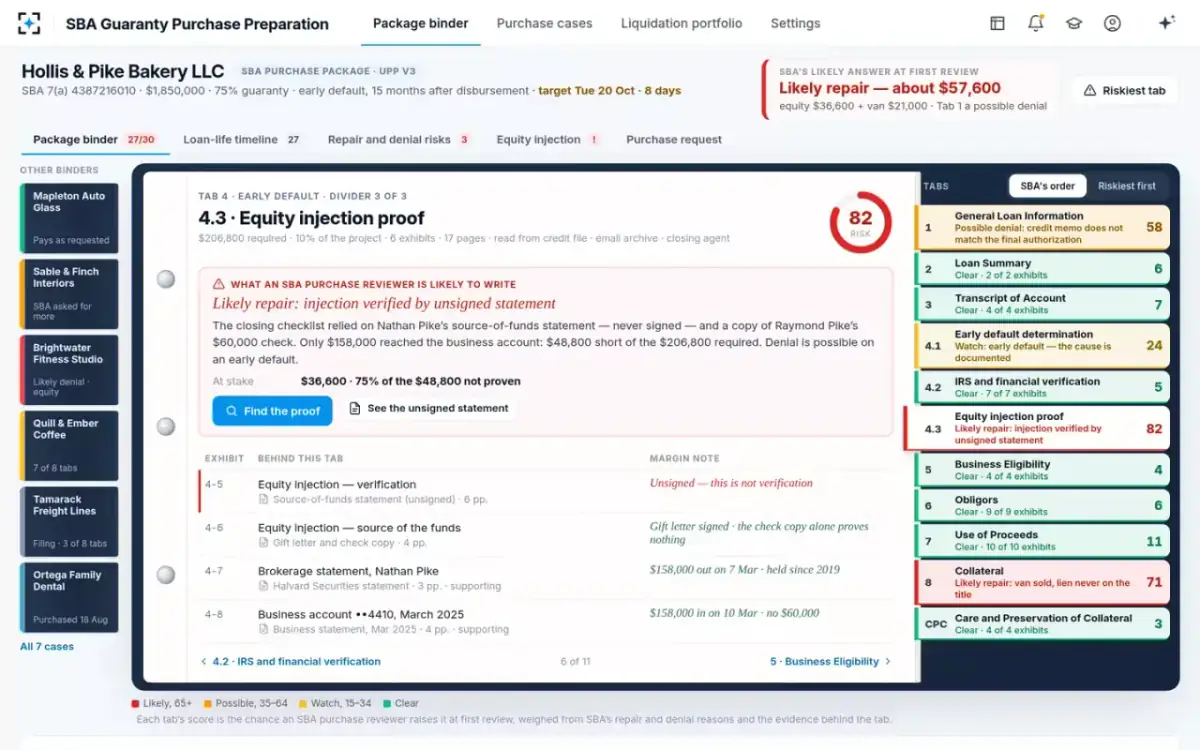
What a scored binder looks like before anyone has fixed anything
Settings to fix before the first run
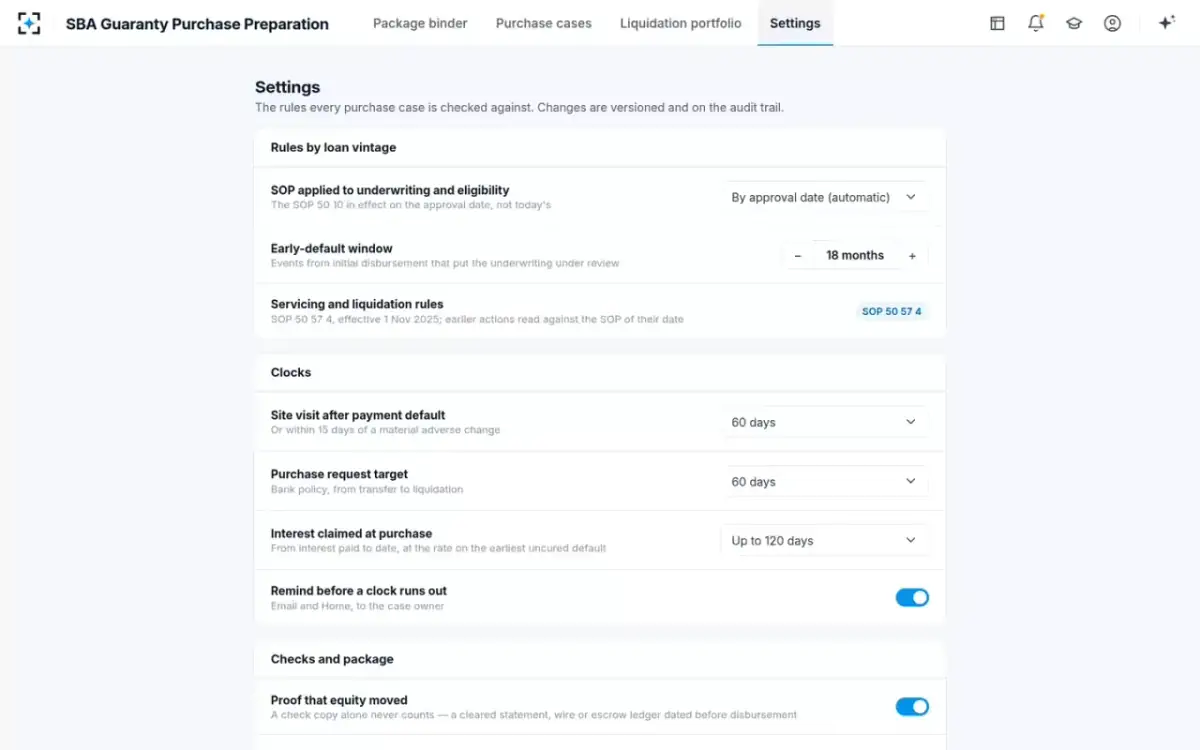
A pilot is only fair if the rules are the bank's and SBA's before the software sees the first loan. In SBA Guaranty Purchase Preparation those are settings, versioned and on the audit trail: the SOP 50 10 applied by approval date, the 18-month early-default window, the site visit clocks after default, the bank's own purchase-request target, the 120-day interest cap, the $10,000 legal-fee line above which SBA must approve a litigation plan, the liquidation officer's repair limit and the officer who signs.
The rules every purchase case is checked against
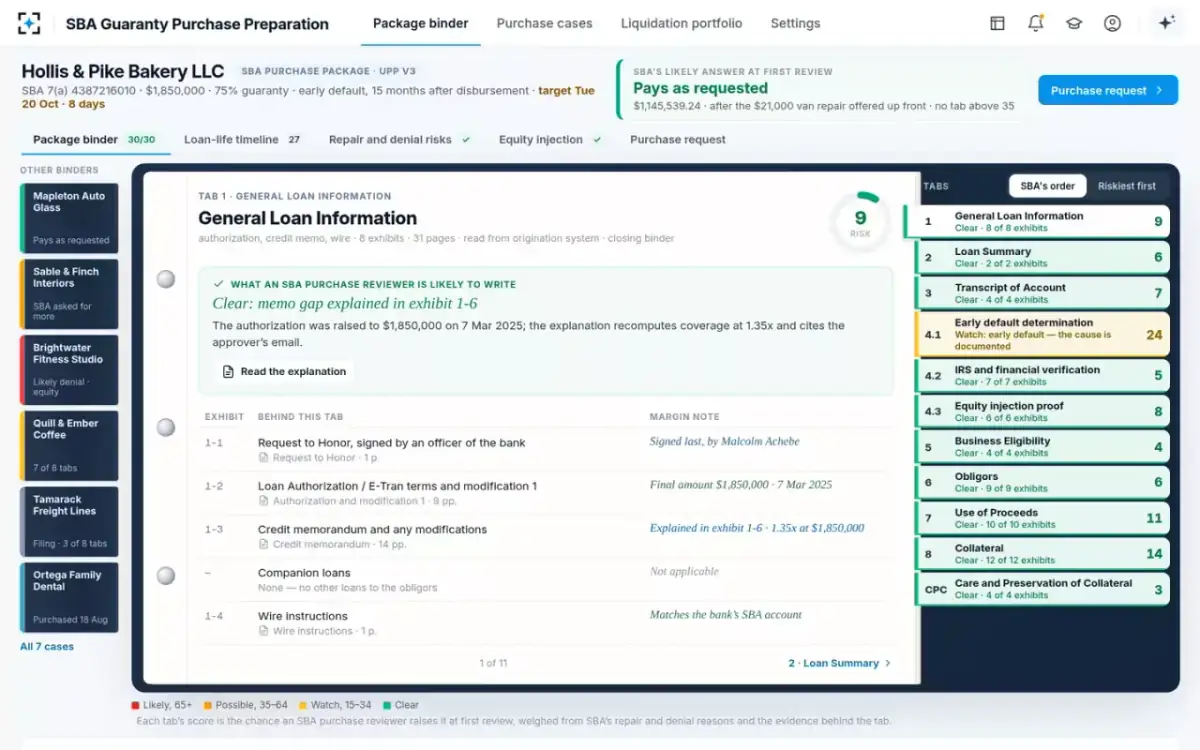
On the sample loan, the same settings turned a binder predicting a repair of about $57,600 into one predicting "pays as requested" at $1,145,539.24, after the agents found the wire and the escrow settlement entry behind the equity injection and the liquidation officer chose a $21,000 voluntary repair on a van sold without the lien noted on its title. That before-and-after is what a pilot should reproduce on the bank's own decided loans.
The same binder after the evidence was found and the repair chosen
What the bank brings to the pilot
Four things, and the pilot is only as good as the weakest. First, read access to the systems where each loan file actually lives: the origination system, the closing binder, the servicing system and transcript, the email archive and whatever collections and counsel produced. A curated folder tests the reading and hides the searching, which is where most missing evidence is found. Second, the decision letters for the five loans, held by someone outside the pilot until the packages are committed. Third, the bank's own rules: its repair limits, its approvers, its purchase-request target. Fourth, a reviewer with an afternoon per loan.
The data request is short. For each loan: the SBA loan number and approval date, which fixes the SOP 50 10 version; the disbursement dates, which fix the early-default window; the transcript from the servicing system; and the location of the collateral and liquidation documents. Everything else the agents find themselves, and what they cannot find is listed by name. That list is itself a result worth having: on a decided loan, it shows which documents the bank would have struggled to produce if SBA had asked.
Keep the pilot inside the bank's existing controls. The agents read; they do not write to the servicing system, file anything with SBA, or contact borrowers. Access can be limited to the five loans' files, and what the agents read and found is on the audit trail of each case.
What a five-loan pilot cannot tell you
Five loans test reading, rules and arithmetic; they cannot measure a rate. A tool that agrees with SBA on five of five may still miss one deficiency in twenty, and a bank that files a handful of purchase requests a year may need a year of live use to know. Read the pilot as a test of whether the software's reasoning can be checked and trusted, then keep measuring: track every package's predicted answer against SBA's actual one.
It also cannot make SBA consistent. The OIG's finding that half the overturned decisions it sampled lacked support means some of the bank's past letters may be wrong in either direction. The point of a cited, tab-by-tab package is to make the right answer obvious to whichever reviewer reads it. We will run SBA Guaranty Purchase Preparation on one of the bank's own loans in liquidation first, then on the decided five, from the solution page. What the days saved are worth is priced in what a late purchase package costs.
Questions people ask
Is there a newer version of the SBA universal purchase package?
SBA revises the package from time to time; the version it publishes openly on its site is effective August 1, 2023, with eight tabs. SOP 50 57 4 tells lenders to follow the instructions of the center that will review the request, so the current version to use is the one the National Guaranty Purchase Center or the Commercial Loan Servicing Center asks for.
Can the universal purchase package be shortened for small loans?
Partly. SBA's published package lets the lender certify Tabs 7 and 8, use of proceeds and collateral liquidation, instead of documenting them in full, if Tab 4 confirms there was no early default and the loan balance on the transcript is $100,000 or less. Every other tab still applies.
How long does a purchase package software pilot take?
About four weeks in the plan above, most of it the bank's time: granting access, holding back the decision letters, and comparing findings tab by tab. The software's own run is minutes per loan; on the fictional sample loan the six agents read 318 documents in 2 minutes 6 seconds.
Which loans should not be in a pilot?
Loans still in SBA review, because there is no final answer to compare with, and loans whose files no longer exist in the bank's current systems, because the test then measures the archive, not the software. PPP loans follow a separate purchase process and do not belong in a 7(a) package pilot.
Who should judge the pilot?
The bank's liquidation officer or SBA servicing manager, who knows what a reviewer asks for, with credit or QC reading the disagreements. Counsel should read any loan where the software and SBA disagreed on a denial, since that is where a package's written explanation does its work.