A lender service provider (LSP) in SBA lending is "an Agent who carries out Lender functions in originating, disbursing, servicing, or liquidating a specific SBA business loan or loan portfolio for compensation from the Lender", and many 7(a) lenders use one to prepare guaranty purchase packages and work loans through liquidation. SBA allows it, under a written agreement SBA reviews, but it does not move the risk: under SOP 50 10 8.1 the lender "itself, not the LSP, bears full responsibility for all aspects of its SBA Loan operation", and if an LSP's package misses a deficiency, the repair or denial falls on the lender's guaranty. That matters because purchase work is done on old files, often years after the people who made the loan have moved on, by whoever is holding the file now. Botminds' SBA Guaranty Purchase Preparation gives a lender, or the provider working for it, six agents that file the loan file behind SBA's tabs and read each tab as SBA's reviewers will, with every decision and signature left to named people at the bank.
The LSP rules are quoted from SOP 50 10 8.1 (effective October 1, 2026), which carries the same text as SOP 50 10 8; purchase rules from SOP 50 57 4.
Why so many lenders outsource purchase work
1,336
lenders approved at least one 7(a) loan in FY2025
711
of them approved five or fewer
50%
of FY2025 7(a) loans came from the ten largest lenders by count
3×
suspected fraud rate on PPP loans involving a service provider, against loans without one
SBA OIG
What is a lender service provider for SBA loans?
It is a specific kind of agent: one paid by the lender to carry out the lender's own functions. SBA "determines whether or not an Agent is an LSP on a loan-by-loan basis", and if an agent meets the definition, "a formal agreement between the Agent and Lender is required and must be reviewed by SBA". The definition comes from 13 CFR 103.1(d), and SOP 50 10 8.1 gives examples that reach further than many lenders expect: agents who "Perform any pre-qualification review", who "Provide to the 7(a) Lender an underwritten application", and "Entities providing technology services to a 7(a) Lender that include underwriting".
The functions an LSP may take on run the length of the loan, from origination to liquidation. Purchase package preparation sits at the far end: gathering the file, putting it in SBA's tab order, computing the request, drafting the loan summary and the explanations, and keeping the liquidation moving. The lender keeps the obligation in 13 CFR 120.410 to have "a continuing ability to evaluate, process, close, disburse, service, liquidate and litigate small business loans".
Is the lender liable for an LSP's errors?
Yes. SOP 50 10 8.1 requires every LSP agreement to state "that the 7(a) Lender bears full responsibility for all aspects of its 7(a) loan operation, including, but not limited to, approvals, closings, disbursements, servicing actions and due diligence. The LSP only provides assistance to the 7(a) Lender." If the LSP has access to SBA's systems, "the 7(a) Lender acknowledges it is responsible for all entries and certifications made into CAFS by the LSP". At purchase, SBA judges the lender's compliance, and a release event under 13 CFR 120.524 costs the lender's guaranty whoever made the mistake.
One rule is harsher still. SOP 50 57 4 lets SBA "deny liability in full on a Loan guaranty if a Lender uses the services of a suspended or debarred Agent to administer the Loan at any time during the life of the Loan, even if the actions of the suspended or debarred Agent did not directly cause the business to fail or result in a loss on the Loan". The same paragraph expects "due diligence and prudent oversight" of LSPs and other agents, including "written policies governing such relationships and monitoring the performance of Loans referred by an Agent or where an Agent provided assistance", and says SBA will review that oversight.
What must an SBA LSP agreement include?
SBA does not supply a form, but it lists what every agreement must contain, and it must be sent to SBA for review before the LSP works under it, and again whenever it changes. The table sets out the terms that matter most for purchase and liquidation work.
The LSP agreement, as SOP 50 10 8.1 requires it
| Term | What the SOP requires | Why it matters on a purchase file |
|---|---|---|
| Services | The contract must specifically identify the services the LSP will perform | Purchase packages and liquidation should be named, not implied. |
| Responsibility | A statement that the lender bears full responsibility; the LSP only assists | The signature on the Request to Honor stays the bank's. |
| Authority | An LSP agreement may not grant the LSP power of attorney to act for the lender | The LSP cannot sign or settle on the bank's behalf. |
| Compensation | Each service priced; fees for services actually performed; packaging, processing or underwriting fees not contingent on approval | Purchase work is paid for the work, not the outcome. |
| Who pays | All compensation paid by the lender; not passed to the applicant or paid from loan proceeds; no share of a secondary-market premium | Fees cannot reappear on the transcript of account. |
| Risk and conflicts | The LSP does not assume risk on the unguaranteed portion; discloses affiliations and prior relationships | An LSP with a stake in the borrower is a conflict SBA must see. |
| Borrower payments | Funds in an account in the lender's name; no commingling across lenders; no netting of fees | Recoveries are SBA's too after purchase and must be traceable. |
| Review and exit | Submitted to SBA for review, resubmitted when changed; termination notice to SBA with the date and the lender's location ID | SBA may audit compliance with any reviewed agreement. |
Can a lender outsource SBA liquidation?
It can outsource the work, not the responsibility, and it has to be able to show it is still in charge. The lender, "not the LSP, must be able to demonstrate that it exercises day-to-day responsibility for evaluating, processing, closing, disbursing, servicing, liquidating, and litigating its SBA portfolio". In practice that means the bank's own liquidation officer knows each file's status and next deadline, approves each servicing and liquidation decision, decides each repair, and has an officer sign each Request to Honor.
The economics explain why outsourcing is common. By our count from SBA's loan file, 711 of the 1,336 lenders that approved a 7(a) loan in FY2025 approved five or fewer. A lender that makes a handful of SBA loans a year may see one default every few years, and cannot keep a specialist who remembers the UPP tabs, the 18-month early-default rules and the 120-day interest cap between them.
The seats around a purchase file, in house and outsourced
Today
Rebuilds a loan she did not make from five systems, one document at a time, while the interest window runs.
With agents
Starts from a binder already in SBA's tab order, riskiest tab first, and spends her time on decisions.
Still theirs: Every repair choice and explanation, up to her limit.
Today
Learns at SBA's first review whether the package earns a repair or a denial.
With agents
Signs knowing the likely answer, with every repair a choice the bank made up front.
Still theirs: The Request to Honor and repairs above the limit.
Today
Receives whatever the bank can find, and returns a package the bank has to trust.
With agents
Works from the same cited binder as the bank, so each finding can be checked in one step.
Still theirs: The work the agreement names, never the signature.
Today
Reads explanations that neither cite a page nor stop.
With agents
Reads each explanation next to the exhibits it cites before the package goes in.
Still theirs: Litigation plans and contested denials.
Does SBA review lender service provider agreements, and what has the Inspector General said?
SBA reviews every one: "All participating 7(a) Lenders must submit each LSP agreement to the LGPC for review", resubmit it after any change, and notify SBA when it ends. SBA "will investigate any complaint" about an LSP's activity or fees and "reserves the right to audit compliance". Its Inspector General wants more. In its FY2026 challenges report the OIG asked SBA to "Enhance the oversight of third-party service providers, including loan agents who lenders place significant reliance on", and noted that "most loan documents and data reside only with the participating lender, which could be problematic if that lender dissolves or ceases to service the loan" (SBA OIG Report 26-01).
The cautionary case is a service provider that worked the far end of the loan. Banc-Serv Partners, an Indianapolis-area lending service provider, helped originate SBA loans for financial institutions from about 2004 to 2017. Its executives were convicted of obtaining guarantees "for loans they knew to be ineligible", including by "unlawfully diverting previously denied loan applications into expedited approval channels at the SBA", and when those loans defaulted they "caused the submission of reimbursement requests to the SBA". Four were sentenced in December 2021, with restitution to SBA of up to $2,289,681 each (FDIC OIG). The scheme shifted most of the losses on those loans to SBA; under today's SOP, the lender whose name is on such a loan answers for its provider's work.
How to oversee a provider that prepares your purchase packages
Oversight of purchase work is mostly checking evidence, which is why a cited package is easier to oversee than a narrative one. The checklist is ours, built from the SOP's requirements; it applies whether the provider is a firm, a contractor, or a tool.
Oversight of an outsourced purchase desk, file by file
- The agreement names purchase and liquidation work, and SBA has reviewed it
and the current version is the one SBA saw.
- The provider and its people are checked against SAM.gov
a suspended or debarred agent at any point can cost the full guaranty.
- The bank holds the whole loan file
not just the package; the OIG warns that loan documents left with one party are a risk.
- Every finding in the package cites its document and page
so the liquidation officer can verify, not just read.
- Repairs and explanations are approved by a named bank officer
and the provider cannot offer one on the bank's behalf.
- No provider fee appears on the transcript or in recoveries
LSP compensation is paid by the lender.
- Deadlines are tracked by the bank
60-day filing threshold, 180 days after maturity, 24 months after purchase, 30 days for the wrap-up.
- Repair and denial outcomes are measured by provider
the performance monitoring SOP 50 57 4 expects of agent relationships.
Where agents fit: in house, outsourced, or both
Software does not change who answers to SBA; it changes how much of the reading a person has to do and how easily the answer can be checked. A lender can run SBA Guaranty Purchase Preparation with its own small desk instead of outsourcing, or give its provider the same binder so both work from one cited file.
Three ways to staff the purchase package
Outsourced to an LSP: The provider's analysts, from what the bank sends them.
In house, with the agents: Six agents read every source the bank connects; the liquidation officer reads their findings.
Outsourced to an LSP: As good as the provider's process; the bank sees the result.
In house, with the agents: Each finding cited to document and page in the bank's own systems.
Outsourced to an LSP: Proposed by the provider, approved by the bank.
In house, with the agents: Proposed by the agents, made by named bank staff within set limits.
Outsourced to an LSP: An LSP agreement reviewed by SBA; provider checked against SAM.gov.
In house, with the agents: Software the bank runs. Whether a given arrangement needs an LSP agreement is a question for counsel, since SBA counts technology services that include underwriting.
Outsourced to an LSP: Scales with the provider's staff and fees.
In house, with the agents: The reading scales; the bank's decision time is what remains.
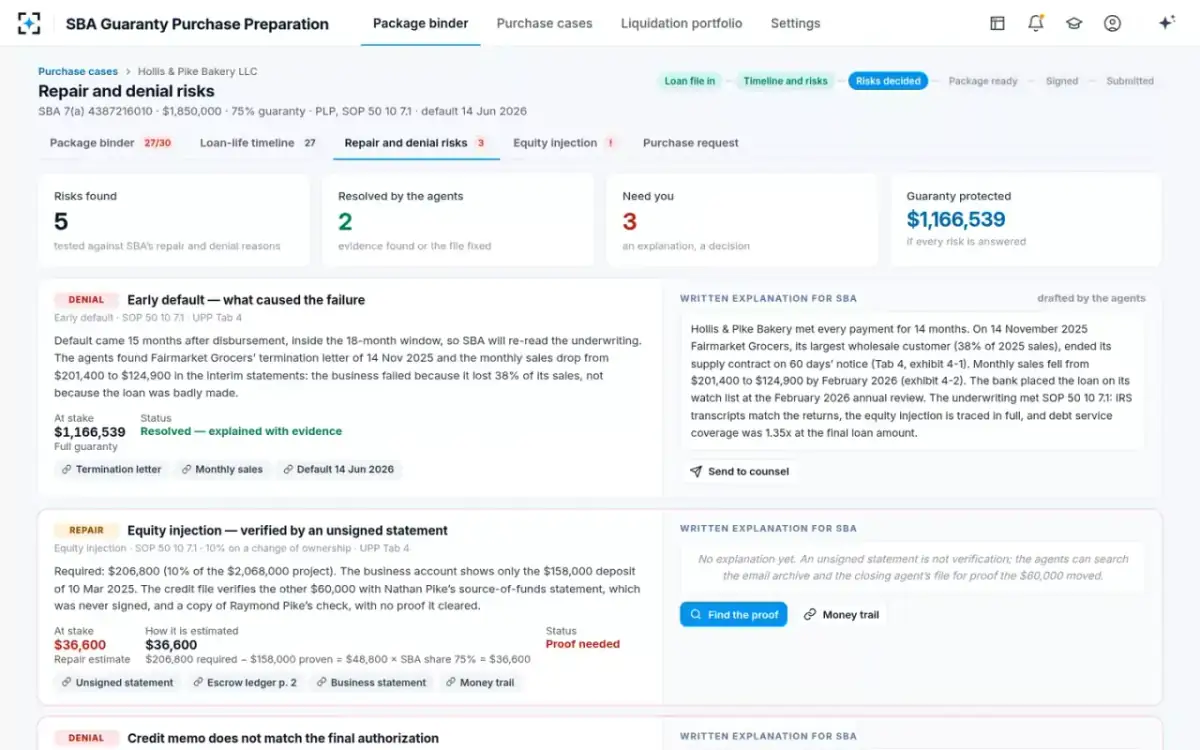
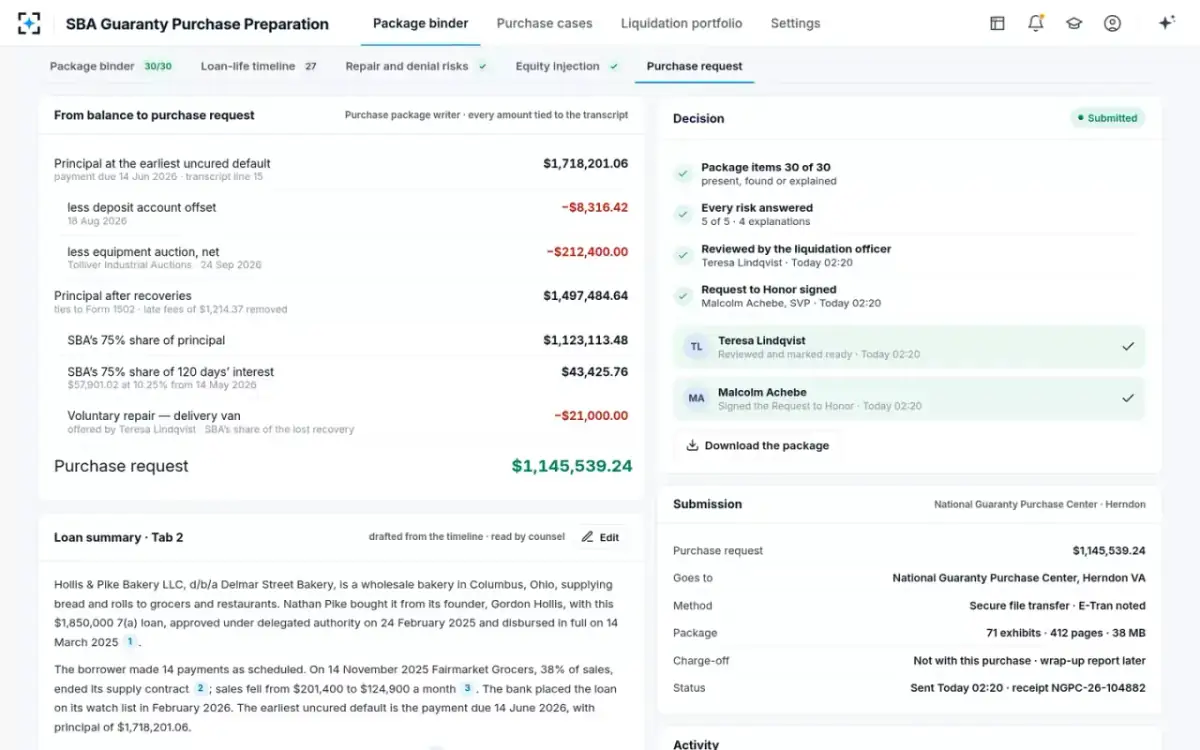
Take a fictional sample loan as it runs through the solution: Hollis & Pike Bakery, a $1,850,000 7(a) loan in early default, made by staff who had since moved on. The agents read 318 documents from five systems in 2 minutes 6 seconds and raised five risks; the liquidation officer resolved them with evidence, one explanation and a $21,000 voluntary repair, and the SVP signed. The people and figures are invented; the division of labor is the point.
Every risk with its rule and the explanation, for whoever holds the file
The bank signs, whoever prepared the package
What goes in the package is set out in the SBA guaranty purchase checklist, and how to test any provider or tool on decided loans is in the five-loan pilot. To see the binder on one of your own files, start from SBA Guaranty Purchase Preparation.
Questions people ask
Who prepares SBA purchase packages?
The lender, through its liquidation or special assets staff, or a lender service provider working under an SBA-reviewed agreement. Either way, SBA's package requires a Request to Honor signed by an officer of the lending institution, and the lender answers for its contents.
Does an LSP need to file SBA Form 159?
Not for services performed for the lender under an SBA-reviewed agreement. SOP 50 10 8.1 says those services "are not reported on SBA Form 159", because SBA reviews the agreement itself. Agents paid by the applicant, such as packagers or brokers, are disclosed on Form 159.
Can an LSP sign the Request to Honor?
No. SOP 50 10 8.1 says an LSP agreement "may not grant the LSP power of attorney to act on behalf of the 7(a) Lender", and SBA's purchase package calls for the request to be signed by an officer of the lending institution.
Is purchase package software a lender service provider?
It depends on the arrangement, and counsel should decide. SBA determines LSP status loan by loan, and SOP 50 10 8.1 names "Entities providing technology services to a 7(a) Lender that include underwriting" as an example. Software the lender's own staff run to prepare packages is a different arrangement from a provider that performs the lender's functions.
What happens to the guaranty if the LSP is later debarred?
SBA may deny it in full. SOP 50 57 4 allows a full denial if the lender used a suspended or debarred agent to administer the loan "at any time during the life of the Loan", even without a causal link to the loss, which is why SAM.gov checks belong in ongoing oversight, not just onboarding.