An SBA guaranty purchase package is the set of documents a 7(a) lender submits to ask SBA to honor its guaranty on a defaulted loan, and a late one costs money from the day the interest window closes: SBA pays "up to a maximum of 120 calendar days of accrued interest" on its guaranteed share, so interest that accrues after that is not reimbursed, and on a loan sold to a secondary-market investor SBA bills the lender for any investor interest beyond 120 days. The slower costs are bigger still: a guaranty exposed to repair or denial for years, and a release from liability if the request comes more than 180 days after maturity. Botminds' SBA Guaranty Purchase Preparation builds the package from the loan file with six agents that file and read every tab the way SBA's reviewers do, so the days a lender spends are spent deciding, not searching.
The rules on this page are quoted from SOP 50 57 4 (effective November 1, 2025) and 13 CFR Part 120. The review times come from SBA's Inspector General. The dollar estimates are our arithmetic on a fictional sample loan and say so where they appear.
Four clocks run on every defaulted 7(a) loan
120days
of accrued interest SBA pays at most on its guaranteed share
SOP 50 57 4, Ch. 24 B.2
808days
average to a final decision on 545 files sent for repair or denial review
SBA OIG 26-12
6years
statute of limitations that cost SBA repair or denial on 13 loans
$5.4 million
180days
after maturity, or after liquidation of a matured loan, before the guaranty is released
13 CFR 120.524(a)(8)
What is in an SBA guaranty purchase package, and when does its clock start?
The package is SBA's Universal Purchase Package: a signed Request to Honor, a certified transcript of account, and the evidence behind eight tabs that the lender made, closed, serviced and liquidated the loan by the rules. The full list is in the SBA guaranty purchase checklist. For the economics, one date matters more than any document: the earliest uncured payment default.
That date fixes two things at once. It sets the interest rate SBA pays on a variable-rate loan, "the rate in effect on the earliest uncured payment Default date", and it starts the run toward the earliest moment a lender may file, more than 60 days later. The 120 days of interest are counted from the date interest was last paid, which on a loan that stopped paying is usually a month before the default date. A lender that spends the first four months after default liquidating equipment and chasing documents has used the whole interest window before the package leaves the building.
How much interest does SBA pay at guaranty purchase?
For 7(a) loans approved on or after May 14, 2007, SBA pays at most 120 calendar days of accrued interest on the guaranteed portion, at the note rate on a fixed-rate loan or, on a variable-rate loan, at the rate on the earliest uncured payment default date. SBA Express and Export Express loans are capped at the maximum rate allowed for standard 7(a) loans when the application was received. Loans approved before May 14, 2007 follow the regulations in force on May 13, 2007.
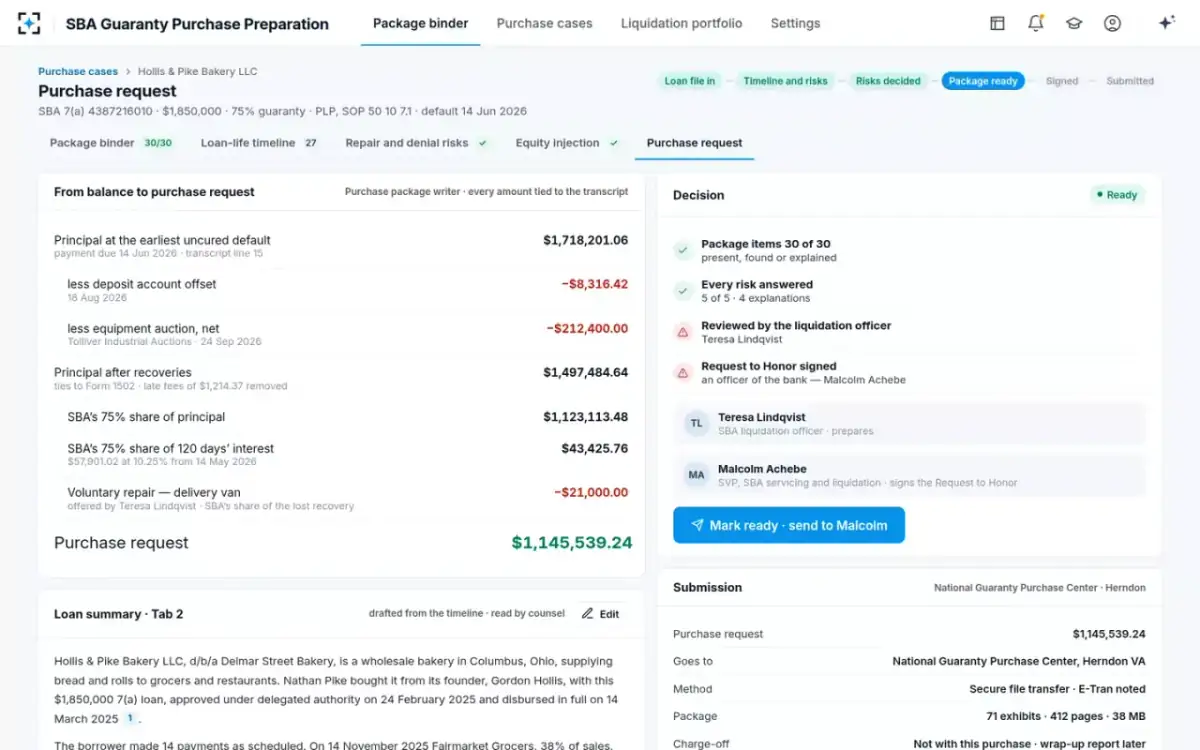
Take a fictional sample loan as it runs through SBA Guaranty Purchase Preparation: Hollis & Pike Bakery, a $1,850,000 7(a) loan at 10.25% with a 75% guaranty, whose earliest uncured default is the payment due June 14, 2026, with interest paid to May 14. Principal at default was $1,718,201.06. The solution computes 120 days of interest at $57,901.02, of which SBA's 75% share is $43,425.76, and adds it to the purchase request. Interest that accrues on the guaranteed share after those 120 days is not in anyone's request. The lender carries it.
What waiting costs on the sample loan, once the 120-day window has closed
Put plainly, on a loan of this size every month of delay past the window costs about $11,000 of interest the guaranty would otherwise have covered. On a smaller loan the daily figure shrinks, but the shape does not: the cost is flat at zero for 120 days and then rises in a straight line until purchase.
Who pays investor interest after 120 days on a sold SBA loan?
The lender does. When the guaranteed portion has been sold on the secondary market, "the Lender or SBA must pay the full amount of accrued interest owed to secondary market investors up to the date of purchase", and "if SBA is required to pay a secondary market holder more than 120 calendar days of accrued interest, SBA will bill the Lender to reimburse SBA for the difference", unless SBA grants an exception "in its sole discretion" (SOP 50 57 4, Ch. 24 B.3).
A sold loan also adds a hard deadline. If the lender does not request purchase in time, the fiscal transfer agent will ask the lender or SBA to buy the guaranteed portion from the investor on the investor's behalf. Once SBA has bought it, the lender has 45 calendar days to deliver a complete package. And SBA's enforcement procedure names this exact failure: civil money penalties may be used "for failure to timely submit complete purchase packages following SBA Secondary Market purchase" (SOP 50 53 (2)). The regulation now caps a penalty at $306,652, adjusted for inflation over time (13 CFR 120.1500).
What a late purchase package costs, term by term
Unpaid interest
guaranteed principal × rate × days past the 120-day window ÷ 365
Lost on a held loan; billed back on a sold one
Liquidation, finance
Service fee
retained to the purchase date unless a wrap-up report goes with the request
Capped at 120 days when an acceptable wrap-up report is filed with it
Finance
Carrying costs
insurance, storage, security and taxes on collateral not yet sold
Shared by SBA only where they qualify as recoverable expenses
Special assets
Exposure
guaranty × chance of repair or denial × years the file stays open
SBA may recover sums paid "at any time"
Credit, counsel
The service fee is the small line. Under 13 CFR 120.220(f) it cannot exceed 0.55% a year of the guaranteed balance, and SBA deducts it from the purchase amount: for at most 120 days if "a Wrap-up Report acceptable to SBA" goes in with the request, and through the date of purchase if it does not. On the sample loan that is roughly $19 a day. It is still worth knowing, because it is the one cost a lender can cut by finishing liquidation before it files.
How long does SBA guaranty purchase take?
SBA does not publish a standard turnaround for a clean purchase, and the honest answer is that the lender controls the first half of the clock and SBA the second. What SBA's Inspector General has measured is the slow path: files where a purchase center recommended a repair or denial, the lender disagreed, and SBA's Portfolio Management and Quality Control team made the final decision. For the 545 such decisions made from October 2021 to March 2025, "SBA took approximately 808 days on average" (SBA OIG Report 26-12).
The average hides a split. Files that entered that review before October 1, 2021 took 1,156 days on average; files that entered after took 362. The OIG traced the delay to two steps: SBA "did not initiate a repair or denial review for 352 days, on average", and legal opinions requested during the review "took 305 days, on average, to complete". The team's own goal was a year.
Five of the 13 loans SBA could no longer repair or deny: where the years went
- Lender and center1,787 days
- Final review5,807 days
- Lender and center3,078 days
- Final review4,424 days
- Lender and center5,264 days
- Final review1,555 days
- Lender and center1,596 days
- Final review3,654 days
- Lender and center1,511 days
- Final review2,563 days
What is the statute of limitations on SBA guaranty recovery?
Six years for a lawsuit, under 28 U.S.C. 2415, which the Inspector General cites; but the limit does not end SBA's right to collect. In 26-12 the OIG found SBA "did not seek repair or denial for 13 loans, totaling about $5.4 million, because the statute of limitations expired", and that SBA had not used administrative offset, the withholding of other federal payments due to the lender, which the statute does not bar. SBA agreed to build a process for it.
For a lender this cuts both ways, and neither way is comfortable. A slow review is not a safe harbor: 13 CFR 120.524(b) entitles SBA to recover "any moneys paid on the guarantee plus interest from the Lender" if it finds a release event "at any time", by "all legal means available, including offset". And every year a file stays open is a year the people who made, closed and serviced the loan drift further from it. The sooner a complete, well-argued package is in, the sooner the question is closed while the evidence is still at hand.
Where the days go inside the bank
Most of the lender's share of the clock is spent finding things. The loan file for one 7(a) loan typically lives in several places: the origination system, the closing binder, the servicing system, email, and whatever collections and counsel produced after default. Assembling it in SBA's order, re-checking the items SBA reads hardest on an early default, following each piece of collateral and writing the explanations is days of skilled work before anyone decides anything.
Where an early-default package's working days go, by hand and with the agents
| Step | By hand | With the solution | What changes |
|---|---|---|---|
| Pull the loan file from five systems | 3 days | half a day | The agents read every source at once; people confirm access and gaps. |
| Put every document in SBA's tab order | 3 days | a quarter day | Each document is identified, dated and filed behind its tab with its source and page. |
| Re-check equity, IRS transcripts and the credit memo | 4 days | half a day | Equity is traced to its source; transcripts compared with returns; memo checked against the final authorization. |
| Follow collateral, liens and recoveries | 3 days | a quarter day | Every collateral item followed from the approval list to its disposition. |
| Work out the amount and write explanations | 2 days | a quarter day | Amount computed from the transcript; explanations drafted for a person to approve. |
| Officer review and signature | 1 day | a quarter day | The decision stays with the bank; the reading does not. |
On the sample loan, the agents read 318 documents and 2,140 pages from five systems in 2 minutes 6 seconds and filed 69 exhibits behind SBA's tabs. The days that remained were people's: the liquidation officer deciding whether to offer a $21,000 voluntary repair on a van sold without the bank's lien noted on its title, approving a written explanation for a credit memo that never caught up with the final authorization, and the SVP signing.
From the balance at default to the purchase request, line by line
Can SBA impose penalties for late purchase packages?
Yes, in two ways. Directly, SBA's supervision procedure names late packages after a secondary-market purchase as a reason for civil money penalties, and SOP 50 57 4 lets SBA refer a lender that misses the 24-month prudent liquidation deadline after purchase to its Office of Credit Risk Management for possible enforcement, which can mean losing access to the secondary market or delegated authority, and require it to repurchase SBA's share.
Indirectly, performance counts. Under 13 CFR 120.410, SBA weighs a lender's risk rating and its history of defaults, purchases and losses when it decides whether a lender keeps participating. A desk that files slowly and gets repaired often is building a history SBA reads. What happens after purchase, from the wrap-up report to the 24-month deadline, is set out in the SBA wrap-up report guide.
Pricing the business case
A business case for faster packages rests on three numbers a lender already has: how many 7(a) loans it sends for purchase in a year, how many days after default its packages usually go in, and how often its packages come back with a repair. The first two give the interest lost past the window; the third, multiplied by the average repair, gives the cost of incomplete files. SBA's FY2025 payment integrity testing gives a sense of scale: 7(a) guaranty purchase outlays of $2,115.5 million, and an estimated improper payment rate of 1.07% after 5.34% the year before (SBA Agency Financial Report FY2025). Each of those improper payments is a file SBA should have repaired or denied and did not; each one found later is a recovery from a lender.
The fourth number is harder to price and matters most: how many files are still open years after purchase, with the guaranty exposed and the people who knew the loan gone. A desk that tracks every clock, not just the next one, sees those files before SBA does.
Every SBA loan in liquidation, with the next clock for each
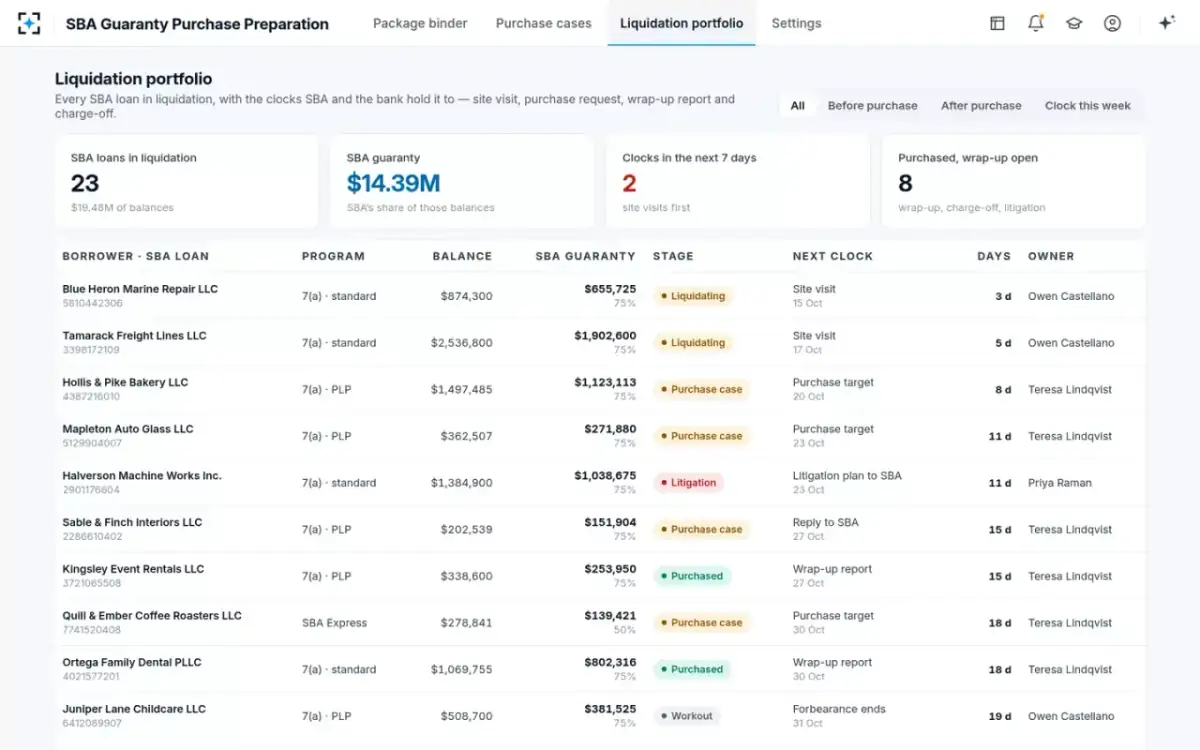
Which loans in a portfolio are most likely to end up in this queue is the subject of SBA 7a default rates. To see the clocks and the package on your own files, start from SBA Guaranty Purchase Preparation.
Questions people ask
Does SBA pay interest for the time it takes to review a purchase request?
Not beyond the cap. For loans approved on or after May 14, 2007, SBA pays at most 120 calendar days of accrued interest on its guaranteed share, however long the review takes. SBA's older guaranty purchase web page still describes a rule under which all interest was paid if the package arrived within 120 days of default; that text predates SOP 50 57 4, which governs today.
Does a borrower's partial payment change the interest SBA pays?
Before the request, a payment that covers an installment in full moves the earliest uncured default date forward, and with it the interest calculation. After the request it does not: under 13 CFR 120.523 the date is fixed and later payments go to principal.
What happens if a lender misses the 180-day deadline after maturity?
SBA is released from its guaranty. 13 CFR 120.524(a)(8) lists failure to request purchase within 180 days after maturity as a release event, or, for a matured loan still in liquidation or collection litigation, within 180 days after that work is complete. There is no cure in the rule.
Can a lender withdraw a purchase request and file later?
SOP 50 57 4 expects it in one case: if "a significant, but not yet quantified loss appears likely", the lender "should withdraw its guaranty purchase request and resubmit it when the Lender has completed its liquidation process", unless SBA has already bought the loan from an investor. Withdrawing costs time against the interest window, so it is a choice to make early.
Can SBA recover a guaranty it has already paid?
Yes. Under 13 CFR 120.524(b), if SBA finds "at any time" that a release event occurred, it may recover what it paid plus interest from the lender, including by offset. The Inspector General has asked SBA to use administrative offset where the six-year statute of limitations has run on a lawsuit.