An SBA 10 tab checklist is the list many 7(a) lenders use to assemble a guaranty purchase package, but the package SBA itself publishes, the Universal Purchase Package effective August 1, 2023, has eight numbered tabs: general loan information, loan summary, transcript of account, early default, business eligibility, obligors, use of proceeds, and collateral liquidation. The extra items on a ten-item list are usually pieces SBA keeps inside a tab, most often the credit memo, equity injection and IRS verification that sit under Tab 4, or documents that go to SBA separately, such as a litigation plan. The count does not matter; the order and the evidence do, because SBA asks lenders to present "each document in the order outlined". Botminds' SBA Guaranty Purchase Preparation files every document of a loan file behind SBA's own tabs and scores each tab the way a purchase reviewer will.
The phrase "10 tab" does not appear in SOP 50 57 4 or in the package SBA publishes; this guide treats it as lender shorthand and works from SBA's text. SOP 50 57 4 tells lenders to follow the instructions of the center that will review the package, so check the version that center requires today.
The package in four numbers
8tabs
numbered in SBA's published Universal Purchase Package
3
early-default items inside Tab 4: credit memo, equity injection, IRS verification
$100K
balance at or under which Tabs 7 and 8 may be certified, if there was no early default
30,000hours
a year SBA estimates lenders spend on the Form 1149 transcript alone
What is the SBA 10 tab checklist?
It is a lender's working list, not an SBA form. Lenders count tabs differently: some split Tab 4 into its parts, some add a tab for the care and preservation of collateral expenses, some count the wrap-up report or the litigation plan. SBA's published index is the reference that matters, because reviewers read in its order, and the purchase center lists "There are no tabs or the package is not organized in order of the checklist or authorization" first among the common errors it sees (SBA, Guaranty Purchase Process).
The practical test for any internal checklist is whether every item on it has a home in SBA's index, and whether every item in SBA's index appears on it. The comparison below does that for the items a ten-item list most often carries.
Where the items on a ten-item list live in SBA's package
If your checklist counts it on its own: A cover tab with the signed request and wire instructions.
Where SBA's published package puts it: Tab 1, General Loan Information, with the authorization, modifications and companion loans.
If your checklist counts it on its own: A tab for underwriting.
Where SBA's published package puts it: Tab 4, Early Default, when the default is early and the loan was delegated.
If your checklist counts it on its own: A tab for the injection proof.
Where SBA's published package puts it: Tab 4, Early Default, under "Equity Injection".
If your checklist counts it on its own: A tab for 4506-C results and transcripts.
Where SBA's published package puts it: Tab 4, Early Default, under "IRS Income Tax Verification".
If your checklist counts it on its own: A tab for expenses claimed.
Where SBA's published package puts it: Tab 3, Transcript of Account, which lists "CPC Tabs" with the change in terms summary.
If your checklist counts it on its own: A closing tab.
Where SBA's published package puts it: Tab 7, Use of Proceeds, where each disbursement is tied to its purpose.
If your checklist counts it on its own: A servicing tab.
Where SBA's published package puts it: Tab 8, Collateral Liquidation, under "Site Visit".
If your checklist counts it on its own: A legal tab.
Where SBA's published package puts it: Not a package tab: SBA approves non-routine litigation plans separately, before the litigation.
How many tabs are in the SBA purchase package?
Eight in the version SBA publishes, each with named sub-sections. The table annotates them: what goes behind each tab, the question a reviewer is answering there, and the gap that most often turns into a repair or denial. Sub-section names are SBA's; the annotations are drawn from SOP 50 57 4, Chapters 24 and 25.
The eight tabs, annotated
| Tab | Behind it (SBA's index) | The reviewer's question | The usual gap |
|---|---|---|---|
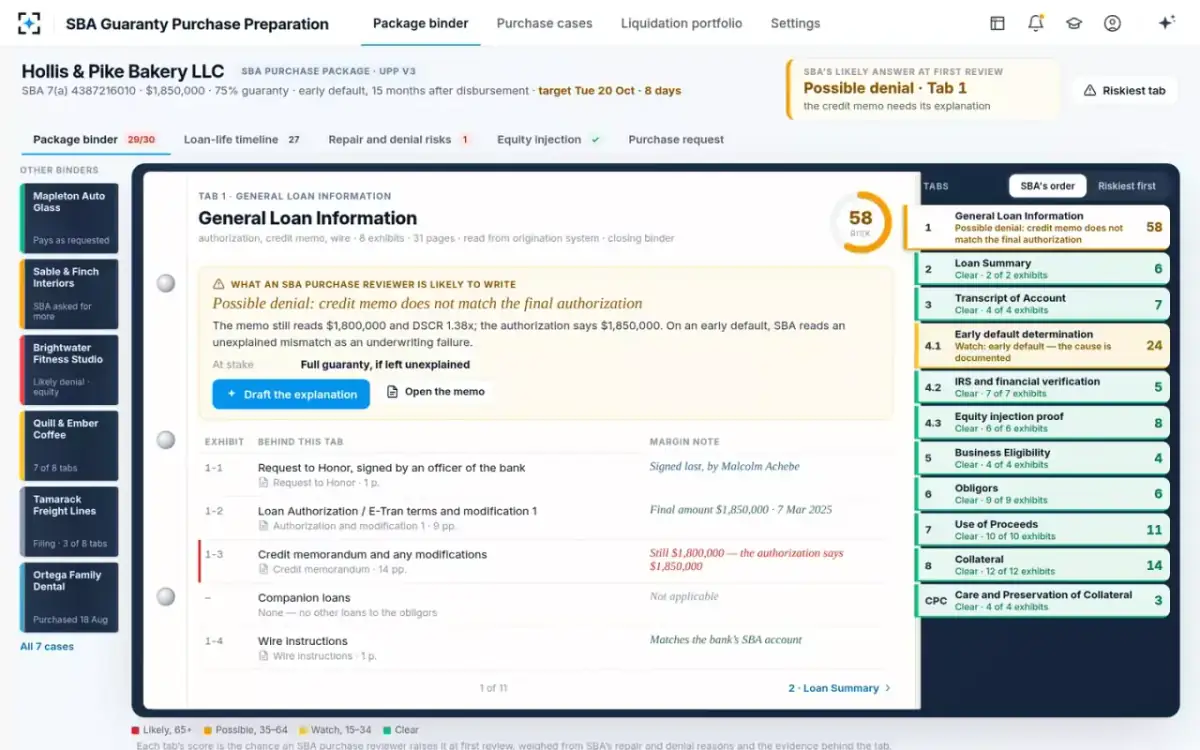
| 1 · General Loan Information | Loan authorization or E-Tran approval; companion loans; wire instructions; the signed Request to Honor | Is this the loan SBA guaranteed, on these terms, and is the request properly made? | A modification never entered in E-Tran; a credit memo at an amount the loan no longer has |
| 2 · Loan Summary | The narrative; the SBA assignment form | What happened, in order, and where is the evidence? | A summary that asserts a cause of failure without citing it |
| 3 · Transcript of Account | Certified transcript; change in terms summary; care and preservation of collateral items | When did default occur, and does every dollar tie out? | Lender fees left on the transcript; an unsigned transcript; the wrong default date |
| 4 · Early Default | The determination and dates; credit memorandum; equity injection; IRS income tax verification | Did the business fail because of how the loan was made? | A gift letter or check copy offered as equity proof; transcripts never compared |
| 5 · Business Eligibility | Affiliation analysis; guaranty application and addenda | Was the business eligible when the loan was approved? | No support for the affiliation or size analysis |
| 6 · Obligors | Business and individual borrowers and guarantors | Was every obligor pursued, and what came back? | A guarantor never sent a demand, or released without consent |
| 7 · Use of Proceeds | By category: equipment, inventory, working capital, leasehold improvements, real estate, refinance, change of ownership, other | Did the money go where the authorization said? | Disbursements without invoices or payee proof; refinance rules not met |
| 8 · Collateral Liquidation | Collateral list; site visit; real estate; business personal property; equipment; life insurance; other | Was every item found, protected and sold for what it was worth? | An item on the approval list missing from the post-default list |
What is in Tab 4, early default?
Tab 4 opens with a determination the lender must make and sign off: the dates of initial and final disbursement, the date of default, which of the four early-default events occurred within 18 months, and whether a cure followed by 12 months of payments takes the loan out, "30 months" in all, as the package puts it. Then comes the question: "Based on the information above, is this an Early Default?"
If yes, the tab fills. For a loan the lender underwrote under delegated authority, the package asks for "the Lender credit memorandum and any/all documentation used and/or relied upon to justify loan approval", and IRS tax transcripts for "the last 3 years in operation; if start-up, all years of operation" where business financials were used or the loan financed a change of ownership. If an equity injection or standby agreement was required, its proof goes here too. That is where the burden shifts against the lender, as the SBA early default definition explains.
Tab 1 read like a reviewer: the memo that never caught up
When can Tabs 7 and 8 be shortened?
When Tab 4 confirms there was not an early default and the loan balance on the transcript is $100,000 or less. On Tab 7 the lender can then check a box certifying "that loan proceeds were disbursed in accordance with the loan approval and applicable loan program requirements"; on Tab 8, that "liquidation is complete and all avenues of collection have been completed". Above $100,000, or on any early default, both tabs are documented in full. Tab 8 does not apply at all to unsecured loans.
The certification is the lender's word, and SBA can still look behind it. Under 13 CFR 120.524(b) SBA may recover a purchase "at any time" if it later finds a release event, so a shortened tab should rest on a file that would support the long form.
What is SBA Form 1149, and what must a transcript of account show?
SBA Form 1149 is the Lender's Transcript of Account, the certified history of every disbursement and payment that SBA uses "to determine date of loan default and whether Lender disbursed and serviced the loan according to Loan Guaranty agreement" (Federal Register 2024-11642). Its use "is not mandatory but is recommended in order to expedite the purchase process", SOP 50 57 4 says. In 2024 SBA renamed its "DEFERMENT" column "TYPE OF PAYMENT", because the old form did not tell reviewers enough about what each payment was.
What every transcript of account must show, in SBA's words
- SBA loan name and 10-digit loan number
- Method used for interest computation
360 day or 365 day.
- Date and amount of each disbursement
- Date and amount of each payment
showing principal and interest applications.
- Date to which interest is paid
which should be the same date payment was received.
- Interest rate changes
for variable-rate loans.
- Next payment due date
the "default date", at which point the interest rate becomes fixed.
- The lender's successful bid at foreclosure, if any
shown as a credit to principal.
- No lender fees
SOP 50 57 4: lenders "must not add their Loan fees to the transcript of account".
On the fictional sample loan the solution found $1,214.37 of late fees on the servicing system's transcript and removed them, so that principal after recoveries, $1,497,484.64, tied to the last Form 1502. A fee left on the transcript is a small error that tells the reviewer the lender did not check its own numbers.
Which tabs decide most purchase outcomes?
Tabs 4 and 8, on the evidence SBA publishes. The purchase center's list of top reasons for repair and denial sorts almost entirely into those two: on early defaults, "Missing or unsupported verification of required equity injection" and missing IRS verification, which can mean denial; and in liquidation, failure to obtain or perfect liens, a site visit that came too late, and collateral not safeguarded, which generally mean a repair (SBA, Guaranty Purchase Process). Tab 7 follows close behind, through proceeds disbursed outside the authorization.
That ranking tells a desk where to spend its last day before filing. A package can carry a thin loan summary and survive; it rarely survives an equity trail that ends at a gift letter, or a collateral list with an item that simply disappears between approval and auction. The tabs that are mostly forms, 1, 5 and 6, fail on mismatches instead: an authorization that was modified but never updated in E-Tran, an affiliation analysis without its support, a guarantor nobody pursued.
How a loan file gets filed behind the tabs
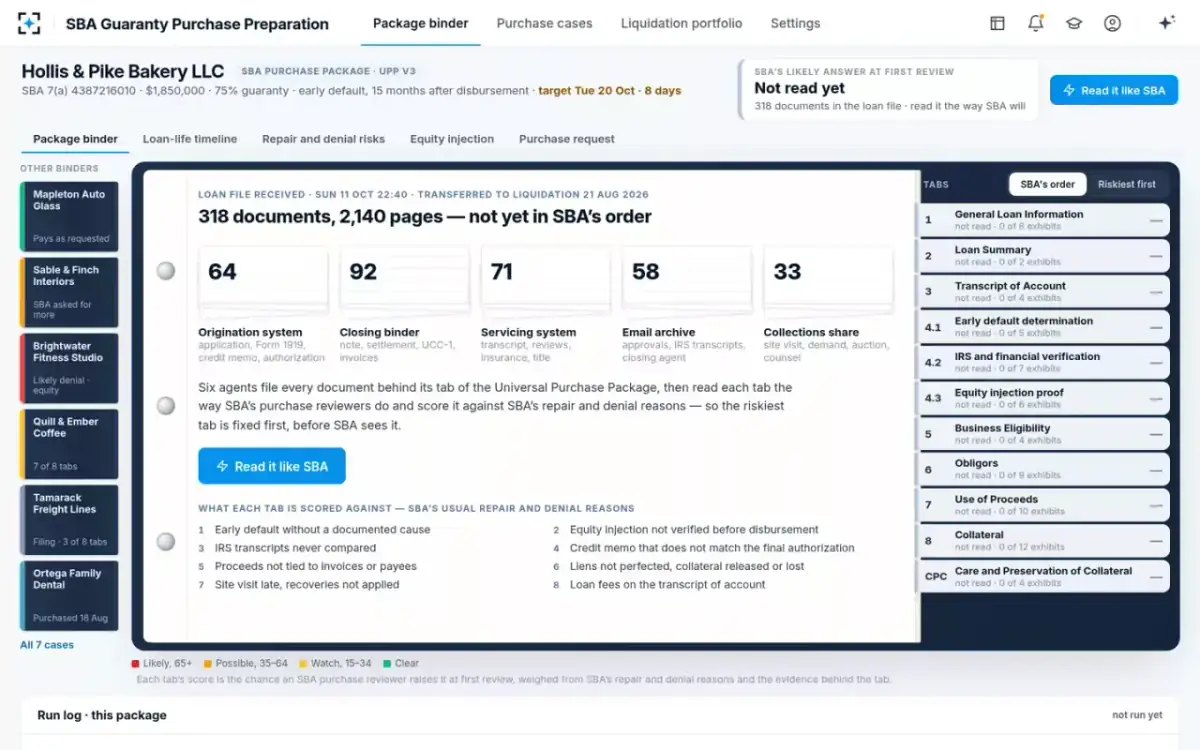
The hard part of a tab checklist is not the list; it is that the documents for one tab sit in four places. On the fictional sample loan, Hollis & Pike Bakery's $1,850,000 7(a) loan, the file arrived as 318 documents from the origination system, the closing binder, the servicing system, an email archive and the collections share. SBA Guaranty Purchase Preparation's loan file reader identified each document's type, date, parties and amounts and filed 69 exhibits behind SBA's eight tabs, with a ninth divider for care and preservation of collateral items, in about 41 seconds. The equity injection proof that resolved Tab 4 was in the email archive, not the credit file.
Before filing: the eight tabs empty, the file in five piles
A list is only as good as what is behind it, and what SBA does when a tab falls short is the subject of what an SBA repair is. The full sequence, from the 60-day test to the officer's signature, is in the SBA guaranty purchase checklist. To see your own loan filed behind SBA's tabs, start from SBA Guaranty Purchase Preparation.
Questions people ask
Does SBA require exactly ten tabs?
No. The package SBA publishes is organized in eight numbered tabs, and SOP 50 57 4 tells lenders to follow the instructions of the center that will review the request. What SBA asks for is that every document is labeled and placed behind the right tab, in order; it lists an unorganized package as a common error.
Is a litigation plan part of the purchase package?
No. Under 13 CFR 120.540, a lender needs SBA's prior approval of a litigation plan before non-routine litigation, including any case where legal fees are estimated to exceed $10,000. SBA's purchase center takes litigation plan tabs by email, separately from the purchase package.
Where do the care and preservation of collateral costs go?
SBA's published index lists "CPC Tabs" under Tab 3, the transcript of account, alongside the change in terms summary. SBA's FY2025 payment integrity testing named improper payment of expenses for the care and preservation of collateral among the main reasons for improper 7(a) purchase payments, so each claimed cost needs its invoice and its reason.
Does the wrap-up report go in the purchase package?
It can. SOP 50 57 4 lets a lender submit an acceptable wrap-up report with the purchase request, and if it does, SBA retains the annual service fee for at most 120 days instead of through the purchase date. Otherwise the wrap-up report follows within 30 days of finishing liquidation.
Do SBA Express loans use the same tabs?
SBA Express, Export Express and Community Advantage loans not sold on the secondary market go to the Commercial Loan Servicing Center, which SOP 50 57 4 says uses its own "Universal Purchase Package Tab System" from the center's website. The evidence rules are the same; check that center's current tab instructions.