A retail communication, under FINRA Rule 2210, is any written or electronic communication a broker-dealer distributes or makes available to more than 25 retail investors within any 30 calendar days. The same message sent to 25 or fewer retail investors in that window is correspondence, and one that goes only to institutional investors is an institutional communication. The category decides who must review the message, whether it must be approved before use, and whether it is filed with FINRA; the content standards apply to all three. An approval also ages, and marketing materials review shows how an approved document can still carry a stale number. For a sales rep or wholesaler, the catch is that the category belongs to the audience, not the text, so the same answer can move between categories when it is forwarded. Botminds' Sales Enablement AI reads each client's category and country before it answers, and tells the rep whether the answer may be shared with that client.
The examples draw on the solution's sample data, a fictional fund manager, Quillfield Capital, and its fictional reps and clients; the rule text is quoted from FINRA's rulebook.
Three categories, one decision: how FINRA Rule 2210 sorts a rep's written message
1
Does every recipient count as an institutional investor?
Banks, insurers, registered funds, registered investment advisers, persons with at least $50 million in total assets, governmental entities, larger employee benefit plans, FINRA members and their registered persons.
Yes, and no reason to believe it will reach a retail investorInstitutional communication: reviewed under the firm’s written procedures.
No, or it may be forwarded to oneGo to question 2.
2
Will more than 25 retail investors receive it within 30 calendar days?
Count every person who is not an institutional investor, whether or not they have an account with the firm.
Yes: more than 25Retail communication: a qualified principal approves it before use; some are filed with FINRA.
No: 25 or fewerCorrespondence: supervised and reviewed under Rule 3110.
What is retail communication under FINRA Rule 2210?
Rule 2210 defines a retail communication by reach. It is a written communication, electronic included, that is distributed or made available to more than 25 retail investors within any 30-calendar-day period (FINRA Rule 2210(a)(5)). A retail investor is defined by exclusion: any person other than an institutional investor, "regardless of whether the person has an account with a member". So a prospect, an advisor's client and an investor reading a website all count.
Two features of the definition cause most of the confusion. "Made available" means a message posted where more than 25 retail investors can see it is a retail communication even if few of them open it. And the 30-day window is rolling: a rep who sends the same email to ten retail investors a week has crossed the line in the third week, not the first.
Retail communication vs correspondence vs institutional communication
The three categories differ in who reviews them and when, not in what they may say. Each must meet the same content standards; each is kept; the difference is the supervisory route.
FINRA's three categories of written communication, side by side
| Retail communication | Correspondence | Institutional communication | |
|---|---|---|---|
| Audience | More than 25 retail investors within 30 calendar days | 25 or fewer retail investors within 30 calendar days | Only institutional investors, with no reason to believe it will reach a retail investor |
| Review | A qualified registered principal approves it before use or filing, with limited exceptions | Supervised and reviewed under Rules 3110(b) and 3110.06 to .09 | Written procedures appropriate to the firm’s business, size, structure and customers |
| Filing with FINRA | Some categories: for example, retail communications promoting a specific registered fund, within 10 business days of first use | No | No |
| Content standards | Rule 2210(d): fair and balanced, no projections, sound basis to evaluate the facts | The same | The same |
| Records | Kept for the SEC Rule 17a-4(b) period, with first and last use dates and the approving principal | Kept under Rules 3110.09 and 4511 | Kept for the SEC Rule 17a-4(b) period |
Correspondence vs retail communication: the 25-investor line
Correspondence is a message to 25 or fewer retail investors within 30 calendar days; one more retail investor makes it a retail communication. The line is a count, so it is easy to state and easy to cross by accident, above all with templates.
A rep who writes one reply to one client has sent correspondence. A rep who saves that reply and sends it to every client who asks a similar question is distributing the same communication, and after the 26th retail investor in 30 days it is a retail communication that needed a principal's approval before first use. The same question arises when a firm gives many reps one approved answer. If 40 reps each send the same answer text to a few retail clients in a month, the firm should ask whether, in substance, it has distributed one communication to more than 25 retail investors. That is a question for the firm's compliance procedures; the safest design treats a reusable answer as content to approve once, before anyone uses it.
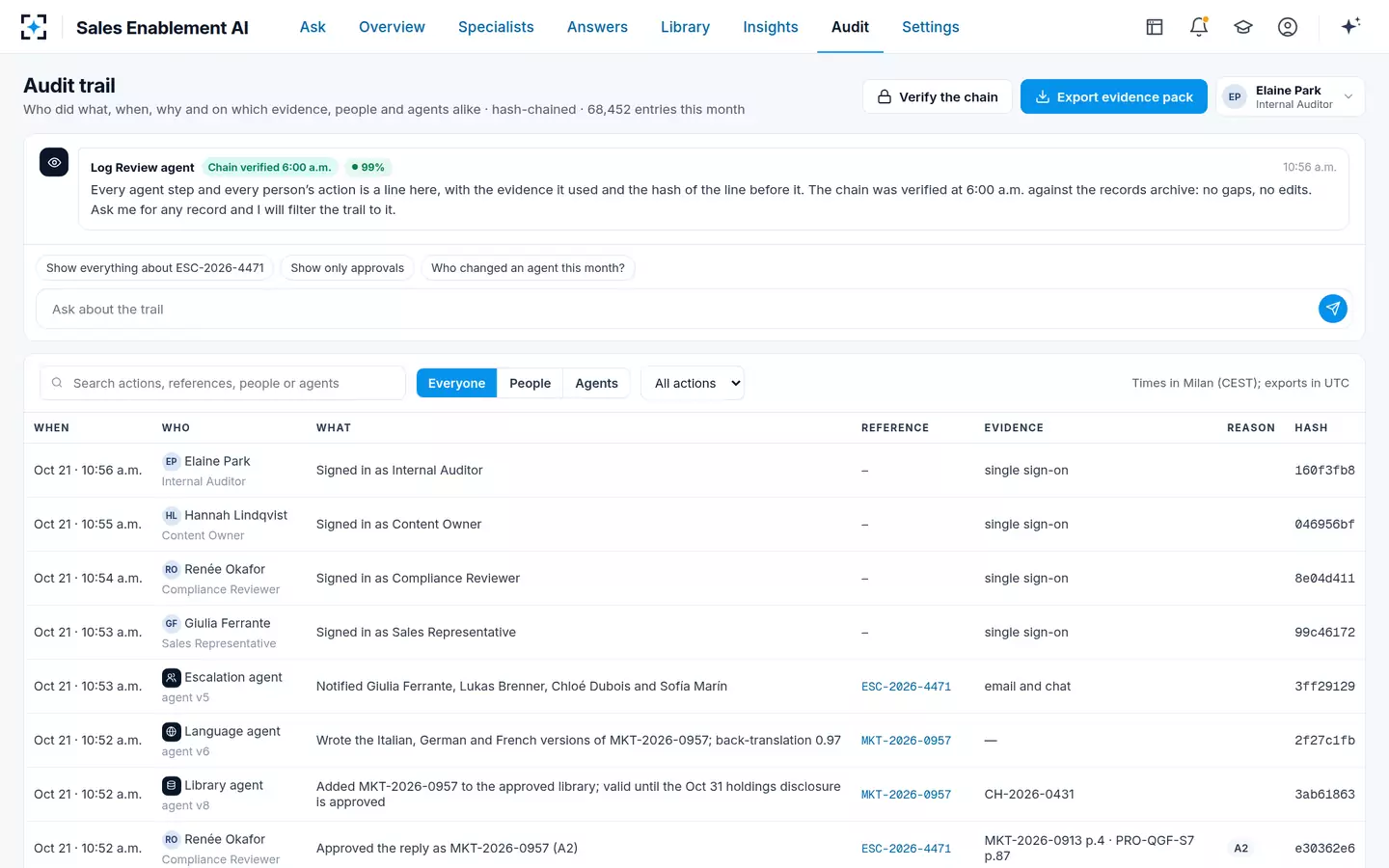
That is the design in the sample firm. A specialist's reply to one rep's question becomes a library answer only after a compliance reviewer approves it with a reason code, for named audiences and countries, valid until its source changes. From then on every rep who asks gets the approved text, and the approval is on the audit trail before the first rep sends it.
FINRA Rule 2210 institutional communication: who counts as institutional
An institutional communication is a written communication distributed or made available only to institutional investors, excluding a member's internal communications. Rule 2210(a)(4) lists who counts. Among them are the institutional accounts of Rule 4512(c): banks, savings and loan associations, insurance companies and registered investment companies, an investment adviser registered with the SEC or a state, and "any other person (whether a natural person, corporation, partnership, trust or otherwise) with total assets of at least $50 million" (FINRA Rule 4512(c)). The list also includes governmental entities, employee benefit plans with at least 100 participants, qualified plans, FINRA members and their registered persons, and anyone acting solely on behalf of an institutional investor.
For a wholesaler, that list covers most of the day. An email to a broker-dealer's registered rep, or to an SEC-registered adviser, goes to an institutional investor. Institutional communications need no pre-use approval by default, but the firm's written procedures must still provide for review by a qualified principal, and where they do not require review before use, they must include training for the firm's people, a record of that training, and surveillance and follow-up to make sure the procedures are actually followed (FINRA Rule 2210(b)(3)).
No member may treat a communication as having been distributed to an institutional investor if the member has reason to believe that the communication or any excerpt thereof will be forwarded or made available to any retail investor.
FINRA Rule 2210(a)(4)
The same answer changes category when it is forwarded
Because the category follows the audience, a single answer can be institutional when it is written and retail by the time it is read. The forwarding sentence above is what makes that happen, and the words "any excerpt thereof" mean that one figure lifted from a long email is enough.
One fund answer, four audiences: how its category changes
| What happens to the answer | Category | What the rep needs before sending |
|---|---|---|
| A wholesaler emails a fund’s duration and yield to a registered rep at a broker-dealer, for the rep’s own research | Institutional communication | An approved, current source; the firm’s institutional procedures. |
| The rep replies: “Great, I’ll send this to my client” | No longer institutional: the firm now has reason to believe it will reach a retail investor | Treat the answer as a retail investor will read it: approved retail wording, required disclosures, no professional-only material. |
| The wholesaler sends the same answer to one retail investor who asked directly | Correspondence | Supervision and review under Rule 3110; content standards of Rule 2210(d). |
| The same answer goes into an email template sent to 60 retail investors over a month | Retail communication | A principal’s approval before first use; filing within 10 business days if it promotes a specific registered fund. |
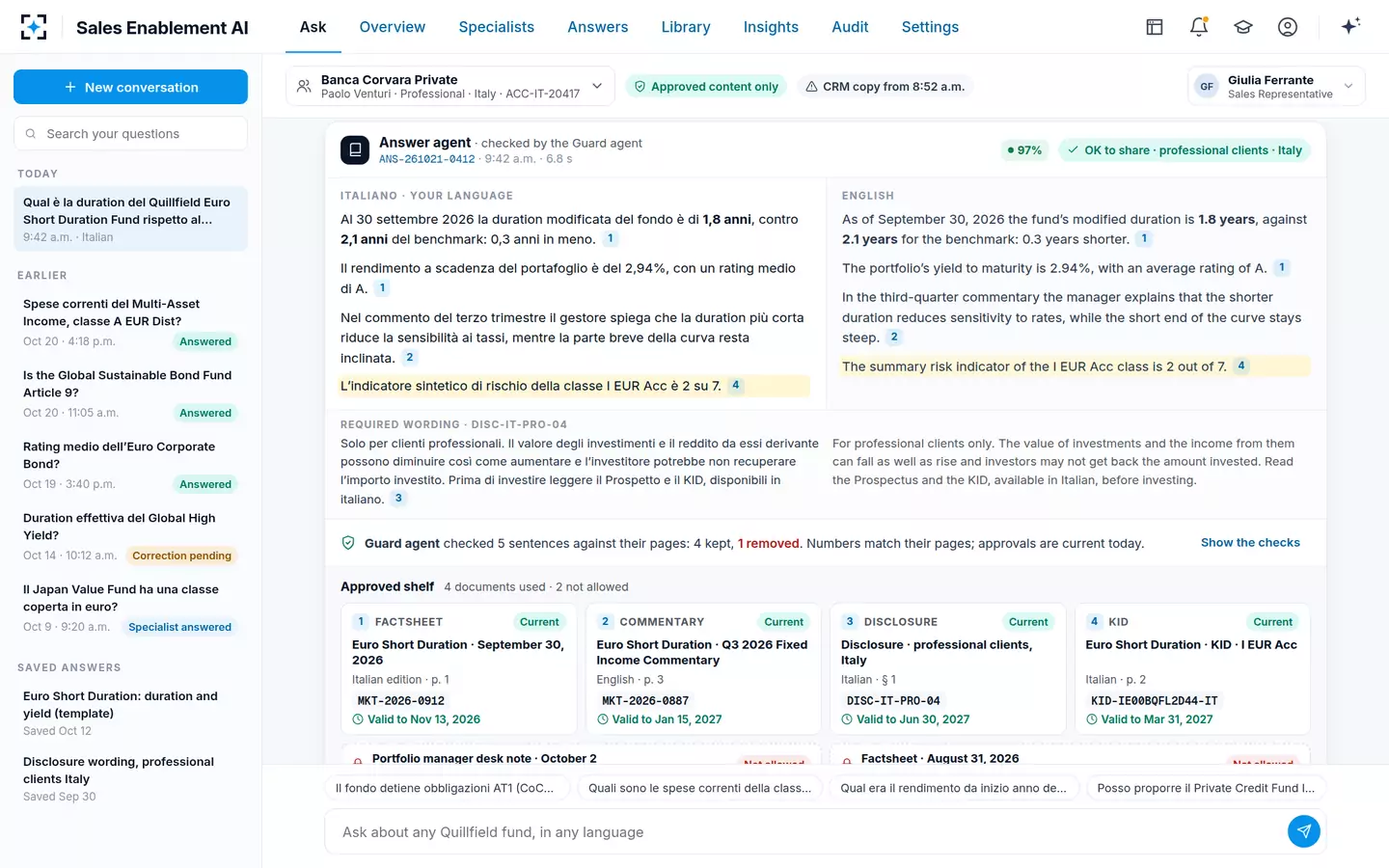
This is why an assistant that knows only the question cannot say whether an answer may be shared. It needs the recipient. In the sample firm, the rep asks with the client already selected from the CRM, so the Question agent knows the client is a professional client in Italy before the Answer agent searches, and the answer carries a note saying it is "OK to share · professional clients · Italy". A professional-only document is never used to answer for a retail client.
In Sales Enablement AI, the answer knows its audience before it is written
Does a retail communication need principal approval?
Yes. Under Rule 2210(b)(1), an appropriately qualified registered principal must approve each retail communication before the earlier of its use or filing with FINRA, subject to the exceptions the rule lists (FINRA Rule 2210(b)(1)). The record of the approval is part of the communication's file: Rule 2210(b)(4) asks firms to keep the name of the approving principal and the date of approval, along with "a copy of the communication and the dates of first and (if applicable) last use", for the retention period in SEC Rule 17a-4(b), at least three years (17 CFR 240.17a-4).
Filing is a separate step for some retail communications. A retail communication that promotes or recommends a specific registered investment company or family of funds must be filed with FINRA "within 10 business days of first use or publication", unless another filing requirement covers it. Two changes are in motion around these steps. FINRA's Regulatory Notice 26-14 of 9 July 2026 proposes replacing pre-use principal approval with risk-based supervision; comments closed on 11 September 2026 and nothing has changed yet. And the SEC approved, on 15 October 2026, a change allowing projections and targeted returns for some audiences, from a date FINRA has yet to set; the 2026 Rule 2210 changes are covered in full elsewhere.
Sales literature (FINRA) and what is sales literature
"Sales literature" is not one of Rule 2210's three categories; the rule works with correspondence, retail and institutional communications. The term lives on in SEC Rule 156, which governs investment company sales literature and defines it as any communication, written or broadcast, used to offer or induce the sale of fund shares, including communications between issuers, underwriters and dealers when their content can reasonably be expected to reach prospective investors (17 CFR 230.156).
Rule 156 matters to reps for its list of how performance statements mislead. It names, among other things, "Representations implying that future gains or income may be inferred from or predicted based on past investment performance", and portrayals of past performance that imply past gains will be repeated. That is the SEC's version of the FINRA content standard, and it applies whatever FINRA category the message falls into.
What every category shares: the content standards
Whatever its category, every member communication must be "based on principles of fair dealing and good faith", must be fair and balanced, and must give a sound basis for evaluating the facts (FINRA Rule 2210(d)(1)(A)). Outside the US the same principle has its own wording: in the UK, COBS 4.2.1R requires communications and financial promotions to be fair, clear and not misleading (FCA Handbook, COBS 4.2). A rep's answer has to pass both tests where both apply.
Before a rep sends a fund answer, in any category
- Who will read it, including anyone it may be forwarded to?
Institutional treatment ends the moment the rep has reason to believe a retail investor will see it.
- Is every figure from an approved, current document?
With its as-of date, for the client’s share class.
- Is there a forecast or projection anywhere in it?
Including views quoted from the firm’s own commentary or notes.
- Is the fund permitted for this client?
Registered for the client’s country, and not professional-only for a retail client.
- Is the required wording attached as approved?
For the client’s country and category, never paraphrased.
- Will a copy be kept with its source?
So the firm can show, later, what was sent, to whom and on what evidence.
The categories decide the review; the standards decide the content. An assistant has to get both right, every time, which is why category and country come first in the sample firm's answer chain. For what FINRA expects of an AI that writes these messages, see FINRA's AI rules for sales teams; for how a wholesaler's day fills with them, see what an internal wholesaler does. The sample morning is on the Sales Enablement AI page.
Sales Enablement AI keeps every answer with its evidence, for whoever asks later
Questions people ask
Is an email to one client a retail communication?
No. An email to one retail investor is correspondence, as long as the same communication does not reach more than 25 retail investors within 30 calendar days. It is still supervised under Rule 3110 and held to the content standards of Rule 2210(d).
What is a retail investor under FINRA Rule 2210?
Anyone who is not an institutional investor, whether or not they have an account with the firm. Institutional investors are listed in Rule 2210(a)(4) and include banks, insurers, registered funds, registered advisers, governmental entities, persons with at least $50 million in total assets, and FINRA members and their registered persons.
Do institutional communications need principal approval?
Not necessarily before use. Rule 2210(b)(3) requires written procedures for review by a qualified principal, appropriate to the firm's business, size, structure and customers; if those procedures do not require pre-use review, they must include training, documentation and surveillance and follow-up.
Is a fund factsheet a retail communication?
A factsheet made available to more than 25 retail investors is a retail communication, so it needs a principal's approval before use, and if it promotes a specific registered fund it is filed with FINRA within 10 business days of first use. A factsheet given only to institutional investors is an institutional communication.
What is the difference between FINRA's categories and the EU's client categories?
FINRA's three categories sort communications by audience for review purposes; MiFID's retail, professional and eligible counterparty categories sort clients for the protections they receive. A fund manager selling in both regions has to apply both, which is why the sample firm's answers carry the client's category and country.