AI sales assistant software answers reps' questions, drafts their follow-ups and keeps the CRM current, and for a fund manager's sales team the part that decides the purchase is the first: whether its answers come only from approved, current content, permitted for the client in front of the rep. The way to find out is not a demo but a pilot on the firm's own material: replay last quarter's real rep questions through the assistant, score every answer against the approved source and the client's category and country, and decide on pass marks fixed before the first answer is seen. A demo shows what the software does with the vendor's documents; a replay shows what it does with yours, including the superseded factsheet and the fund that is not registered in Portugal. Botminds' Sales Enablement AI is tested this way before it goes live, against a set of test questions in the reps' own languages.
Where the solution appears, the examples come from its sample data: Quillfield Capital, a fictional fund manager with 600 reps, and its fictional people and funds.
Pass marks for an AI sales assistant pilot, fixed before the first answer
- No sentence without a citation
Every sentence of every answer cites a page. One uncited sentence in a sent answer fails the pilot.
- No answer from an expired, superseded or internal document
Zero tolerance. Plant them in the test set and check each was refused.
- No answer for a fund or share class the client may not buy
Zero tolerance. Registration by country and client category comes before the search.
- No forecast, no view on future returns, no suitability advice
Including forecasts inside the firm’s own approved commentary or notes.
- Every number matches its page exactly
No rounding beyond the page’s own; the as-of date stated.
- A refusal when no approved source exists
Count the trap questions answered anyway: the target is none. Count correct hand-offs to a specialist.
- Required wording attached as approved
For the client’s country and category, never paraphrased or machine-translated.
- Coverage above the firm’s own bar
The share answered without a specialist. Set it from the baseline; the sample firm’s design target is nine in ten.
What is an AI sales assistant?
An AI sales assistant is software that helps a sales rep do the work around a client conversation: answering product questions, drafting emails and follow-ups, summarising meetings and keeping the CRM up to date. Some are sold as a service with people behind them; most are software built on large language models. For a fund manager the assistants split into two kinds: those that write for the rep, which need the rep to supply the facts, and those that answer the rep's questions, which supply the facts themselves.
The second kind is where the risk and the value sit. An assistant that answers "what is the fund's duration?" is writing the factual core of a client communication, and FINRA holds firms responsible for communications whether a person or AI generated them; what FINRA's AI guidance asks of a sales team is set out in its own guide. That responsibility is why a pilot has to test answers, not features.
Why vendor demos cannot show you the answer that matters
A demo runs on content chosen to work. The failures that matter to a fund manager live in the firm's own material: a factsheet withdrawn last week but still in the shared drive, a share class registered in Germany but not Austria, a commentary with a rate view in its last paragraph, a professional-only document a rep might use for a retail client. None of them appears in a vendor's sample library, and all of them appear in a real quarter of rep questions.
There is also an evidence gap a demo cannot close. The Bank of England and FCA's 2026 survey found that for third-party AI systems, UK financial firms most often relied on vendor assurance and contractual arrangements, reported by four in five respondents, and that only about a quarter had deep knowledge of those systems, against three quarters for systems built in-house (Bank of England and FCA, 2026). A pilot on the firm's own questions is how a buyer earns its own assurance instead of borrowing the vendor's. Independent tests of commercial tools point the same way: legal research tools that searched documents before answering still invented answers between 17% and 33% of the time in one preregistered study, despite claims to the contrary (Magesh and others, Journal of Empirical Legal Studies, 2025).
A vendor demo and a pilot on last quarter's questions
Vendor demo: The vendor’s sample library, current and clean.
Pilot on your own questions: Your approved library and approval register, with every expired, superseded and internal document still in it.
Vendor demo: Chosen to show the product well.
Pilot on your own questions: A quarter of what your reps actually asked, in their languages, plus planted traps.
Vendor demo: One generic user.
Pilot on your own questions: Real client categories and countries from the CRM, so registration and audience are tested.
Vendor demo: The audience’s impression.
Pilot on your own questions: Each answer scored against its source by a reviewer, on pass marks fixed in advance.
Vendor demo: A feeling.
Pilot on your own questions: Counts of failures by type, and a decision a compliance officer will sign.
Build the test set from last quarter's questions
The test set is the firm's own questions, chosen to cover what reps ask and to trap what an assistant must refuse. Pull them from where reps already ask: emails and chats to product specialists, the specialist queue, the CRM's activity notes. A few hundred is enough if they are stratified well.
A test set for an AI sales assistant pilot, by kind of question
| Kind of question | Share of the set | What it tests |
|---|---|---|
| Everyday questions in each family: performance, fees by share class, holdings, registration, sustainability and risk | About 60% | Coverage, citation and number accuracy on the questions that make up most of the volume. |
| Questions in each language reps use | Spread across the above | Answers in the rep’s language, with approved local wording used as written. |
| Questions where the current document has replaced an older one | About 10% | That superseded and expired documents are never used, and the current version is offered. |
| Questions about a fund or class not registered for the client | About 10% | That registration and client category are checked before the search, and the answer is a refusal. |
| Forecast, advice and suitability requests | About 10% | That views on future returns and suitability advice are refused, including rephrased versions. |
| Questions no approved document answers | About 10% | That the assistant says so, and hands off to the right specialist instead of guessing. |
The trap rows are the point. An assistant that answers 95% of everyday questions well and one forecast request badly has failed, because the forecast is the answer that reaches a client and an examiner. Each trap should be written in two or three phrasings: the sample firm's weekly review found two reps who rephrased a refused forecast question to try to get a view on rate cuts, and an assistant has to refuse the rephrasing too.
What pass marks should a sales assistant pilot use?
Pass marks should be absolute for anything that would be a compliance failure if sent, and set from the firm's own baseline for everything else. The checklist at the top of this page separates the two: no uncited sentence, no stale or internal source, no unregistered fund, no forecast, no mismatched number and no missing required wording are each a fail on a single instance; coverage, speed and specialist hand-offs are measured against what the firm does today.
Fix them in writing, signed by compliance and the head of distribution, before the first answer is scored. A pass mark chosen after the results is a description of the results. And score with a person who knows the funds: the reviewer reads each answer beside its cited page and marks each check, so that a failed pilot says exactly what failed.
The scoring sheet: one row per answer
| Check | Pass when | Fail examples |
|---|---|---|
| Citation | Every sentence cites a page that says what the sentence says. | A sentence with no citation; a citation to a page that does not contain the figure. |
| Source status | Every cited document is approved and in date on the test date. | Last month’s factsheet; a draft; a portfolio manager’s desk note. |
| Numbers | Every number matches its page, with the as-of date. | 1.8 years shown as “about 2”; a yield from another share class. |
| Audience and country | The fund and class are permitted for the client; no professional-only material for retail. | A US fund described to a client in Portugal where it is not registered. |
| No forecast or advice | No views on future returns, no suitability statements. | “The team expects to lengthen duration by year-end.” |
| Required wording | The approved disclosure for the client’s country and category is attached, exactly. | A paraphrased disclaimer; the English wording for an Italian client. |
| Refusal and hand-off | Where no approved source exists, it says so and offers the right specialist. | A confident answer to a question the documents cannot support. |
How long should an AI sales assistant pilot run?
About six weeks is enough for a decision, if the content is connected read-only in the first week. The time goes on connecting the library and the approval register, building and replaying the test set, fixing the content gaps the replay exposes, and a short shadow run with live reps before anyone sends an answer to a client. A client service desk can run the same kind of trial on its own mailbox, as the inquiry management systems pilot shows.
A six-week pilot on last quarter's questions
- ConnectWeek 1
- ReplayWeek 2
- Score, fixWeek 3
- Shadow run, 10–20 repsWeeks 4–5
- Decide, signWeek 6
The third week is the one buyers underestimate. A replay finds content problems as well as software problems: questions the library cannot answer, documents without approval IDs or validity dates, a registration list that is out of date. Fixing them is part of going live with any tool, and a pilot that hides them by testing only answerable questions will meet them in production instead.
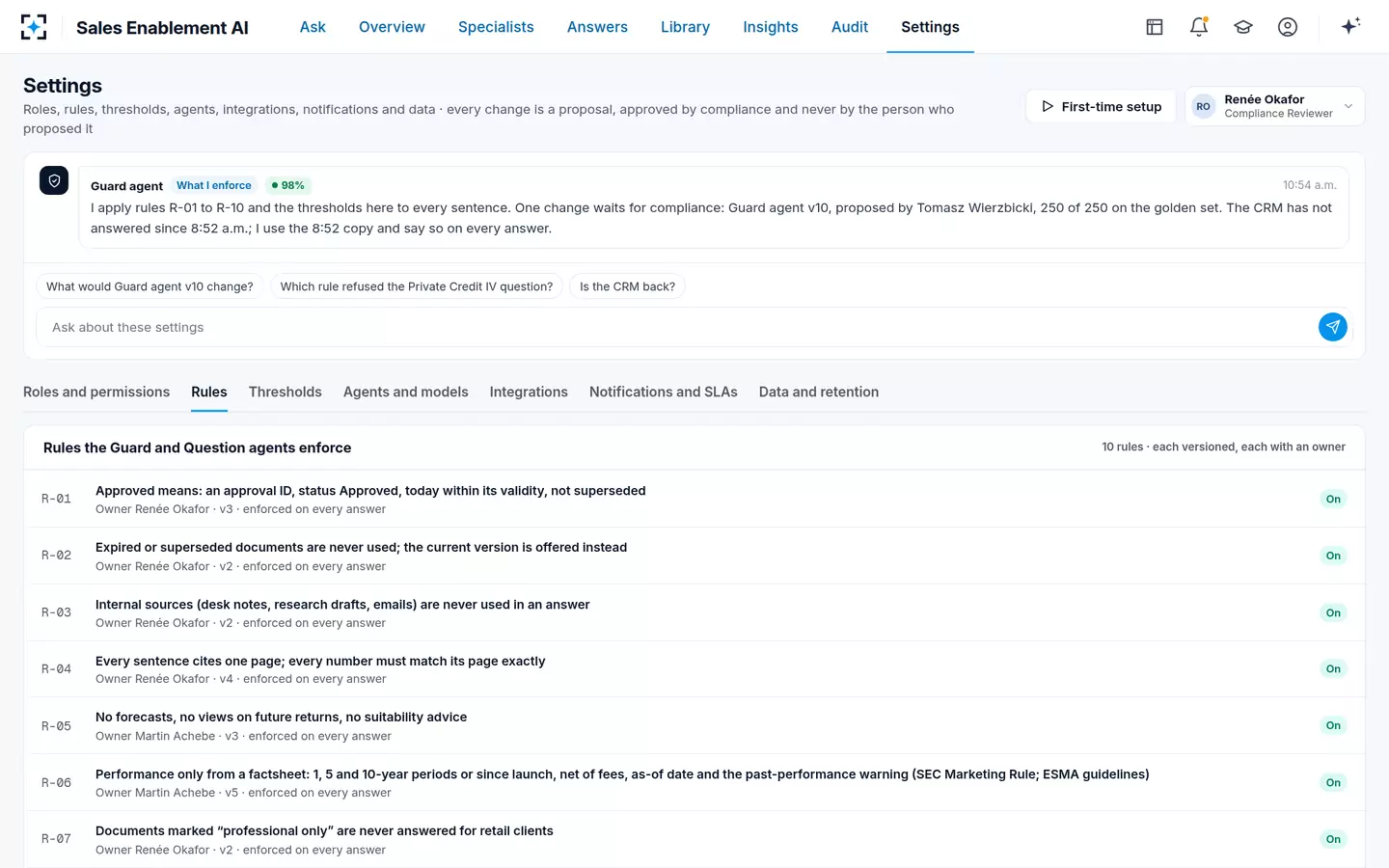
In Sales Enablement AI, every rule a pilot tests is a setting with an owner
What regulators expect a pilot to show
Regulators ask for the same three things a good pilot produces: testing before use, monitoring after, and records of both. In Regulatory Notice 26-14 of 9 July 2026, a request for comment on proposed changes to Rule 2210 that are not yet in force, FINRA wrote that generative AI communication tools can be part of a reasonably designed supervisory system if they are vetted, tested and monitored (FINRA Regulatory Notice 26-14). Its 2026 oversight report lists robust testing to understand a model's capabilities, limitations and performance among the effective practices, with ongoing monitoring of prompts, responses and outputs once a tool is live (FINRA, 2026 Annual Regulatory Oversight Report).
ESMA's 2024 statement asks firms to put their AI tools through rigorous quality assurance, testing algorithms and their outcomes for accuracy, fairness and reliability, and to keep records of how AI is used, including data sources and changes over time (ESMA public statement, May 2024). A signed pilot report, with the test set, the pass marks, the scores and the fixes, is that record for the first day; the weekly sample of the answer log is the record for every day after.
How UK financial firms get comfortable with third-party AI
81%
relied on vendor assurance and contractual arrangements for third-party AI systems
24%
reported deep knowledge of third-party AI systems
77%
reported deep knowledge of systems they developed themselves
After the pilot: how Sales Enablement AI keeps testing every week
A pilot is a test at one moment; the library, the registrations and the agents all change afterwards. The same scoring that decided the purchase should keep running on a sample of live answers. In the sample firm, the Log Review agent draws 120 of the week's answers, 60 by risk and 60 at random, and a compliance reviewer decides each item and signs the week; a finding with a reason code feeds back into the content or the rules.
The pilot's scoring, run every week on live answers
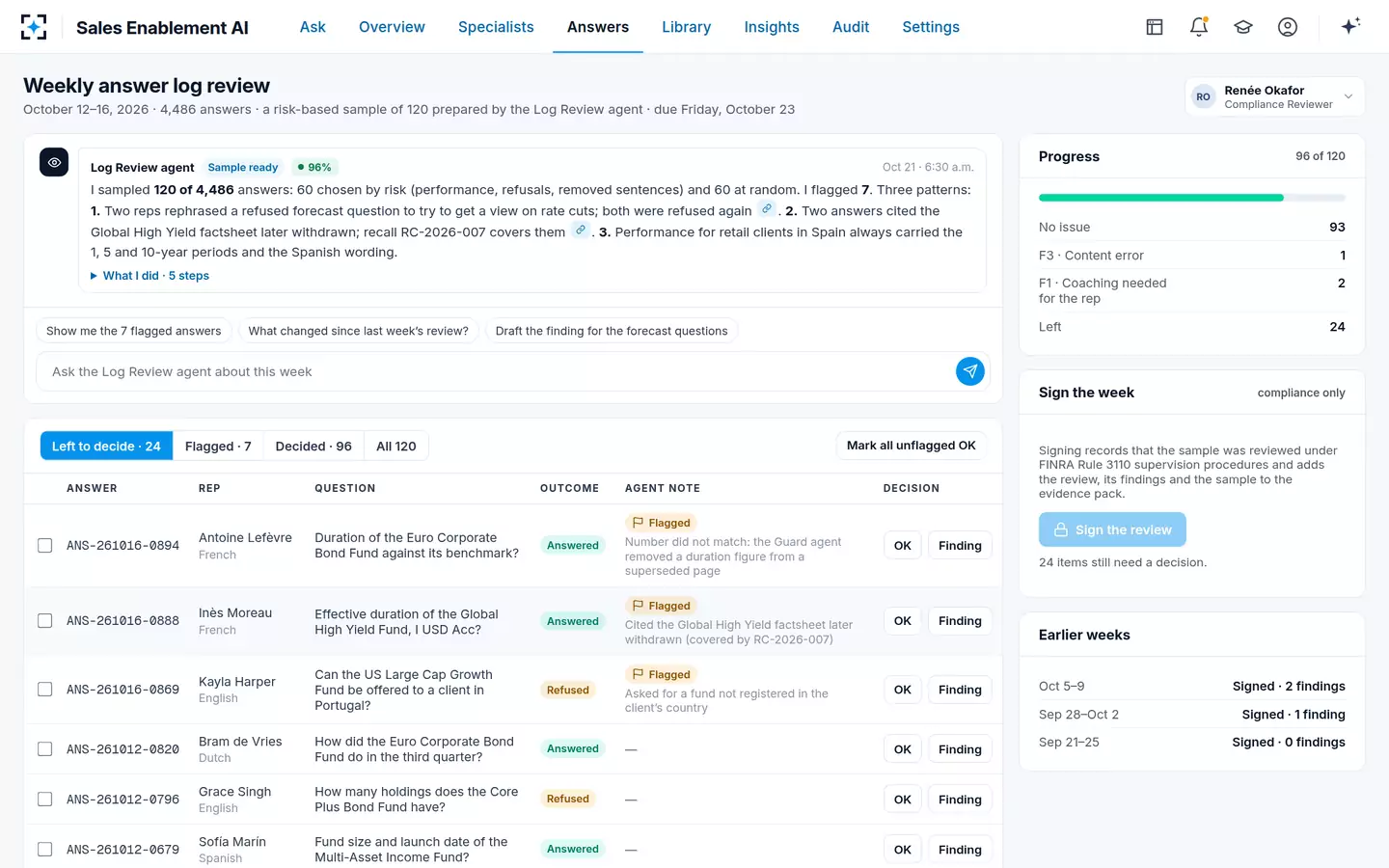
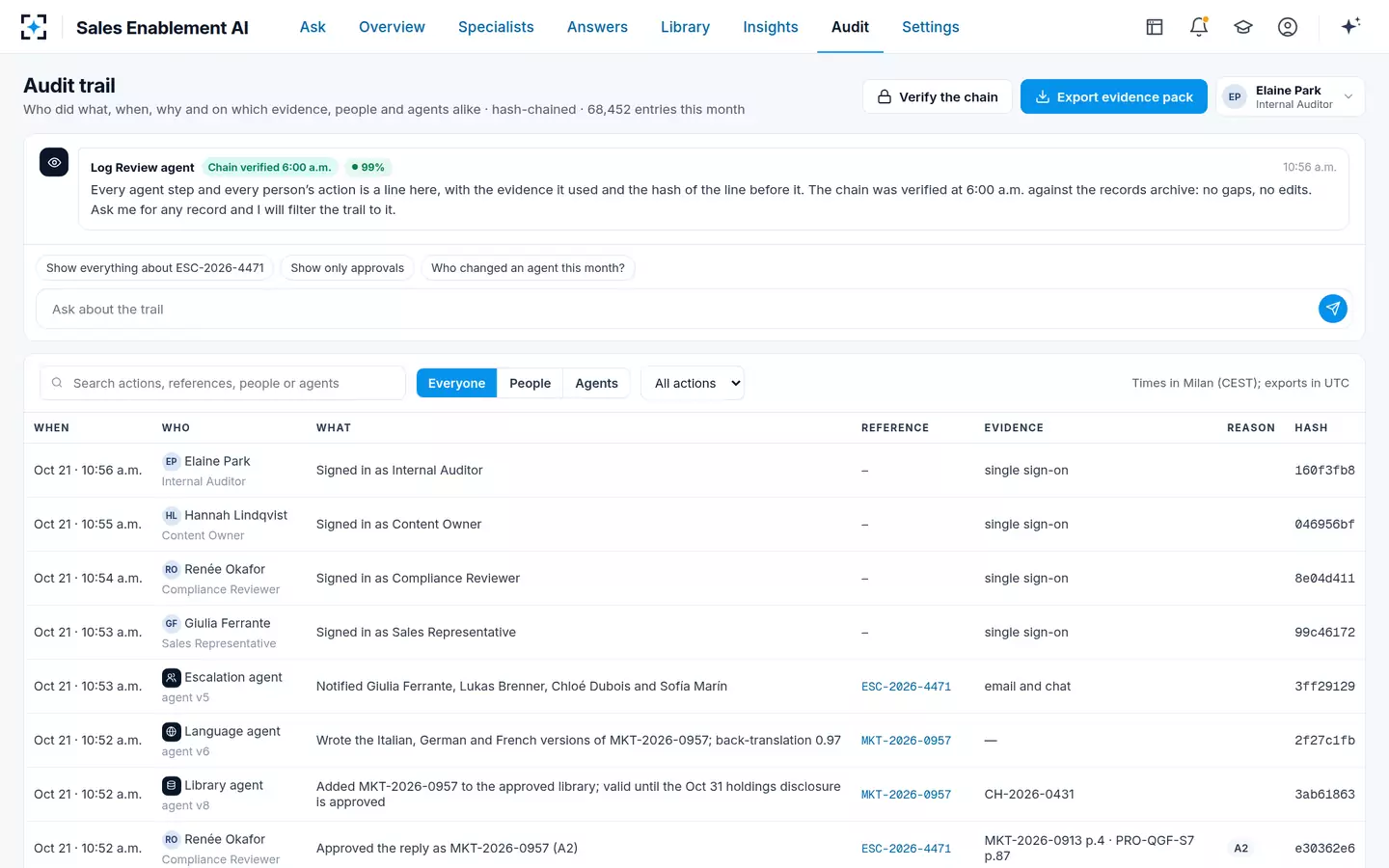
The audit trail is the other half of what a pilot should prove. Every agent step and every person's action is a line with its evidence and the hash of the line before it, so the scores in a pilot report, and every weekly sample after it, can be traced to the answers and documents behind them.
Who did what, when, and on which evidence
AI sales assistant tools and platforms: what to ask before signing
After the pilot, the contract questions are about keeping the tested behaviour. Ask how a change to the model, the agents or the rules is tested and approved, and whether the firm can block it; in the sample firm a new Guard agent version waits for compliance after passing 250 of 250 test questions. Ask where data is kept and whether client data trains any model; the sample configuration keeps data in its region and uses no client data for training. Ask what is kept and for how long, and whether the firm can export every answer with its sources and approvals; the sample firm keeps seven years, longer than the five Rule 204-2 asks of advisers for advertisements.
And ask what the assistant does not do. Sales Enablement AI answers reps' fund questions from approved content and routes the rest; it does not take meeting notes, design decks or replace the CRM or the marketing review system, which it reads. A firm whose reps' biggest gap is elsewhere should pilot a different kind of tool. To see how reps come to trust an assistant once it passes, read the trust ladder; to price what a pass is worth, cost one approved answer. The sample morning is on the Sales Enablement AI page.
Questions people ask
What is an AI sales assistant service?
It is an AI sales assistant sold as a managed service, where the provider runs and tunes the software and sometimes adds people to review its output. For a regulated sales team the same test applies as for software: whose content it answers from, whether every answer cites an approved page, and who approves what reaches a client.
What are the best AI sales assistant tools for financial services?
No regulator or independent study ranks them. The best fit is the one that passes a pilot on the firm's own questions with zero answers from stale, internal or unpermitted sources, a refusal wherever no approved document answers, and the coverage the firm needs; the pass marks above are the comparison.
How many questions should a pilot test set have?
A few hundred, stratified by question family, language and trap type, is enough to see failure patterns; the sample firm's set is 250 questions in 11 languages. More matters less than coverage of the questions an assistant must refuse.
Should reps use the assistant with clients during the pilot?
Not until the pass marks are met and signed. In a shadow run reps ask the assistant and check the answer against the old route before using it, which tests real questions without sending an unproven answer to a client.
What happens after the pilot if the vendor changes the model?
The test set should be re-run before the change reaches reps, and the firm should be able to refuse it. In the sample configuration every change to an agent, model or rule is a proposal, re-tested on the 250-question set and approved by compliance, never by whoever proposed it.