Content management for sales enablement is the work of keeping the documents sales reps draw on approved, current and easy to find, and at a fund manager it has a second half that most content platforms leave out: knowing which answers already went to clients from a document that has since been corrected, withdrawn or replaced. Factsheets change every month; prospectuses, supplements, KIDs, commentaries and holdings disclosures change on clocks of their own. A rep's answer is only as current as the page it came from, and the library's latest version does nothing for the email sent last week. Botminds' Sales Enablement AI answers reps only from documents that are approved and in date today, and when a document is corrected its Library agent finds every answer that cited the old version and drafts a correction for compliance to approve.
The examples are from the solution's sample data, a fictional fund manager, Quillfield Capital, with 600 reps and an approved library of 7,436 documents for 214 funds and strategies.
A fund manager's sales library is mostly documents reps must not use
What is sales content management at a fund manager?
Sales content management is the control of every document a rep may quote, show or send: what it is, who approved it, for which audiences and countries, until when, and what replaced it. At a fund manager the library holds factsheets by share class and language, prospectuses and supplements, KIDs, quarterly commentaries, approved holdings disclosures, talking points, required wording by country and audience, and the approved answers that specialists and compliance have already signed.
The control that matters is the approval, not the file. Each document needs an approval ID, an approver, the audiences it is approved for and a validity window, and an assistant that answers from the library must check all four at the moment it answers, not when the document was uploaded. In the sample firm that is rule R-01 of the solution's settings: approved means "an approval ID, status Approved, today within its validity, not superseded". The other 1,524 documents in the chart above are in the library for the record and are never quoted. RFP teams keep the same kind of approved library for their answers, and the guide to RFP content management applies the same test to it.
Every document has its own clock
A library goes stale document by document, on schedules set by rules and by the firm. The useful map lists each document type, what sets its clock and what an answer citing it must carry.
What sets each sales document's clock
| Document | What sets the clock | What an answer citing it must carry |
|---|---|---|
| Factsheet | Monthly. A US fund advertisement with performance must either quote returns current to the most recent month ended seven business days before use or point to where month-end figures are available (SEC Rule 482). | The as-of date, the standard periods, and the past-performance warning. |
| Prospectus and supplements | Amended when the fund changes; each supplement changes what the prospectus says. | The supplement that applies today, not the base document alone. |
| KID or KIID | Revised when its content changes significantly, and reviewed periodically. | The share class and language edition the client will receive. |
| Quarterly commentary | Each quarter, with an approval valid until the next one (in the sample firm, the third-quarter fixed income commentary is valid to 15 January 2027). | The quarter it describes; no forecasts carried into the answer. |
| Holdings disclosure | Monthly and approved at the sample firm, from portfolio accounting, under the fund’s disclosure policy. | The as-of date; never a figure from portfolio systems or a desk note. |
| Approved answer | Valid until the source it rests on is replaced: the sample firm’s AT1 answer is valid until the next holdings disclosure is approved. | Its own approval ID, and the sources beneath it. |
European rules tie the clocks together. ESMA's guidelines on fund marketing communications ask that information on an investment's features be kept current, and that when a marketing communication refers to past performance, "this information should be consistent with the past performance included in the prospectus", the KID or the KIID (ESMA guidelines on marketing communications, 2021). A rep's answer quoting a return is therefore tied to two documents at once, and drifts when either one changes. The monthly factsheet itself is a separate production problem.
Why storing the latest version is not enough: answers drift
A content platform that replaces last month's factsheet with this month's has done its job for every future answer. It has done nothing for the answers already sent. Those live in reps' sent mail, in chat, in CRM activity notes and in the advisors' inboxes, and each one still carries the old figure.
FINRA's recordkeeping rule shows the gap. For each retail and institutional communication a member keeps, Rule 2210(b)(4) asks for a copy of the communication with the date it was first used and, where there is one, the date it was last used (FINRA Rule 2210(b)(4)). A library knows the last date a factsheet was used. Unless the firm also knows which rep answers were built from that factsheet, it cannot say when the figure in them stopped being used, and nobody can list the reps who quoted it.
That list is what an assistant with citations can produce, and a search tool without them cannot. When every sentence of every answer cites a document and a page, the question "which answers used MKT-2026-0903?" has an exact answer, and so does "which of those reached a client?".
How do you recall an answer that cited a corrected document?
A recall starts from the corrected document, compares it with the old one field by field, finds every answer that cited a changed field, works out which of those reached a client, and drafts a correction for each rep, which a compliance reviewer approves before anything is sent. The steps are mechanical; the approval is not.
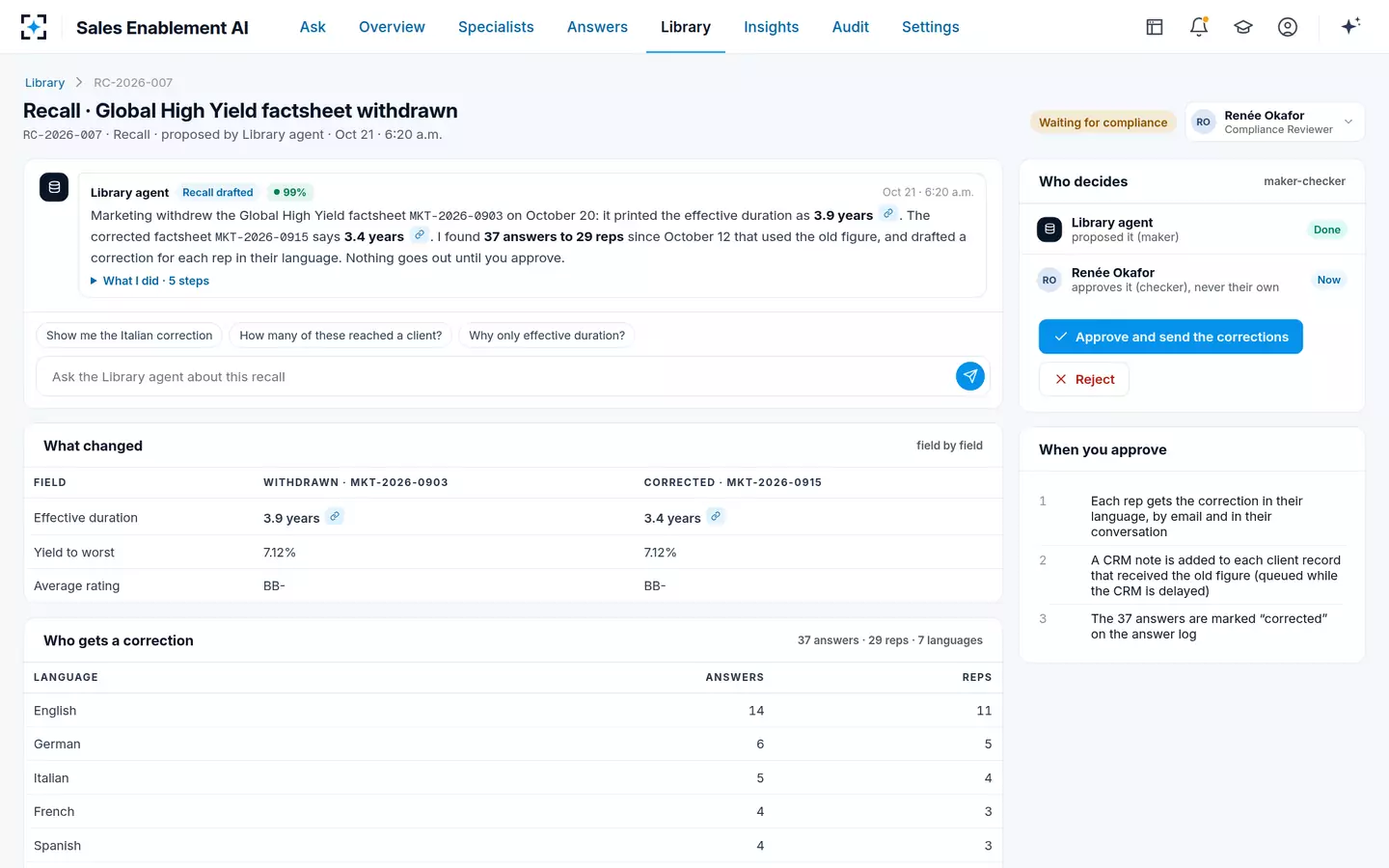
The sample firm's case: on 20 October, marketing withdrew the Global High Yield factsheet MKT-2026-0903, which had printed the fund's effective duration as 3.9 years; the corrected MKT-2026-0915 says 3.4. Yield to worst and average rating were unchanged.
A factsheet recall in Sales Enablement AI, step by step
Agent
CompareThe Library agent compares the withdrawn and corrected factsheets field by field: effective duration 3.9 → 3.4 years; yield to worst and rating unchanged.
Never: Edits the library: withdrawal and replacement are the content owner’s changes, approved by compliance.
Agent
FindLists every answer since 12 October that cited the changed field: 37 answers to 29 reps, in 7 languages.
Agent
TraceMarks which answers left the conversation: 12 were copied into an email or logged to the CRM, so a client may have seen 3.9 years.
Agent
DraftWrites a correction for each rep in the rep’s language, and a CRM note for each of the 12 client contacts.
Never: Sends anything before approval.
A person decides
Compliance reviewerReads the comparison and the drafts, approves or rejects the recall with a reason code.
Agent
DeliverOn approval: each rep gets the correction by email and in their conversation, the CRM notes are added, and the 37 answers are marked corrected on the answer log.
One corrected factsheet, counted
37
answers cited the withdrawn figure
29
reps gave those answers
7
languages the corrections had to be written in
12
answers left the conversation by email or the CRM
The 12 is the number that matters to compliance. The other 25 answers were not copied into an email or logged to the CRM, so a correction to the rep may be enough, though a rep who read the figure out on a call will know to follow up. The 12 may be in a client's inbox, and the firm's procedures, not the software, decide whether the client hears from the rep, from the firm, or both. What the software owes the reviewer is the list, the drafts and a single place to approve them.
A Sales Enablement AI recall: what changed, who used it, what happens on approval
How often should sales content be reviewed?
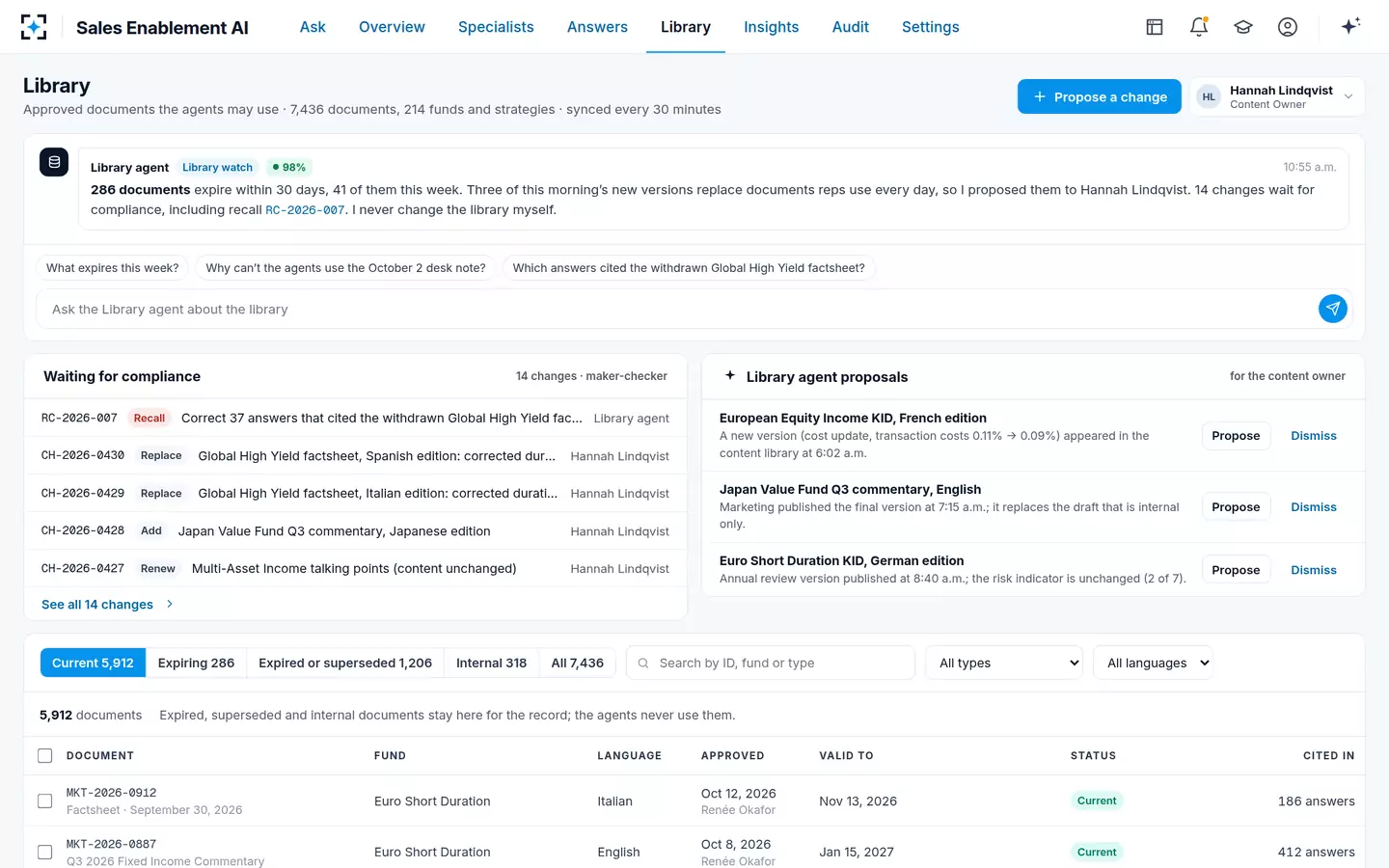
Every time it is used, and on a calendar as well. The calendar is the familiar part: each document carries a validity date set at approval, and someone renews or retires it before it lapses. In the sample firm, 286 documents expire within 30 days, 41 of them this week, and the content owner sees them ranked with where each was cited. A factsheet's monthly figures may be used for up to 45 days after month-end, a setting the firm chose, until the new factsheet is approved.
The use-time check is the part a calendar cannot do. An assistant should test the approval and validity of every document at the moment it answers, so an answer built at 9:00 on the day a document expires is the last one it supports. ESMA's 2024 statement on AI in retail investment services asks for controls on the accuracy of what AI systems use "in order to prevent the dissemination to clients of erroneous information", and for ex-post checks frequent enough to catch what slips through (ESMA public statement, 30 May 2024). In a sales library those are the same two controls: refuse what is out of date, and recall what went out before it was.
The monthly drift report: five numbers to watch
Drift can be measured, and it should be, monthly, by the owner of the library. None of these numbers is published by a regulator or an independent study for the industry, so the only benchmark is the firm's own last month.
A drift report for the owner of a sales content library
| Measure | How to count it | Why it matters |
|---|---|---|
| Answers citing a superseded or withdrawn document | Answers sent in the month whose cited document was later replaced or withdrawn, by document. | The size of the exposure each correction creates. |
| Withdrawal to recall | Hours from a document’s withdrawal to an approved recall of the answers that cited it. | How long a known-wrong figure keeps circulating. |
| Recalled answers that reached a client | Of those answers, how many were emailed or logged to the CRM. | Which corrections need a client contact, not just a rep notice. |
| Expired before replaced | Documents that lapsed before their replacement was approved, and the questions refused meanwhile. | Gaps in the calendar that leave reps without an answer. |
| Blocked sources | Attempts to answer from internal or unapproved documents, by document. | Where reps or specialists keep reaching for material that is not approved. |
The last line is a content signal disguised as a compliance one. In the sample firm, a portfolio manager's desk note was a candidate source for a duration answer and was refused because it is internal; if reps keep asking questions only a desk note answers, the firm needs an approved document that answers them. Turning those refused and escalated questions into new content is the subject of another guide.
What to look for in sales content management software
Look for software that enforces approval at the moment of use and can trace every use back to a page. Storage, search and tagging are table stakes; the questions below separate a library from a controlled one.
Eight questions for any sales content management platform
- Is approval checked when a rep uses a document, or only when it is uploaded?
The validity date has to be tested on the day of use, not on the day of publication.
- Can it show where each document was cited?
In the sample library, one current factsheet is cited in 186 answers and a commentary in 412; that count is what a recall starts from.
- Does it compare a new version with the old one field by field?
A recall that cannot say which figure changed sends every rep a notice about every field.
- Can it tell answers that reached a client from those that did not?
Copied to an email, logged to the CRM, or never left the rep’s screen.
- Who approves a change, and can the proposer approve it?
Every withdrawal, replacement and correction should be proposed by one person and approved by another.
- Does it handle every language edition as its own document?
An Italian factsheet corrected a day after the English one is a separate exposure.
- Are internal documents kept out of answers by rule?
Desk notes and research drafts can stay in the library for the record without being quotable.
- How long are answers, sources and approvals kept?
At least as long as the longest of the firm’s record rules: three years for broker-dealer communications under SEC Rule 17a-4(b)(4), five for an adviser’s advertisements under Rule 204-2.
Where Sales Enablement AI fits, and where it does not, is specific. It does not replace the content library, the digital asset store or the marketing review system: it reads the library and the approval register, read-only, and answers from what they say. It does not design factsheets or decks, and it does not run training or coaching programmes, which many sales enablement platforms bundle. It adds the layer that sits between the library and the rep's email: answers cited to the page, checked against the approval on the day, and recalled when the page changes.
Sales enablement content that reps can actually use
The most useful content in a fund manager's library is often not a document at all, but an approved answer: a short, cited reply to a question reps ask again and again, signed by compliance and valid until its source changes. In the sample firm, the AT1 answer a specialist wrote at 10:31 and compliance approved at 10:52 became approved answer MKT-2026-0957, for professional and institutional clients in every registered country, and reached the next rep who asked in seconds.
The library view: what expires, where it was cited, what waits for approval
Approved answers need the same discipline as documents, and one more: they inherit their sources' clocks. An answer resting on the September holdings disclosure expires when the October one is approved, and the library has to know that without anyone remembering. Measuring what that discipline saves is the job of sales enablement metrics priced per answer. The recall above, and the morning around it, are on the Sales Enablement AI page.
Questions people ask
What is a sales enablement content platform?
It is the system that stores, organises and distributes the material sales reps use, with search, version control and analytics on what gets used. At a regulated firm it also needs the approval and validity of every item, and a way to trace which communications used which version, because a figure a rep sends is the firm's statement.
Who owns sales content at an asset manager?
Ownership is usually split: marketing or a content owner publishes and retires documents, product specialists own the substance, and marketing compliance approves. In the sample firm a content owner proposes every change, the Library agent spots new versions and expiries, and a compliance reviewer approves; nobody approves their own change.
How long must sales content and answers be kept?
A broker-dealer keeps communications sent and their approvals for at least three years under SEC Rule 17a-4(b)(4), and an adviser keeps its advertisements for five years under Rule 204-2. The sample firm keeps every answer with its sources, checks and approvals for seven years, which is its own choice.
What happens to answers when a KID or prospectus changes?
Answers that cited the old version are now drifting, and need the same treatment as a corrected factsheet: find them, decide which reached a client, and correct them with approval. A supplement that changes a prospectus is a new source in its own right, so an answer citing the base document alone may already be out of date.
Should internal notes be in the sales library?
They can be kept there for the record, as long as a rule stops them being quoted. The sample library holds 318 internal documents that the agents never use, and in the sample morning the Guard agent removed a sentence taken from a portfolio manager's desk note before the rep saw it.