Revenue sharing, in mutual fund distribution, is a payment a fund's investment adviser or one of its affiliates makes to a broker-dealer, bank or platform out of its own profits, to compensate that intermediary for selling the fund: for a place on its shelf, access to its advisors, or a spot on a preferred list. It is not a fund expense, which is what separates it from the two payments that do come out of fund assets, 12b-1 fees and sub-accounting or sub-transfer agency fees. All three can reach the same intermediary, and the SEC staff has found them stacked in that order. Advisors ask wholesalers about them, and the answer they need is the prospectus and statement of additional information, not a sales pitch. Botminds' Sales Enablement AI answers reps' fee and share-class questions only from those approved fund documents, cited to the page, and refuses anything that would turn a fee question into advice.
The definitions and rules below come from the SEC's rules and staff guidance and FINRA's rulebook; the research from peer-reviewed journals. Where the solution appears, its examples are fictional sample data.
Three payments behind a fund's shelf space: who pays, from what, and under which rule
Paid byThe fund, from its assets
Payment12b-1 fees
For whatDistribution and service fees under a written plan the fund’s board approves and renews each year; shown in the prospectus fee table.
The limitFINRA caps: asset-based sales charge 0.75% a year, service fee 0.25%.
Paid byThe fund, from its assets
PaymentSub-accounting or sub-transfer agency fees
For whatPayments for recordkeeping and shareholder services on omnibus and networked accounts the intermediary keeps.
The limitIf any part pays for distribution, it must come under a 12b-1 plan; the board judges.
Paid byThe adviser or an affiliate, from its own profits
PaymentRevenue sharing
For whatPayments to compensate the intermediary for distribution: shelf space, access to its advisors, a place on a preferred list.
The limitNot a fund expense; disclosed in the prospectus and SAI as a possible conflict.
All three may be paid to the same broker-dealer, bank, platform or retirement plan recordkeeper.
What is revenue sharing in mutual funds? A definition
The SEC staff's own definition is short. "Revenue sharing generally refers to payments made by advisers or other affiliated entities out of their “legitimate” profits to intermediaries to compensate them for their distribution efforts," the Division of Investment Management wrote in IM Guidance Update 2016-01. The word "legitimate" carries the legal point: the adviser may spend its own profits on distribution, but it may not use the fund's money to do so outside a 12b-1 plan.
Broker-dealer revenue sharing is the same payment seen from the receiving side. The broker-dealer receives it from the fund family's adviser or distributor, on top of any 12b-1 fees and sub-accounting fees it receives from the fund, and in return the fund is offered on its platform, its advisors can be reached by the fund family's wholesalers, or the fund appears on a list the firm recommends. None of it shows up in the fund's expense ratio, because the fund does not pay it.
Three payments behind the shelf: 12b-1, sub-accounting and revenue sharing
The three payments differ in who pays and under what rule, and the line between them is where the regulatory risk sits. The SEC staff described how they are often combined: "overall payments are often structured (formally or informally) so that any payments are first made from rule 12b-1 fees, then fund-paid sub-accounting fees (generally through an affiliated entity), and finally any balance is paid by the adviser or an affiliate from revenue sharing." Such tiered arrangements, it said, raise the question of what each part is really paying for.
The question matters because the fund can pay for distribution only through a 12b-1 plan. Rule 12b-1 says a fund acts as a distributor of its own shares if it finances "any activity which is primarily intended to result in the sale of shares issued by such company, including, but not necessarily limited to, advertising, compensation of underwriters, dealers, and sales personnel" (17 CFR 270.12b-1(a)(2)). A sub-accounting fee that quietly buys shelf space is distribution paid outside the plan.
12b-1 fees explained
A 12b-1 fee is an annual charge, deducted from fund assets, that pays for distribution and, often, shareholder servicing, under a written plan the rule requires. The plan must be approved by the fund's board, including the independent directors; it continues beyond a year "only so long as such continuance is specifically approved at least annually"; and the people spending the money must give the board a written report of the amounts and purposes "at least quarterly". The fund keeps the plan, agreements and reports for at least six years.
Form N-1A tells investors what the fee does to them in plain terms. A fund with a 12b-1 plan must say, to this effect: "Because these fees are paid out of the Fund’s assets on an on-going basis, over time these fees will increase the cost of your investment and may cost you more than paying other types of sales charges" (SEC Form N-1A, Item 12(b)). In the statement of additional information, under Item 19(g), the fund lists what the plan money was spent on in the last fiscal year: advertising, printing and mailing prospectuses to non-shareholders, compensation to underwriters, to broker-dealers and to sales personnel, financing charges, and other items.
The FINRA limits on what a fund may pay for sales and service
0.75%
a year: the most a fund’s asset-based sales charge may be, of average annual net assets
0.25%
a year: the most a fund’s service fees may be, as disclosed in its prospectus
0.25%
the most total sales and service charges may be for a fund to be called “no load”
How to calculate 12b-1 fees, and when they are charged
A 12b-1 fee is a percentage a year of the fund's net assets attributable to the share class, so an investor's share of it is the rate times the value of the holding, spread over the year. It is charged continuously, as part of the class's operating expenses, rather than at purchase or sale; the plan and prospectus say how often the distributor is paid.
What a 12b-1 fee costs a year on a $100,000 holding
The fee is included in the expense ratio. Form N-1A's fee table lists "Distribution [and/or Service] (12b-1) Fees" as its own line under Annual Fund Operating Expenses, between management fees and other expenses, and all of them add up to Total Annual Fund Operating Expenses (SEC Form N-1A, Item 3). A rep answering "what does this class cost?" should give the total and the 12b-1 line for the client's share class, from the current prospectus, because the same fund's classes can differ by the whole 12b-1 rate.
Sub-transfer agency fees and the distribution-in-guise question
Sub-transfer agency fees, also called sub-accounting fees, pay an intermediary that keeps the underlying shareholder accounts in an omnibus or networked account, doing the recordkeeping the fund's transfer agent would otherwise do. The fund may pay them from its assets as a service cost, outside a 12b-1 plan, as long as they really pay for services and not for distribution.
The SEC staff's 2016 guidance came out of examinations that found the line blurred. "Some intermediaries were observed to condition providing certain distribution-related activity (for example, access to wholesalers, distribution through mutual fund supermarkets, or placement on preferred lists) on a fund’s payment or rate increase of sub-accounting fees," the staff wrote, adding that such conditions may indicate that part of the fee pays for distribution. It also flagged a governance point a sales team will recognise: when employees "whose primary job was to distribute the mutual fund" helped set sub-accounting fees, it "heightens the risk that distribution benefits or services are in part driving the arrangement." The guidance is staff views, not a rule; the board's business judgment decides.
Broker-dealer revenue sharing: what the research and the SEC found
The research finds that payments to brokers move money, and that what moves is not always what performs. Christoffersen, Evans and Musto, studying the incentives disclosed in funds' own filings, "find significant effects of these payments to brokers on funds’ inflows, particularly when the brokers are not affiliated", and found "load sharing, but not revenue sharing, to predict poor performance" (Journal of Finance, 2013). Del Guercio and Reuter found that "actively managed funds sold through brokers face a weaker incentive to generate alpha and significantly underperform index funds", while in the direct-sold segment they found no such underperformance (Journal of Finance, 2014).
The enforcement record is about disclosure. In March 2019 the SEC settled charges against 79 investment advisers that, it found, had not adequately disclosed the conflict of putting clients in share classes that paid 12b-1 fees when a cheaper class of the same fund was available; the advisers agreed to return more than $125 million to clients, most of it to retail investors (SEC press release 2019-28). Share-class selection is a Reg BI and adviser-conduct question; for the fund manager's sales team, the lesson is that every payment an advisor's firm receives is a fact its clients may ask about.
These payments may create a conflict of interest by influencing the broker-dealer or other intermediary and your salesperson to recommend the Fund over another investment.
SEC Form N-1A, Item 8: the statement a fund must include when it or its related companies pay intermediaries
What the prospectus must tell investors about payments to intermediaries
The summary prospectus carries the short version. Under Form N-1A Item 8, a fund whose adviser or other related companies pay intermediaries must include a statement headed "Payments to Broker-Dealers and Other Financial Intermediaries" saying that if an investor buys through a broker-dealer or bank, the fund and its related companies may pay that intermediary for the sale of fund shares and related services, that the payments may create the conflict quoted above, and that the investor should ask the salesperson or visit the intermediary's website for more. A fund may omit it only if neither it nor any related company pays intermediaries.
Two other rules close the obvious workarounds. Rule 12b-1(h) bars a fund from compensating a broker for promoting or selling its shares by directing portfolio brokerage to it, and requires board-approved procedures where a fund does trade through brokers that sell its shares (17 CFR 270.12b-1(h)). And FINRA Rule 2341 caps what the fund itself may pay, as above. What the adviser pays from its own profits is uncapped, but it must be disclosed.
When an advisor asks about revenue sharing: what a rep should be able to show
- The fee table for the client’s share class
Management fee, the 12b-1 line and the total annual operating expenses, from the current prospectus.
- The 12b-1 plan’s purpose
What the plan pays for, from the prospectus, and the spending categories in the statement of additional information.
- The Item 8 statement
Payments to broker-dealers and other financial intermediaries, as the fund discloses it.
- The fuller disclosure in the statement of additional information
Where the fund family describes payments by the adviser or distributor to intermediaries.
- What the rep does not say
No view on which share class suits the client, and no characterisation of another firm’s arrangements.
- Who to ask when the documents are silent
A product specialist or compliance, with the question logged, rather than an answer from memory.
When an advisor asks a wholesaler about revenue sharing
The rep's job is to give the documents' answer, quickly and exactly, and to stop there. An advisor who asks "do you pay my firm revenue sharing?" is asking a question about the advisor's own firm that the fund family's prospectus and statement of additional information address in general terms, and that the advisor's firm discloses in its own terms. An advisor who asks "what does the A class cost compared with the I class?" is asking a fee-table question with an exact answer.
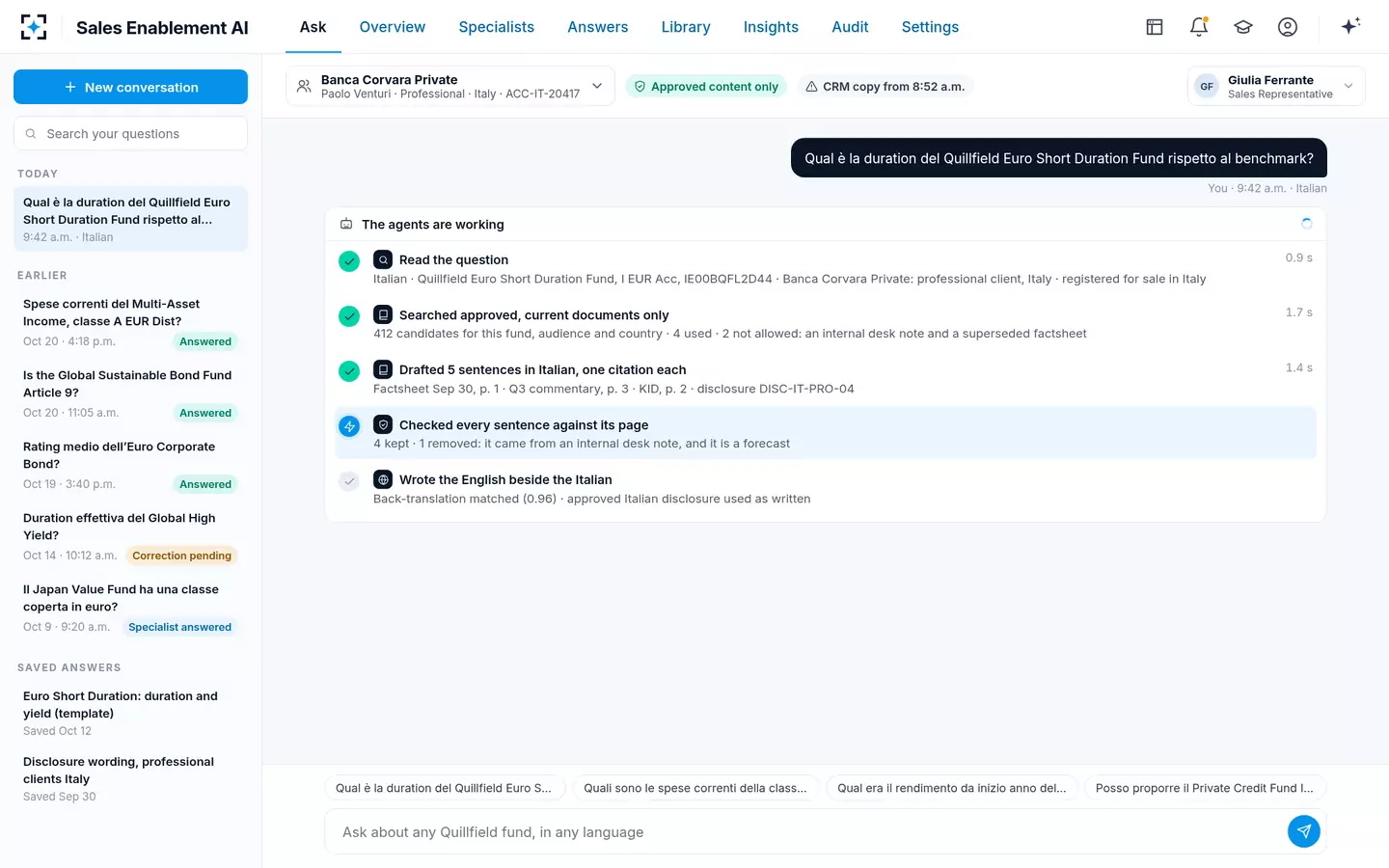
That split suits an assistant built on approved documents. In Sales Enablement AI, the Question agent resolves the fund and share class and the client's category and country first, and the Answer agent drafts only from documents approved for that audience, cited to the page; suitability questions, such as which class suits a client, are refused by rule. The sample data's questions are about duration and holdings rather than revenue sharing, so the screens below show the mechanism, not this topic.
Sales Enablement AI resolves the fund and share class before it searches
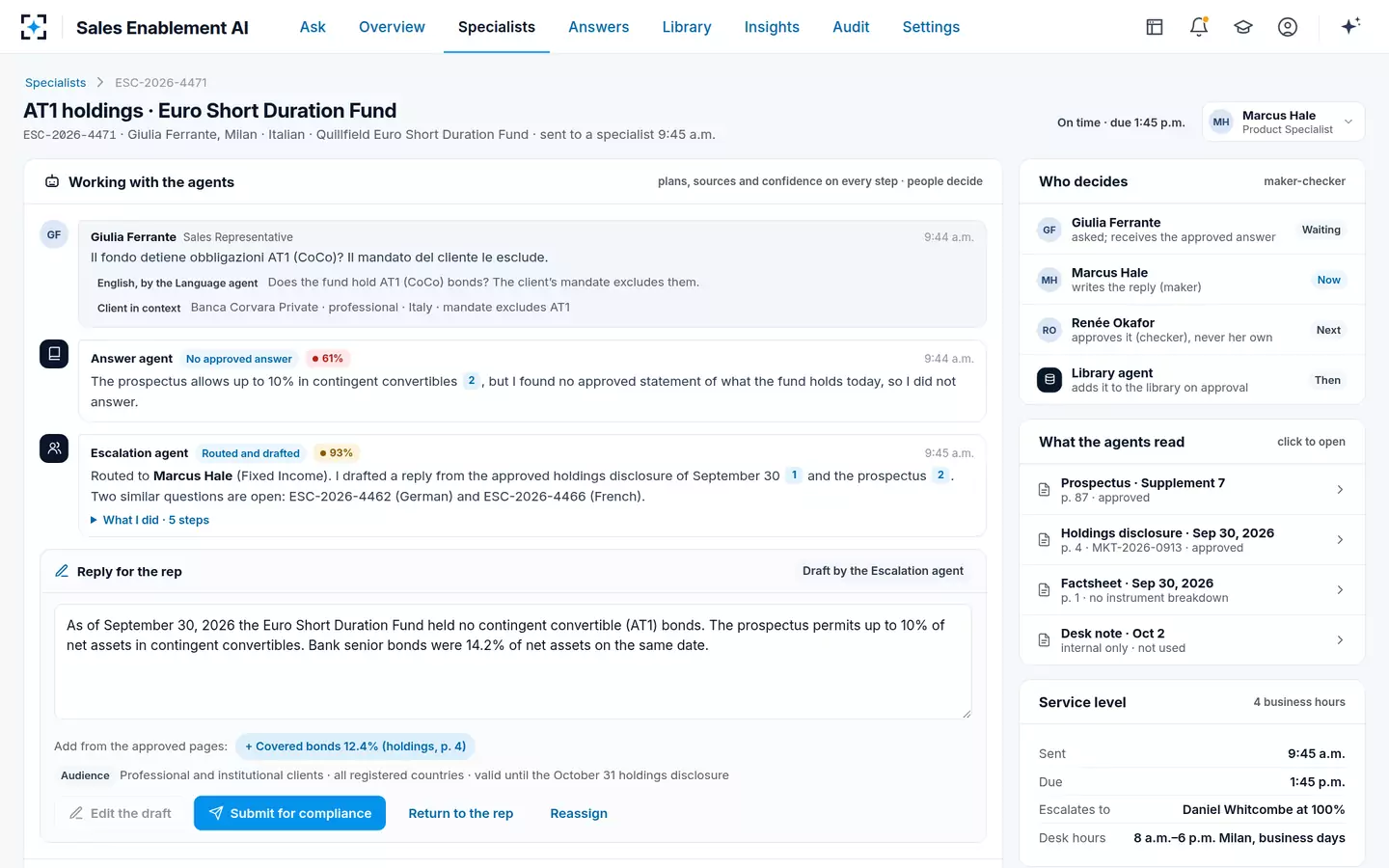
When the approved documents do not answer, the question goes to a person. The sample firm's fixed income specialist received a rep's question with a drafted, cited reply and the similar open questions from other reps merged in, and compliance approved the result before any rep saw it. A revenue-sharing question the statement of additional information does not settle belongs on the same route, to whoever in the firm owns distribution agreements.
In Sales Enablement AI, what no approved document answers goes to a specialist
For the bigger picture of which questions reps bring and where each one's answer lives, see the question families sales enablement should start from, and for the rules on what a rep may send, FINRA's three categories of communication. The full sample morning is on the Sales Enablement AI page.
Questions people ask
Is revenue sharing legal?
Yes. An adviser may pay intermediaries for distribution from its own profits, and the fund's prospectus must carry the Form N-1A Item 8 statement that such payments may create a conflict of interest. What the law forbids is using fund assets for distribution outside a 12b-1 plan, or compensating brokers for sales with the fund's portfolio brokerage, which Rule 12b-1(h) bars.
Are 12b-1 fees included in the expense ratio?
Yes. They are a line of their own in the prospectus fee table, "Distribution [and/or Service] (12b-1) Fees", within Annual Fund Operating Expenses, and are counted in the total. Revenue sharing is not in the expense ratio, because the adviser pays it, not the fund.
Do A shares have 12b-1 fees?
Some do and some do not; the fee table for the class in the current prospectus is the only reliable answer. FINRA Rule 2341 caps any fund's asset-based sales charge at 0.75% a year and its service fees at 0.25%, and bars calling a fund "no load" if it has a front-end or deferred sales charge or total sales and service charges above 0.25%.
What is shelf space in fund distribution?
It is a fund's place on an intermediary's platform or recommended list, where its advisors can use it. The SEC staff observed intermediaries conditioning access to wholesalers, supermarket distribution and preferred-list placement on fund-paid sub-accounting fees, which is why boards must judge whether any part of those fees pays for distribution.
How are 12b-1 fees paid?
From fund assets attributable to the share class, at an annual rate, under a written plan the board approves and renews at least annually. They are paid to the distributor and, under the plan's agreements, on to dealers and other intermediaries, and the board reviews a written report of the amounts and purposes at least quarterly.