Internal wholesaling is the office-based half of a fund manager's sales to advisors, and its seat, the internal wholesaler, is a registered representative of the firm's distributor who covers the financial advisors in a territory by phone, email and video, answers their questions about the firm's funds, and books the meetings the external wholesaler then holds in person. Most of the day is questions, such as a share class's expense ratio, a fund's duration against its benchmark, or whether a fund can be offered to a client in a given state or country, and the hard part is rarely the conversation. It is finding an approved, current answer while the advisor is still on the line. Botminds' Sales Enablement AI exists for that part of the job: it answers a rep's fund question in seconds from documents compliance has approved, cites every sentence to its page, and hands anything no approved document covers to a product specialist with a drafted reply.
The worked examples come from Quillfield Capital, a fictional fund manager in the solution's sample data, and its rep Giulia Ferrante, who covers private banks in Italy: the European version of the same seat.
One sample month on an internal wholesaling desk is mostly questions
600
reps asking the assistant for approved answers
20,000
advisor questions a month across the desk
9 in 10
answered without waiting for a specialist: the target
What is an internal wholesaler in finance?
In finance, an internal wholesaler is a sales representative who sells a fund family's products to the intermediaries who sell them on, not to investors. The wholesaler's clients are broker-dealer representatives, registered investment advisers, bank and insurance advisors, and the home-office teams that decide which funds an advisor may use. The word comes from the distribution chain: the fund manager manufactures, the wholesaler sells to the advisor, and the advisor sells or recommends to the investor.
Because the wholesaler offers fund shares, the seat sits inside a FINRA member, usually the fund family's distributor, and the person in it must be registered. FINRA Rule 1210 says "each person engaged in the investment banking or securities business of a member shall be registered with FINRA" in each category "appropriate to his or her functions and responsibilities" (FINRA Rule 1210). For a rep whose work is limited to funds and variable products, Rule 1220 offers the Investment Company and Variable Contracts Products Representative category, which covers "the solicitation, purchase or sale of" fund shares among other products (FINRA Rule 1220(b)(7)).
Internal wholesaler vs external wholesaler: one territory, two seats
The external wholesaler travels the territory and meets advisors face to face; the internal wholesaler works the same territory from the office and keeps every advisor relationship moving between visits. The two are usually paired, and the pairing works because the seats have different constraints: the external has hours with a handful of advisors a day, the internal has minutes with dozens.
The two halves of a wholesaling team
Internal wholesaler: At a desk: calls, email, video, chat, the CRM.
External wholesaler: In advisors’ offices, at branch meetings, conferences and client events.
Internal wholesaler: Many short ones: answering questions, following up, qualifying interest.
External wholesaler: A few long ones: portfolio reviews, product presentations, practice-management sessions.
Internal wholesaler: The specific number: a fee, a duration, a holding, a registration, a share class.
External wholesaler: The case: why this strategy, how it fits a model, what the manager thinks.
Internal wholesaler: Fast access to current, approved documents and to product specialists.
External wholesaler: The internal’s preparation, and the same documents, printed or on a tablet.
Internal wholesaler: Volume: hundreds of written answers a month, each one kept and reviewable.
External wholesaler: Presentation: what is said and shown in the room, and the material left behind.
The difference that matters most for this page is the written trail. An external wholesaler's day is mostly conversation. An internal wholesaler's day is mostly writing: an email with an expense ratio, a chat reply with a yield, a fact sheet attached to a follow-up. Every one of those is a communication the firm keeps, reviews and answers for, and each draws on a document that may have changed since the rep last opened it.
What do internal wholesalers do all day? Mostly, they answer questions
An internal wholesaler's day is a queue of advisor questions, worked between scheduled calls. Some are answered from memory, many from a fact sheet or prospectus, and the rest go to a product specialist, who answers the ones no approved document covers. The split between the last two decides how long the advisor waits.
At the sample firm, Quillfield's 600 reps ask about 20,000 fund questions a month, and the solution's own estimate is that one in four went to a product specialist before it was in place. Its design target is nine in ten answered without one. In the first three weeks of the sample October, 89.2% of more than 13,600 questions were answered from approved content.
Where a rep's fund question goes: by hand, in a sample month, and the target
By hand (estimate)
- Answered from what the rep finds · 75%
- To a specialist · 25%
Sample month, 1–21 Oct
- Answered from approved content · 89.2%
- Specialist or refused · 10.8%
Design target
- Answered without a specialist · 90%
- To a specialist · 10%
The questions themselves fall into a small number of families, each with its own source and its own clock: performance, from the latest fact sheet; fees and share classes, from the prospectus and the cost disclosures; holdings and exposures, from the approved holdings disclosure; where a fund may be sold and to whom, from the registration list; and sustainability and risk, from the fund's disclosures. Building sales enablement around those question families, rather than around a document list, is a guide of its own.
Where the hours go: finding the answer, not giving it
The time an advisor waits is mostly time a document or a person is being found. A question answered from a current, approved page takes seconds. A question that needs a specialist takes as long as the specialist's queue, and then as long as compliance takes to approve the reply, if the firm asks it to.
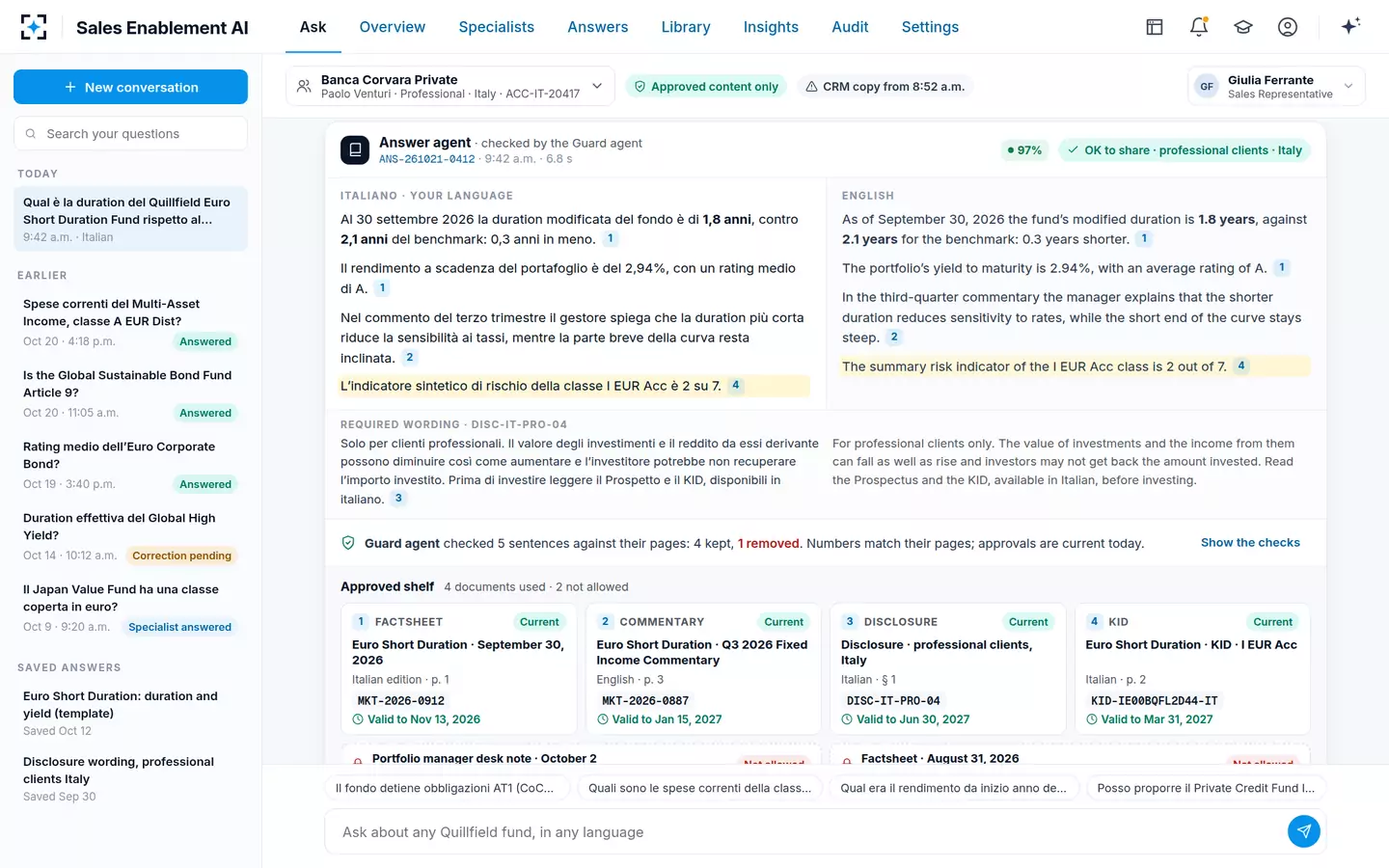
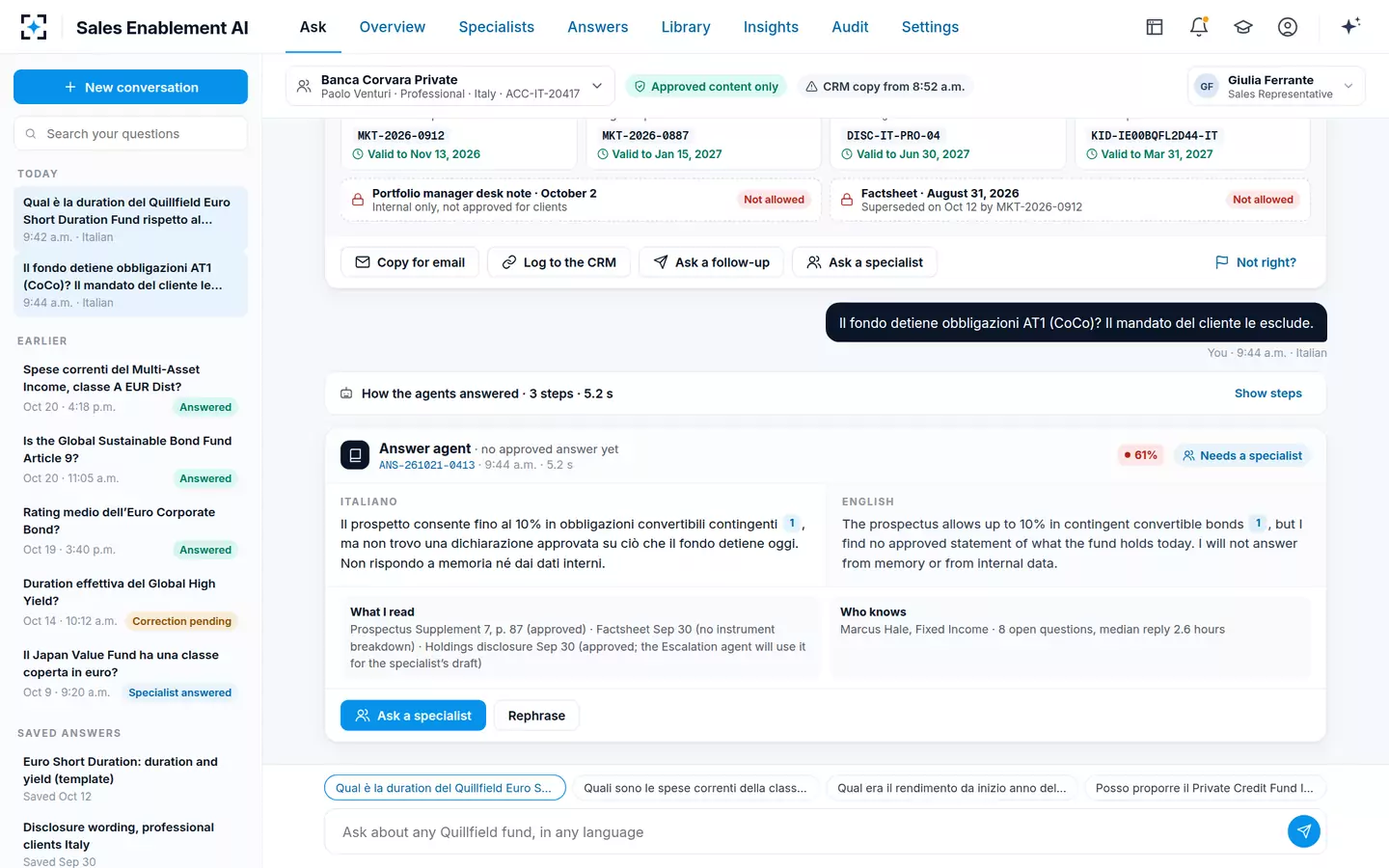
Take one morning at the sample firm. At 9:42 Giulia asks, in Italian, for the duration of the Quillfield Euro Short Duration Fund against its benchmark, for a fund selector at a private bank she is calling at 10:30. The cited answer arrives 6.8 seconds later. Her follow-up, whether the fund holds AT1 bonds that the client's mandate excludes, has no approved answer: the prospectus allows up to 10% in contingent convertibles, but no approved document says what the fund holds today. The question goes to a fixed income specialist at 9:45, with a four-business-hour service level.
One follow-up question, by the clock: the allowance and what it took
- Specialist’s window, 9:45 to 1:45240 min
- With the specialist47 min
- Review22 min
Two things in that timeline are worth noticing. The specialist did not start from a blank page: the reply was drafted from the approved holdings disclosure and the prospectus, and the specialist added one figure, bank senior bonds at 14.2% of net assets, from the same page. And the answer, once approved, was not used once. It joined the approved library, and the three other reps who had asked the same question were told. The next rep to ask gets it in seconds.
The rep's view in Sales Enablement AI: an answer in her language, every sentence cited
Internal wholesaling duties that carry compliance weight
A firm's own description of the seat will list prospecting, territory planning, CRM upkeep and supporting the external wholesaler. The duties below are the ones that carry regulatory weight, and they decide whether a fast answer is also a safe one.
Six internal wholesaling duties, and the rule behind each
- Know what an advisor email is
A message to a registered person of a FINRA member, or to an SEC- or state-registered adviser, is an institutional communication under FINRA Rule 2210, because both are institutional investors. It stops being one if the rep has reason to believe it will be forwarded to a retail investor.
- Treat dealer material as sales literature
SEC Rule 156 counts communications between issuers, underwriters and dealers as sales literature when their content can reasonably be expected to reach prospective investors.
- Quote only current, approved figures
A number from last month’s fact sheet or a portfolio manager’s note is the firm’s statement once the rep sends it.
- Never project performance
Rule 2210(d)(1)(F) bars predictions and projections of performance and any suggestion that past results will repeat. The October 2026 projections change applies only to narrow audiences, from a date FINRA has not yet set.
- Log what was sent
Broker-dealers keep copies of communications sent, and any approvals of them, for at least three years under SEC Rule 17a-4(b)(4).
- Hand off what no document answers
An advisor who is told “let me get the specialist” has waited; one who is told a guess has been misled.
The first duty surprises people who come to the seat from retail. FINRA Rule 2210 defines an institutional investor to include any "member or registered person of such a member" and any person described in Rule 4512(c), which in turn lists "an investment adviser registered either with the SEC under Section 203 of the Investment Advisers Act or with a state securities commission" (FINRA Rule 4512). So most of an internal wholesaler's email is institutional communication. But Rule 2210(a)(4) withdraws that treatment when the firm has reason to believe the message, or any part of it, will be passed on to a retail investor (FINRA Rule 2210). An advisor who asks for a fund's yield "for a client" has just told the rep where it is going. FINRA's three categories, applied to one email, works through that case.
The second is easy to miss because Rule 156 is an SEC rule about fund advertising. Its definition of sales literature reaches past the investor: "Communications between issuers, underwriters and dealers are included in this definition of sales literature if such communications, or the information contained therein, can be reasonably expected to be communicated to prospective investors" (17 CFR 230.156(c)). Material made for advisors is still subject to the rule's test of whether it is materially misleading.
How should a firm measure its internal wholesaling desk?
By the questions, not the calls. Call counts measure activity; the numbers that show whether the desk works are questions per rep, the share answered from an approved source without a specialist, and how long an advisor waits for each answer. No regulator or independent study publishes a benchmark for any of them, so the useful baseline is the firm's own CRM log for one month.
At the fictional sample firm, 600 reps asked about 20,000 questions a month, and the target is nine in ten answered without waiting for a specialist. The second measure belongs to compliance: the share of answers sent from an approved, current document, and a list of every one that was not. Costing one approved answer turns the wait into a cost the head of distribution can weigh.
What registration does an internal wholesaling desk need?
A firm staffs the desk on two things, registration and product knowledge, and only the first is a rule. Registration is a requirement: a rep who solicits fund sales for a member must be registered in the right category, and FINRA's rule for the examinations is plain: "In order to become registered to engage in securities business, an individual must pass the SIE and a qualification exam appropriate for the type of business the individual will engage in" (FINRA, Securities Industry Essentials exam). Product knowledge is what the internal seat builds, because it is where a rep hears every question advisors ask, across every fund, before they are asked in a meeting.
O*NET, the occupational database the Department of Labor sponsors, lists the occupation's tasks in language that fits the seat: "Discuss financial options with clients and keep them informed about transactions", "Identify opportunities or develop channels for purchase or sale of securities or commodities", and "Keep accurate records of transactions" (O*NET 41-3031). The last of those is the one an internal wholesaler does dozens of times a day, every time an answer is logged to the CRM.
What changes when the answers come from Sales Enablement AI
The seat does not change; the waiting does. With an assistant that answers only from approved, current documents, the rep spends the call on the advisor rather than on the content portal, the specialist sees only the questions no document answers, and compliance sees every answer a rep could send, not only the fact sheets it approved.
The people around one advisor question, before and after
Today
Searches the portal, a shared drive and old email, then waits for a specialist; translates the answer for a foreign client.
With agents
Asks in their own language and gets a cited answer in seconds, with a note saying whether it may go to this client.
Still theirs: The advisor relationship and the decision to send.
Today
Arrives at a meeting with questions the internal could not answer in time.
With agents
Gets the answers, and the questions advisors asked between visits, before the meeting.
Still theirs: The case for the strategy.
Today
Answers the same duration question ten times a week between portfolio meetings.
With agents
Sees only questions with no approved answer, each with a drafted, cited reply and duplicates merged.
Still theirs: The expert answer, written once.
Today
Approves fact sheets, but rarely sees the answers reps build from them.
With agents
Signs every specialist reply and correction, and reviews a weekly sample of the answer log.
Still theirs: The signature.
The assistant's limits are as important as its speed. It refuses a fund that is not registered for the client's country or category, it never forecasts, and when no approved source answers the question it says so and offers a specialist instead of guessing. In the sample morning, the Guard agent removed a sentence before the rep saw it, "the team expects to lengthen duration by year-end", because it came from an internal desk note and was a forecast. The same economics hold for the internal seat: in a peer-reviewed study of 5,172 customer-support agents, access to an AI assistant raised issues resolved per hour by 15% on average, and less experienced agents gained in both speed and quality (Brynjolfsson, Li and Raymond, Quarterly Journal of Economics, 2025). A new internal wholesaler is exactly that worker.
When no approved document answers, the assistant says so
To see the whole morning, screen by screen, start from Sales Enablement AI.
Questions people ask
What does a mutual fund wholesaler do?
A mutual fund wholesaler sells a fund family's funds to the advisors and platforms that sell them to investors. The work is explaining the funds, answering advisors' questions about performance, fees, holdings and share classes, and supporting the advisor's own client conversations. The wholesaler works for the fund's distributor, a FINRA member, and is registered.
What does an external wholesaler cover that the internal does not?
An external wholesaler covers a territory in person: meetings with advisors and branch teams, product and portfolio presentations, conferences and client events, usually paired with an internal wholesaler who works the same advisors from the office. The role carries a sales target for the territory, and the material shown or left behind in meetings is subject to the same FINRA communication rules as the internal's email.
Must an internal wholesaler be registered with FINRA?
Yes, if they solicit fund sales for a FINRA member. Rule 1210 requires each person engaged in a member's securities business to be registered in the category that fits their functions, and Rule 1220 has a category for representatives limited to funds and variable products. Firms often ask for broader registrations as well.
Can an internal wholesaler send performance figures to an advisor?
Yes, from an approved, current source, and in a form that would stand up if it reached the advisor's client. A note to an advisor at a member firm is an institutional communication, but not if the rep has reason to believe it will be forwarded to a retail investor, and SEC Rule 482 requires a fund advertisement that shows performance either to quote returns current to the most recent month ended seven business days before use or to say where month-end figures can be found.
How many advisors does an internal wholesaler cover?
No regulator or independent study publishes a figure; it depends on the channel and the firm. The more useful number for a firm to track is questions per rep and the share answered without a specialist: at the fictional sample firm, 600 reps asked about 20,000 questions a month, and the target is nine in ten answered without waiting.