AI sales enablement tools range from content platforms with a chat box added to assistants that answer a rep's question directly, and for a fund manager's sales team the one that earns trust is the one that cites every sentence to an approved page and says "no approved source" rather than guessing. Reps adopt an assistant when its answers survive contact with an advisor, and drop it after the first wrong number they had to retract. That makes trust a design property and a measurable one: it can be built rung by rung, from shadow use to routine, and tracked by how often reps send an answer unchanged. Botminds' Sales Enablement AI was built for that path: seven agents answer, check and translate only approved, current content, hand the rest to product specialists, and leave every decision to send or approve with a person.
The examples come from the solution's sample data, a fictional fund manager, Quillfield Capital, with 600 reps working in 11 languages.
The trust ladder: four rungs from trial to habit, and how to know which one a team is on
1Shadow
Reps ask the assistant and still check the answer themselves before using it: they open the cited page, or ask a colleague.
MeasureShare of answers where the rep opened a citation; questions a rep asked twice.
Move up whenReps find the cited page says what the answer says, answer after answer.
2Compare
Reps use the answer, and compare it with what a specialist or the old route would have said on the questions that matter most.
MeasureAgreement with specialist answers on a sample; “Not right?” flags per 100 answers.
Move up whenFlags are rare, and the ones raised are fixed in the library, not argued about.
3Use with sampling
Reps send answers as they stand; compliance reviews a weekly sample of the answer log, chosen by risk and at random.
MeasureAnswers sent unchanged; findings per 100 sampled answers; refused questions rephrased.
Move up whenFindings fall week on week and come from content gaps, not from the assistant.
4Routine
The assistant is where reps go first. Specialists see only new questions; the library grows from the gaps.
MeasureReps asking each week; questions per rep; reuse of approved answers.
Move up whenThere is no exit: the weekly sample keeps running.
What are sales enablement tools, and what does AI add?
Sales enablement tools are the systems that give sales reps what they need to sell: a content library, training and coaching, guided selling and playbooks, and analytics on what content is used and what works. AI adds two things to that stack. It can write, summarising a document or drafting an email; and it can answer, taking a rep's question and returning a reply instead of a list of files to open.
For a fund manager the second is the one that changes the work, and the one that carries the risk. A rep asking for a share class's ongoing charges does not want ten documents; the rep wants the figure, for this share class, in the client's language, from the current document, with the wording the client's country requires. An assistant that gives that answer becomes, in effect, a writer of client communications, and FINRA's Advertising Regulation FAQs leave no doubt that firms answer for communications whether a person or AI produced them (FINRA FAQ D.8). What FINRA's AI guidance asks of a sales team is covered in its own guide.
What to look for in AI sales enablement tools at a fund manager
Look for proof, not fluency. Every AI sales enablement tool writes well; the ones that suit regulated distribution show where each sentence came from and refuse what they cannot support. The comparison below sets a general-purpose AI sales enablement platform beside an assistant built for fund distribution.
Two kinds of AI sales enablement tool, compared on what a fund manager needs
General AI sales enablement platform: Whatever is in the content library, often with the model’s general knowledge filling gaps.
Assistant built for fund distribution: Only documents with an approval ID, approved and in date today, permitted for this client’s category and country.
General AI sales enablement platform: Links to documents, sometimes.
Assistant built for fund distribution: A citation on every sentence, opening the page in its original language.
General AI sales enablement platform: A plausible answer.
Assistant built for fund distribution: A plain statement that no approved document answers it, and a one-click hand-off to a specialist.
General AI sales enablement platform: Depends on the prompt.
Assistant built for fund distribution: Removed by rule, even when the source document contains one.
General AI sales enablement platform: Not modelled.
Assistant built for fund distribution: Refuses funds not registered for the client’s country or category, and says whether the answer may be shared.
General AI sales enablement platform: The next answer uses the new version.
Assistant built for fund distribution: The next answer uses the new version, and every past answer that cited the old one is found and corrected.
General AI sales enablement platform: Usage analytics.
Assistant built for fund distribution: An answer log with sources and checks, sampled weekly by compliance.
Seven things to see an AI sales enablement tool do before you buy it
- Answer a question from your current factsheet, and cite the page
Then change the factsheet’s validity date to yesterday and ask again. It should refuse and offer the current version.
- Refuse a question no approved document answers
Ask about current holdings when only the prospectus limit is approved. A guess is a fail.
- Strip a forecast out of a source
Give it a commentary or desk note with a view on rates. The view must not reach the answer.
- Refuse a fund not registered for the client
Put a client in a country where the fund is not registered, and ask.
- Answer in the rep’s language without translating the disclosure
Approved local wording should be used as written, beside the answer.
- Show you the log
Every answer, the documents it read and rejected, the sentences it removed, and who approved what.
- Recall answers after a correction
Correct a figure in a document and ask the vendor to list every answer that used the old one.
Why reps trust a tool that says no
A rep's trust in an assistant is set by its worst answer, not its average. One wrong duration sent to a fund selector costs the rep a correction and some credibility with the client; after that, the rep checks everything, and an assistant that has to be checked every time saves nothing. The assistant that keeps a rep's trust is the one that never makes the rep retract, and the cheapest way to never be wrong is to refuse when the source is not there.
In the sample morning, a rep asked whether a bond fund held AT1 bonds, because her client's mandate excluded them. The assistant found that the prospectus allows up to 10% in contingent convertibles, said it had no approved statement of what the fund holds today, named the fixed income specialist who would know, and offered to send the question. "I will not answer from memory or from internal data," its reply ends. The specialist's answer, approved by compliance 68 minutes after she asked, was then available to every rep in seconds.
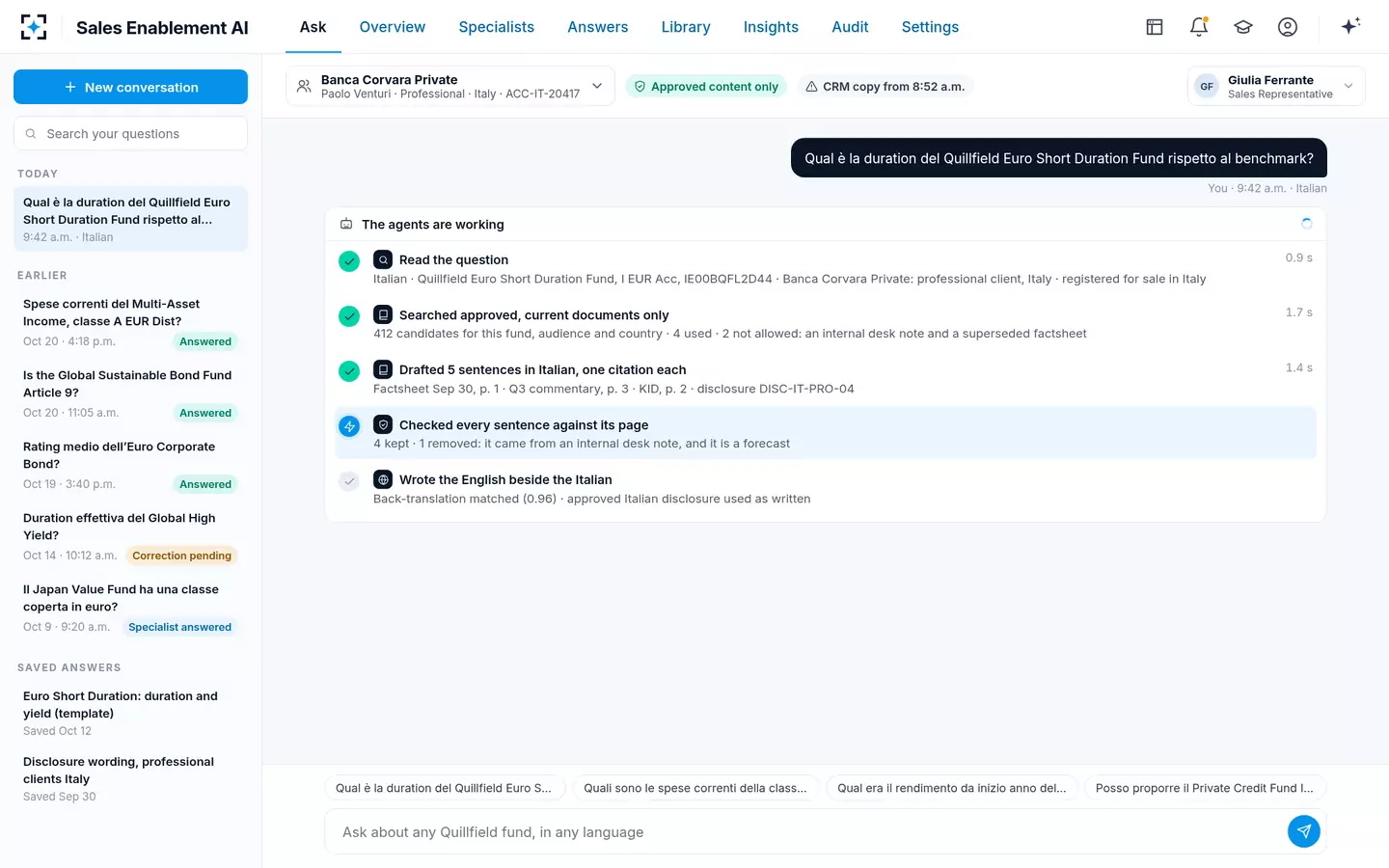
Every step in view: what Sales Enablement AI read, used and refused to use
The research on AI assistance at work points to where trust is earned fastest. In a peer-reviewed study of 5,172 customer-support agents, the gains from an AI assistant were greatest on problems that came up only occasionally, where the human agents had little experience of their own but the system had enough examples to learn from, and less experienced agents improved in both speed and quality (Brynjolfsson, Li and Raymond, Quarterly Journal of Economics, 2025). For a sales team that means the new rep and the unfamiliar fund. A field experiment with 758 consultants found the other edge: on a task outside what the AI did well, consultants using it were markedly less likely to reach a correct answer than those without it (Dell'Acqua and others, Harvard Business School working paper, 2023). An assistant that knows where its edge is, and says so, keeps reps on the right side of it.
How do you get reps to use an AI assistant?
Put it where the question is asked, start with the questions asked most often, and let reps see it refuse. A rollout that begins with a training session and a link to a new portal competes with a rep's habit of messaging a specialist. One that starts inside the conversation, with the client already in context from the CRM, removes a step instead of adding one.
Four practices move a team up the ladder faster. Start with the question families that repeat most, such as duration, fees by share class and registration, so early answers are right and visible. Make escalation one click, so a question the assistant cannot answer costs the rep nothing. Show reps what the assistant removed and why, so they stop typing it back by hand. And publish the gaps closed: when the sample firm's specialist answered the AT1 question once, the three other reps who had asked it were told, which is the strongest argument for asking next time.
Adoption in the sample firm's first three weeks of October
571of 600
reps asked at least one question
11
languages the questions came in
89.2%
of questions answered from approved content
What reps need to see on every answer before they rely on it
Reps rely on what they can check in a few seconds, so the answer has to carry its own proof. Five things on the screen do that work, and a tool that hides any of them asks the rep to take it on faith.
The first is the citation on each sentence, opening the page itself rather than the document's first page. The second is the as-of date of every figure, because a duration without a date is not an answer an advisor can use. The third is the list of documents used, each with its approval ID and expiry, and the documents the tool was not allowed to use, so the rep sees that the desk note was rejected rather than missed. The fourth is a plain statement of whether the answer may go to this client, which in the sample firm reads "OK to share · professional clients · Italy". The fifth is what was removed and why. In the sample morning, the rep saw that one of five sentences had been removed because it came from an internal desk note and was a forecast; a rep who sees that once stops wondering what the tool might be leaving in.
Sales enablement AI agent or AI-powered platform: what is the difference?
An AI-powered platform usually means one model behind a search or chat box. A sales enablement AI agent design splits the work among agents with separate jobs and written limits, so a check is done by something other than the writer. In Sales Enablement AI, the Answer agent drafts, and the Guard agent, which can only keep, remove or block, re-reads every sentence against its page before the rep sees it.
The useful question about any agent is how much it may do on its own. The Bank of England and FCA's 2026 survey of UK financial firms sorted agents into four levels of autonomy, and the distribution is a guide to what regulated firms are comfortable with: 80% of respondents reported agents used for decision support, 46% agents with constrained execution, 22% agents with conditional autonomy, and only 2% agents with broad autonomy (Bank of England and FCA, Artificial intelligence in UK financial services 2026).
Levels of agent autonomy, and what each would mean in a sales assistant
| Autonomy level | Share of UK firms reporting it | In a sales assistant |
|---|---|---|
| Decision support: the agent recommends, a person decides and acts | 80% | Drafts a cited answer; the rep decides whether to send it. |
| Constrained execution | 46% | Removes an unsupported sentence, refuses an unregistered fund, routes a question to a specialist. |
| Conditional autonomy | 22% | Would send a pre-approved answer to a client without the rep. Sales Enablement AI does not. |
| Broad autonomy | 2% | Would write and send new client communications unsupervised. Not appropriate for regulated sales. |
The measure that tells you which rung you are on: answers sent unchanged
The share of answers a rep sends exactly as drafted is the single best measure of trust, because it is behaviour rather than opinion. A rep who rewrites every answer does not trust the assistant, or does not trust its tone; a rep who sends answers unchanged and never gets a finding in the weekly review has reached rung 3.
Read it with two companions. Flags per 100 answers, where a rep marks an answer "not right", show whether low trust is earned; a team with many edits and few flags has a style problem, not an accuracy one. And refused questions rephrased show the opposite risk, a rep who trusts the assistant too little to accept its refusal. The sample firm's log shows what that looks like: two reps asked the assistant for a view on rate cuts, were refused, and asked again in other words. The second attempts were refused too, and compliance treated it as coaching for the reps rather than a fault in the tool.
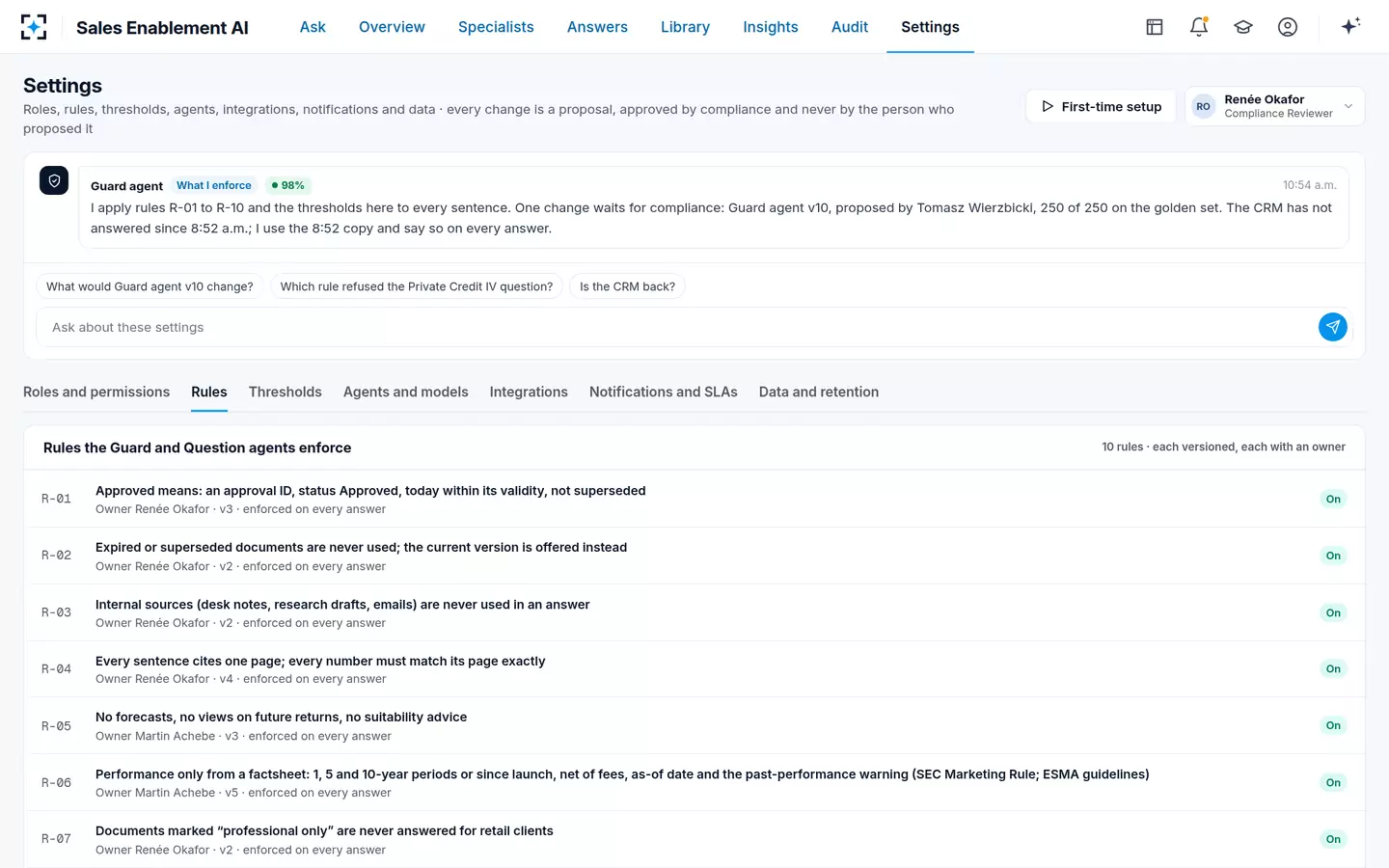
The rules a rep can rely on, each with an owner and a version
Where Sales Enablement AI fits among AI sales enablement tools
Sales Enablement AI is the answer layer, not the whole stack. It does not host the content library, design factsheets or decks, run training and certification, record calls or replace the CRM. It reads the library, the approval register, fund data and registrations and the CRM's client category and country, read-only, and it writes back only what a rep chooses to share, logged as a CRM activity.
Its fit is narrow on purpose: answering reps' fund questions from approved content, in their language, with every sentence cited, specialists writing what is new and compliance signing it. A firm whose main gap is coaching, deal rooms or presentation design needs a different tool. A firm whose reps wait hours for numbers that sit in approved documents, or whose compliance team cannot see the answers reps send, is the case it was built for. The sample morning, from the first question to the signed weekly review, is on the Sales Enablement AI page, and a pilot on last quarter's questions is the way to find out on your own documents.
Questions people ask
What is the best AI sales enablement tool for an asset manager?
No regulator or independent study ranks them, and vendor rankings test fluency rather than control. The best fit for a fund manager is the tool that answers only from documents approved and in date on the day, cites every sentence, refuses what it cannot support and logs everything for supervision; test those on your own documents before choosing.
What is a sales enablement AI agent?
It is an AI component with one job and written limits inside a sales assistant: reading the question, drafting the answer, checking it, translating it or routing it to a specialist. Splitting the work lets one agent check another, so the agent that wrote a sentence is never the one that approves it.
How long does it take reps to trust an AI assistant?
No study measures it for sales teams, so track it: the share of answers sent unchanged, flags per 100 answers and findings per 100 sampled answers show which rung of the ladder a team is on. The first wrong number a rep has to retract sets trust back further than any training session moves it forward.
Do AI sales enablement tools replace product specialists?
No; they take the repeat work away. In the sample firm's estimate, specialist time falls from about 125 days a month to 20, but the 12 days spent on genuinely new questions barely move, and each new answer, once approved, serves every rep who asks next.
Are AI sales enablement tools FINRA compliant?
A tool cannot be compliant on its own; a firm's use of it can be. FINRA holds firms responsible for communications whether a person or AI wrote them, and supervises chatbot messages by audience, so what matters is whether the tool gives the firm the controls, logs and review its procedures need.