Sales enablement in financial services is the work of giving sales reps, wholesalers and advisors the knowledge, content and answers they need to sell regulated products, and at a fund manager it works best when it starts from the questions reps ask rather than from the documents the firm publishes. Those questions fall into a handful of families, such as performance, fees and share classes, holdings, where a fund may be sold and to whom, and sustainability and risk, and each family has its own source of truth, its own clock and its own rule. A programme built as a document library makes every rep translate a question into a file and a page; one built as a map from question to source answers it. Botminds' Sales Enablement AI works from that map: it answers each question from the approved document that owns it, cited to the page, and groups what the library cannot answer into a ranked list of content to write.
The examples come from the solution's sample data: Quillfield Capital, a fictional fund manager whose 600 reps asked more than 13,600 questions in 11 languages in the first three weeks of October 2026.
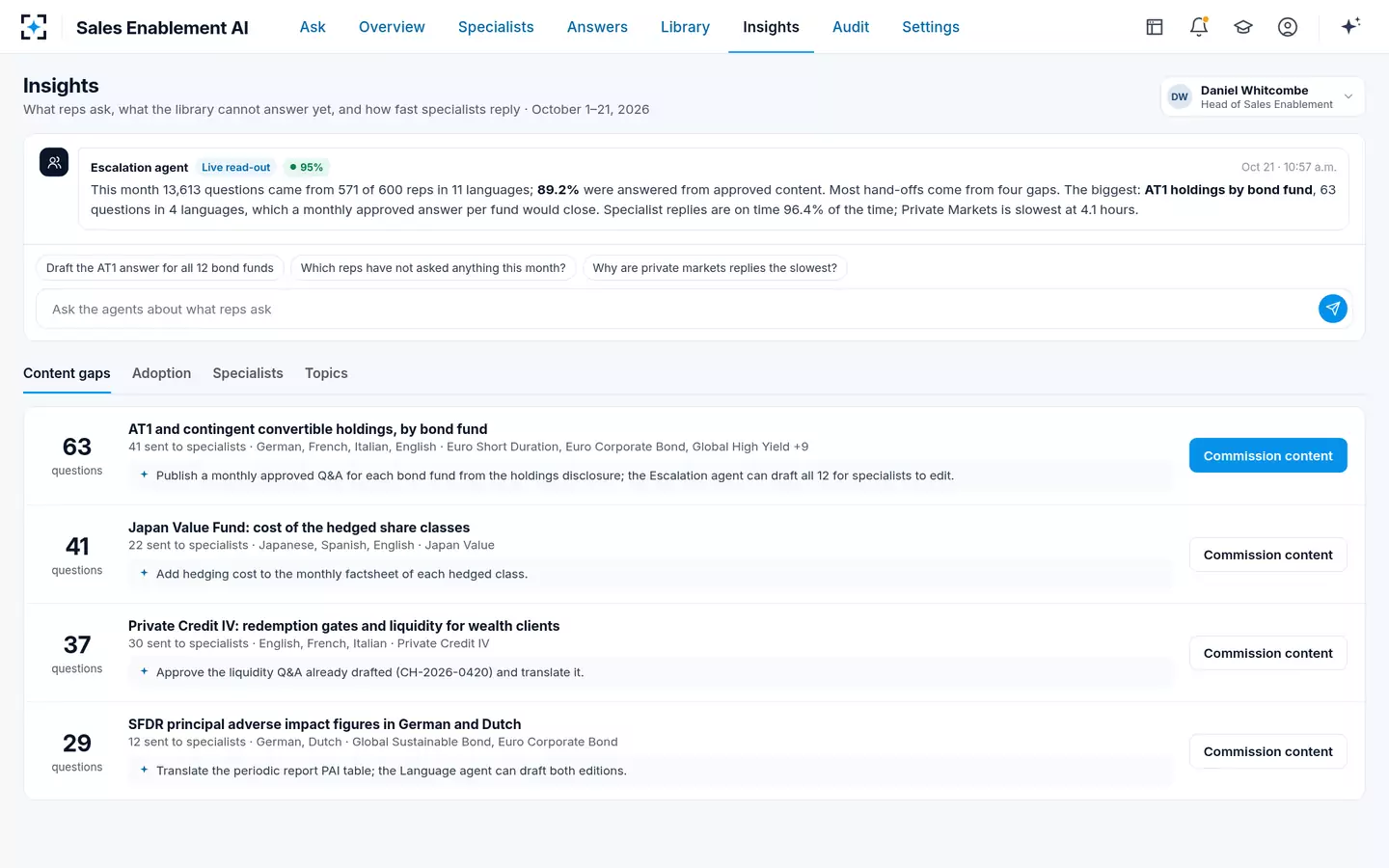
What the library could not answer: the four biggest content gaps in a sample month
What is sales enablement in financial services?
Sales enablement is the function that equips a sales force to sell: content, training, tools and access to experts, organised so that a rep has what a client needs at the moment the client needs it. In financial services the definition gains a clause. What the rep says is a regulated communication, so enablement has to deliver answers that are correct, current and permitted for the client, not merely persuasive.
The distribution chain adds a second obligation that runs the other way. In the UK, the Consumer Duty makes the manufacturer of a product responsible for ensuring "that firms distributing the product have all necessary information to understand the value that the product is intended to provide to a retail customer" (FCA Handbook, PRIN 2A.4.15). The FCA's product governance rules start the distributor's side with the same verb: "A distributor must: (1) understand the financial instruments it distributes to clients" (FCA Handbook, PROD 3.3.1R). For a fund manager, sales enablement is the practical form of the first duty and the precondition of the second.
The questions reps actually ask: five families
Most of what reps ask about funds falls into five families. The family decides where the answer must come from, how often it changes and which rule it must satisfy, so it is the right unit to organise enablement around.
A question-to-source map for a fund manager's sales team
| Question family | Typical question | Where the answer must come from | Its clock and rule |
|---|---|---|---|
| Performance | How did the fund do against its benchmark over five years? | The current approved factsheet for the share class | Monthly. US fund advertising ties performance to recent month-ends (SEC Rule 482); in the EU it must match the prospectus or KID (ESMA guidelines). |
| Fees and share classes | What are the ongoing charges for the A EUR Dist class? | The prospectus fee table or the KID’s cost section, for that class | Annual or on change; the US fee table includes the 12b-1 line (Form N-1A Item 3). |
| Holdings and exposures | Does the fund hold AT1 bonds? What is its duration? | The approved holdings disclosure, or the factsheet’s characteristics | Monthly, released under the fund’s disclosure policy. |
| Where it may be sold, and to whom | Can I offer this fund to a retail client in Portugal? | The registration list by share class, country and client category | On every registration change; refusals matter as much as answers. |
| Sustainability and risk | Is the fund Article 9? What is its risk indicator? | The SFDR disclosures and the KID | Periodic and on change; required wording by country. |
Two features of the map are easy to miss. The registration family is the one where "no" is the most important answer: a fund described to a client in a country where it is not registered is a problem however accurate the description. And the families overlap in single questions. "Is the Global Sustainable Bond Fund Article 9, and can my client in Austria buy the retail class?" draws on the sustainability disclosure and the registration list at once, which is exactly the kind of question a document library cannot answer by search.
Which questions need a product specialist?
A question needs a specialist when no approved document answers it. Everything else should be answerable from the map in seconds, and the share that is not is the clearest measure of what the content programme still owes the sales team.
In the sample month, about one question in ten went to a specialist or was refused, and the escalations clustered. The AT1 question, whether each bond fund held contingent convertibles, came up 63 times in four languages because the prospectus states a limit and the factsheet gives no instrument breakdown; only the holdings disclosure answers it, and reps could not find it in that form. Hedged share-class costs, private credit liquidity terms and translated sustainability figures followed. Each is a gap a document can close: a monthly approved answer per bond fund, a hedging-cost line on each hedged class's factsheet, an approved liquidity Q&A, a translated table.
A document library and a question-to-source map, compared
Organised by document: Guesses which document holds it, opens it, finds the page.
Organised by question: Asks the question; the answer cites the page.
Organised by document: Two searches, and the rep joins them.
Organised by question: One answer, each sentence cited to its own source.
Organised by document: Invisible: the rep messages a specialist.
Organised by question: A ranked list of unanswered questions, counted by language and fund.
Organised by document: The new version replaces the old in the library.
Organised by question: The new version is used, and answers that cited the old one are found.
Organised by document: Whatever is on the production calendar.
Organised by question: Whatever closes the biggest gap.
What is a sales enablement program at a fund manager?
A sales enablement programme at a fund manager is the set of people, content and routines that keep the question-to-source map complete and current. It has a short list of working parts, and each can be checked.
The working parts of a sales enablement programme for fund distribution
- A question log
Every rep question, with fund, share class, client category and country, the answer and its source. Without it, nothing below can be measured.
- A question-to-source map
For each family, the approved document that owns the answer and the rule it must satisfy.
- An approved answers library
Short, cited answers to repeated questions, approved once, valid until their source changes.
- A specialist desk with a service level
For questions no document answers, with a drafted reply to start from and duplicates merged across languages.
- Compliance review built in
Every new answer and correction approved before use, and a regular sample of the answers reps sent.
- A gap-to-content loop
Unanswered questions ranked monthly and turned into commissioned content, with an owner and a date.
- Feedback to the manufacturer
What reps are asked, refused and unable to answer, passed to product and marketing.
The last item is a regulatory feature as much as a commercial one. ESMA's product governance guidelines say "distributors must provide them with information on sales" to support manufacturers' product reviews, and give as examples "information on which distribution channels have been employed, the proportion of sales made outside the target market, summary information of the types of clients, a summary of any complaints received, and questions suggested by the manufacturer to a sample of clients for feedback" (ESMA product governance guidelines, 2023). A question log is the richest source a fund manager has of what intermediaries' clients actually want to know.
What does a sales enablement person do? Roles and responsibilities
A sales enablement person makes sure reps can answer, which in practice means owning the gap between what reps are asked and what the library can say. At a fund manager the work is shared among several roles, and the programme fails where their responsibilities blur.
Five roles in a fund manager's sales enablement, and what each owns
Today
Owns the library, the specialists’ service levels and adoption, but sees questions only when reps complain.
With agents
Sees volume, adoption by region and language, specialist service levels and content gaps ranked by questions.
Still theirs: Commissioning the content that closes each gap.
Today
Publishes and retires factsheets, commentaries and talking points by hand.
With agents
Sees what expires within 30 days, where each document was cited, and new versions spotted for review.
Still theirs: Proposing every library change.
Today
Answers the same questions all week between portfolio meetings.
With agents
Sees only questions no document answers, with a drafted, cited reply.
Still theirs: The expert answer.
Today
Approves documents but rarely the answers built from them.
With agents
Signs every new answer, change and correction, and samples the answer log weekly.
Still theirs: Every approval.
Today
Searches, waits and translates.
With agents
Asks in their own language and gets a cited answer, with a note on whether it may go to this client.
Still theirs: The client and the decision to send.
Why a document library misses the question
A library is organised the way the firm produces content: by document type, fund and date. Reps' questions are organised the way clients think: by concern. "What does this fund cost me?" is a fee-table question for one share class; "is it safe for my client?" is a risk indicator, a holdings breakdown and a suitability question the rep must not answer. A library can hold every document that matters and still leave the rep doing the joining.
The question log also shows what the library holds that it should not offer. In the sample firm a portfolio manager's internal desk note was the most relevant document for a duration question, and it was refused, because it is internal and contains a forecast. If reps keep asking questions that only internal material answers, the right response is an approved document, not a looser rule. The client inquiry desk faces the same tension with institutional clients' requests for holdings, on a different clock.
Sales Enablement AI insights: the question log, grouped into content to write
Turning the question log into content with Sales Enablement AI
The loop is short when the log is structured. Questions without an approved answer are grouped by topic and fund, counted by language, and ranked; the head of sales enablement commissions the content that closes the biggest gaps; specialists write or edit it; compliance approves it; and the next rep who asks is answered in seconds. In the sample firm, the AT1 gap's fix was a monthly approved answer per bond fund, drafted from each fund's holdings disclosure for the specialist to edit.
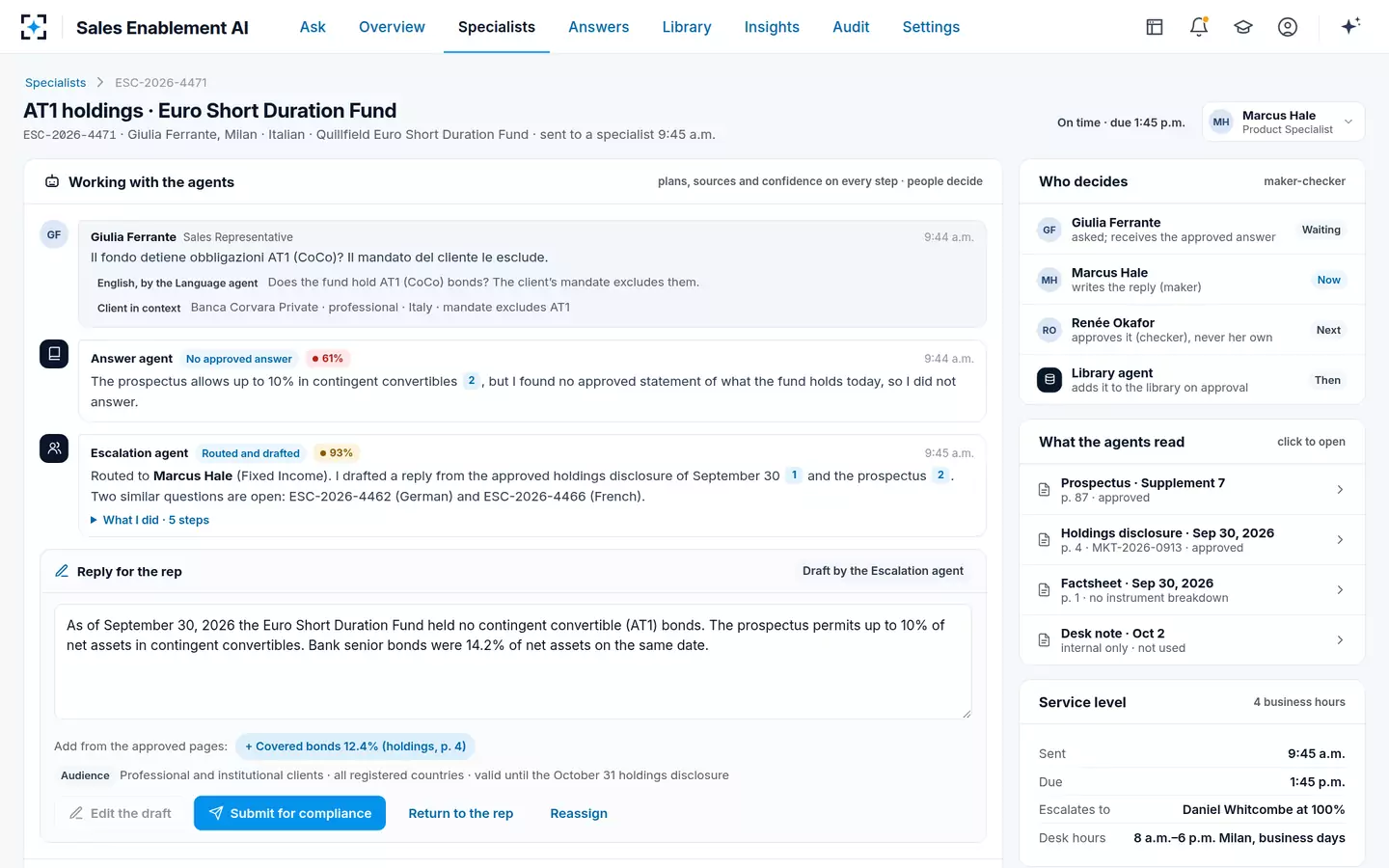
Merging is what makes the loop cheap. The same question arrives in Italian, German and French within an hour; a specialist who answers it three times has done two answers too many. When the sample firm's specialist opened the Italian rep's AT1 question, the two similar open questions in German and French were already attached, and one approved answer, written in three languages, closed all of them.
One question, three languages, one answer to write
To price what the loop saves, cost one approved answer; to see what happens when one of the sources changes after reps have used it, read content management for sales enablement. Sustainability questions have their own source documents, and SFDR reporting is where they are produced. The whole sample morning is on the Sales Enablement AI page.
How to start: a two-week question log
A firm can build its first question-to-source map in two weeks without buying anything. Ask a dozen reps across regions and languages, and the specialists they call most, to log every fund question they receive or send for ten working days: the question as asked, the fund and share class, the client's category and country, where the answer came from, how long it took and whether a specialist was needed.
Sort the log into the five families and count. The result shows three things a document inventory never does: which families carry the volume, which questions have no approved source at all, and which approved documents reps cannot find in practice. Those three lists are the programme's first work plan, and the counts become the baseline that any later tool, process or hire has to beat.
Questions people ask
What is sales enablement in asset management?
It is the function that equips a fund manager's wholesalers and sales reps to answer intermediaries' and clients' questions with approved, current content, and to get the rest from product specialists quickly. Its distinctive constraint is that every answer is a regulated communication, so speed only counts when the answer is right and permitted for the client.
What is the difference between sales enablement and sales operations?
Sales operations runs the machinery of selling: territories, CRM data, pipeline, compensation and reporting. Sales enablement equips the rep for the conversation: content, training and answers. At a fund manager the two meet in the CRM, which holds the client's category and country that every permitted answer depends on.
How do you build a question log?
Capture every rep question with the fund, share class, client category and country, the answer and the document and page it came from, and whether it went to a specialist. A two-week sample logged by hand is enough to see the families; an assistant that cites every answer keeps the log automatically.
Who should own sales enablement at a fund manager?
A head of sales enablement inside distribution, owning coverage, adoption and content gaps, with content owners in marketing, product specialists for new answers and marketing compliance for approvals. Splitting ownership this way keeps each measure with the person who can move it.
Why do manufacturers need to know what reps are asked?
Because product governance runs both ways. The FCA requires manufacturers to give distributors the information to understand a product's value, and ESMA asks distributors to give manufacturers information on sales, client types and complaints for product reviews. Reps' questions are where intermediaries' clients' concerns first show up.