FINRA's AI rules are not a separate rulebook. FINRA's position, set out in Regulatory Notice 24-09 in June 2024 and repeated since, is that its rules are technology neutral and apply in full when a member uses generative AI: a sales answer drafted by a chatbot is supervised, kept and judged by the same content standards as one a registered rep typed. For a sales team, that settles the design of any AI assistant before the first demo. Agents may find, draft, check and cite; a registered person decides what goes to a client; and compliance signs anything that becomes the firm's standard answer. Botminds' Sales Enablement AI is built on exactly that line, and this guide sets out the rules that put it there.
Where the solution appears below, the examples come from its sample data: Quillfield Capital, a fictional fund manager with 600 reps, and its fictional people.
Gen AI communication tools can be part of such a reasonably designed system, provided they are vetted, tested and monitored.
FINRA Regulatory Notice 26-14, 9 July 2026
What are FINRA's AI rules? The same rules, applied to a new writer
FINRA has published no rule written for AI. It has published guidance that its existing rules reach AI. Regulatory Notice 24-09, published on 27 June 2024, reminds members that FINRA's rules are meant to be technology neutral and keep applying when firms use generative AI, and that Rule 2210's content standards hold whether a person or a technology tool produced the communication (FINRA Regulatory Notice 24-09). The same notice repeats that each member needs a supervisory system reasonably designed for its own business.
The practical reading is that every obligation a sales team already has follows the text, not the author. A fund's yield in a chatbot reply must be accurate, current and balanced. The reply must be kept. Someone must supervise it. What changes with AI is the volume and the speed at which those obligations are tested, which is the problem FINRA itself raised in 2026.
Is a firm responsible for AI-generated sales answers?
Yes, entirely. FINRA's Advertising Regulation FAQ D.8, posted on 10 May 2024, answers "yes" to exactly this question: firms are responsible for their communications whether a person or AI technology generated them. It goes on to say that AI-generated communications must comply with the securities laws and FINRA rules, including supervision, recordkeeping and the content standards of Rules 2210 and 2220 (FINRA Advertising Regulation FAQs). The FAQ makes no exception for a tool a vendor built, or for a draft a rep sent without reading.
FAQ B.4, posted the same day, deals with chatbots used with investors. Its answer turns on audience: a chatbot's messages may be correspondence, retail communications or institutional communications depending on who receives them, and the firm must therefore supervise them under the FINRA rules for that category, citing Rules 2210(a), 2210(b), 3110(b)(4) and 3110.06 through .09. The content must also meet the standards in Rule 2210(d). So a chatbot is not a fourth category of communication; it is a fast writer of the three that already exist. FINRA's three categories, applied to one rep's email, shows how one answer can move between them.
Which FINRA rules an AI sales assistant touches
An assistant that answers reps' fund questions touches five sets of obligations, and each one has to be met by design rather than by hoping the rep notices. The table maps them.
The rules behind every AI-drafted sales answer
| Obligation | What the rule says | What the assistant must do |
|---|---|---|
| Fair and balanced content | Rule 2210(d)(1)(A): communications must be based on principles of fair dealing and good faith and be fair and balanced. | Answer only from approved documents, with the as-of date and the required wording for the audience. |
| No projections | Rule 2210(d)(1)(F): no predictions or projections of performance, and nothing implying that past results will repeat. | Remove forecasts and views on future returns, including those in internal notes. |
| Review by category | Rule 2210(b): principal approval for retail communications, supervision under Rule 3110 for correspondence, written procedures for institutional communications. | Know the client’s category and country from the CRM, and say whether the answer may be shared with this client. |
| Supervision | Rule 3110 and FAQ B.4: chatbot communications are supervised under the rules for their category. | Give compliance the answer log and a sample to review, with what was removed and why. |
| Books and records | Rule 2210(b)(4) and SEC Rule 17a-4(b)(4): communications sent, and any approvals of them, kept for at least three years. | Keep every answer with its sources, checks and approvals, in a form an examiner can read. |
The records row deserves a second look. SEC Rule 17a-4(b)(4) requires a broker-dealer to keep copies of the communications it sends, together with their approvals, for at least three years, the first two in an easily accessible place (17 CFR 240.17a-4). An assistant that keeps the final answer but not the documents it read, or the sentence it removed, leaves the firm unable to show why the answer was right. The sample firm keeps every answer, source, check and approval for seven years, its own setting, longer than the rule asks.
FINRA AI guidance on agents: what the 2026 oversight report flags
FINRA's December 2025 Annual Regulatory Oversight Report gave generative AI its own section for the first time, and it addresses AI agents directly. It describes them as systems that carry out and complete tasks for a user on their own, and lists the risks that come with that autonomy: agents acting without a person validating and approving the result, agents going beyond the authority the user meant to give them, and multi-step reasoning that is hard to trace or audit afterwards (FINRA, 2026 Annual Regulatory Oversight Report).
The report's effective practices are where a sales team should start. Among them: "Ongoing monitoring of prompts, responses and outputs to confirm the GenAI solution continues to perform as expected and results in compliant behavior", keeping prompt and output logs, and human review of model outputs. For chatbots used with investors it lists supervision and retention of the communications, and of the chat sessions themselves. Each of those is a feature to ask a vendor to show, not a policy to write after go-live.
Does FINRA require approval of AI-generated communications?
Only where it requires approval of any communication. Under Rule 2210(b) as it stands, a qualified registered principal must approve each retail communication before use or filing; correspondence is supervised and reviewed under Rule 3110; institutional communications follow written procedures the firm sets. An AI author changes none of that. What FINRA has signalled is that the pre-use approval model itself strains under AI's volume.
Regulatory Notice 26-14, published on 9 July 2026, asked for comment on dropping the requirement that a principal approve every retail communication before use, in favour of risk-based standards for supervising them (FINRA Regulatory Notice 26-14). Its reasoning names AI. FINRA reports that, from its engagement with members, "applying the principal pre-use approval requirement to AI-generated retail communications can be challenging", and adds: "These challenges are compounded by the potential speed and volume of AI-generated communications." It then sets the condition quoted at the top of this page: such tools can sit inside a reasonably designed supervisory system if they are vetted, tested and monitored.
What FINRA's filings review found, 2023 to 2025
4,501
retail communications filed before first use and reviewed by FINRA
24%
of those pre-filed communications were noncompliant
172,898
retail communications filed after first use
593
members submitted them
Read the numbers as the case for supervising content where it is produced. One pre-filed communication in four failed review even though firms knew it would be read by FINRA first. An assistant that writes thousands of answers a month cannot rely on a principal reading each one; it has to stop the noncompliant sentence before the rep sees it, and leave a trail a reviewer can sample. None of Notice 26-14 is in force; until a rule change is approved, Rule 2210(b)(1) is unchanged. The SEC approved a separate change on 15 October 2026 that lets broker-dealers show projections and targeted returns to some audiences, from a date FINRA has yet to announce; both 2026 Rule 2210 changes are set out in a guide of their own.
Agents prepare, reps send: drawing the authority line
The rules leave one design that works at volume: agents do the reading, drafting, checking and citing; people keep every decision that puts words in front of a client or into the firm's library. In Sales Enablement AI the line is drawn agent by agent, and each agent's limit is written into its job.
Sales Enablement AI: who prepares, who sends, who signs
Agent
Question agentReads the question: language, fund and share class, the client’s category and country from the CRM, and whether the fund is registered for them.
Never: Guesses an ambiguous fund, or answers for an unregistered one.
Agent
Answer agentSearches only approved, current documents permitted for this audience and country; drafts one cited sentence at a time.
Never: Uses internal notes, the web, expired documents or its own knowledge; forecasts or advises.
Agent
Guard agentRe-reads every sentence against its page: numbers, as-of date, approval valid today, audience, no forecast; attaches the required wording.
Never: Adds content. It keeps, removes or blocks, and blocks the whole answer below 90% support.
A person decides
RepReads the cited answer and the note on whether it may go to this client; decides whether to send it.
Never: Is sent anything on their behalf.
A person decides
Product specialistWrites the answer no approved document covers, from a drafted, cited reply.
Never: Approves their own reply.
A person decides
Compliance reviewerApproves every specialist reply, library change and correction with a reason code, and signs the weekly review of the answer log.
Never: Is bypassed: nothing new reaches a rep before approval.
The design maps onto FINRA's three agent risks one by one. Autonomy without validation: no agent sends to a client or approves. Scope beyond authority: each agent's limits are settings a compliance reviewer owns, versioned and changed only by approval. Auditability: every step, by a person or an agent, is a line on the audit trail with the evidence it used.
Sales Enablement AI's Guard agent shows its work, including what it removed
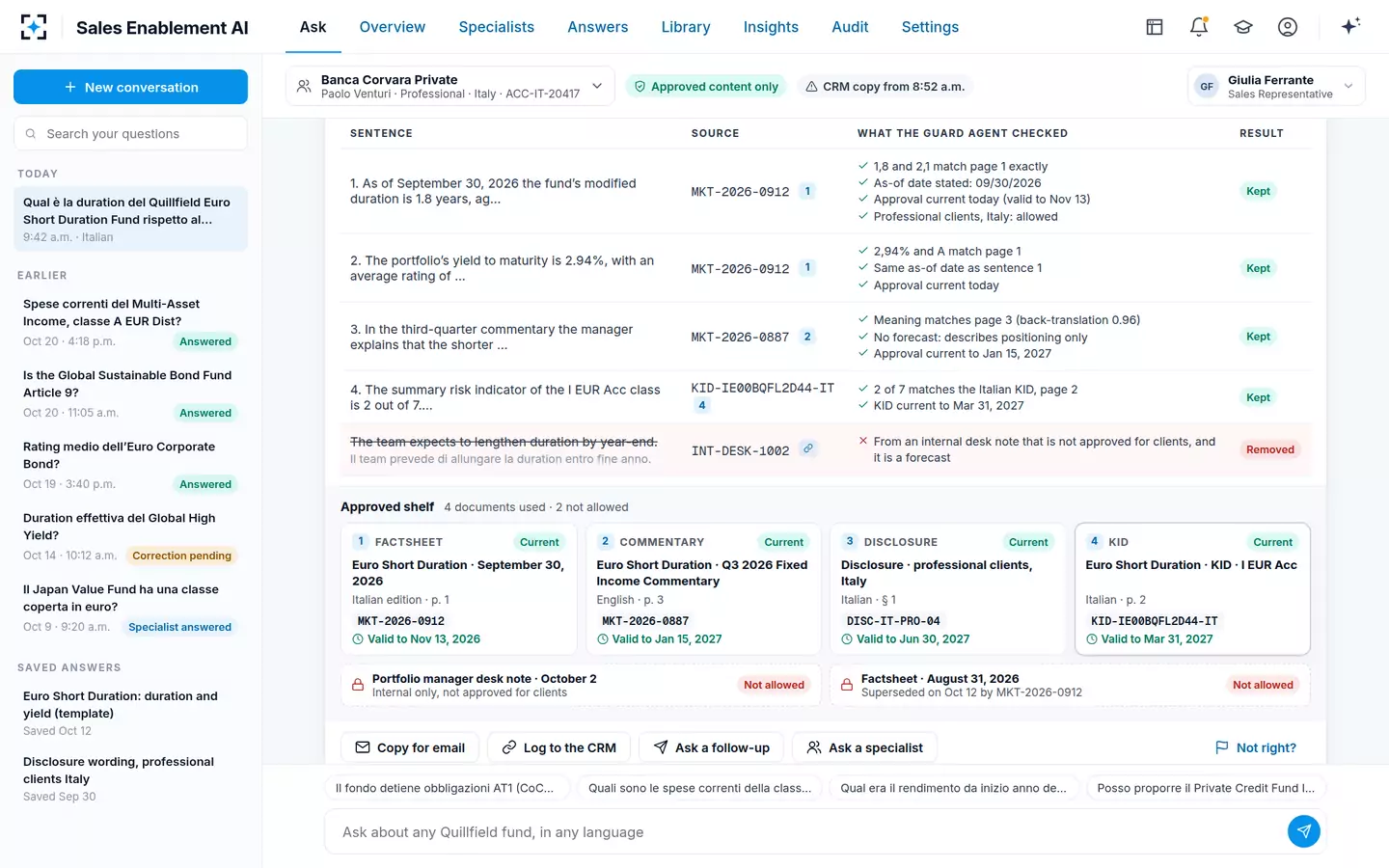
Showing the removal to the rep matters more than it looks. A rep who never learns why a sentence vanished may type it back from memory. In the sample firm's weekly review, the Log Review agent found two reps who had rephrased a refused forecast question to try to get a view on rate cuts; both were refused again, and the pattern went to compliance as a coaching item.
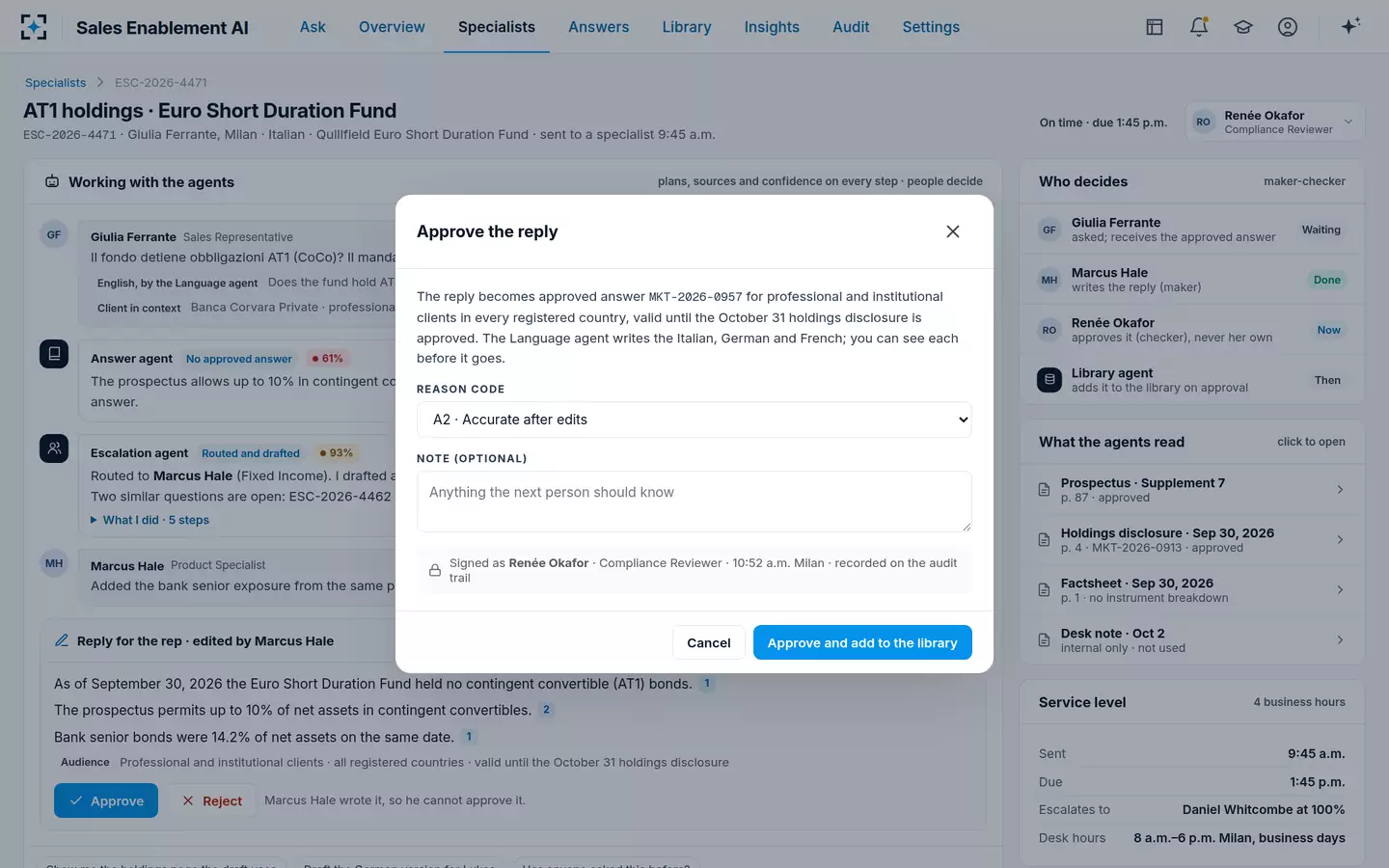
Maker-checker on every new answer: the writer cannot approve
Outside FINRA: what the SEC, ESMA and the Bank of England add
The SEC, ESMA and the UK regulators reach the same place by their own routes. The SEC's Division of Examinations, in its fiscal 2027 priorities, writes that registrants are building what it calls "super intelligence" into their businesses, with client communications among the uses it names, and says it will examine whether firms still meet obligations it describes as technology neutral (SEC Division of Examinations, FY2027 priorities). The statement is staff guidance, not a rule.
Three regulators, one principle: the firm answers for the AI's words
What the regulator says: Rules are technology neutral; firms are responsible for AI-generated communications; chatbots are supervised by audience; AI tools must be "vetted, tested and monitored".
What it asks of a sales assistant: Category-aware answers, a supervised answer log, a test set before go-live and monitoring after.
What the regulator says: Firms that use chatbots or other AI systems to interact with clients should tell those clients, during the interaction, that the technology is in use.
What it asks of a sales assistant: Where a client talks to the assistant directly, say so. A rep-facing assistant whose answers the rep sends keeps the rep as the firm’s voice.
What the regulator says: Agents with more autonomy are most likely deployed in operations and IT, risk and compliance, and sales and marketing.
What it asks of a sales assistant: Sales is where autonomy is creeping in first, which is why the send and approve steps stay with people.
The UK survey adds a useful reality check on autonomy. Most of the firms surveyed deployed agents with limited autonomy, chiefly for decision support, where the agent recommends and a person decides and acts, and only 2% reported agents with broad autonomy (Bank of England and FCA, 2026). The survey also found that "where AI agents were reported to have greater levels of autonomy, they were most likely to be deployed in Operations and IT, Risk and Compliance, and Sales and Marketing". A sales assistant that keeps the send button with the rep is not behind the market; it is where most regulated firms already are.
Supervising the answer log every week
Supervision of an assistant's output is a sampling problem, and it can be designed. The sample firm's compliance reviewer gets a weekly sample prepared by the Log Review agent: 120 of the week's 4,486 answers, 60 chosen by risk (performance, refusals, removed sentences) and 60 at random. The reviewer decides each item as acceptable or a finding with a reason code, and signing the week records that the sample was reviewed under the firm's FINRA Rule 3110 supervisory procedures.
The weekly answer log review, prepared by an agent and signed by a person
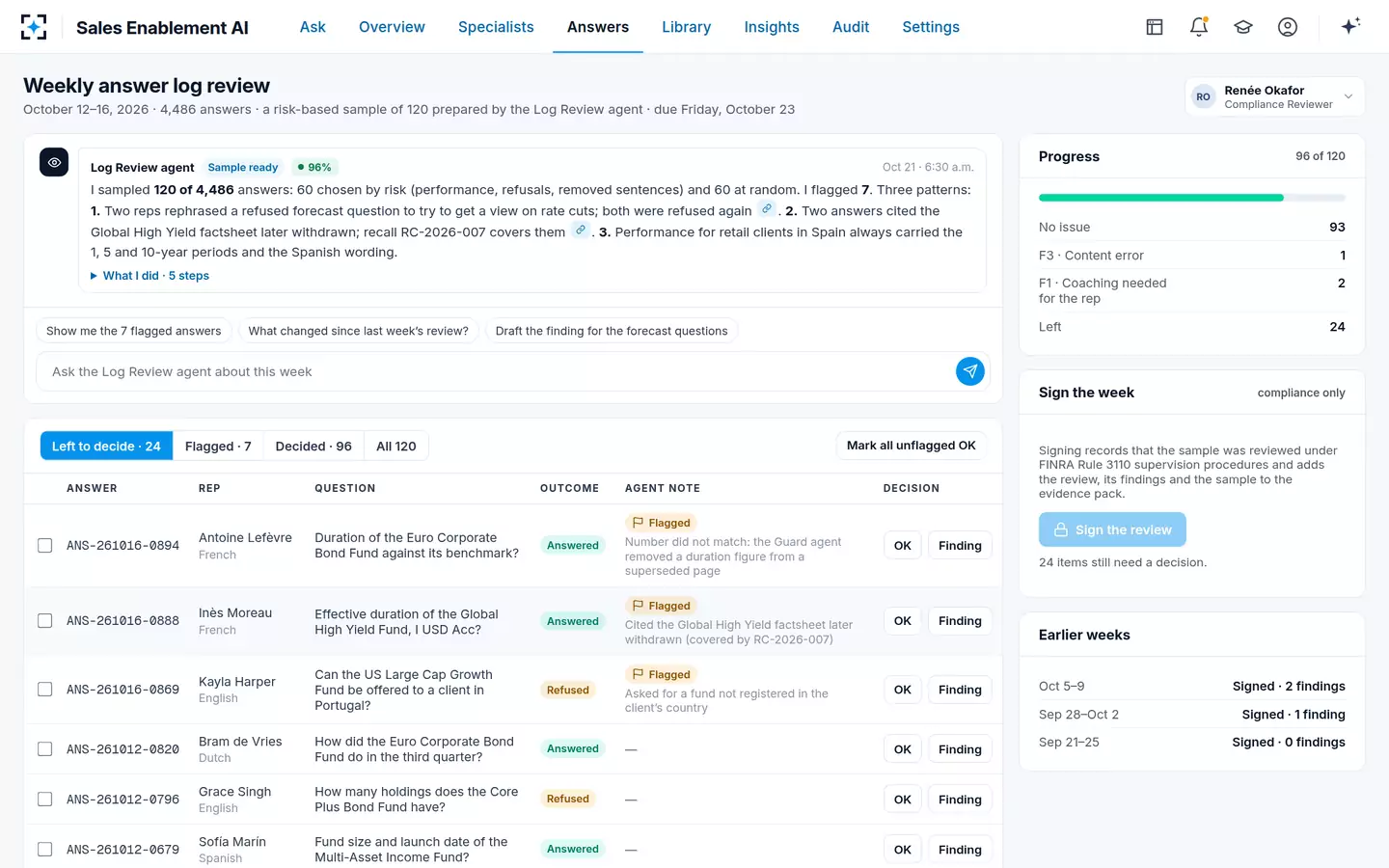
A random half matters as much as the risk-based half: risk rules find what the firm already expects to go wrong, and a random sample is how it learns what it did not expect. To test the whole design before buying, a pilot on last quarter's rep questions sets pass marks in advance. The full sample morning, from the rep's question to the signed review, is on the Sales Enablement AI page.
Questions people ask
What is FINRA Regulatory Notice 24-09?
It is FINRA's June 27, 2024 reminder of members' obligations when they use generative AI and large language models. It says FINRA's rules are intended to be technology neutral and continue to apply to AI, that Rule 2210's content standards apply whether a person or a tool wrote the communication, and that firms need a reasonably designed supervisory system tailored to their business.
Does FINRA allow firms to use chatbots with investors?
Yes, under supervision. FAQ B.4 treats chatbot messages as correspondence, retail or institutional communications depending on who receives them, supervised under Rules 2210 and 3110, with content held to Rule 2210(d). FINRA's 2026 oversight report adds supervision and retention of the chat sessions themselves.
Do FINRA rules apply to AI agents?
Yes: the rules apply to what the firm does, whoever or whatever does it. FINRA's 2026 oversight report singles out agents acting without human validation, beyond their intended authority, or in ways hard to audit, and suggests supervisory processes specific to the type and scope of each agent.
How long must AI chat logs and answers be kept?
For a broker-dealer, communications sent and any approvals of them are kept for at least three years, the first two easily accessible, under SEC Rule 17a-4(b)(4); FINRA Rule 2210(b)(4) points to the same retention for retail and institutional communications. Advisers keep advertisements and certain written communications for five years under Rule 204-2. Many firms set one longer period for everything.
Must a firm tell clients that AI wrote a message?
FINRA's FAQs and Notice 24-09 focus on supervision, records and content standards rather than labelling. In the EU, ESMA expects firms using AI for client interactions to disclose it to clients during those interactions. An assistant used by reps, whose answers the rep chooses to send, keeps the rep accountable either way.
Is Regulatory Notice 26-14 in force?
No. It is a request for comment published on 9 July 2026; comments closed on 11 September 2026. Until FINRA files and the SEC approves a rule change, principal pre-use approval of retail communications under Rule 2210(b)(1) still applies.