The sales enablement metrics that tell a fund manager whether its reps are equipped are the cost and the wait of one approved answer: how long a rep searches, how often a product specialist has to step in and for how long, how much compliance review a new answer needs, and how many times the answer is reused before its source changes. Content views, logins and library size measure activity; they do not say whether an advisor got a correct answer while still on the call. No regulator or independent study publishes rep search time or specialist minutes per question, so the numbers have to come from the firm's own log. This guide gives the formula and the fields to capture, with a worked example from Botminds' Sales Enablement AI, which answers reps' fund questions from approved content and logs every step of every answer.
The worked example uses the solution's sample data for Quillfield Capital, a fictional fund manager with 600 reps, and the solution's own estimates for it; wages come from the Bureau of Labor Statistics.
Where a month of product-specialist time goes, by hand and with Sales Enablement AI
By hand: 125 days
- Finding the current document · 32%
- Rewriting an old answer · 28%
- Translating, adding disclosure · 20%
- New questions · 20%
With the agents: 20 days
- Finding · 15%
- Rewriting · 10%
- Translating · 15%
- New questions · 60%
What are the right sales enablement metrics for a fund distribution team?
The right metrics follow the question, not the content. A rep asks something; the firm either answers it from an approved source in seconds, or someone has to find, write or approve the answer. Three families of measure follow: speed (how long until the rep can answer the advisor), quality (whether the answer was right, current and permitted for that client), and coverage (how much of what reps ask the library can answer without a person).
Activity metrics still have a place, but as inputs. A factsheet downloaded 4,000 times tells the content owner it matters; it does not tell the head of distribution whether the 4,000 downloads produced correct answers or fed a stale figure into 4,000 emails. The scorecard further down puts each activity number behind the outcome it supports.
The cost of one approved answer: the formula
An approved answer costs the time of everyone who touched it, divided by the number of times it is used. Four terms cover nearly all of it.
The cost of one approved answer, term by term
Rep search
minutes searching × rep hourly cost
Portal, shared drive, old email, a colleague: every minute before the rep can answer.
Measured by: the rep’s log or a timed sample
Specialist reply
escalation rate × minutes per reply × specialist hourly cost
Only for questions no approved source answers.
Measured by: the escalation queue
Compliance approval
review minutes per new answer × compliance hourly cost ÷ times reused
A reviewed answer used 20 times costs a twentieth per use.
Measured by: the approval log
Translation and disclosure
minutes per language × languages × hourly cost
Writing the answer for a client in Milan or Frankfurt, with the right wording.
Measured by: whoever does it today
Two public wage references help a first pass. The BLS median for securities, commodities and financial services sales agents, the occupation that includes wholesalers, was $37.82 an hour in 2025 (BLS Occupational Outlook Handbook). Product specialists have no BLS code of their own; the nearest is financial analysts, at a median of $49.79 an hour in 2025 (BLS Occupational Outlook Handbook). Both mappings are ours, both medians are wages only, and a firm in New York, London or Milan will pay more. For compliance reviewers, use the firm's own rate.
Worked example: 20,000 questions a month at the sample firm
Take the sample firm's own estimate: 600 reps ask about 20,000 fund questions a month, one in four goes to a product specialist, and a specialist spends about 12 minutes on each. That is 5,000 escalations, 60,000 specialist minutes, or about 1,000 hours a month: 125 eight-hour days. At the BLS financial analyst median, the wage cost alone is about $49,800 a month, or close to $600,000 a year, before any loading. The arithmetic is ours, from the solution's estimate.
Specialist days a month, by task, by hand and with the agents
Read the bars from the bottom. The line that falls least is the one that should: questions no approved document answers still need a specialist, and the specialist's 12 remaining days are spent on them, with a drafted, cited reply to edit instead of a blank page. The three lines that nearly vanish are repeat work. Finding the current factsheet, rewriting the answer given last week, translating it again: none of that needs a specialist's judgement, and all of it is where the 1,000 hours went.
The rep side of the formula has no estimate in the sample data, because no one measures it well, and that is the point. At 20,000 questions a month, every minute a rep spends searching is 333 rep hours, or about $12,600 a month at the BLS sales agent median. A two-week timed sample tells a firm which multiple of that it is paying.
How long does a rep wait for a product specialist?
As long as the specialist's queue, plus approval. No regulator or independent study publishes the figure, so measure it as the time from escalation to an approved reply, by specialist desk, with the median and the slowest tenth reported separately, because a median of two hours can hide a Friday afternoon that runs into Monday.
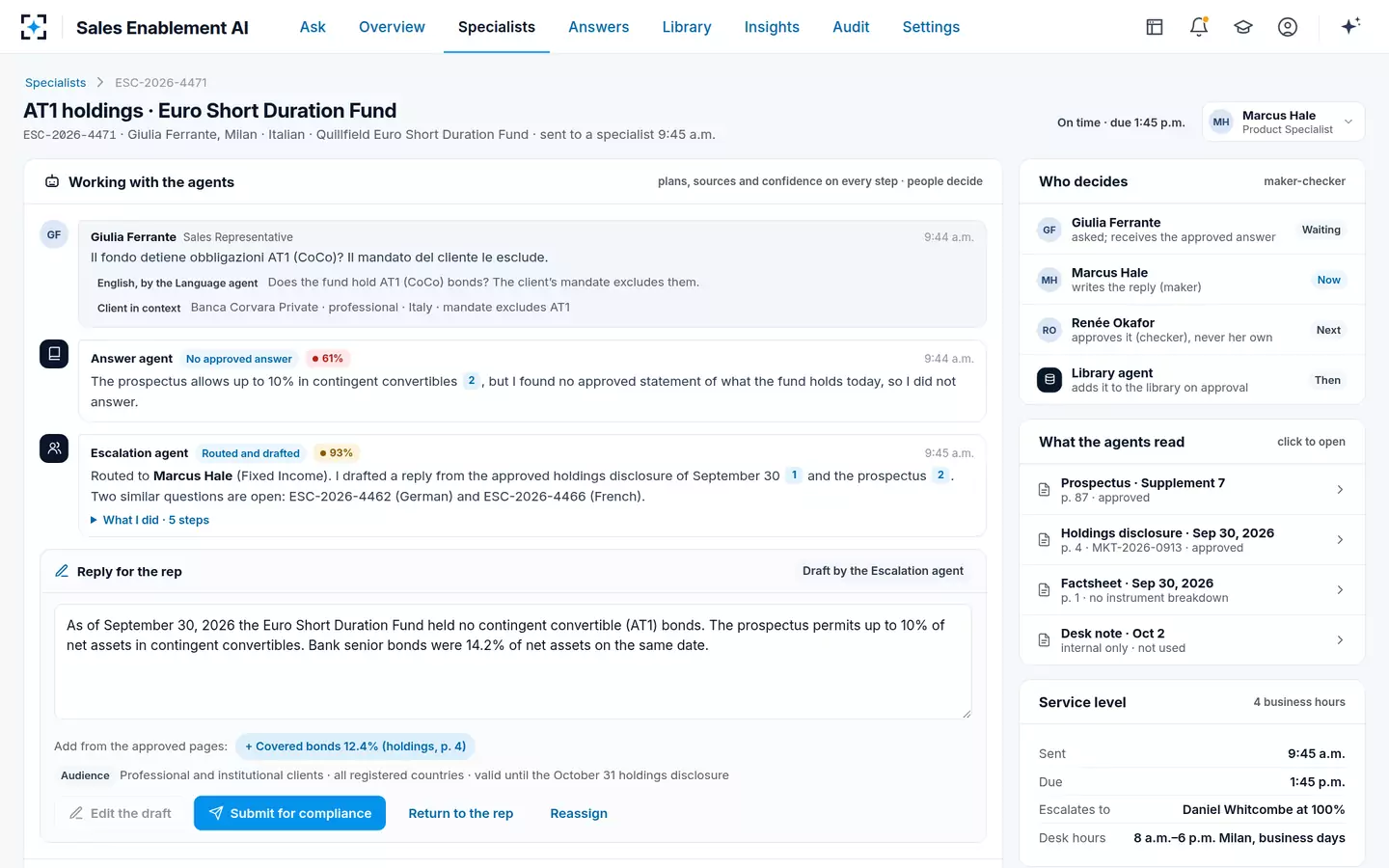
The sample firm sets a service level of four business hours, counted in desk hours, 8 a.m. to 6 p.m. Milan time on business days, and tells the head of sales enablement when a question runs past it. In the first three weeks of October, specialist replies were on time 96.4% of the time, and the private markets desk was the slowest at 4.1 hours. One AT1 question took 69 minutes from the rep's follow-up to an approved answer in her language, 46 of them with the specialist and 21 with compliance.
A specialist's queue item in Sales Enablement AI: drafted, cited, with the service level beside it
Sales enablement KPIs: a scorecard with definitions
A sales enablement scorecard for fund distribution needs definitions more than it needs more lines. Each KPI below is defined so that two people counting it from the same log get the same number.
A sales enablement KPI scorecard for a fund manager
| KPI | Definition | Sample month |
|---|---|---|
| Answered from approved content | Questions answered without a person, from documents approved and in date on the day, ÷ all questions. | 89.2% (target 9 in 10) |
| Escalation rate | Questions sent to a specialist ÷ all questions, by fund family and language. | 10.8% went to a specialist or were refused |
| Specialist on time | Replies approved within the service level ÷ all replies, by desk. | 96.4% |
| Time to approved reply | Escalation to compliance approval, median and slowest tenth, by desk. | slowest desk 4.1 hours |
| Reuse of approved answers | Times each new approved answer was served to another rep before its source changed. | measure it |
| Content gaps | Questions in the month with no approved answer, grouped by topic, ranked. | top gap: 63 questions |
| Recall exposure | Answers that cited a document later corrected or withdrawn, and how many reached a client. | 37 answers, 12 reached the CRM or email |
| Adoption | Reps who asked at least one question ÷ all reps, and questions per rep, by region and language. | 571 of 600 reps, 11 languages |
Two KPIs on the list are the least familiar and the most telling. Reuse shows whether specialist effort compounds: an answer written once and served to 40 reps is a different investment from one written 40 times. Recall exposure shows the price of a stale library in client-facing terms, and it can only be counted if every answer cites its source. Content management for sales enablement shows the recall that produced the sample month's figure.
How to measure sales enablement ROI without inventing the baseline
Measure the baseline before buying anything, from a sample of real questions, timed. A return calculated from a vendor's assumptions about rep search time is a return on the vendor's assumptions. Two weeks of logging by a handful of reps and specialists is enough to give each term in the formula a number the firm believes.
The fields to log for each rep question, before and after
- When it was asked, and by whom
Timestamp, rep, region and language: the base for volume, adoption and questions per rep.
- What it was about
Fund, share class and topic family (performance, fees, holdings, registration, ESG and risk).
- Who the client is
Category and country, because the same answer can be permitted for one client and not another.
- Where the rep looked, and for how long
The rep search term of the formula. Before a tool, time it; after, the system logs it.
- Whether it went to a specialist
Which desk, sent when, replied when, approved when.
- What the answer cited
Document, version and page. Without this, recall exposure cannot be counted later.
- Whether it reached a client
Sent by email, logged to the CRM, said on a call, or not used.
- Whether it was reused
For approved answers: each later rep who received it.
The after-measure is the same log, run on the same question families, so the two are comparable. The FINRA 2026 oversight report's advice for AI tools points the same way from the supervision side: it lists ongoing monitoring of prompts, responses and outputs, and keeping prompt and output logs, among the effective practices (FINRA, 2026 Annual Regulatory Oversight Report). A firm that keeps the log for supervision has its ROI data for free. To run the comparison as a formal test before buying, replay last quarter's questions in a pilot.
Sales enablement manager KPIs, and who owns each number
A sales enablement manager owns the outcome numbers, but not every input. Splitting ownership keeps each KPI with the person who can move it.
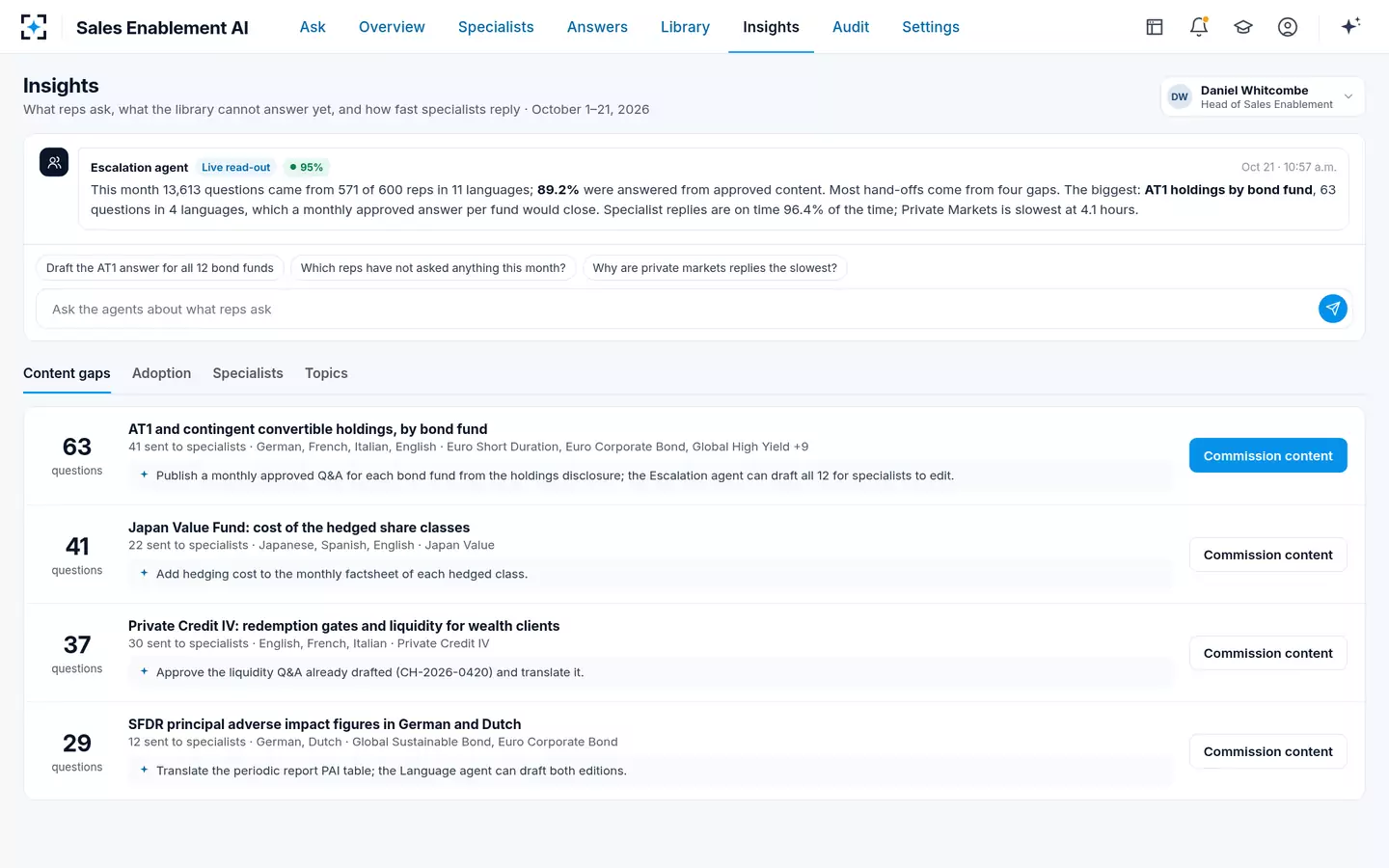
The head of sales enablement owns coverage and adoption: the share answered from approved content, content gaps and their closure, and adoption by region and language. Product specialist desks own the service level and the time to reply. Marketing compliance owns approval time and recall time, and the content owner owns expiries and replacements. In the sample firm, the head of sales enablement can commission the content that closes a gap straight from the gap itself, and the agents can draft it for specialists to edit.
The sample firm's month, in five numbers
13,613
questions from 1 to 21 October
571of 600
reps asked at least one question
11
languages the questions came in
89.2%
answered from approved content
96.4%
of specialist replies on time
Insights: what reps ask and what the library cannot answer yet
Where the savings are, and where they are not
The savings are in repeat work, and the costs that remain are judgement. In the sample estimate, specialist time falls from about 125 days a month to 20, but the 12 days spent on genuinely new questions barely move, and they should not. Compliance time moves the other way at first: a reviewer who used to approve factsheets now also signs specialist replies and a weekly sample of the answer log. That is the price of supervising answers the firm used to send unseen, and it falls as approved answers accumulate and are reused.
The cost that a per-answer metric shows best is the one a library metric hides: the answer given from a stale or unapproved source. It costs nothing on the day and a correction, a client conversation or an examination finding later. The full sample month, from the first question to the signed weekly review, is on the Sales Enablement AI page.
Questions people ask
What are the most important sales enablement KPIs?
For a fund distribution team: the share of rep questions answered from approved content without a person, the time to an approved specialist reply, the reuse of approved answers, and the content gaps ranked by questions. The sample firm's month shows 89.2% answered from approved content and specialist replies on time 96.4% of the time.
How do you measure sales enablement success?
By the outcome for the rep's question, not by content activity: was it answered, how fast, from what source, and was the source approved and current that day. A two-week timed baseline of real questions, then the same log after any change, is the comparison that holds up.
What does one product specialist answer cost?
Minutes per reply times the specialist's loaded hourly cost, plus the compliance review if the answer becomes standard, divided by the times it is reused. At the sample firm's estimate of 12 minutes per reply and the BLS financial analyst median of $49.79 an hour, the wage alone is about $10 a reply before loading and review.
Is there an industry benchmark for rep search time?
No regulator or independent study publishes one for fund distribution. Figures that circulate tend to come from vendor and analyst surveys in which firms estimate their own time, so a firm's own timed sample is a better baseline than any of them.
Should compliance time count as a sales enablement cost?
Yes, because supervising what reps send is part of the cost of every answer. FINRA's guidance makes firms responsible for communications whether a person or an AI wrote them, so the review of new answers belongs in the formula, divided by how often each approved answer is reused.