A USPAP Standard 3 appraisal review is a review of another appraiser's work performed under the appraisal profession's own standard for reviews, and it is the only kind of review that may end in a different opinion of value. The federal guidelines draw the line in one sentence: "Though a reviewer cannot change the value conclusion in the original appraisal, an appraisal review performed by an appropriately qualified and competent state certified or licensed appraiser in accordance with USPAP may result in a second opinion of market value" (Interagency Appraisal and Evaluation Guidelines, 2010). A collateral underwriter's review is something else: a test of support and policy before the credit decision. Botminds' Residential Appraisal Review automates the reading and arithmetic of that underwriter review, and the underwriter decides and signs; it never forms or changes a value.
Confusing the two causes most of the trouble in appraisal review: underwriters who think they can adjust a value, reviewers who think a percentage limit is a rule, and lenders who forget that some failures must be reported to the state. This guide sets out who may do what, with the rule behind each.
The people who can give a second opinion are fewer, and states do discipline them
42,912
certified residential appraiser credentials at the end of 2025, down from 54,177 in 2007
755
disciplinary actions states took against appraisers in 2025
87
disciplinary actions states took against appraisal management companies in 2025
What is USPAP Standard 3?
Standard 3 is the part of the Uniform Standards of Professional Appraisal Practice that governs appraisal review: how an appraiser develops an opinion about the quality of another appraiser's work, and how that opinion is reported. USPAP is published by the Appraisal Standards Board of The Appraisal Foundation, which controls its text, so it is described here rather than quoted. What matters for lenders is where federal and agency rules require a USPAP review, and what such a review may conclude.
Since 2019, federal banking rules require one. The rule that raised the residential appraisal threshold from $250,000 to $400,000 also "amends the agencies' appraisal regulations to require regulated institutions to subject appraisals for federally related transactions to appropriate review for compliance with the Uniform Standards of Professional Appraisal Practice" (84 FR 53579). Note the phrasing: review "for compliance with" USPAP. That is a duty on the institution, and it does not require every reviewer to be an appraiser. A review that may change the value does.
Who can perform an appraisal review?
Two kinds of people review appraisals, with different powers. A collateral underwriter or other qualified reviewer may review any appraisal for support, compliance and policy, provided they are independent of the loan. A state-licensed or certified appraiser performing a USPAP review may, in addition, form a second opinion of value. The 2010 guidelines want reviewers "independent of the transaction" with "no direct or indirect interest, financial or otherwise, in the property or transaction," and "independent of and insulated from any influence by loan production staff" (section XV.A).
Fannie Mae is specific about the second kind. A desk or field review "must be completed in accordance with the USPAP," and "because the Scope of Work for either type of review allows for a change of the opinion of market value for something other than a mathematical error, the appraiser completing the appraisal review must be licensed or certified in the state in which the property is located, have access to the appropriate data sources, and possess the knowledge and experience to appraise the subject property" (Selling Guide B4-1.3-12).
An underwriter's review and a USPAP appraisal review are different jobs
Collateral underwriter's review: Decide whether the appraisal supports the credit decision and meets policy.
USPAP appraisal review (desk or field): Form an opinion on the quality of the appraisal, and where the scope allows, a value.
Collateral underwriter's review: An underwriter or reviewer independent of loan production.
USPAP appraisal review (desk or field): An appraiser licensed or certified in the property's state, with local data and experience.
Collateral underwriter's review: No. It asks the original appraiser to explain, support or correct.
USPAP appraisal review (desk or field): It cannot change the original appraisal, but may produce a second opinion of market value.
Collateral underwriter's review: Agency guides, the bank's policy, the 2010 guidelines.
USPAP appraisal review (desk or field): USPAP, the appraisal profession's review standard.
Collateral underwriter's review: The original appraisal and its value go to the agency portal.
USPAP appraisal review (desk or field): If relied on, the review's value is reported at sale; the original appraisal must still be in the portal.
Can an underwriter change the appraised value?
No. No reviewer can change the value in someone else's appraisal, and an underwriter cannot form a new one. The guidelines say so directly: "a reviewer cannot change the value conclusion in the original appraisal." What a lender can do, if it doubts the value, is a short list set by Fannie Mae: contact the appraiser to address the deficiencies, obtain a desk or field review, or obtain a new appraisal (B4-1.3-12).
Two guardrails surround that list. A request for a change in value needs a material, substantive reason, and a value that falls short of the loan amount is not one. And when a lender orders a new appraisal it must "adhere to a policy of selecting the most reliable appraisal, rather than the appraisal that states the highest value," documenting the deficiencies that led to it. Regulation Z adds the hard edge: no covered person may try to cause the value to rest on anything but the appraiser's independent judgment, and steering an appraiser toward a minimum or maximum value is the first violation the rule names (12 CFR 1026.42(c)).
Nobody edits the original value. A lender may ask for support, order a review by a licensed appraiser, or order a new appraisal, and must choose the most reliable, not the highest.
What is a desk review vs a field review?
A desk review is a USPAP review performed from the report and data without inspecting the property; a field review adds an inspection, usually of the exterior of the subject and the comparables. Both are appraisal reviews in the USPAP sense, both need a reviewer licensed or certified in the state, and both may produce a second opinion of value when the scope allows. The choice is about evidence: a question about comparable selection can often be settled from the desk; a question about condition or location may need eyes on the street.
The agencies' delivery rules treat both the same way. When "the appraisal used to underwrite the loan is a desk or field review of an existing appraisal," the value reported at sale "will reflect the value as stated in the desk or field review," but "the original appraisal that was the subject of review must have been submitted to UCDP" (B4-1.1-06). A second opinion adds to the file; it never replaces the original's place in it.
Who may do what, from appraisal to a second opinion of value
A person decides
The appraiserDevelops and reports the opinion of value, and alone may revise it in response to questions.
Agent
Review agentsRead the report, photos, sketch and contract; recompute the grid; draft questions with page and rule.
Never: State a value, change a rating, or contact the appraiser.
A person decides
Collateral underwriterReviews for support and policy, signs the review, and sends questions through the management company, which keeps lender and appraiser apart.
A person decides
Review appraiserA state-licensed or certified appraiser performs a USPAP desk or field review; may give a second opinion of value.
A person decides
Underwriting managerDecides on reliance, orders a new appraisal if needed, and refers material failures to the state.
Must lenders report appraisers to the state?
Yes, when the failure is material. Regulation Z requires "any covered person that reasonably believes an appraiser has not complied with the Uniform Standards of Professional Appraisal Practice or ethical or professional requirements" to "refer the matter to the appropriate state agency if the failure to comply is material," and defines material as "likely to significantly affect the value assigned to the consumer's principal dwelling" (12 CFR 1026.42(g)). Because "covered person" includes creditors and settlement service providers, the duty reaches the lender's reviewers.
Fannie Mae sets a parallel duty with a different trigger. If "material deficiencies identified in the appraisal report are not corrected or addressed by the appraiser upon request, or if there is evidence of any unacceptable appraisal practices," the lender "must forward the appraisal report and summary of findings to the appropriate appraisal licensing agency or regulatory board," and must report "suspected overt violations of anti-discrimination laws" (B4-1.3-12). States act on such referrals: the Appraisal Subcommittee counted 755 state disciplinary actions against appraisers in 2025 (ASC 2025 Annual Report).
What are appraisal independence requirements for the reviewer?
Independence binds the reviewer as tightly as the appraiser. Regulation Z defines "valuation management functions" to include "reviewing or verifying the work of a person that prepares valuations," so the anti-coercion rule applies to the review step, and lists what a reviewer may ask: that the appraiser consider additional comparables, explain or support the conclusion, or correct errors (1026.42(b) and (c)(3)). The guide to writing an appraisal revision request turns those permitted asks into wording.
The 2010 guidelines add structural independence: the reviewer insulated from loan production, the review policy addressing "the independence, educational and training qualifications, and role of the reviewer." In practice that means a loan officer may see that a review is pending but should not see or shape the questions, and that questions travel through the appraisal management company. Fannie Mae also expects the lender to check that each appraiser's licence is "active as of the effective date of the appraisal report" (B4-1.1-03).
Who may do what in appraisal review
| Role | May | May not |
|---|---|---|
| Appraiser | Revise the report and the value in response to questions; explain and support adjustments. | Accept direction toward a value, a range or a target. |
| Collateral underwriter | Review for support and policy; ask for comparables, explanation or correction; decline to rely on the report. | Change the value; suggest a number; contact the appraiser around the management company where policy routes through it. |
| Review appraiser (USPAP) | Form an opinion of the appraisal's quality and, where the scope allows, a second opinion of value. | Alter the original report. |
| Loan officer | See the status of the review. | Influence the value or the questions; serve as the reviewer. |
| Review agents | Read, recompute, compare and draft questions with page and rule. | State or request a value; change a rating; send anything without the underwriter. |
Where the agents sit in the chain
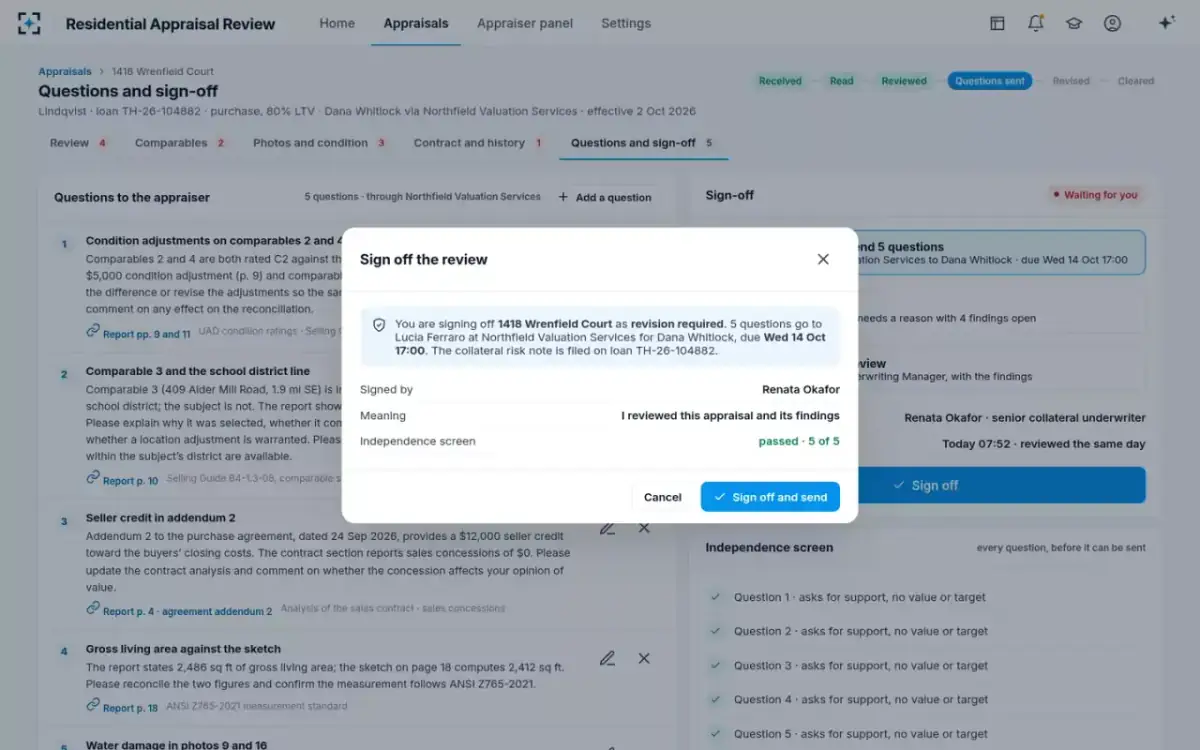
Residential Appraisal Review's six agents sit inside the underwriter's review, never inside the appraisal. They read the redesigned report or the legacy forms, recompute the adjustment grid, read each photo against the condition and quality ratings, measure the sketch, compare the contract and its addenda with the report, and tie each agency risk message to its page. The revision request drafter turns findings into questions with a page and a rule, and an independence screen blocks any question that names a value, a target or a preferred outcome.
Where the agents show a reviewer's test, such as the comparables recalculated with one rate per difference, the solution labels it as not the appraiser's figures. On a sample appraisal of a fictional house, 1418 Wrenfield Court, that view put the $615,000 value above every adjusted sale; the solution's answer is five questions asking for support, not a number. A value question that survives a revision, or a risk score above 4.0, routes to the Underwriting Manager for a desk or field review, which is where a USPAP reviewer comes in. The underwriter appraisal review checklist lists the checks the agents run.
Residential Appraisal Review: the underwriter signs, with the meaning of the signature recorded
The second opinion: relying on it, and saying why
A lender may rely on a second opinion of value, but it has to show its work. "An institution may rely on the second opinion of market value obtained through an acceptable USPAP-compliant appraisal review to support its credit decision," the 2010 guidelines say, and Fannie Mae requires the lender to "either document in the loan file the resolution of the noted deficiencies in the original appraisal or detail the reasons for relying on a second opinion of market value" (B4-1.3-12).
That documentation is where a structured review pays off. If each finding carries its page, the question asked, the appraiser's answer and the reviewer's decision, the file already explains why a second opinion was needed. FHA's version is narrower but similar in spirit: an underwriter may request a reconsideration of value when the appraiser missed information relevant on the effective date, and must give the appraiser the data needed (HUD Handbook 4000.1, II.A.3.a.ix).
One more boundary is easy to miss. Regulated institutions do not need a state-certified or licensed appraiser for residential transactions of $400,000 or less, nor for loans that qualify for sale to Fannie Mae or Freddie Mac under their standards (12 CFR 34.43(a)(1) and (a)(10)), but the agencies' own guides require an appraisal for most loans they buy. Which rulebook governs a given loan decides which review standard applies, and the guide to the Collateral Underwriter risk score covers what the agencies relieve once the report is in.
Questions people ask
Does an underwriter's review have to follow USPAP?
Not as a USPAP appraisal review, unless the underwriter is a licensed or certified appraiser developing an opinion of the work's quality under USPAP. The 2019 federal rule requires institutions to review appraisals "for compliance with" USPAP, which an underwriter's checklist can address. A review that may change the value must be a USPAP review by an appraiser licensed in the state.
Can a lender order a second appraisal because the first came in low?
Only for material, substantive deficiencies, documented in the file. Fannie Mae forbids requesting a change solely because the value does not support the loan amount, and requires a policy of choosing the most reliable appraisal rather than the highest. Regulation Z permits "obtaining multiple valuations … to select the most reliable valuation," not to shop for a number.
What makes a USPAP breach material enough to report?
Regulation Z's test is whether the failure "is likely to significantly affect the value assigned to the consumer's principal dwelling." Fannie Mae's separate trigger is material deficiencies the appraiser will not correct, or evidence of unacceptable practices such as unsupported adjustments or prohibited language. A reviewer's file should record the reasoning either way.
Is an appraisal review the same as a reconsideration of value?
No. A reconsideration of value is a request to the original appraiser to reassess the report in light of deficiencies or new information, often started by the borrower. Fannie Mae requires the lender to "complete its appraisal review before initiating the ROV process," and limits a borrower to one ROV per appraisal with up to five comparables.
Can software perform a USPAP appraisal review?
No. A USPAP review that may produce a second opinion of value must be performed by an appraiser licensed or certified in the state. Software can support the underwriter's review and the review appraiser's work, by reading, recomputing and organising evidence, but the opinion and the signature are a person's.