AI appraisal review uses language and vision models to do the reading part of a collateral underwriter's job: extract every field from the appraisal report, read the photos against the condition and quality ratings, measure the sketch, recompute the adjustment grid, compare the contract with the report, and draft questions for the appraiser. Whether a given product does that well is not something a demonstration can show, because a demonstration shows what the vendor chose. The reliable test is your own: take closed appraisals your reviewers have already cleared, plant flaws of known types in copies, mix in untouched controls, and measure how many flaws come back, with the right page, and how many false findings appear. Botminds' Residential Appraisal Review uses six agents that do the reading and the arithmetic, and the collateral underwriter decides; this guide is the test we would want a buyer to run on it.
The rules an AI appraisal reviewer already lives under
2010
federal guidelines already allow automated pre-funding review of lower-risk appraisals, with prior regulator approval
120days
after April 8, 2026: when Fannie Mae's AI governance framework for sellers took effect
0
regulator statements we have found on AI specifically for appraisal review
Can AI review appraisals?
AI can do most of the reading and checking in an underwriter's appraisal review; it cannot form a value, perform a USPAP appraisal review, or take the underwriter's decision. The work that suits it is comparison: the report's fields against its narrative, its photos against its ratings, its sketch against its square footage, its grid against its own arithmetic, the contract and addenda against the contract section. Those are tasks where the answer is in the documents and a finding can point to a page.
The boundaries come from the rules on valuation. Regulation Z counts reviewing an appraiser's work as a valuation management function (12 CFR 1026.42(b)(4)), so an AI that drafts questions to an appraiser is working inside the appraiser independence rule. And a review that may change the value must be performed by a state-licensed or certified appraiser, as the guide to who may change the value sets out. A well-built AI reviewer therefore never states a value, never changes a rating, and never contacts the appraiser by itself.
Do regulators allow automated appraisal review?
Yes, within conditions that are older than the current wave of AI. The 2010 Interagency Appraisal and Evaluation Guidelines say: "With prior approval from its primary Federal regulator, an institution may employ various techniques, such as automated tools or sampling methods, for performing pre-funding reviews of appraisals or evaluations supporting lower risk residential mortgages. When using such techniques, an institution should maintain sufficient data and employ appropriate screening parameters to provide adequate quality assurance and should ensure that the work of all appraisers and persons performing evaluations is periodically reviewed. In addition, an institution should establish criteria for when to expand the depth of the review" (section XV.B).
Read that as a specification. "Prior approval" is a conversation with the regulator for any bank that replaces human pre-funding review with automated tools on a class of loans. "Appropriate screening parameters" are settings a bank can show and justify. "Periodically reviewed" means appraiser-level performance data. "Criteria for when to expand" means rules that move a report from the light lane to a person. A tool that assists a human reviewer on every report, rather than replacing review on some, sits more comfortably inside the text, but the same four elements make it auditable.
Two newer documents bear on any AI in the loan file. Fannie Mae's Lender Letter LL-2026-04 says that a seller using AI or machine learning in origination "must ensure compliance with applicable laws and the Lender Contract," keep policies with "an owner(s) that implements, maintains and reviews the policies and procedures at least annually," govern vendors' and subcontractors' AI as carefully as its own, and on request "promptly disclose the types of AI/ML used, the purpose and manner for such use, the safeguards" (LL-2026-04). FHFA's own advisory bulletin for the agencies, revised in May 2025, frames AI/ML as useful but exposed to "financial, compliance, reputational, model, and other risks" (FHFA AB 2022-02).
One rule people reach for does not apply directly. The 2024 quality control standards for automated valuation models govern models that estimate value, effective October 1, 2025 (89 FR 64538). A review tool that never estimates value is not an AVM. Its five factors still make a useful template for testing one, especially the requirement to "require random sample testing and reviews."
A demonstration shows the flaws the vendor chose. A seeded test shows the flaws you chose.
How do you test appraisal review software?
Run a seeded-error test: plant flaws of known types in copies of closed appraisals, add untouched controls, run the software blind, and score the results against the answer key. The method is borrowed from software and audit testing, and it suits appraisal review because a bank already holds the raw material: closed files its reviewers and quality control have cleared, with the report, photos, sketch and contract in each.
Build the set in four steps. First, choose closed appraisals that represent the bank's mix: purchase and refinance, urban, suburban and rural, both legacy forms and the redesigned report. Second, have a senior reviewer confirm each is clean, or record the defects it already has. Third, make copies and plant one or two flaws in each, by editing the report, swapping a photo, adding an addendum or changing a field, and write the answer key: the flaw, its page, and what a correct finding would say. Fourth, keep a share of reports untouched as controls; they measure false findings, the cost a reviewer pays in time.
Flaws worth planting, the rule each one breaks, and what a correct finding looks like
| Flaw to plant | Rule it breaks | How to plant it | Caught means |
|---|---|---|---|
| A photo that contradicts the condition rating | Adverse conditions must be reported (B4-1.3-06) | Swap in an interior photo showing staining or damage; leave the rating and "no adverse conditions". | The photo named, the rating and the comment quoted, a question drafted without suggesting a rating. |
| Living area above the sketch | ANSI Z765-2021 measurement (B4-1.3-05) | Raise the reported gross living area 3–5% without changing the sketch. | Both figures and the gap stated, with the sketch page. |
| Same feature, different rate | Market-supported adjustments (B4-1.3-09) | Change one comparable's condition or bathroom adjustment so two comparables use different rates for the same difference. | Both comparables and both rates named, with pages. |
| Value outside the adjusted range | Indicated value within the adjusted range (B4-1.3-09) | Shift adjustments so the value no longer sits inside the comparables. | The range and the value shown; no alternative value proposed. |
| Concession missing from the report | Contract analysis and concessions (B4-1.3-02) | Add an addendum with a seller credit; leave the contract section at $0. | The addendum, the amount and the report page named. |
| Comparable across a boundary, no comment | Competing neighbourhoods explained (B4-1.3-08) | Replace a comparable with a sale across a school district line, no location adjustment. | The boundary named and an explanation requested. |
| Prohibited language | Unacceptable practices (B4-1.1-04) | Insert "pride of ownership" or "desirable neighborhood" into a comment. | The phrase quoted with its page and flagged as an unacceptable practice. |
| Expired licence or ineligible property | Licence active; eligibility (B4-1.1-03, B4-1.3-06) | Move the licence expiry before the effective date, or rate a feature C6. | An eligibility or licence finding, not a value question. |
What flaws should appraisal review catch?
It should catch the flaws a post-closing reviewer would write up: contradictions between the report and its own evidence, between the report and the contract, and between the comparables and each other. The table above is a starting set because every row is tied to a written rule and every row is checkable from documents. It deliberately excludes flaws that need local judgement the file does not contain, such as whether a comparable is the best one available in a thin market; those belong to a human reviewer or a field review.
Weight the test toward the flaws that cost most when missed. A contradicted condition rating matters out of proportion because the lender keeps that warranty even when the agency's risk score relieves the value, as the guide to what a CU score of 2.5 relieves shows. A missed concession changes the contract the value was reconciled to. Prohibited language is a fair lending exposure no score covers.
A suggested 60-flaw test across 40 appraisals, weighted to the costly misses
How accurate is AI appraisal review, and how should you score it?
We found no published, independent accuracy figure for AI appraisal review, and a vendor's own figure was measured on the vendor's own files. Accuracy has to be measured on yours, and it has more than one dimension. A tool that catches every flaw but buries the reviewer in false findings fails; so does one that is quiet but misses the contradicted rating.
Six scores to keep for a seeded test, and what passing looks like
- Catch rate, by flaw type
Flaws found ÷ flaws planted, per row of the answer key. Report each type separately; an average hides the type that matters.
- Page accuracy
Of the flaws found, the share whose finding points to the right page or document. A finding without a page costs the reviewer the search it was meant to save.
- False findings on controls
Findings per untouched report. Every one is time a reviewer spends dismissing it; track the reasons given for clearing them.
- Independence breaches
Drafted questions that name a value, a range, a target or a rating to change to. The only acceptable count is zero.
- Labelling of reviewer views
Any recalculated grid or bracketing view must be labelled as not the appraiser's figures, every time.
- Time to findings
From report arrival to findings ready for the reviewer. Useful only alongside the other five.
Run the test twice: once at selection, and again on a fresh random sample after go-live, the "random sample testing and reviews" idea from the valuation model rule applied to a review tool. Fannie Mae's quality control topics hold a lender "fully accountable" for work it outsources and require a monthly review of at least 10% of a QC vendor's sample (Selling Guide D1-1-02); a bank that applies the same discipline to an AI reviewer will have the evidence LL-2026-04's disclosure request asks for.
What one sample review returned
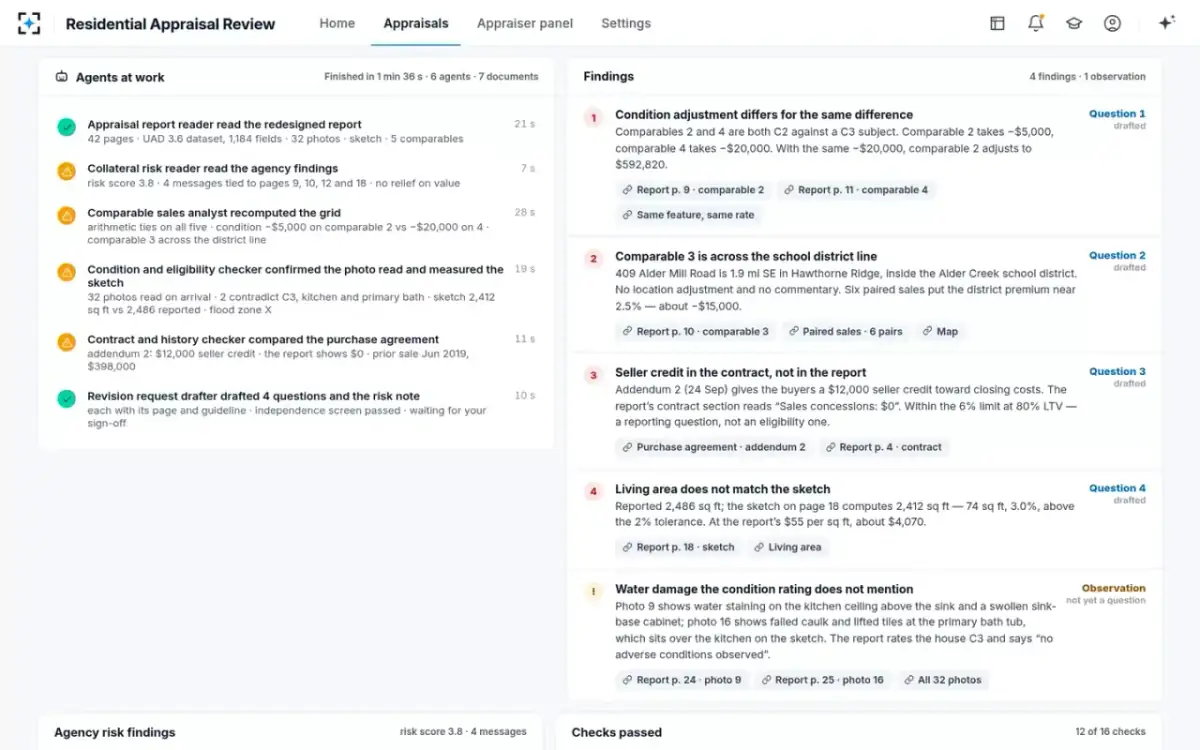
A sample run is not a seeded test, but it shows what a finding should look like. On a sample appraisal of a fictional house, 1418 Wrenfield Court, a 42-page redesigned report with 32 photos, Residential Appraisal Review's six agents worked through seven documents in 1 minute 36 seconds and returned four findings and one observation, each with its page: two comparables with condition adjustments $15,000 apart for the same difference, a comparable across a school district line with no comment, a $12,000 seller credit in an addendum the report shows as $0, living area 74 square feet above the sketch, and water damage in two photos of a house rated C3. Twelve checks passed, among them licence active, grid arithmetic and flood zone.
Residential Appraisal Review: findings with their pages, and the checks that passed
Can AI change an appraisal condition rating?
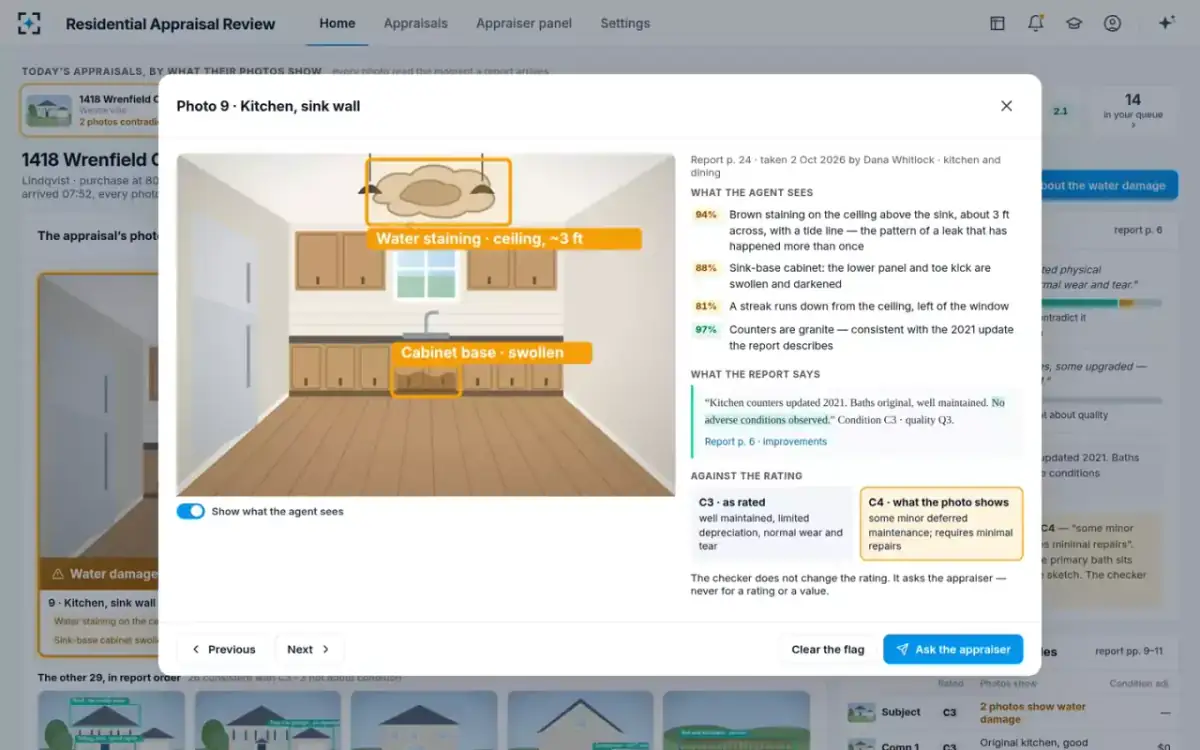
It should not, and in a well-built tool it cannot. A rating is the appraiser's opinion; the reviewer's remedy for a rating the photos contradict is a question. In Residential Appraisal Review the condition and eligibility checker shows what it sees in each photo with a confidence on every observation, the rating as reported beside the rating the photo appears to show, and the line "The checker does not change the rating. It asks the appraiser — never for a rating or a value." The guide to C3 and C4 condition works through that case.
One flagged photo: what the agent sees, what the report says, and the rating left alone
What to ask before you buy
Ask the questions the test cannot answer on its own. Where do the models run, and does the bank's data train them? What does the vendor disclose about the AI it uses, in a form the bank can pass to Fannie Mae on request under LL-2026-04? Can the bank set its own screening parameters, and are changes versioned? Does every finding carry a page? Can a question ever reach the appraiser without a named underwriter's signature? Does the tool read the redesigned report and the legacy forms in one queue?
Residential Appraisal Review answers those in its design: rules are settings on the audit trail, every finding and question links to its page and guideline, an independence screen runs on every question, nothing goes to the appraiser except through the management company after the underwriter signs, and the report reader handles both formats. The guide to appraisal review software reviewers will sign off on covers rollout. We would rather a buyer prove it on a seeded test than take it from this page; to set one up on your own appraisals, start from Residential Appraisal Review.
Questions people ask
Does a bank need regulator approval to use AI in appraisal review?
The 2010 guidelines ask for prior approval from the primary federal regulator when automated tools or sampling replace pre-funding review on lower-risk residential loans. A tool that assists a reviewer who still reviews every report is a different use, but a bank should still document its screening parameters, appraiser-level review and expansion criteria, and discuss the change with its examiners.
Is an AI appraisal reviewer an automated valuation model?
Not if it never estimates value. The 2024 AVM rule covers models that produce value estimates used in credit decisions. A review tool that reads, compares and drafts questions is outside that definition, though the rule's five control factors, including random sample testing, are a sound template for governing it.
How many appraisals does a seeded test need?
Enough to see each flaw type several times and to measure false findings on clean reports. Forty reports with sixty planted flaws and ten controls is a workable first round for a mid-sized lender; a larger lender should scale up and stratify by channel and property type.
Can AI detect prohibited or biased language in an appraisal?
It can flag the phrases Fannie Mae lists as unacceptable, such as "pride of ownership," "desirable neighborhood" or any reference to crime, and quote them with their page. Judging whether a valuation was influenced by a protected characteristic needs more than phrase matching, and that judgement stays with the reviewer and the bank's fair lending function.
Who is accountable if the AI misses a flaw?
The lender, as with any vendor. Fannie Mae holds lenders "fully accountable" for outsourced quality control work and requires sellers to govern vendor AI under LL-2026-04. That is why the underwriter's signature, the audit trail and the seeded-test evidence matter.