An appraisal revision request letter is the lender's written request, usually sent through the appraisal management company, asking the appraiser to address specific deficiencies in a report. Regulation Z lists what it may ask: to "consider additional, appropriate property information, including information about comparable properties," to "provide further detail, substantiation, or explanation" for a conclusion, and to "correct errors in the valuation" (12 CFR 1026.42(c)(3)). It may never seek "to influence a person that prepares a valuation to report a minimum or maximum value" (1026.42(c)(1)). Botminds' Residential Appraisal Review drafts each question for the collateral underwriter with the report page and the rule behind it, screens every one so none names a value or a target, and sends nothing until the underwriter signs.
What a revision request may ask, and what it may not
Permitted under 1026.42(c)(3): Ask the appraiser to "consider additional, appropriate property information, including information about comparable properties."
Prohibited under 1026.42(c)(1): Supply comparables chosen to reach a number, or say what number they would support.
Permitted under 1026.42(c)(3): Request "further detail, substantiation, or explanation" for the appraiser's conclusion about value.
Prohibited under 1026.42(c)(1): Seek "to influence a person that prepares a valuation to report a minimum or maximum value."
Permitted under 1026.42(c)(3): Ask the appraiser "to correct errors in the valuation."
Prohibited under 1026.42(c)(1): Alter the report yourself, or ask someone else to.
Permitted under 1026.42(c)(3): Obtain "multiple valuations … to select the most reliable valuation."
Prohibited under 1026.42(c)(1): Order valuations until one reaches the contract price.
Permitted under 1026.42(c)(3): Withhold pay for "breach of contract or substandard performance of services."
Prohibited under 1026.42(c)(1): Imply future work "depends on the amount at which the person estimates the value," or tie pay to the loan closing.
What can a lender ask an appraiser?
A lender can ask for more information to be considered, for explanation or support, and for corrections, and it can obtain more than one valuation to choose the most reliable. Those four items, plus withholding pay for substandard work and acting as the law requires, are Regulation Z's list of permitted actions. The commentary explains why they are safe: requesting that an appraiser "consider additional, appropriate property information, does not violate § 1026.42(c), because such request does not supplant the independent judgment of the person that prepares a valuation" (comment 42(c)(1)-2).
The test, then, is purpose. A question that asks the appraiser to look at something and explain is permitted because it leaves the conclusion with the appraiser. The same facts phrased as "the contract is $612,000; please review" carry a number, and the number does the steering. Fannie Mae puts the substantive bar alongside: any request for a change in value "must be based on material and substantive issues and must not be made solely on the basis that the opinion of market value as indicated in the appraisal report does not support the proposed loan amount" (Selling Guide B4-1.3-12).
How do you write an appraisal revision request?
Write each item as one question about one deficiency: name the page, describe what the report says and what the evidence says, ask for one of the permitted actions, cite the rule, and leave the conclusion to the appraiser. Group the items in a single letter for the report, sent through the management company with a due date. A letter that bundles five vague concerns into one paragraph gets one vague answer.
Seven parts of a revision request question that an appraiser can answer
- The report and the page
Property, effective date, appraiser, and the page or field the question is about.
- What the report says
Quote or state the reported figure, rating or statement exactly.
- What the evidence says
The contract addendum, the photo, the sketch, the paired sales: name the document and where in it.
- One permitted ask
Consider, explain or support, or correct: the three verbs Regulation Z allows. Add "comment on any effect on the reconciliation" where relevant.
- The rule
The guide section the question rests on, such as Selling Guide B4-1.3-09 for adjustments or B4-1.3-02 for the contract.
- No number the appraiser has not reported
No value, no range, no contract price as a target, no rating to change to.
- Routed and dated
Through the appraisal management company, with a reasonable due date, recorded with the review.
Fannie Mae describes the same move in its own words: the lender "can return the appraisal report to the appraiser that completed the assignment, identify the deficiencies found, and provide justification for requesting correction of the deficiencies the lender believes make the report unreliable" (B4-1.3-12). The justification is the evidence and the rule. It is never the loan amount.
Five questions from one sample review, as drafted
The questions below come from a sample appraisal of a fictional house, 1418 Wrenfield Court, reviewed in Residential Appraisal Review: a purchase at 80% loan-to-value, a $612,000 contract and a $615,000 value. Each question was drafted by the agents, passed the independence screen, and was edited and sent by the collateral underwriter.
Five revision questions, each with its evidence, its rule and its permitted ask
| Question | Evidence | Rule cited | Permitted ask |
|---|---|---|---|
| 1. Condition adjustments on comparables 2 and 4 | Both C2 against a C3 subject; −$5,000 on p. 9, −$20,000 on p. 11. | Selling Guide B4-1.3-09 | Explain the difference or revise so the same difference is treated consistently; comment on the reconciliation. |
| 2. Comparable 3 and the school district line | 1.9 miles SE in another school district; no location adjustment or comment (p. 10). | B4-1.3-08, competing neighbourhoods | Explain why it was selected and whether an adjustment is warranted; consider other closed sales in the subject's district. |
| 3. Seller credit in addendum 2 | Addendum signed 24 Sep 2026: $12,000 toward closing costs; report shows $0 (p. 4). | B4-1.3-02, contract analysis | Update the contract analysis and comment on whether the concession affects the opinion of value. |
| 4. Living area against the sketch | Reported 2,486 sq ft; the sketch on p. 18 computes 2,412. | ANSI Z765-2021, required by B4-1.3-05 | Reconcile the two figures and confirm the measurement standard. |
| 5. Water damage in photos 9 and 16 | Ceiling staining and a swollen cabinet in the kitchen; failed caulk in the bath above it; report says no adverse conditions (p. 6). | B4-1.3-06, adverse conditions | Comment on cause and any active leak, and whether the C3 rating still holds. |
Read the fourth column again. Not one item states what the answer should be. Question 1 does not say which condition rate is right; question 2 does not say what the district is worth, although six paired sales in the file suggest about $15,000; question 5 does not suggest C4. The appraiser can answer every question by explaining, and the value may not move at all. That is the point: the lender wants support, and the rule protects the appraiser's right to give it.
Residential Appraisal Review: questions with page and guideline, and the screen beside them
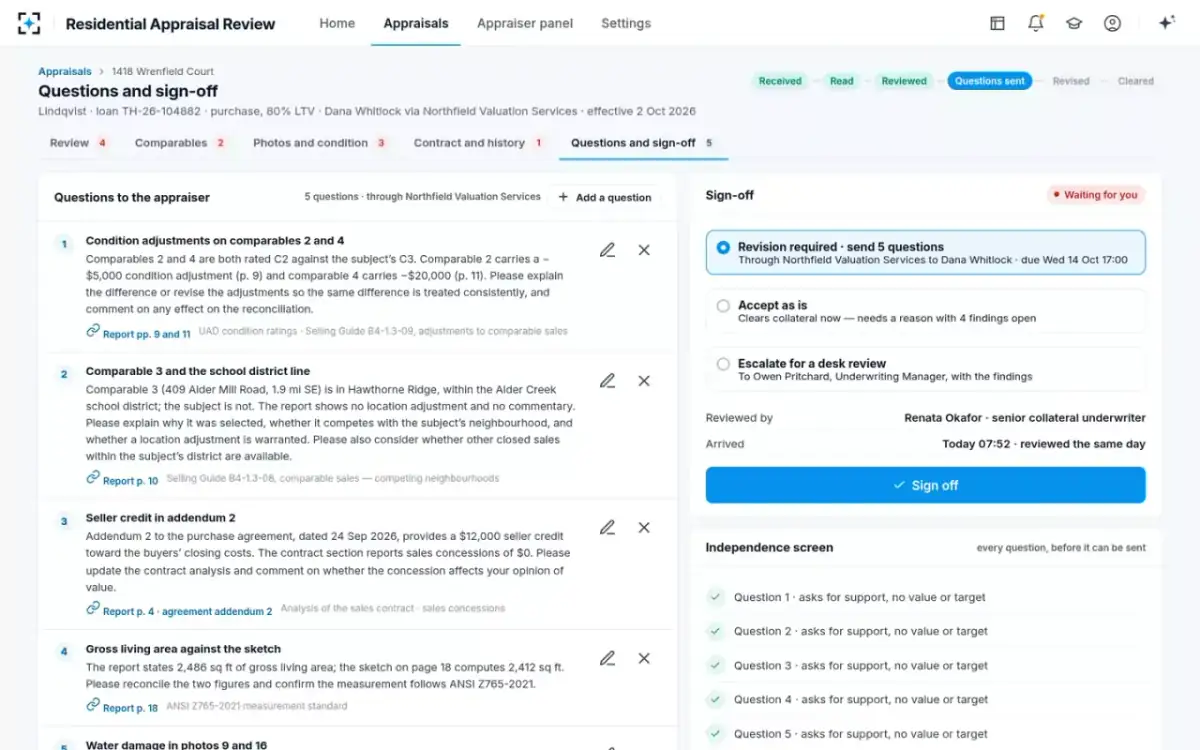
What violates appraiser independence?
Anything that tries to make the value rest on something other than the appraiser's own judgment violates it, directly or indirectly. Regulation Z gives five examples: seeking a minimum or maximum value; withholding or threatening to withhold timely payment because the appraiser "does not value the consumer's principal dwelling at or above a certain amount"; implying that "current or future retention" depends on the value; excluding an appraiser from future work for missing "a predetermined threshold"; and "conditioning the compensation paid to a person that prepares a valuation on consummation of the covered transaction" (1026.42(c)(1)(i)).
The commentary closes two gaps that revision letters tend to fall into. A target need not be a single number: a "specific value" and a "predetermined threshold" include "a predetermined minimum, maximum, or range of values." And the rule is not only about inflation: it "applies equally to cases where a covered person's prohibited actions are designed to cause the value assigned to the dwelling to be below a certain amount" (comment 42(c)(1)(i)-2). A reviewer pushing a value down to fit a risk appetite is as exposed as a loan officer pushing it up.
A revision request asks for support. The moment it carries a number the appraiser did not report, it starts to steer.
Can loan officers talk to appraisers?
Regulation Z does not ban conversation; it bans influence, and the agencies' practice keeps loan production away from the appraiser altogether. The 2010 guidelines keep reviewers apart from loan production staff (Interagency Guidelines, XV.A), and the Regulation Z commentary gives a pointed example: "a loan originator may not coerce a loan underwriter to alter an appraisal report to increase the value" (comment 42(c)(2)(iii)-1). For loans sold to Fannie Mae, the lender is also responsible for compliance with the agencies' Appraiser Independence Requirements, named in Selling Guide B4-1.1-02.
The workable policy is simple. The loan officer sees the status of the review and when the revision is due, and does not see or shape the questions. The questions go from the reviewer to the management company to the appraiser. In Residential Appraisal Review, the loan officer's view shows status only, and nothing reaches the appraiser except through the management company.
Can a lender ask for a specific value?
No. Seeking a minimum or maximum value is the first example of a violation in 1026.42(c)(1), and the commentary extends it to a range. In practice this rules out more phrasing than people expect: "the contract price is $612,000," "the value needs to support 80% loan-to-value," "could you consider $620,000," "is a C3 really right here, given the price." Each puts a number or an outcome in front of the appraiser.
Phrases an independence screen should stop, and how to rewrite them
| Blocked wording | Why it is a problem | Rewritten as a permitted ask |
|---|---|---|
| "The contract price is $612,000. Please review the value." | Names a target the appraiser did not report. | "Please explain the reconciliation and the weight given to each comparable." |
| "We need the value at $615,000 to hold 80% LTV." | Names a value and a loan outcome. | "Comparables 2 and 4 use different condition rates; please explain or revise, and comment on any effect on the reconciliation." |
| "Could you consider comparable X, which sold for $640,000?" | Offers a sale for its price, pointing at a number. | "Please consider these closed sales within the subject's school district and explain whether they are more similar." |
| "Should this be C4?" | Suggests a rating, which drives the adjustments and the value. | "Photos 9 and 16 appear to show water damage; please comment on cause and whether the C3 rating still holds." |
What is a reconsideration of value, and how is it different?
A reconsideration of value (ROV) is "a request from a financial institution to the appraiser or other preparer of the valuation report to reassess the report based upon potential deficiencies or other information that may affect the value conclusion" (Federal Reserve SR 24-3). It differs from a revision request mainly in where it starts: an ROV is often prompted by the borrower. The 2024 interagency guidance describes how institutions may fold ROV handling into their risk management, and it is "supervisory guidance that does not have the force and effect of law" (FR Doc. 2024-16200).
Fannie Mae's version is binding for loans it buys. The lender must "complete its appraisal review before initiating the ROV process," designate an underwriter or other expert to review the request, and allow one borrower-initiated ROV per appraisal with "additional data, information, or comparable properties (not to exceed five)." Its standardized communication to the appraiser must include "instructions for delivering the ROV response as part of a revised appraisal report that includes commentary on conclusions regardless of the outcome" (B4-1.3-12). FHA lets the underwriter request one when the appraiser "did not consider information that was relevant on the effective date" (HUD Handbook 4000.1, II.A.3.a.ix).
The ROV process is also where fair lending risk surfaces. In United States v. Rocket Mortgage, a Fair Housing Act case over a refinance appraisal, the court denied the lender's and the management company's motions to dismiss on September 12, 2025; the complaint alleges the home was undervalued because of the owner's race (U.S. Department of Justice). Allegations are not findings, but the case shows that a borrower's challenge to a value is a compliance event as well as a credit one.
What an agent may draft, and what it may not
Drafting questions is the most automatable part of a review, and the most dangerous to automate carelessly, because a model that sees a contract price and a value will happily mention both. Residential Appraisal Review handles it with boundaries rather than trust. The revision request drafter drafts the questions with page and guideline, screens each for independence, and drafts the collateral risk note for the file. It never asks for a value, never sends without the reviewer, and always routes through the management company. Where the comparable sales analyst shows the grid with consistent adjustments, the view is labelled as not the appraiser's figures, and the drafter does not quote it to the appraiser.
One sample review, from arrival to five questions
1:36min
for six agents to review 7 documents and draft the questions
5of 5
questions passed the independence screen; none names a value or a target
2days
business days for the revision, the sample lender's setting
The underwriter stays in charge of every word: questions can be edited, removed or added, and the screen runs again on each edit. On the sample appraisal, the fifth question did not exist until the underwriter pressed "Ask the appraiser" on the photo of the kitchen ceiling; the agent drafted it, and she sent it with the other four. The guide to C3 and C4 condition shows why that photo earned a question, and the guide to who may change the value covers what happens if the answer does not resolve it. To see the drafter on your own appraisals, start from Residential Appraisal Review.
Questions people ask
Is there a standard appraisal revision request form?
No agency mandates a single form for revision requests. Fannie Mae prescribes standardized content for borrower-initiated ROVs, including the property, the appraiser, the deficient areas and up to five comparables, and a lender can adapt that structure for its own revision letters. What the form contains matters more than its layout.
Can the underwriter call the appraiser directly?
Regulation Z does not forbid it, and some lenders allow reviewer-to-appraiser contact for clarifications. Others route all contact through the appraisal management company, so that communication is documented and production staff stay out of it. Whatever the channel, the content limits are the same: ask, explain, correct, never a number.
How long does an appraiser have to answer a revision request?
No federal rule sets a deadline; it is a matter of the lender's or management company's engagement terms. Residential Appraisal Review makes it a setting of one, two or three business days. Regulation Z allows withholding pay only for "breach of contract or substandard performance," not for the value reached.
Can a lender send comparable sales with a revision request?
Yes. Asking the appraiser to "consider additional, appropriate property information, including information about comparable properties" is expressly permitted. Choose them for similarity and location, explain why they may be better, and do not present them by price or as support for a number.
What if the appraiser refuses to revise?
The appraiser is entitled to keep the value if it is supported. If material deficiencies remain, Fannie Mae's options are a desk or field review by a state-licensed or certified appraiser, or a new appraisal, documented in the file, and a referral to the state licensing board where deficiencies go uncorrected or unacceptable practices appear.