The UAD 3.6 mandatory date is November 2, 2026. From that day, appraisal reports submitted to the Uniform Collateral Data Portal for loans sold to Fannie Mae or Freddie Mac must use Uniform Appraisal Dataset 3.6 and the redesigned Uniform Residential Appraisal Report, which replaces the static forms reviewers have read for years with "a single dynamic Uniform Residential Appraisal Report" used "with all property types and property valuation methods" (Freddie Mac Bulletin 2025-7). On September 30, 2026 the agencies added a temporary exception for sellers that are not ready, and it is not free. For collateral underwriters the change is practical: a new layout, new condition fields and a larger dataset to review against. Botminds' Residential Appraisal Review reads the redesigned report and the legacy forms side by side, with a page reference for every value, so a reviewer's checks do not depend on which format arrived.
Three dates that decide which appraisal report a lender may deliver
Nov 22026
UAD 3.6 mandatory for reports submitted to the agencies' portal
May 192027
last day an approved seller may submit a new UAD 2.6 report
Jun 282027
UAD 2.6 policy and technology support retired, resubmissions included
When is UAD 3.6 mandatory?
UAD 3.6 is mandatory for appraisal reports submitted to the Uniform Collateral Data Portal on or after November 2, 2026. The date attaches to the portal submission, not to the inspection or the note: "Appraisal reports with UCDP submission dates on or after November 2, 2026 must use UAD 3.6," while those submitted from January 26 through November 1, 2026 "may use UAD 2.6 or UAD 3.6" (Bulletin 2025-7). Sellers approved for the limited production period could use the new dataset from September 8, 2025.
The joint program behind it is run by both agencies. Freddie Mac's announcement describes "Freddie Mac's and Fannie Mae's (the GSEs) Uniform Appraisal Dataset (UAD) and forms redesign project," and the later bulletin confirms the mandate "is effective for appraisal reports submitted to the Uniform Collateral Data Portal® (UCDP®) on or after November 2, 2026" (Bulletin 2026-J). Fannie Mae's Selling Guide appraisal topics each point to the same place: "Lenders using UAD 3.6 must follow the requirements in the UAD 3.6 Policy Supplement" (Selling Guide B4-1.1-06; the supplement is here).
Two roads to UAD 3.6: on time, or by exception with a cost in 2027
- Limited productionSep 8, 2025
- Broad productionJan 26, 2026
- UAD 3.6 onlyNov 2, 2026
- Limited productionSep 8, 2025
- Broad productionJan 26, 2026
- Both formatsNov 2, 2026
- No reliefMar 1, 2027
- FinalMay 20
Can lenders still use UAD 2.6 after November 2, 2026?
Only with approval, only until May 19, 2027 for new reports, and with a penalty from March 1. Bulletin 2026-J says that "in coordination with U.S. Federal Housing (FHFA) and Fannie Mae, Sellers that need more time to complete their UAD 3.6 implementation may, with Freddie Mac approval, continue to submit to UCDP new UAD 2.6 appraisal reports through May 19, 2027, and resubmissions of UAD 2.6 appraisal reports through June 27, 2027." To apply, a seller must "commit to a final implementation plan, including coordination with vendor(s) and appraisers."
The cost lands on collateral risk. From March 1 to May 19, 2027, "for UAD 2.6 appraisal reports submitted to UCDP, the collateral risk score returned by Loan Collateral Advisor® will be '99', and the Seller will not be eligible for appraised value representation and warranty relief" (Bulletin 2026-J). A lender that relies on automated relief to fast-track low-risk appraisals loses that lane on every legacy report in those eleven weeks, which means its reviewers carry the full value and comparables review on them. The guide to what a low collateral risk score relieves sets out exactly which warranties move.
The exception buys time on the format. It does not buy relief on the value.
What changes with UAD 3.6 for lenders?
Four things change for a lender's collateral team: the report's structure, the data behind it, the condition fields, and the way square footage is reported. Freddie Mac's bulletin lists the Guide changes, which "include, but are not limited to: specification labels and allowable values; quality and condition ratings definitions … including the new interior and exterior condition ratings and the new condition status of certain interior and exterior features; reporting requirements for measured square footage; UCDP submission requirements for the new Restricted Appraisal Update Report and the new Completion Report" (Bulletin 2025-7).
What changes on the redesigned report, and what a reviewer does differently
| Area | What changes | What the reviewer does differently |
|---|---|---|
| Report structure | One dynamic URAR replaces separate forms by property type and inspection type. | Stops navigating by form number and page position; finds sections by content, since the report changes shape with the property. |
| Dataset | "A larger dataset than the current version of the UAD (UAD 2.6)." | Checks more fields against the narrative, and the narrative against the photos, because more is now structured. |
| Condition | New interior and exterior condition ratings, and a condition status for certain features. | Tests each rating separately against the photos of that part of the house, not one overall C-rating. |
| Square footage | New reporting requirements for measured square footage. | Ties reported living area to the sketch and the ANSI Z765-2021 measurement Fannie Mae already requires. |
| Updates and completions | New Restricted Appraisal Update Report and Completion Report, delivered through the portal. | Tracks the completion report as its own document, with its own portal status. |
Square footage deserves its own line in any readiness plan because it already trips reviews today. Fannie Mae's current Guide requires appraisers to "follow the American National Standard Institute (ANSI) Square Footage-Method for Calculating: ANSI® Z765-2021 … when measuring, calculating and reporting the above- and below-grade square footage(s)," and says output from sketching or 3D scanning software "must conform to the ANSI standard" (B4-1.3-05). A reviewer who ties the reported figure to the sketch is ready for the new reporting; one who copies the reported figure into the file is not.
When will the new URAR form be required, and which forms retire?
The redesigned URAR is required on the same date as the dataset, November 2, 2026, because the two are one change: UAD 3.6 "eliminates the use of static appraisal forms and replaces them with a single dynamic Uniform Residential Appraisal Report (URAR)." Effective that day Freddie Mac retires ten Guide forms: Form 70 (the Uniform Residential Appraisal Report), 70B (manufactured home), 70D (desktop), 70H (hybrid), 72 (small residential income property), 442 (appraisal update and completion), 465 and 465H (condominium unit, and its hybrid), 466 (exterior-only condominium) and 2055 (exterior-only residential) (Bulletin 2025-7).
Reviewers know most of these by their Fannie Mae numbers: the Uniform Residential Appraisal Report is Form 1004 in Fannie Mae's list, the condominium report Form 1073, the small residential income report Form 1025 (B4-1.1-06). Any internal checklist, condition template or exception code written around those form numbers and their page layout needs rewriting around content. The redesigned report changes shape with the property; a rule that says "check page 2, Improvements section" no longer points anywhere reliable.
Does FHA use UAD 3.6?
The November 2 mandate is the agencies' rule for loans sold to Fannie Mae and Freddie Mac; FHA sets its own timing through HUD. FHFA said in October 2024 that "in partnership with the Department of Housing and Urban Development, FHFA will significantly expand the UAD to include appraisal data from applications for FHA-insured loans" (FHFA, October 28, 2024). HUD Handbook 4000.1 as revised on August 12, 2026 still directs mortgagees to use "Fannie Mae Form 1004D/Freddie Mac Form 442" for completion certifications (II.A.3.b), the very form Freddie Mac retires on November 2.
For a lender with both conventional and FHA production, the practical consequence is a mixed queue for some time: redesigned reports on loans headed to the agencies, and FHA reports that follow HUD's own adoption schedule. Lenders should take FHA's dates from HUD's own notices rather than assume they follow the conventional mandate.
What reviewers must re-learn on the redesigned report
Most of what a collateral underwriter checks does not change: the contract, the comparables, support for adjustments, eligibility and independence are the same rules. What changes is where the evidence sits and how much of it is structured. Three habits need deliberate re-learning.
The first is reading condition in parts. A single overall rating let a reviewer ask one question, does the house look C3. Separate interior and exterior ratings, and a condition status on features, invite the more precise question the Guide has always implied, because adverse conditions apparent at the inspection must be in the report (B4-1.3-06). The guide to C3 and C4 condition works through a case where two photos contradict the rating. The second is navigating by data rather than by page. The third is treating structured fields as claims to test, not as facts: a field that says "no adverse conditions" is a statement the photos can support or contradict.
How should lenders prepare for UAD 3.6?
Lenders prepare in three tracks: delivery (can every report reach the portal in the new format), review (do the reviewers and their rules work on the new report), and panel (are the appraisers and their software ready). The checklist below is a practical order of work for a collateral team in the weeks around the mandate.
A lender's UAD 3.6 readiness checklist for the collateral team
- Decide on the exception, today
If any channel cannot deliver UAD 3.6 by November 2, request Freddie Mac's temporary exception with a committed plan, and plan for the loss of value relief on 2.6 reports from March 1, 2027.
- Count the panel
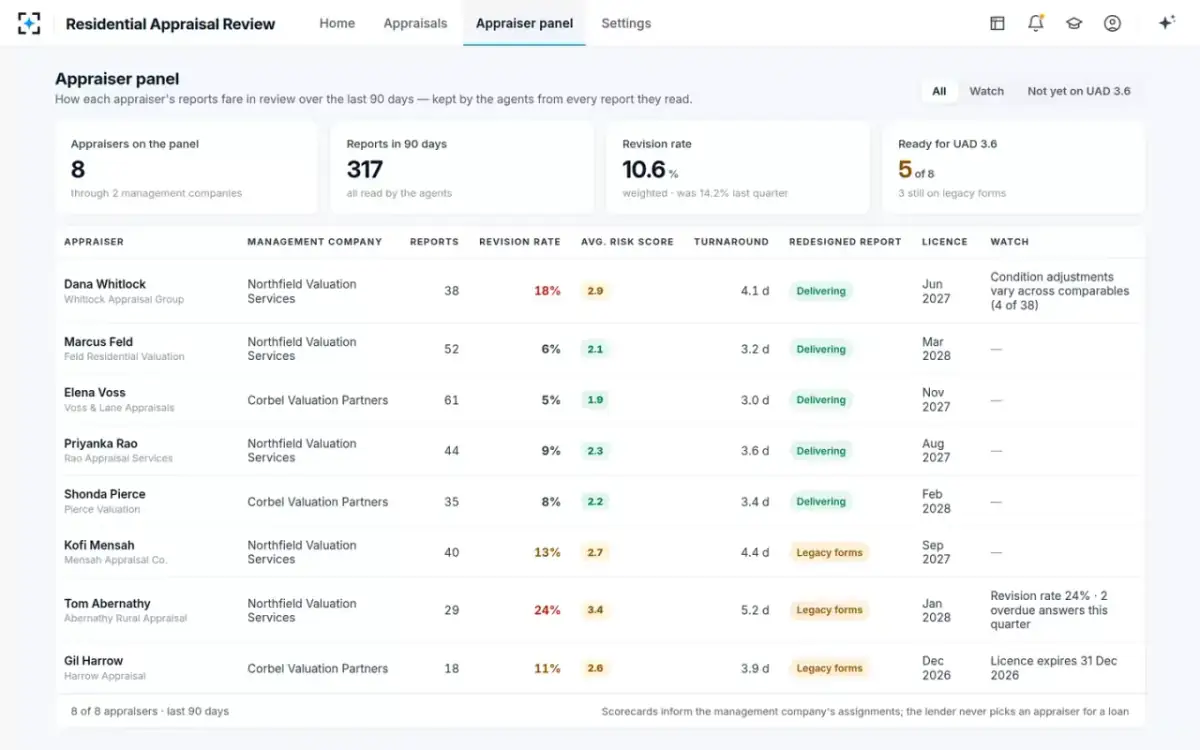
For each appraiser and management company, know who is already delivering the redesigned report and who is still on legacy forms.
- Rewrite form-number rules
Replace checklist lines, conditions and exception codes keyed to Form 1004 or Form 70 pages with rules keyed to content.
- Re-train on condition
Walk reviewers through the new interior and exterior condition ratings and feature condition status, on real redesigned reports.
- Tie square footage to the sketch
Make the ANSI Z765-2021 check routine on every report, not only when the figure looks odd.
- Map completion reports
Route the new Completion Report and Restricted Appraisal Update Report through the same review and portal checks as the original.
- Run both formats in one queue
Expect redesigned and legacy reports side by side into 2027, including FHA reports on HUD's schedule.
- Read the Policy Supplement
Fannie Mae's appraisal topics each direct UAD 3.6 users to the Policy Supplement; make it the reviewers' reference, not the old form instructions.
Residential Appraisal Review: which appraisers already deliver the redesigned report
Legacy-form review rules that no longer fit
Some review habits were built around the old forms and will break quietly. Rules that reference a page or block position will misfire on a report that changes shape. Rules that accept a single overall condition rating will miss a poor interior behind a sound exterior. And any rule that assumes a fixed set of comparable rows or attachments will mis-count on a report that adapts to the property and valuation method.
One rule that should not change at all is the one that matters most: a reviewer tests support, and asks the appraiser when it is missing. The redesigned report gives the reviewer more structured evidence to test against, which helps. It also gives more fields an appraiser may have filled by default, which is why the comparison between field, narrative and photo becomes the reviewer's main job. The underwriter appraisal review checklist is written to apply to both formats.
Reading both formats in one queue with Residential Appraisal Review
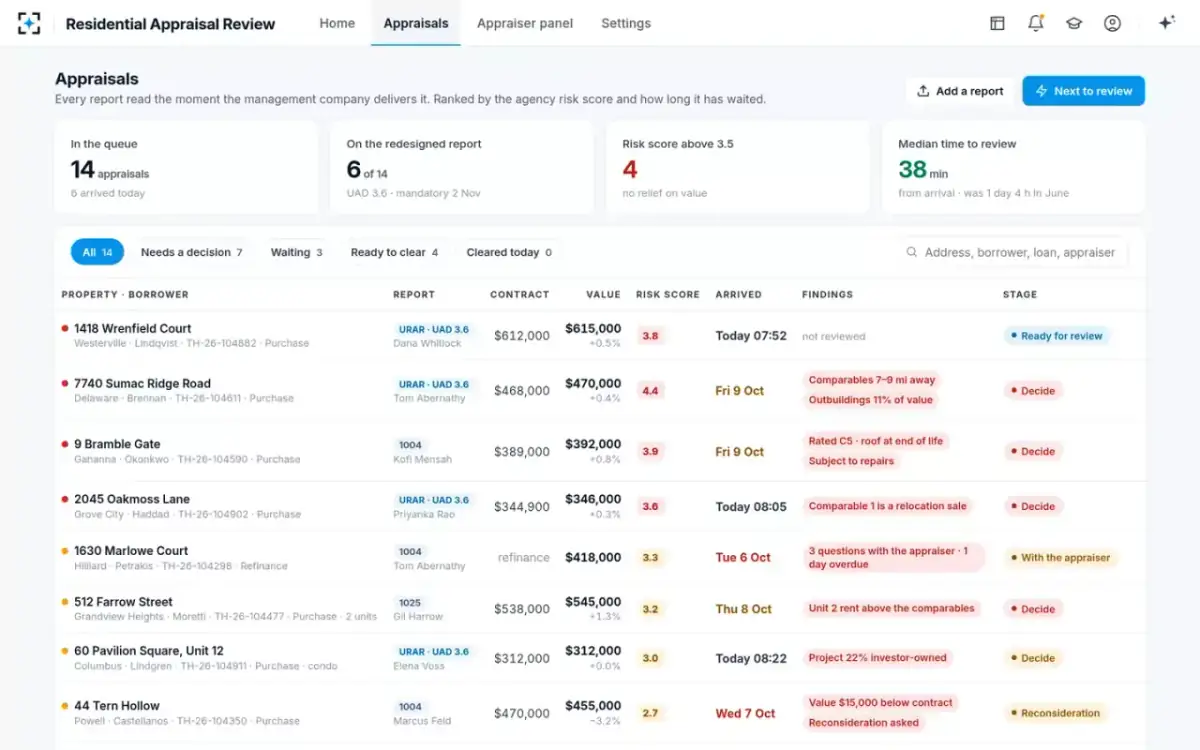
Residential Appraisal Review's appraisal report reader reads the redesigned URAR with its UAD 3.6 dataset and the legacy 1004, 1073 and 1025 forms, every field, photo and the sketch, with a page reference for every value. On the sample appraisal used across these guides, a fictional 42-page redesigned report for 1418 Wrenfield Court, the reader parsed a dataset of 1,184 fields and 32 photos before the other agents began, and all six agents finished in 1 minute 36 seconds.
The queue shows which reports arrived in which format, so a team running the exception can see its legacy exposure each morning, and the appraiser panel shows who is delivering the redesigned report. The reviewer's rules, such as how far apart two rates for the same feature may be, or how far reported living area may sit from the sketch, are settings that apply to both formats. To try it on your own recent redesigned reports, start from Residential Appraisal Review.
Fourteen appraisals, six on the redesigned report, ranked by risk
Questions people ask
What is UAD 3.6?
UAD 3.6 is the new version of the Uniform Appraisal Dataset that Fannie Mae and Freddie Mac developed jointly under the Uniform Mortgage Data Program. It "contains a larger dataset than the current version of the UAD (UAD 2.6)" and comes with the redesigned URAR, one dynamic report for all property types and valuation methods. It is mandatory for portal submissions from November 2, 2026.
Does the November 2 date apply to the inspection date or the submission date?
The submission date. Freddie Mac's bulletin ties the rule to "UCDP submission dates on or after November 2, 2026." A report inspected in October but submitted on or after November 2 must use UAD 3.6 unless the seller holds the temporary exception.
What happens to a UAD 2.6 report submitted after November 2 without the exception?
The bulletins describe the mandate and the exception, not a separate cure; a seller without approval should expect a legacy report submitted after the mandate not to meet the agencies' requirements. From May 20, 2027 even approved sellers receive a "Not Successful" portal status on new UAD 2.6 reports, and a loan generally needs a "Successful" status before sale.
Do the condition ratings C1 to C6 still exist under UAD 3.6?
The redesign keeps condition and quality ratings but changes their definitions and adds separate interior and exterior condition ratings and a condition status for certain features. Reviewers should read the new definitions in the agencies' current guides and the UAD 3.6 Policy Supplement rather than the legacy form instructions.
Does UAD 3.6 change what an underwriter must review?
The underwriter's obligations do not change: contract, listing, comparables, ownership, eligibility and a reliable value under Selling Guide B4-1.3-01. What changes is the report the review is done on, with more structured fields, separate condition ratings and new reporting for measured square footage.