Appraisal review software, for mortgage lenders, is software that helps a collateral underwriter decide whether a home appraisal supports the value and the loan: it reads the report, photos, sketch and purchase contract, recomputes the comparable grid, tests the property description, ties the agency's risk messages to their pages, and drafts questions for the appraiser. It is not performance review software, and it is not a valuation model. The test of a product is not its feature list; it is whether a senior reviewer will put a name to a review built on it. Botminds' Residential Appraisal Review was designed around that signature: six agents do the reading and arithmetic on every report as it arrives, the underwriter edits and signs, and the design target is that every appraisal is reviewed the day it arrives.
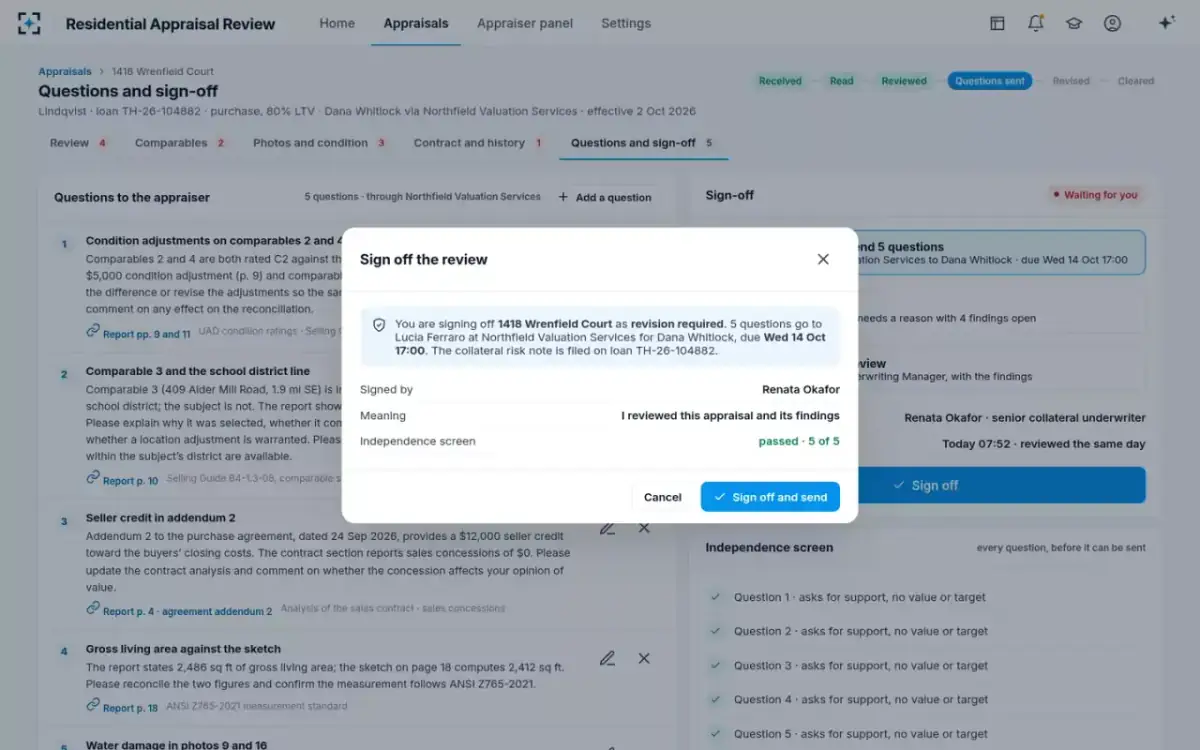
Residential Appraisal Review: the signature, with its meaning recorded
What is appraisal review software?
It is software that does the mechanical part of an underwriter's appraisal review so the reviewer can spend time on the judgement. The underwriter's job is set by the agencies: analyse the contract, the listing, the comparable sales and the current ownership, and validate that the property is eligible and that the appraiser's opinion of value is accurate and reliable and reflects the property's market value, condition and marketability (Fannie Mae Selling Guide B4-1.3-01). Software can extract and compare everything those duties touch; it cannot decide whether the value is reliable.
Three kinds of product use the name, and buyers should know which they are looking at. Rules engines check the report's data against fixed edits, which catches missing fields but not a photo that contradicts a rating. Tools built for appraisers help write reports, not review them. And AI review tools read the whole file, including images and addenda, and draft findings and questions. Residential Appraisal Review is the third kind, built for the lender's side.
One sample appraisal, from arrival to a signed revision request
2min
from arrival to all 32 photos read; 2 contradict the C3 condition rating
96s
for six agents to review 7 documents, the 42-page report among them
5of 5
questions passed the independence screen; none names a value or a target
Will reviewers trust AI findings?
Reviewers trust findings they can check in seconds, and distrust everything else. That turns trust into a design requirement: every finding must link to the page, photo, addendum or paired sales it rests on, show its arithmetic, and state a confidence where it reads an image. A finding that says "condition adjustment inconsistent" makes the reviewer search; one that says "comparable 2 takes −$5,000 for C2 against C3 on page 9, comparable 4 takes −$20,000 for the same difference on page 11" lets the reviewer agree or disagree on the spot.
Trust also depends on being able to disagree. In Residential Appraisal Review a reviewer can clear any flag, and the reason goes on the audit trail with the photo and the observation it cleared. Over time those reasons are the most useful feedback a bank can collect on its tool, and they are evidence for the periodic testing the guide to testing AI appraisal review recommends. Fannie Mae's AI framework for sellers expects exactly that kind of ownership: a named owner for the AI policies, reviewing them at least once a year (LL-2026-04).
Label the recalculated view as the reviewer's, not the appraiser's
The most useful view a review tool can offer is also the most dangerous: the comparables recalculated with consistent adjustments, to see whether the value is still bracketed. On a sample report, that view put the $615,000 value above all five adjusted sales, where as reported it sat inside the closed sales' range of $607,820 to $628,180. A reviewer needs to see that. But the federal guidelines leave the value conclusion with the original appraiser, and a recalculated range that looks like a valuation invites someone to treat it as one.
The consistent view, labelled: why the questions matter, not a value
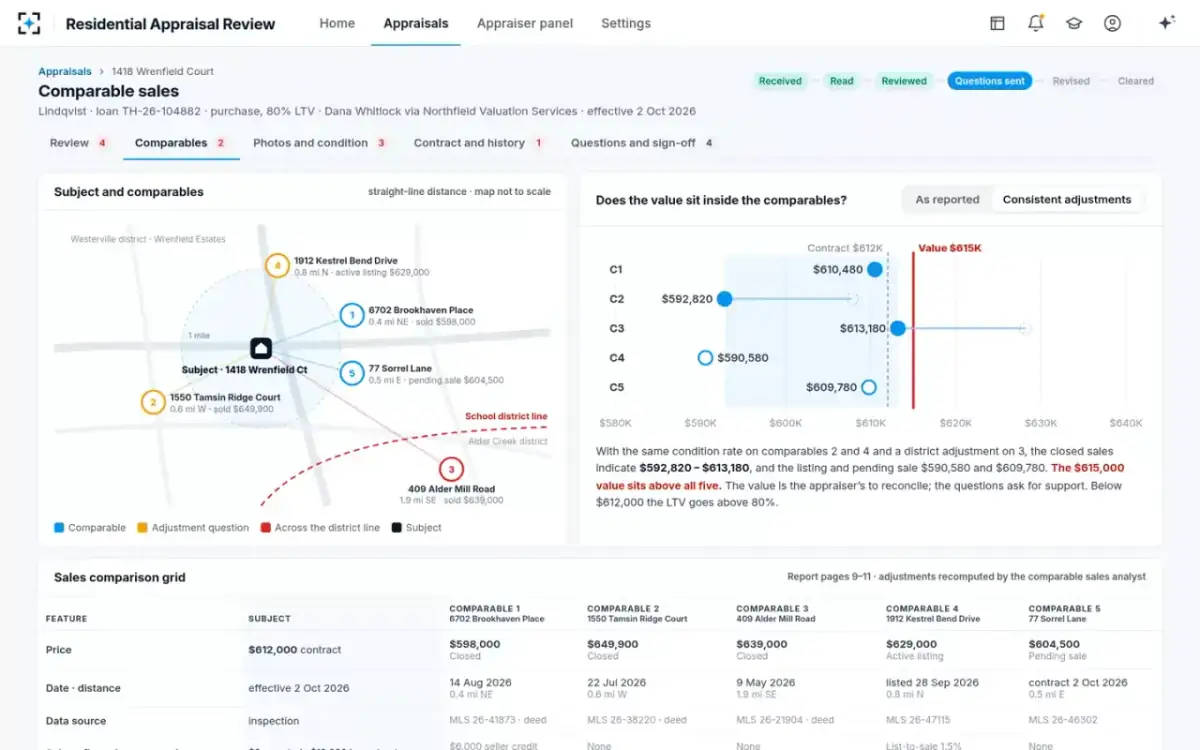
Residential Appraisal Review handles this with labels and walls. The consistent view is labelled as not the appraiser's figures; the comparable sales analyst "never states a value"; and the revision request drafter does not carry the recalculated range into the questions. When the reviewer asks the solution whether the value sits inside the comparables, the answer ends: "That is not a value of mine — it is why questions 1 and 2 matter."
A reviewer who signs a review built on software is signing the software's restraint as much as its findings.
How do you keep AI from influencing the appraiser?
Screen every question, route every question through the management company, and require a named underwriter to send it. Regulation Z forbids any covered person from trying to make the value rest on anything other than the appraiser's independent judgment, and its definition of valuation management includes reviewing an appraiser's work (12 CFR 1026.42). A model that drafts questions has read the contract price and the loan-to-value; nothing in its nature stops it mentioning them. A screen does.
In Residential Appraisal Review the independence screen blocks any question that names a value, a target or a preferred outcome until it is rewritten, and the screen is always on. Questions go through the appraisal management company, never directly to the appraiser, and the loan officer sees the status of the review, never the questions. The guide to the appraisal revision request letter shows the wording the screen allows and the wording it stops.
What should a reviewer sign?
A reviewer should sign a decision with a stated meaning, over a record of what was found and what was asked. The 2010 guidelines want a bank's review policy to "set forth documentation standards for the review and the resolution of noted deficiencies" and to "establish a process for resolving any deficiencies" (Interagency Guidelines, section XV). Fannie Mae wants the file to show how deficiencies were resolved, or why a second opinion of value was relied on (B4-1.3-12).
Three sign-off choices, and what each must carry
| Decision | When | What the signed record carries |
|---|---|---|
| Revision required | Findings that the appraiser can answer by explaining, supporting or correcting. | The questions as sent, each with page and rule; the independence screen result; the due date; the management company. |
| Accept as is | No findings, or findings the reviewer resolves without the appraiser. | With findings open: a written reason and a second reviewer, in the sample lender's settings. |
| Escalate for a desk or field review | A value question that survives a revision, or a risk score above the manager threshold. | The findings and the appraiser's answers, for the Underwriting Manager's decision. |
The meaning line matters more than it looks. A signature that says only "approved" leaves an examiner or a post-closing reviewer to guess whether the reviewer read the findings or clicked through them. "I reviewed this appraisal and its findings" is a claim a reviewer will make only if the findings are checkable, which brings the argument back to the page links.
How do you roll out appraisal review software?
Roll it out in four phases over about two months: write the bank's collateral policy as settings, prove the tool on a seeded test of closed appraisals, run it in parallel with the current review, then go live by lane. The schedule below is ours, a plan for a mid-sized lender, and the order matters more than the weeks.
An eight-week rollout, with the proof before the go-live
- Policy as settingsWeeks 1–2
- Seeded test on closed filesWeeks 3–4
- Parallel runWeeks 5–6
- Go live by laneWeeks 7–8
In weeks one and two, the chief appraiser and underwriting manager turn the review policy into settings: which risk scores route where, what rate difference for the same feature is worth a question, how far reported living area may sit from the sketch, how many days the appraiser has to answer. Each is versioned on the audit trail, so the bank can show an examiner the parameters the 2010 guidelines ask for. Weeks three and four are the seeded test. Weeks five and six run the tool beside the current review on live reports, comparing findings. Go-live then starts with the lanes where the evidence is strongest, usually the fast lane and the senior reviewer's queue, and widens as the reasons for cleared flags settle.
The redesigned report should be in the parallel run from the start. Appraisal reports submitted to the agencies' portal from November 2, 2026 must use UAD 3.6 for most sellers, and the final report the underwriting decision relied on must reach the portal with a "Successful" status before sale (B4-1.1-06). The guide to the UAD 3.6 mandatory date covers the timeline.
Measuring whether it works after go-live
Measure the review, not the software: how long reports wait, what the questions achieve, and what quality control finds later. Four measures cover most of it. Time from arrival to a signed review shows whether the backlog is gone. The share of questions that lead to a revised report, by appraiser, shows whether the questions are the right ones; on a sample panel of eight fictional appraisers in Residential Appraisal Review, revision rates ranged from 5% to 24% over 90 days. The reasons reviewers give for clearing flags show where settings are too tight. And post-closing findings on loans the tool reviewed show what it missed.
The last measure has a ready source. Fannie Mae's post-closing quality control already requires a collateral risk assessment on sampled loans: confirm eligibility and loan-to-value, assess the comparables, check the report against the unacceptable practices and reconcile the agency's flags. Every collateral defect that review finds on a loan the software read is a test result, and the bank should route it back to the settings and to the seeded test set. The 2010 guidelines expect every appraiser's work to be reviewed periodically; a review tool deserves no less.
What questions should you ask an appraisal review software vendor?
Nine questions to ask, each with the answer a reviewer will sign on
- Does every finding cite a page?
Report page, photo, addendum or data source, opened in one click.
- Does it read photos, or only data?
Photos against condition and quality ratings, with a confidence on each observation.
- Is any recalculated view labelled?
As the reviewer's test, never the appraiser's figures, and kept out of the questions.
- Can it ever name a value to the appraiser?
The right answer is no, enforced by a screen on every question and every edit.
- Who sends the questions?
A named underwriter, through the management company, never the software on its own.
- Whose rules does it apply?
The bank's, as versioned settings, including flags it labels as its own rather than agency rules.
- Does it read both report formats?
The redesigned URAR with UAD 3.6 and the legacy forms, in one queue.
- What does the signature record?
Name, meaning, decision, and a second reviewer for accepting with findings open.
- What AI does it use, and can we disclose it?
Enough detail for a Fannie Mae request under LL-2026-04, and support for the bank's annual policy review.
What appraisal review software cannot do
It cannot replace the people the rules name. It cannot perform a USPAP appraisal review or give a second opinion of value; that needs an appraiser licensed in the state, as the guide to who may change the value explains. It cannot see a house: it reads the appraiser's photos and sketch, so a field review remains the remedy when the question is what is actually there. It cannot judge a thin market from data the file does not hold, and it should not override a rating or an adjustment.
Residential Appraisal Review is honest about the same limits. Its agents never edit the report, never state a value, never override a rating, never contact the borrower, agents or appraiser, and never treat the agency score as the review. Where a question survives a revision, the solution's answer is to route the file to the Underwriting Manager for a desk or field review. What it does do is make sure that by the time a person is needed, the reading is done and the question is already drafted. To see it on your own appraisals, start from Residential Appraisal Review.
Questions people ask
Is appraisal review software the same as an AVM?
No. An automated valuation model estimates a property's value; appraisal review software reviews an appraiser's report and should never estimate value at all. AVMs used in credit decisions are covered by the 2024 quality control rule effective October 1, 2025; a review tool that states no value is outside it.
Does appraisal review software replace the underwriter?
It should not. Federal guidelines expect a qualified reviewer, independent of production, to review appraisals before the credit decision, and Fannie Mae holds the lender responsible for the value and description warranties it does not get relief on. The software prepares the review; the underwriter decides and signs.
How long does it take to see value from appraisal review software?
The first useful output is the parallel run, when reviewers compare the tool's findings with their own on live reports, typically within the first two months of a plan like the one above. Measured gains in turnaround or revision quality need the bank's own before-and-after data, collected from the start.
Can appraisal review software check FHA appraisals?
It can read the same report types and apply the same comparisons, but the rules differ: FHA's requirements are in HUD Handbook 4000.1, including minimum property requirements and a 12-month resale check. A tool should let the bank apply the right rulebook by loan type.
What if reviewers disagree with a finding?
They clear it with a reason, which goes on the audit trail. Those reasons tell the bank where its settings are too tight and where the tool reads poorly, and they are the evidence of human judgement an examiner or quality control reviewer will look for.