There are no current Fannie Mae appraisal net and gross adjustment guidelines in the sense most checklists mean: the Selling Guide says "Fannie Mae does not have specific limitations or guidelines associated with net or gross adjustments," and that "the number and/or amount of the dollar adjustments must not be the sole determinant in the acceptability of a comparable" (Selling Guide B4-1.3-09). The familiar 15% net and 25% gross figures are a rule of thumb that lives on in review checklists and software defaults. A lender may keep them as its own flags, but a grid can pass both while hiding the problems that do matter. Botminds' Residential Appraisal Review, which reads every appraisal for collateral underwriters as it arrives, uses the percentages as review flags only and puts its weight on two other tests: is the same feature adjusted at the same rate, and is each adjustment supported.
This guide sets out what the rule actually says, how to calculate net and gross adjustments, and a sample grid from a fictional house, 1418 Wrenfield Court, that passes every percentage test and still earns two questions to the appraiser.
A grid that passes 15/25 on every comparable, and still has two problems
Comparable 1 · closed
Price$598,000
Net+$12,480
Net %+2.1%
Gross %4.1%
Adjusted$610,480
What the review foundClean. Its $6,000 seller credit is adjusted down, as the Guide requires.
Comparable 2 · closed
Price$649,900
Net−$42,080
Net %−6.5%
Gross %6.5%
Adjusted$607,820
What the review foundC2 against C3 at −$5,000.
Comparable 3 · closed
Price$639,000
Net−$10,820
Net %−1.7%
Gross %1.7%
Adjusted$628,180
What the review foundAcross the school district line, $0 location adjustment, no comment.
Comparable 4 · listing
Price$629,000
Net−$38,420
Net %−6.1%
Gross %6.1%
Adjusted$590,580
What the review foundC2 against C3 at −$20,000.
Comparable 5 · pending
Price$604,500
Net+$5,280
Net %+0.9%
Gross %0.9%
Adjusted$609,780
What the review foundClean.
What are the net and gross adjustment guidelines?
For loans sold to Fannie Mae, the guideline is that there is no percentage limit and the adjustments must be market-based. The full passage is worth reading, because it does more than remove a ceiling. "Ideally, the best and most appropriate comparable would require no adjustment; however, this is rarely the case." The appraiser's adjustments "must reflect the market's reaction," and the expectation is "to analyze the market for competitive properties and provide appropriate market based adjustments without regard to arbitrary limits on the size of the adjustment" (B4-1.3-09).
The Guide then gives the example that should retire the habit. It would be inappropriate, it says, "for an appraiser to provide a $20 per square foot adjustment for the difference in the finished above-grade area based on a rule-of-thumb when market analysis indicates the adjustment should be $100 per square foot." Read the other way round, an appraiser who keeps adjustments small to stay under 15% and 25% is applying exactly the kind of arbitrary limit the Guide rejects, and the value moves with it.
The 15/25 habit, against what the Selling Guide says
What the habit assumes: Over 15% of the sale price makes a comparable suspect.
What B4-1.3-09 says: "Fannie Mae does not have specific limitations or guidelines associated with net or gross adjustments."
What the habit assumes: Over 25% means the comparable is too different to use.
What B4-1.3-09 says: The number or amount of adjustments "must not be the sole determinant in the acceptability of a comparable."
What the habit assumes: Keep any single line under 10% (another common habit).
What B4-1.3-09 says: Adjustments must reflect the market's reaction, "without regard to arbitrary limits on the size of the adjustment."
What the habit assumes: A red flag on their own.
What B4-1.3-09 says: A signal to check conformity: if adjustments suggest the property "may not conform to the neighborhood, the underwriter must determine if the opinion of value is adequately supported."
Net adjustment vs gross adjustment: how to calculate each
Net adjustment is the sum of a comparable's adjustments with their signs, divided by its sale price; gross adjustment is the sum of the same adjustments without their signs, divided by the same price. Net tells you how far the adjustments moved the price; gross tells you how much adjusting it took to get there. A comparable can have a small net and a large gross when large plus and minus adjustments cancel out, which is the case reviewers worry about most.
How to calculate net and gross adjustments, worked on one comparable
| Step | Calculation | Result |
|---|---|---|
| 1. List each adjustment with its sign | Concession −$6,000; living area +$4,180 (76 sq ft at $55); basement finish +$9,300 (620 sq ft at $15); deck +$5,000 | Four lines |
| 2. Net adjustment | −$6,000 + $4,180 + $9,300 + $5,000 | +$12,480 |
| 3. Net adjustment % | $12,480 ÷ $598,000 | +2.1% |
| 4. Gross adjustment | $6,000 + $4,180 + $9,300 + $5,000 | $24,480 |
| 5. Gross adjustment % | $24,480 ÷ $598,000 | 4.1% |
| 6. Adjusted price | $598,000 + $12,480 | $610,480 |
Two details matter in practice. The denominator is the comparable's sale price, not the subject's value, so a percentage on a listing uses the list price and should be read with that in mind. And the concession line belongs in the count: Fannie Mae requires concessions on comparables to be adjusted to "reflect the difference between what the comparables actually sold for with the sales or financing concessions and what they would have sold for without," and "positive adjustments for sales or financing concessions are not acceptable" (B4-1.3-09).
Does Fannie Mae limit gross adjustments?
No. Fannie Mae sets no limit on gross adjustments, on net adjustments, or on individual line adjustments. What it does set is a reconciliation rule that is often more useful than any percentage: "the indicated value in the Sales Comparison Approach must be within the range of the adjusted sales price of the comparables that are reported in the appraisal" (B4-1.3-09). It also lists among unacceptable appraisal practices "use of adjustments to comparable sales that do not reflect market reaction" and "not supporting adjustments in the sales comparison approach" (B4-1.1-04).
Those two rules shift the reviewer's question from size to support. A $40,000 adjustment for a third garage bay may be fine if the comments show paired sales; a $5,000 condition adjustment may be wrong if the next column uses $20,000 for the same difference. The Guide also asks for comments that "detail the work performed and data sources utilized for the market supported adjustments," and says "a statement only recognizing that an adjustment has been made is not acceptable."
Gross adjustment on each sample comparable, against a 25% review flag
Are large adjustments a red flag?
Large adjustments are a reason to look, not a finding. The Guide's own trigger is conformity: if the adjustments are large enough "to indicate that the property may not conform to the neighborhood, the underwriter must determine if the opinion of value is adequately supported" (B4-1.3-09). A house that needs heavy adjustment against every sale in its market may be an over-improvement, a unique property, or simply in a thin market, and the Guide expects the appraiser to explain which. In rural areas and for unusual properties it explicitly accepts sales that are "not truly comparable" if "the appraiser adequately documents the analysis and explains why they were used" (B4-1.3-08).
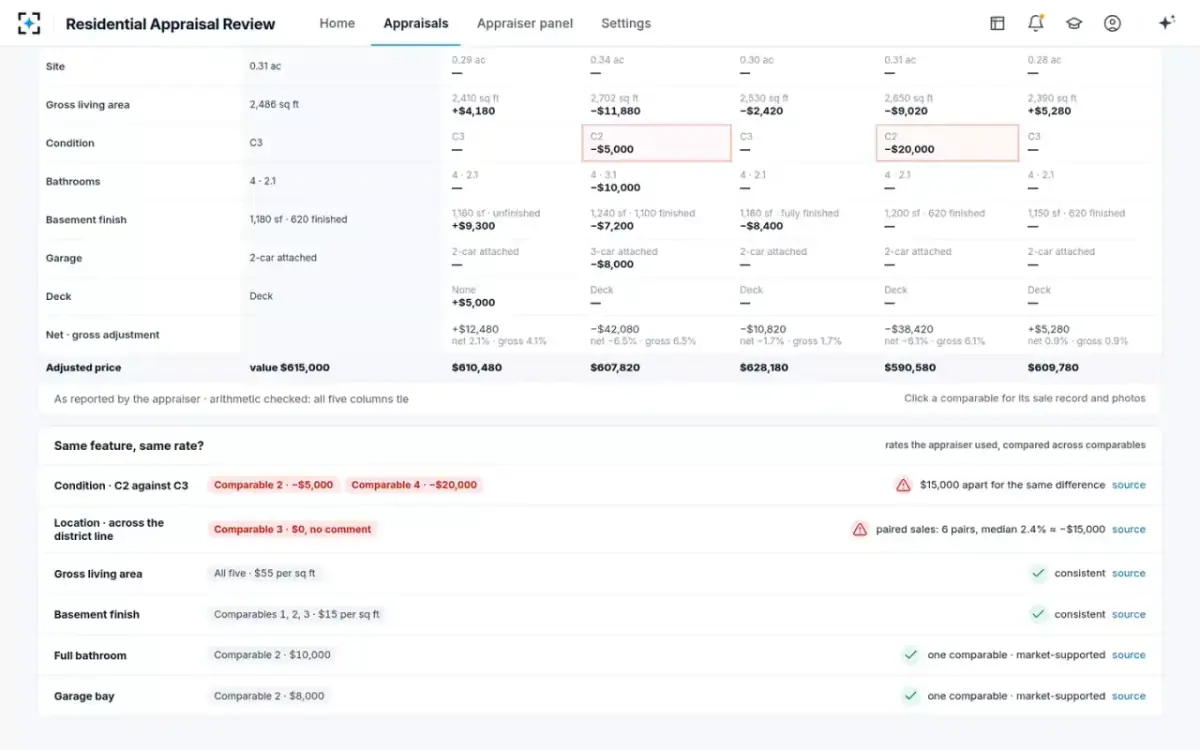
Small adjustments deserve the same suspicion when they look too small. A comparable from across a school district line with a $0 location adjustment and no comment shows a gross percentage that looks clean precisely because an adjustment is missing. On the sample appraisal, comparable 3 sits 1.9 miles away in a different school district; six paired sales in the solution's data put the difference at about $15,000. Its gross adjustment is 1.7%, the second-lowest in the grid.
A percentage test rewards an appraiser for leaving out an adjustment. A consistency test catches it.
What should an underwriter check instead of adjustment percentages?
Three tests find more than percentages do: whether the same feature carries the same rate across comparables, whether each adjustment has support in the comments or the data, and whether the value is bracketed once the adjustments are made consistent. Each is a test of the report against itself, so none requires the reviewer to form a view of value.
Three grid tests that find what 15/25 misses
| Test | How to run it | On the sample grid |
|---|---|---|
| Same feature, same rate | For each difference (condition, living area, bathrooms, garage), list the rate each comparable used. Flag spreads above the bank's tolerance. | Condition: −$5,000 on comparable 2, −$20,000 on comparable 4, both C2 against C3. $15,000 apart. |
| Support | Read the comments for each line between concessions and condition, as B4-1.3-09 requires. Paired sales, a regression or a cost source should be named. | Living area at $55 per sq ft on all five, consistent. The location line on comparable 3 has no support because it has no adjustment. |
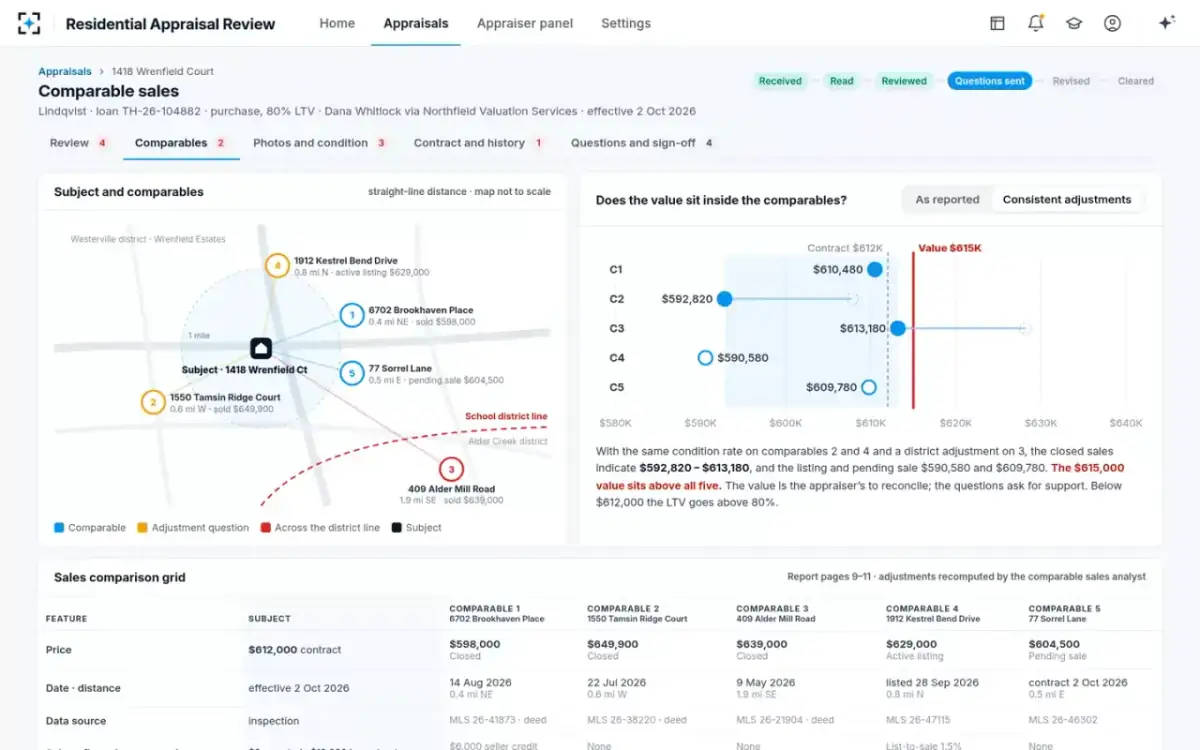
| Bracketing, made consistent | Apply one rate per difference and see whether the value still sits inside the adjusted range. Label the result as the reviewer's test, not a value. | As reported, closed sales indicate $607,820 to $628,180. Made consistent, $592,820 to $613,180, and the $615,000 value sits above all five. |
The bracketing test is where the two small problems become one material question. With a single condition rate and a district adjustment, the closed sales no longer support $615,000, and below $612,000 the loan-to-value goes above 80%. That is not a reason for the reviewer to name a lower number; Regulation Z names an attempt to get an appraiser to report a minimum or maximum value as the first example of a violation (12 CFR 1026.42(c)). It is a reason to ask the appraiser to explain or revise the two adjustments and comment on any effect on the reconciliation, as the guide to wording an appraisal revision request shows.
Residential Appraisal Review: same feature, same rate, compared across comparables
FHA appraisal adjustment guidelines: is there a percentage limit?
HUD Handbook 4000.1 does not state a net or gross percentage limit either; we searched the full text of Update 18, published 12 August 2026, and found no such figure. What FHA does require of the lender is general and strict: the mortgagee must review each appraisal for completeness, accuracy and a credible analysis of marketability and value, and "must ensure the Market Value of the Property is sufficient to adequately secure the FHA-insured Mortgage" (HUD Handbook 4000.1, II.A.3.a). FHA's appraiser-facing protocols govern how adjustments are developed and explained.
So for both conventional and FHA loans, a percentage test is a bank's own policy, not an agency rule. That is fine, provided the policy says so. A review finding that reads "gross adjustment exceeds 25%" invites the appraiser to answer, correctly, that no guideline requires otherwise. A finding that reads "comparables 2 and 4 carry different rates for the same condition difference; please explain or revise" asks for something the appraiser can support.
Is there a limit on individual line adjustments?
No agency rule caps a single line. Some review checklists flag any line above 10% of the sale price, and that can be a reasonable screen, as long as it is treated as a request for support. The Guide's example cuts the other way: a living area adjustment held at $20 per square foot when the market says $100 is a support failure, and the cap is what caused it.
Where a bank keeps percentage flags, the honest approach is to label them as its own. In Residential Appraisal Review the adjustment flags are a setting, net 15% and gross 25% by default with stricter and looser choices, and the settings screen describes them as "review flags, not agency limits." The test that carries more weight is the same-feature rate check, which flags when two comparables carry rates for the same difference $5,000 or more apart, a tolerance the bank sets.
Made consistent, the value sits above every sale
Why consistency matters more under the new condition ratings
Condition is the line where inconsistent rates hide most easily, because a rating is a category and the adjustment between two categories is a judgement. Fannie Mae requires ratings to be assigned "on an absolute basis," each property on its own merits, and notes that "properties can have the same rating or description and still require an adjustment" (B4-1.3-06). That makes the rate between, say, C2 and C3 something the appraiser should apply consistently and explain where it varies.
The redesigned report under UAD 3.6 adds detail rather than removing the problem: Freddie Mac's announcement lists "new interior and exterior condition ratings" among the changes, which gives a reviewer more lines on which a rate can differ. The guide to the UAD 3.6 mandatory date covers what else changes for reviewers, and the underwriter appraisal review checklist places the grid tests among the other nineteen checks.
Questions people ask
What is a net adjustment on an appraisal?
The sum of all of a comparable's adjustments, plus and minus, usually stated as a percentage of the comparable's sale price. A net adjustment of −6.5% means the adjustments together took 6.5% off the sale price to reach the adjusted price. It measures how far the comparable had to move, not how much adjusting it took.
Why do some lenders still use 15% net and 25% gross?
Because the figures are easy to check and long familiar, and many checklists and systems carry them as defaults. Used as flags that prompt a look at support, they do little harm. Used as limits, they contradict the Selling Guide's statement that the size of adjustments must not be the sole test of a comparable, and they can push appraisers toward unsupported small adjustments.
Can an underwriter reject an appraisal for large adjustments?
An underwriter can question support and, if the concerns are not resolved with the appraiser, obtain a desk or field review or a new appraisal. Fannie Mae's process requires the lender to try the original appraiser first and to document the deficiencies behind any new appraisal. Size alone is not a deficiency under the Guide; lack of market support is.
Do adjustments for concessions count toward gross adjustment?
Yes, they are adjustments like any other and belong in the calculation. Under B4-1.3-09 they can only be negative, and they should equal the effect of the concession on the price, which is not necessarily its dollar cost. A seller credit of $6,000 does not automatically mean a −$6,000 adjustment, unless the appraiser's analysis shows the market's reaction was the full amount.
What rate difference should a review flag for the same feature?
There is no agency figure; it is a policy choice. A tolerance in the range of a few thousand dollars catches material inconsistencies in typical suburban price bands without flagging rounding. Residential Appraisal Review offers $2,500, $5,000 or $10,000 and defaults to $5,000, versioned on the audit trail.