The difference between C3 and C4 condition on an appraisal is maintenance. A C3 house is "well-maintained" with "limited physical depreciation due to normal wear and tear"; a C4 house has "some minor deferred maintenance and physical deterioration" and "requires only minimal repairs to building components/mechanical systems and cosmetic repairs" (Fannie Mae Selling Guide B4-1.3-06). The rating matters beyond the label: it drives the condition adjustments against every comparable, and it is one of the property facts a lender keeps warranting even when the agency's risk score relieves the value. Because the appraiser must photograph the kitchen, every bathroom and "examples of physical deterioration, if present," a reviewer can test the rating against the report's own photos. Botminds' Residential Appraisal Review reads every photo against the condition and quality ratings when the report arrives and frames the ones that contradict them; the collateral underwriter decides what to ask.
One sample report: what page 6 says, and what the photos show
The report says (condition C3): "Well maintained." "No adverse conditions observed." (p. 6)
The photos show: Photo 9: brown staining above the sink about 3 ft across, with a tide line. Agent confidence 94%.
The report says (condition C3): "Kitchen counters updated 2021."
The photos show: Photo 9: lower panel and toe kick swollen and darkened. 88%.
The report says (condition C3): "Baths original, well maintained."
The photos show: Photo 16: caulk failed along the tub (91%); two floor tiles lifted, grout cracked (86%).
The report says (condition C3): —
The photos show: On the sketch (p. 18) the primary bath is directly above the kitchen sink wall: one leak would explain both.
The report says (condition C3): C3: well-maintained, limited depreciation from normal wear.
The photos show: Closer to C4: minor deferred maintenance requiring minimal repairs. The rating is the appraiser's to confirm.
What is C3 vs C4 condition on an appraisal?
Both are acceptable, ordinary conditions, and both are eligible "as is." The difference is whether the house has been kept up. Fannie Mae's definitions add notes that make the line clearer. A C3 improvement "is in its first-cycle of replacing short-lived building components (appliances, floor coverings, HVAC, etc.) and is being well-maintained. Its estimated effective age is less than its actual age." For C4, "the estimated effective age may be close to or equal to its actual age," some short-lived components "are at or near the end of their physical life expectancy," and "most minor repairs have been addressed on an ongoing basis resulting in an adequately maintained property" (B4-1.3-06).
So the tell for C4 is deferral: repairs that are minor but waiting, components at the end of their life, an effective age that has caught up with the calendar. The tell for C3 is the opposite: the owner has been replacing things as they wear, and the house looks younger than it is. A water stain on a ceiling is a small thing, but it is the kind of small thing the C4 definition describes, and the kind the C3 definition does not.
The six condition ratings, in brief, and what each means for eligibility
| Rating | In Fannie Mae's words, shortened | Eligibility |
|---|---|---|
| C1 | "Very recently constructed and have not previously been occupied"; no physical depreciation. | As is |
| C2 | "No deferred maintenance, little or no physical depreciation, and require no repairs"; almost new, or recently completely renovated. | As is |
| C3 | "Well-maintained and feature limited physical depreciation due to normal wear and tear." | As is |
| C4 | "Some minor deferred maintenance and physical deterioration"; "only minimal repairs." | As is |
| C5 | "Obvious deferred maintenance and are in need of some significant repairs"; still "useable and functional as a residence." | As is |
| C6 | "Substantial damage or deferred maintenance" severe enough "to affect the safety, soundness, or structural integrity." | Not eligible until repaired to at least C5; appraised "subject to" |
What does C3 condition mean?
C3 means the house is well-maintained with only normal wear and tear: "Some components, but not every major building component, may be updated or recently rehabilitated. The structure has been well-maintained." It can also describe "a property in which the majority of short-lived building components have been replaced but not to the level of a complete renovation." It is a common rating for a sound, lived-in house that has been looked after.
Two rules govern how the appraiser picks it, and both help a reviewer. The rating must be "based on a holistic view of the property," and "it would be inappropriate to select either a lower or higher overall rating on the basis of one or two minor inferior or superior areas." And it must be absolute, not relative: the property is rated "on its own merits," not by how it compares with its neighbours (B4-1.3-06). The holistic rule is why one stained ceiling does not automatically make a house C4; the absolute rule is why "typical for the area" is no defence for an unreported problem.
C2 vs C3 condition: where updated ends and renovated begins
The C2 line is about completeness. A C2 house has "no deferred maintenance," and "virtually all building components are new or have been recently repaired, refinished, or rehabilitated"; it is "almost new" or "recently completely renovated and … similar in condition to new construction." A C3 house may have updated kitchens or baths without every major component being new.
The distinction matters most on comparables, because the grid adjusts for the difference. On the sample appraisal, comparables 2 and 4 are both rated C2 against the C3 subject; one is adjusted −$5,000 for condition and the other −$20,000. Fannie Mae accepts that two properties with the same rating may still differ enough to need an adjustment, so two C2 sales need not take identical adjustments, but a $15,000 gap for the same difference needs an explanation. The guide to appraisal net and gross adjustment guidelines covers that test.
Do photos have to match the condition rating?
The photos and the rating must tell the same story, because both describe the property and the report must reflect what the appraiser saw. Fannie Mae requires that "appraisal reports must reflect adverse conditions that were apparent during the inspection or discovered while performing research, such as, but not limited to, needed repairs, deterioration," and that "detrimental conditions of the improvements must be reported in the appraisal even if the conditions are typical for competing properties" (B4-1.3-06). Minor items are not exempt: "minor plumbing leaks" appear on the Guide's list of minor conditions that "do not rise to the level of a required repair" but "must be reported."
The appraiser is "not responsible for hidden or unapparent conditions." A photo the appraiser took and placed in the report is, by definition, apparent. When it shows staining or deterioration that the comments and rating do not mention, the report contradicts itself, and the reviewer has a fair question that requires no view on value. Where the photos suggest dampness, the Guide adds a specific duty: the appraisal "must comment on the effect on the value and marketability," and the lender must show the condition was corrected or obtain a professional report.
A photo the appraiser took is evidence the appraiser saw. When it contradicts the rating, the report is disagreeing with itself.
What are Fannie Mae appraisal photo requirements?
For a traditional appraisal, Fannie Mae requires "clear, descriptive color photographs showing the front, back, and a street scene of the subject property and the front of each comparable," and interior photographs of, at a minimum, the kitchen, all bathrooms, main living areas, below-grade areas, "examples of physical deterioration, if present," and "examples of recent updates" (Selling Guide B4-1.2-01). The list is short and specific, which is what makes it useful to a reviewer.
The photo set a reviewer should find in every traditional appraisal
- Subject exterior: front, back and street scene
Clear, descriptive color photographs, identified as the subject.
- Front of each comparable
Each identified; the reviewer can check condition and quality against the grid.
- The kitchen
Where water damage, updates and appliance age usually show first.
- All bathrooms
Every one, not a representative one; failed caulk and lifted tile show here.
- Main living areas and all bedrooms
Living, family and dining rooms and every bedroom.
- Below-grade areas, finished and unfinished
Where dampness and settlement are most likely to appear.
- Physical deterioration, if present
If the comments mention none and the other photos show some, ask.
- Recent updates, if present
The evidence for an "updated" or "remodeled" description, and for a C2 rather than C3.
Why the rating carries weight: adjustments, eligibility and the lender's warranty
The condition rating is not a description for its own sake; three things hang on it. It sets the condition line in the adjustment grid against every comparable. It decides eligibility at the bottom of the scale, where a C6 loan "is not eligible for sale" until the deficiencies are repaired to at least C5. And it sits on the lender's side of the warranty line whatever the risk score: with a Collateral Underwriter score of 2.5 or below, the lender is relieved of warranties on value and comparables keeps responsibility for the accuracy of the property data on the report, condition and quality ratings expressly included (Selling Guide A2-2-06).
That last point is the one reviewers underestimate. A fast lane that waves through low-score reports without looking at the photos is waving through the one part of the collateral the lender still warrants. The guide to what a CU score of 2.5 relieves sets out the split, and Fannie Mae's general duty applies on top: the lender "must ensure the appraiser described the property and the market area in factual, unbiased, and specific terms" (B4-1.1-02).
What reading every photo looked like on one sample report
32
photos in the report, all read against the C3 and Q3 ratings within two minutes of arrival
26
photos consistent with C3; 4 not about condition
2
photos that read closer to C4: the kitchen sink wall and the primary bath above it
A worked case: two photos and a C3
Take the sample report as it runs through Residential Appraisal Review. It arrives at 07:52; by 07:54 the condition and eligibility checker has read all 32 photos. The home screen opens not on a queue but on the question "do the photos support the ratings?" Twenty-six photos support C3. Photo 9, the kitchen sink wall, is framed in amber: staining across the ceiling above the sink, a tide line that suggests a leak that has happened more than once, a swollen sink-base cabinet. Page 6 of the report says "No adverse conditions observed."
Residential Appraisal Review: the appraisal opens on the photos that disagree with the rating
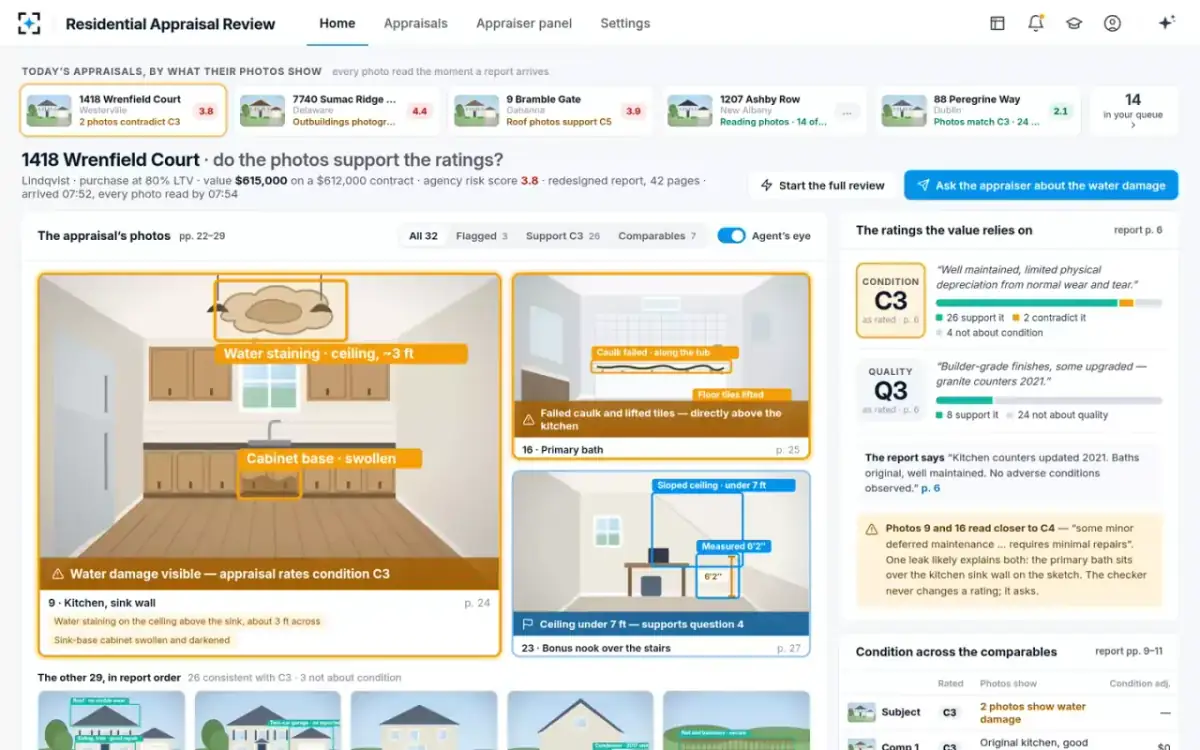
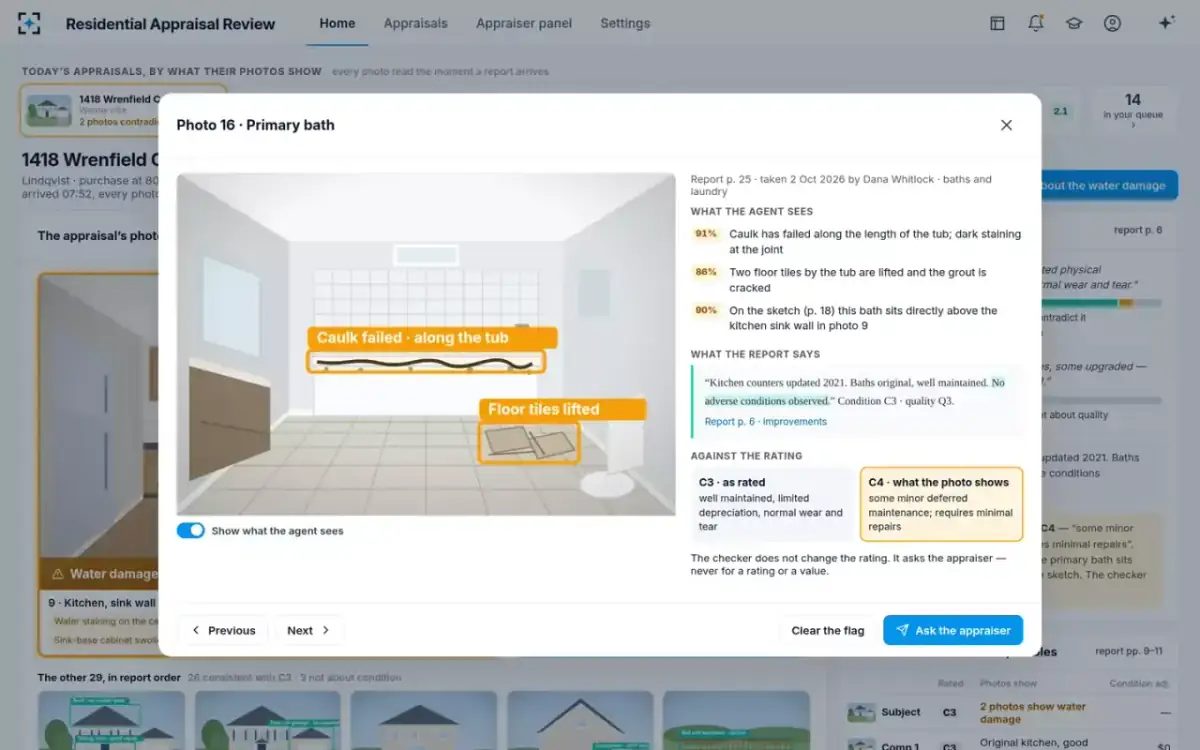
The next flagged photo explains the first. Photo 16, the primary bath, shows caulk failed along the length of the tub and two lifted floor tiles. On the sketch on page 18 that bath sits directly above the kitchen sink wall. One leak would explain both. The checker shows C3 as rated beside C4 as the photo appears, with a confidence on each observation, and states its limit: it does not change the rating, it asks.
How to ask about a rating without asking for one
Ask about the evidence and the cause, and leave the rating to the appraiser. Regulation Z allows a reviewer to ask for more detail or support and for errors to be corrected (12 CFR 1026.42(c)(3)). Suggesting C4 is different: a rating drives the adjustments and so the value, and a reviewer who names one is steering toward an outcome.
On the sample, the underwriter pressed "Ask the appraiser" on photo 9 and the question was drafted as question 5: photo 9 shows staining on the kitchen ceiling above the sink and a swollen sink-base cabinet; photo 16 shows failed caulk and lifted tiles at the primary bath tub, directly above it on the sketch; please comment on the cause, whether there is an active leak, and whether the C3 rating still holds. It suggests no rating and no value, and it passed the independence screen. The guide to the appraisal revision request letter covers the wording rules in full.
The photo above the kitchen: failed caulk and lifted tiles in the primary bath
Do condition ratings change under UAD 3.6?
The ratings remain, with revised definitions and more of them. Freddie Mac's announcement of UAD 3.6 lists among the Guide changes "quality and condition ratings definitions … including the new interior and exterior condition ratings and the new condition status of certain interior and exterior features" (Freddie Mac Bulletin 2025-7). The redesigned report is mandatory for submissions from November 2, 2026, as the guide to the UAD 3.6 mandatory date explains.
For a reviewer, separate interior and exterior ratings make the photo test sharper, not obsolete. A sound exterior no longer averages away a tired interior, and each rating can be checked against the photos of its own part of the house. The principle is unchanged: the photos are the appraiser's evidence, the rating is the appraiser's conclusion, and the reviewer's job is to ask when the two disagree. To see the photo test on your own recent appraisals, start from Residential Appraisal Review.
Questions people ask
Is C4 condition bad on an appraisal?
No. C4 describes an adequately maintained house with some minor deferred maintenance, and it is eligible "as is" for Fannie Mae. It usually means a lower value than the same house in C3, through the condition adjustments against comparables, and it may come with comments on the minor repairs needed.
Can a lender change the appraiser's condition rating?
No. The rating is part of the appraiser's opinion. A lender can ask the appraiser to explain, support or correct it, obtain a desk or field review by a licensed appraiser, or order a new appraisal if deficiencies are not resolved. Under Fannie Mae's rules the lender stays responsible for the accuracy of the rating either way.
What is the difference between condition and quality ratings?
Condition (C1 to C6) describes the state of the improvements: wear, maintenance and repairs needed. Quality (Q1 to Q6) describes how the house was built: design, materials and workmanship, from architect-designed Q1 to basic Q6. A well-built house can be in poor condition, and a modest one in excellent condition.
Does a C5 rating make a loan ineligible?
Not for Fannie Mae. Properties rated C1 through C5 are eligible "as is," provided any conditions are minor and do not affect safety, soundness or structural integrity. C6 is the line: a C6 property must be appraised "subject to" repairs and reach at least C5 before the loan is sold.
Can one bad room change the condition rating?
Usually not on its own: Fannie Mae calls it inappropriate to move the overall rating "on the basis of one or two minor inferior or superior areas." The exception is C6: "if any portion of the dwelling is rated a C6, the whole dwelling must be rated a C6." A room that suggests a wider problem, such as a leak, still has to be reported.