A Collateral Underwriter risk score is Fannie Mae's automated assessment of an appraisal submitted through the agencies' portal, and its practical meaning for a lender sits in one threshold: when a one-unit property's appraisal scores 2.5 or below, Fannie Mae provides enforcement relief on the lender's warranties about the value and the comparable sales (Selling Guide A2-2-06). The relief is narrower than many fast lanes assume. The lender "remains responsible for the description of the property … and the accuracy and completeness of all data on the appraisal that pertains to the property," and the Guide adds: "This includes the property's condition and quality ratings." Botminds' Residential Appraisal Review reads the agency score and messages and ties each to its page, but treats the score as a routing signal, never as the review, so a low score still gets its photos read against the ratings.
What a CU score of 2.5 or below takes off the lender's list, counted duty by duty
Score above 2.5 · all ten duties stay
- Value and comparables · 4 · 40%
- Description, ratings, data, eligibility, fair lending, life of loan · 6 · 60%
2.5 or below · four relieved, six stay
- Relieved: value and comparables · 4 · 40%
- Still the lender's · 6 · 60%
What is a Collateral Underwriter risk score?
It is the score Fannie Mae's Collateral Underwriter returns on an appraisal submitted through the Uniform Collateral Data Portal, together with flags and messages that point at specific risks in the report. The Selling Guide uses one threshold on that score, 2.5 or below, to decide whether relief is available. Freddie Mac runs a parallel tool, Loan Collateral Advisor, with its own score and its own appraised value relief (Freddie Mac Bulletin 2026-J).
The score has uses beyond relief. Desktop appraisals reported on Form 1004 Desktop "will be scored by Collateral Underwriter," and those scoring 2.5 or less are eligible for the same relief (B4-1.2-02). For value acceptance, the agencies' appraisal waiver, a prior appraisal "must be found for the subject property in Fannie Mae's Collateral Underwriter (CU) data" (B4-1.4-10). For a collateral reviewer, though, the score matters mostly for two things: which warranties the lender carries on this loan, and which messages quality control will expect the file to answer.
What does a CU score of 2.5 mean?
A score of 2.5 or below means the appraisal qualifies for enforcement relief on value and comparables, provided the loan is "secured by a one-unit detached, attached, or condo property (manufactured homes are not eligible)" (A2-2-06). It does not mean the appraisal has been reviewed, that the property is eligible, or that the condition rating is right. And it does not protect against the unacceptable practices the Guide lists; A2-2-06 points to them directly.
A score above 2.5 means no relief: the lender warrants all of it. That is not a finding against the appraisal. A higher score on a rural property with few sales, or on an unusual house, may reflect the market rather than the appraiser. It means the lender's own review carries the full weight, which is where the depth of review belongs.
Relieved at 2.5 or below, and still the lender's
The lender is not responsible for: "underwriting the appraisal report to determine whether the subject property presents adequate collateral for the mortgage"
The lender remains responsible for: "ensuring the property meets the property eligibility requirements in this Guide"
The lender is not responsible for: "ensuring the appraisal accurately reflects the market value of the property"
The lender remains responsible for: "adherence to fair lending, local, state, and federal laws"
The lender is not responsible for: "ensuring the appraiser used sound reasoning and provided evidence to support the methodology"
The lender remains responsible for: "the description of the property"
The lender is not responsible for: "analyzing the comparable sales … including the description, selection, adjustments, and reconciliation"
The lender remains responsible for: "the accuracy and completeness of all data on the appraisal that pertains to the property and project … This includes the property's condition and quality ratings"
The lender is not responsible for: —
The lender remains responsible for: "any life-of-loan representations and warranties that may apply to the property or the appraisal"
What does the lender still own with a low CU score?
The lender still owns everything about the house itself: what it is, what condition it is in, whether the data on the report is accurate, whether it is eligible, and whether the report and the decision comply with fair lending law. The sentence that matters most for a collateral team is short: the retained data duty "includes the property's condition and quality ratings."
That clause is why a low score cannot skip the photos. A condition rating feeds both the comparables' adjustments and eligibility, and Fannie Mae sets hard consequences on it: a property rated C6 is not eligible until the deficiencies are "repaired with a resulting minimum condition rating of C5 prior to sale of the loan" (B4-1.3-06). If the photos in a 2.4-scored report show damage the rating ignores, relief on value does not reach the problem, because the problem is in the description. The guide to C3 and C4 condition shows what such a contradiction looks like.
Relief covers the value the appraiser reached. It does not cover the house the appraiser described.
Do CU flags have to be reconciled?
Yes, in quality control, whatever the score. Fannie Mae's prefunding quality control requires a full-file review to assess the "appraisal or other eligible collateral data or documentation, if applicable, including reconciliation of CU flags and messages" (D1-2-01). Post-closing, the lender's collateral risk assessment must "reconcile flags and messages that were identified in Collateral Underwriter (CU) if the property was able to be scored in CU," and where it could not be scored, "reconcile any known quality messages … reflected in other third-party tools" (D1-3-03).
The score does change one quality control step. Post-closing, "appraisal comps do not have to be reverified on appraisals with a Collateral Underwriter (CU) score of 2.5 or below if the lender satisfied all the requirements for obtaining representation and warranty enforcement relief." The other elements stay: confirm eligibility and loan-to-value ratios, check the report against the unacceptable practices, and "conclude that the rationale for the reconciliation of value is supported."
How the score changes the work, step by step
| Step | Score above 2.5 | Score 2.5 or below |
|---|---|---|
| Underwriter's review of value and comparables | Full review; the lender warrants value and comparables. | Relief available; review depth is the lender's policy choice. |
| Condition and quality ratings, description, data | The lender's. | Still the lender's (A2-2-06). |
| Property eligibility | The lender's. | Still the lender's. |
| CU flags and messages | Reconciled in prefunding and post-closing quality control. | Still reconciled (D1-2-01, D1-3-03). |
| Post-closing reverification of comparables | Required. | Not required, if all relief requirements were met. |
| Unacceptable practices check | Required. | Still required. |
What happens to risk scores on UAD 2.6 appraisals after the mandate?
On Freddie Mac loans, a legacy-format report loses relief during the 2027 exception period. Under Bulletin 2026-J, sellers approved for a temporary exception may keep submitting UAD 2.6 reports after the November 2, 2026 mandate, but from March 1 to May 19, 2027 those reports receive a Loan Collateral Advisor score of 99 and no appraised value representation and warranty relief (Freddie Mac Bulletin 2026-J). The bulletin was issued in coordination with FHFA and Fannie Mae.
For a fast lane, that is a design input. A rule that says "score at or below 2.5, no findings, one-click sign-off" must not read a 99 or a missing score as low risk, and a team running the exception needs to know how many of its legacy reports are losing relief. The guide to the UAD 3.6 mandatory date sets out the full timeline.
Should a low CU score skip appraisal review?
A low score can justify a lighter review of value and comparables; it cannot justify skipping the parts the lender still warrants. The 2010 federal guidelines describe the right shape: with prior regulator approval, an institution may screen lower-risk residential appraisals before funding with automated tools or sampling, provided it maintains sound screening parameters, periodically reviews every appraiser's work, and sets rules for when a review must go deeper (Interagency Guidelines, XV.B).
A defensible fast lane therefore has two conditions, not one: the agency score is low, and the lender's own checks of the retained half (photos against ratings, living area against the sketch, contract against report, eligibility) found nothing. If either fails, the report leaves the fast lane. That is also how the review stays honest about Fannie Mae's broader lender duty to ensure "the appraisal does not contain subjective and prohibited language relating to discriminatory practices and appraisal bias," which no score checks for the lender (B4-1.1-02).
Routing by score in Residential Appraisal Review, with both halves checked
Agent
Read the agency findingsThe collateral risk reader reads the score and each message and ties it to its page in the report.
Never: Treat the score as the review.
Agent
Check the retained halfPhotos against condition and quality ratings, living area against the sketch, contract against report, property eligibility.
A person decides
Fast lane: one-click sign-offScore 2.5 or lower and no findings: the collateral underwriter confirms and signs.
A person decides
Senior collateral underwriterScore above 3.5, by the sample lender's settings: no relief on value, deeper review.
A person decides
Underwriting ManagerScore above 4.0, or a value question that survives a revision: decides on a desk or field review.
When a score shapes the next loan: value acceptance and prior appraisals
A Collateral Underwriter result outlives the loan it was run for. For value acceptance, Fannie Mae's appraisal waiver, "generally a prior appraisal must be found for the subject property in Fannie Mae's Collateral Underwriter (CU) data," and if "a CU 'Overvaluation Flag' was issued on the prior appraisal, or the appraisal could not be scored, that prior appraisal will not be used and value acceptance will not be offered" (Selling Guide B4-1.4-10). An appraisal reviewed carelessly today can decide whether a refinance on the same house needs a new one later.
The waiver has its own warranty line, and it is drawn differently. Where value acceptance is exercised, the lender is not responsible for value and marketability, but "remains responsible for the accuracy and completeness of all data that pertains to the property and project … that is submitted to DU (other than the property value)," and must warrant that the property is adequately insured; with value acceptance plus property data, physical characteristics and eligibility, including condition, return to the lender (A2-2-06). The lender may not exercise the offer "if the lender believes that an appraisal is warranted based on additional information" about the property, and may not exercise it at all once an appraisal has been obtained. The pattern is the same as for the 2.5 line: automation relieves the lender of the number, not of the house.
How Residential Appraisal Review uses the score
In Residential Appraisal Review the score is one of six agents' inputs. The collateral risk reader reads the risk score and each message and ties each to its page; on a sample appraisal of a fictional house, 1418 Wrenfield Court, it tied a 3.8 score's four messages to pages 9, 10, 12 and 18 in seven seconds. The other agents do the review the score does not: the comparable sales analyst recomputes the grid, the condition and eligibility checker reads all 32 photos against the C3 rating, and the contract checker compares the purchase agreement with the report.
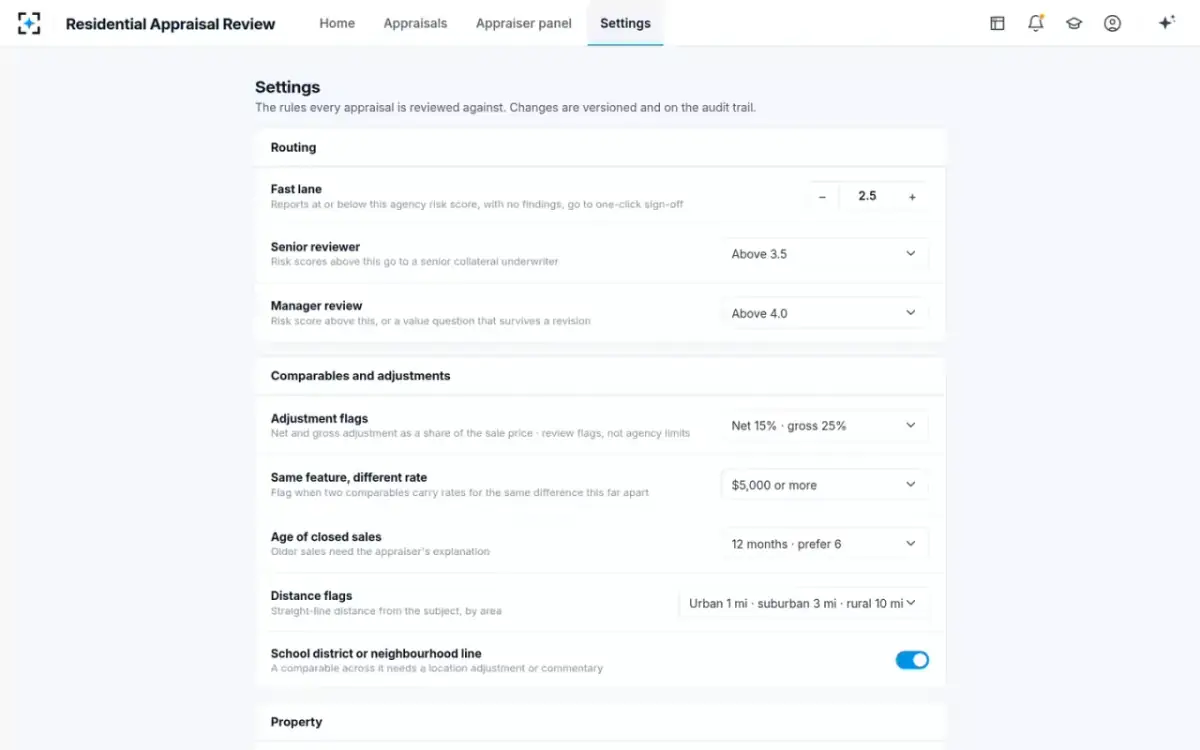
Routing is a setting. The fast lane takes reports at or below a score the lender sets, 2.5 by default, only when no agent found anything; above 3.5 goes to a senior collateral underwriter and above 4.0 to the Underwriting Manager, both adjustable. On the sample queue of fourteen appraisals, four carried scores above 3.5. The underwriter appraisal review checklist lists what the agents check on every report regardless of score.
Your routing rules, with the 2.5 fast lane only when nothing was found
Questions people ask
Does a CU score of 2.5 or below mean the appraisal is accurate?
No. It means Fannie Mae offers enforcement relief on certain warranties about value and comparables for eligible one-unit properties. The appraisal may still misdescribe the property or misrate its condition, and those remain the lender's warranties under Selling Guide A2-2-06.
Does CU relief apply to manufactured homes or two- to four-unit properties?
No. A2-2-06 limits relief to loans "secured by a one-unit detached, attached, or condo property," and says "manufactured homes are not eligible." Other properties carry the full warranties on value and comparables whatever their score.
Can a lender rely on the CU score instead of an underwriter?
Not for the duties it retains, and not without its own review policy. The score relieves certain warranties; it does not review the description, condition, eligibility or fair lending compliance. Federal guidelines allow automated pre-funding screening of lower-risk loans only with prior regulator approval and criteria for expanding review.
Do CU messages need a written response?
Fannie Mae's quality control topics require CU flags and messages to be reconciled in prefunding full-file reviews and in post-closing collateral risk assessments. A reviewer who ties each message to the page it concerns and records the conclusion has the reconciliation ready when quality control asks for it.
Is Freddie Mac's Loan Collateral Advisor score the same as a CU score?
They are separate tools run by each agency, with their own scores and relief terms. Freddie Mac's 2026-J bulletin describes its score for UAD 2.6 reports during the 2027 exception, which shows that each agency's relief must be read in that agency's own guide.