An underwriter appraisal review checklist covers five things: the transaction (contract, listing history and ownership), the comparable sales and their adjustments, the property (condition, photos, living area and eligibility), the appraiser's independence and conduct, and how any deficiency is resolved and documented before the credit decision. Each of those is a written requirement somewhere: the 2010 Interagency Appraisal and Evaluation Guidelines, the Fannie Mae Selling Guide, HUD Handbook 4000.1 and Regulation Z. Botminds' Residential Appraisal Review exists because doing all of it by hand, page by page in a forty-page report, is the reason appraisal review falls behind the loan. Six agents read the report, the photos, the sketch and the purchase contract when the report arrives, and the collateral underwriter decides.
This page lists the checks, the rule behind each one, and what a reviewer actually looks at. Where an example helps, it comes from a sample appraisal of a fictional house, 1418 Wrenfield Court, as it runs through the solution.
The review is required, and it comes before the decision
Before
the final credit decision: when the federal guidelines expect appraisals to be reviewed
3closed
comparable sales, at a minimum, in every Fannie Mae appraisal
4months
before the note date: an older appraisal needs an update; past 12 months, a new one
What does an underwriter look for in an appraisal?
An underwriter looks for evidence that the report supports the value and that the property is eligible collateral: a contract and history that agree with the report, comparable sales that are the right ones with adjustments the market supports, a condition and quality rating the photos bear out, and an appraiser who was free to reach the number. The Fannie Mae Selling Guide states the lender's half of this in one paragraph. The lender "must analyze the current contract for sale," the current listing, the comparable sales and current ownership, and is responsible for validating that "the appraiser has provided an accurate and reliable opinion of value that reflects the market value, condition, and marketability of the subject property" (Selling Guide B4-1.3-01).
Notice what that sentence does not say. It does not ask the underwriter to re-appraise the house, or to second-guess every adjustment. The underwriter tests support. When support is missing, the remedy is to ask the appraiser, not to substitute another number, and the line between reviewing an appraisal and changing its value is drawn by federal guidance, not by habit.
FHA puts the same duty in fewer words. "The Mortgagee must review the appraisal and ensure that it is complete, accurate, and provides a credible analysis of the marketability and value of the Property," and even when the scorecard returns an Accept, "the underwriter must still underwrite all appraisals according to standard FHA requirements" (HUD Handbook 4000.1, II.A.3.a and II.A.4.a).
When must an appraisal be reviewed, and who can review it?
The federal answer is before the credit decision, by someone independent of the loan. "As part of the credit approval process and prior to a final credit decision, an institution should review appraisals and evaluations," the 2010 guidelines say, and reviewers should have no interest in the transaction and be kept clear of loan production (Interagency Guidelines, section XV). Since 2019 the bank regulators' own appraisal rules go further: regulated institutions must have appraisals for federally related transactions reviewed for compliance with the Uniform Standards of Professional Appraisal Practice (84 FR 53579).
Who may review depends on what the review is for. A collateral underwriter reviews for support and policy. A review that may produce a different opinion of value is an appraisal review in the USPAP sense, and Fannie Mae requires that reviewer to hold a licence or certification in the property's state (B4-1.3-12). The guidelines also want the depth set by risk, not by habit: a bank's review policy should "reflect a risk-focused approach for determining the depth of the review" and set documentation standards for the review and for resolving what it finds. A checklist is the floor; risk decides how far past it the reviewer goes.
The transaction: contract, listing history and ownership
Start with the documents around the house before the house itself, because this is where a report most often disagrees with the file. The contract, the listing history and the chain of ownership are each a requirement on the lender, and each has a matching field the appraiser must complete.
Five transaction checks, each with the rule behind it
- The appraiser had the whole contract, and analysed it
The lender "must provide the appraiser with a copy of the complete, ratified contract," and the appraiser must report whether an analysis was performed and its results (B4-1.3-02).
- Concessions in the contract appear in the report
The appraiser must indicate any financial assistance paid on the borrower's behalf and "report the total dollar amount" (B4-1.3-02). Compare every addendum, not just the first page.
- Twelve months of listing history
The report must say whether the subject was offered for sale in the 12 months before the effective date, with each offering price, date and source (B4-1.3-02).
- The seller owns the property
Lenders "must confirm and document in the loan file" that the seller (or refinance borrower) is the owner, with a deed, tax bill, title report or sale history (B4-1.1-02).
- A recent prior sale is explained
FHA requires the mortgagee to check whether the property sold within 12 months of case number assignment and review it for identity-of-interest and flipping (HUD 4000.1 II.A.3.a.vii).
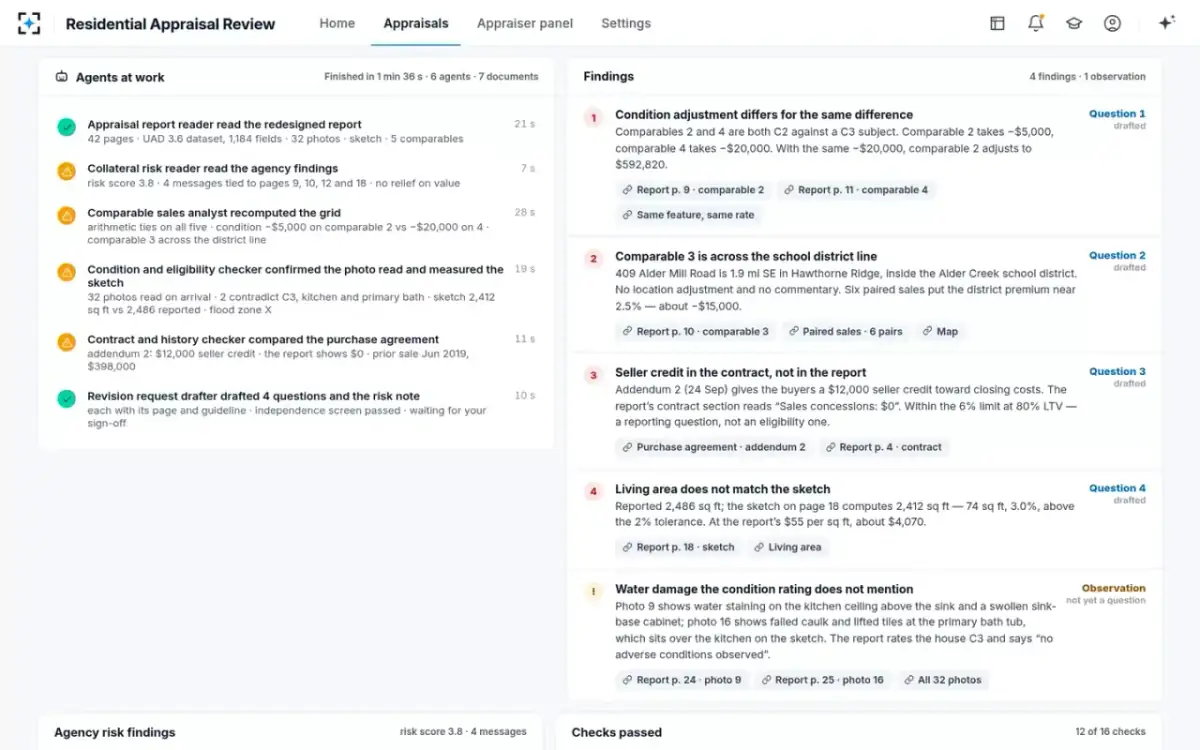
The concession line is the one most often missed, because the evidence sits in an addendum signed after the appraiser's copy of the contract. On the sample appraisal, addendum 2, signed 24 September, gives the buyers a $12,000 seller credit toward closing costs; the report's contract section shows $0. At 80% loan-to-value the credit is inside Fannie Mae's 6% limit on interested party contributions, so it is a reporting question, not an eligibility one. It still has to be asked, because the appraiser's concession analysis is part of the value.
Comparable sales: selection, distance, age and adjustments
The comparable sales are where a reviewer's time goes, and the Selling Guide is more specific about them than most checklists admit. It sets minimums, requires explanations, and, notably, declines to set some of the limits reviewers often assume it does.
What the Selling Guide requires of the comparable sales, and what the reviewer checks
| Check | The rule | What the reviewer looks at |
|---|---|---|
| Number | At least three closed comparables; listings and contracts only as support (B4-1.3-08). | Count the closed sales. A listing in the grid is supporting data, not a comparable. |
| Age | Sales closed within the last 12 months "should be used"; older ones need an explanation (B4-1.3-08). | Any sale over 12 months old, and whether the comments say why. |
| Distance and location | Distance in miles with a direction, straight line; comparables from a competing neighbourhood must be explained (B4-1.3-08). | Each comparable on a map. A school district or neighbourhood line with no comment. |
| Adjustments | Must reflect "the market's reaction"; Fannie Mae "does not have specific limitations" on net or gross (B4-1.3-09). | The same feature at the same rate across comparables, and the support the comments give. |
| Concessions on comparables | Negative adjustments only; positive adjustments for concessions "are not acceptable" (B4-1.3-09). | Every comparable sold with a seller credit, and how it was adjusted. |
| Reconciliation | The indicated value has to fall inside the range of the comparables' adjusted prices (B4-1.3-09). | Whether the value is bracketed, and which sale carried the most weight, and why. |
The adjustment line is worth slowing down for. Many review checklists still carry a 15% net and 25% gross adjustment limit, but the Guide says plainly that the size of the adjustments is not, on its own, a test of whether a comparable is acceptable. A bank may keep those percentages as its own flags; it should know where they come from, and why net and gross percentages miss the adjustment problems that matter. The more telling test is consistency. On the sample appraisal, comparables 2 and 4 are both rated C2 against a C3 subject; one takes −$5,000 for condition and the other −$20,000. Neither breaks any percentage. Together they are a question.
The property: condition, photos, living area and eligibility
A reviewer can test the property description against evidence in the report itself: the photos, the sketch and the comments. The Guide makes that evidence mandatory, which is why it is fair to hold the description to it.
Five property checks a reviewer can test against the report's own exhibits
- The required photos are there
Front, back and street scene of the subject; the front of each comparable; and inside, the kitchen, all bathrooms, main living areas, below-grade areas and "examples of physical deterioration, if present" (B4-1.2-01).
- The photos support the condition rating
Adverse conditions apparent at the inspection belong in the report, minor ones such as small plumbing leaks included (B4-1.3-06).
- The living area matches the sketch
Appraisers must follow ANSI Z765-2021 "when measuring, calculating and reporting" square footage, and sketching software output "must conform to the ANSI standard" (B4-1.3-05).
- The property is eligible as rated
Loans on C6 properties "are not eligible for sale"; the deficiency must be repaired to at least C5 first, and the appraisal made "subject to" (B4-1.3-06).
- Dampness, settlement or infestation is addressed
If the appraisal indicates any of them, it must comment on value and marketability, and the lender must show the condition was corrected or obtain a professional report (B4-1.3-06).
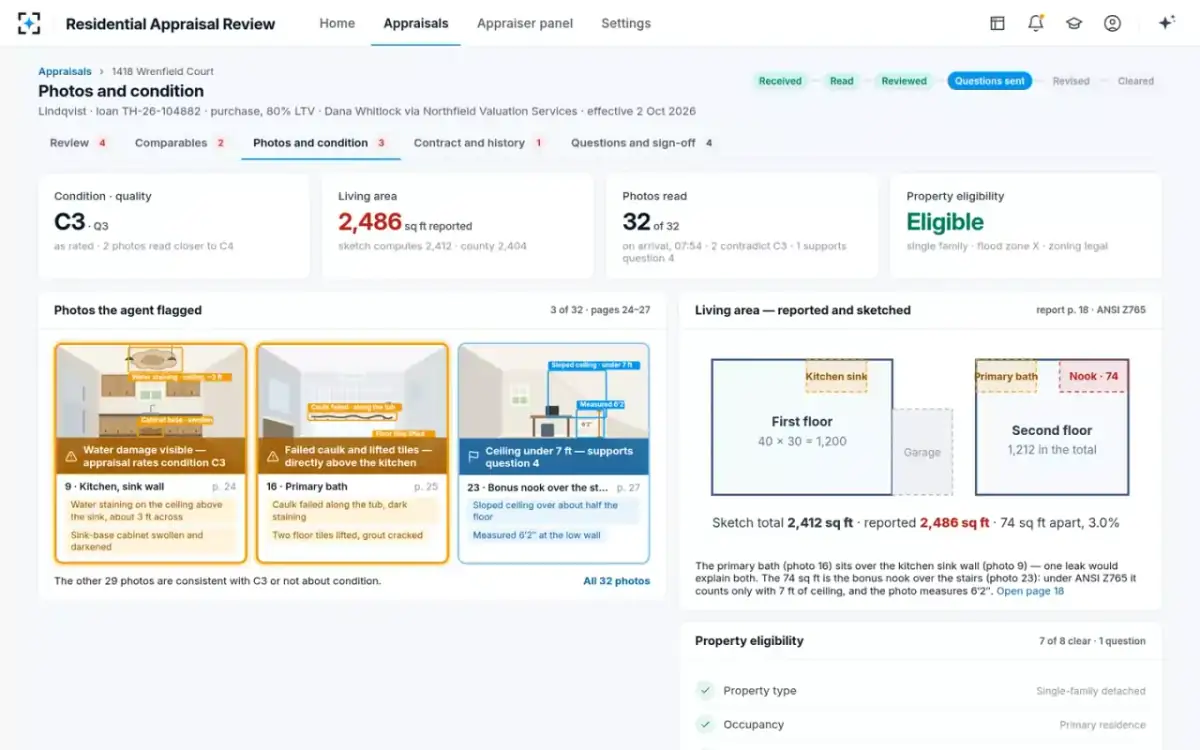
Those rules make the photo set a test the reviewer can run, not a formality. In the sample report, photo 9 shows staining across the kitchen ceiling above the sink and a swollen sink-base cabinet, while page 6 says "No adverse conditions observed" and rates the house C3. Photo 16, of the primary bath directly above it on the sketch, shows failed caulk and lifted tiles. The guide on checking a C3 rating against the photos works that case through. The living area check works the same way: the report states 2,486 square feet, the sketch on page 18 computes 2,412, a 3.0% gap that turns on a bonus room whose ceiling is under seven feet.
Residential Appraisal Review: the photos, the sketch and eligibility on one screen
Independence, and the unacceptable practices list
Two independence questions belong on the checklist: was the appraiser free to reach the value, and is the report free of the practices the agencies call unacceptable. Regulation Z answers the first. In any consumer credit transaction secured by the principal dwelling, no covered person may try to cause the value to rest on anything other than the appraiser's independent judgment, and its first example of a violation is pressing the appraiser toward a minimum or maximum value (12 CFR 1026.42(c)). Because the rule counts reviewing an appraiser's work as a valuation management function, the reviewer is inside it too.
The second is a list, and a reviewer can read for it. Fannie Mae's unacceptable practices include an opinion of value "not supportable by market data," subjective terms such as "pride of ownership" or "desirable neighborhood," any reference to crime, "misrepresentation of the physical characteristics" of the property or the comparables, "failure to comment on negative factors," and "not supporting adjustments in the sales comparison approach" (B4-1.1-04). The lender is also responsible for checking that the appraiser's licence was active on the report's effective date (B4-1.1-03).
A reviewer tests support. When support is missing, the remedy is a question to the appraiser, never a different number.
Data checks: age, delivery and the agency's own flags
A handful of checks are about the file rather than the house, and they fail quietly. An appraisal dated more than four months before the note needs an update that includes an exterior inspection; one more than 12 months old needs replacing (B4-1.2-04). The final version of the report "that was utilized in making the underwriting decision" must be submitted through the Uniform Collateral Data Portal and receive a "Successful" status before sale, and it must be "the unaltered report submitted by the identified appraiser" (B4-1.1-06).
The agency's automated findings are a check in their own right, not a substitute for the review. Fannie Mae's prefunding quality control expects a full-file review to cover the appraisal and to reconcile the Collateral Underwriter flags and messages (D1-2-01). A low risk score narrows what the lender warrants, as the guide to what a Collateral Underwriter score of 2.5 relieves sets out, but it never removes the condition and quality ratings, the property description or eligibility from the lender's side of the line.
What happens if an appraisal is deficient?
A deficient appraisal goes back to its appraiser first, then to a review appraiser if the answer does not resolve it, and to a new appraisal if neither does; every step is documented. The order matters, and Fannie Mae writes it down. If the lender has concerns about reliability, it "must attempt to resolve its concerns with the appraiser that originally prepared the report," and if it cannot, "must obtain a replacement report prior to making a final underwriting decision" (B4-1.3-12).
From a finding to a cleared appraisal: who acts at each step
Agent
Read and recomputeReads the report, photos, sketch and contract; recomputes the grid; ties each agency message to its page.
Never: Changes a rating, an adjustment or the value.
Agent
Draft the questionsDrafts each question with its page and rule, and screens it so none names a value or a target.
Never: Sends anything to the appraiser.
A person decides
Collateral underwriter decidesEdits or removes questions, signs off as revision required, accept, or escalate, with the meaning of the signature recorded.
A person decides
Appraiser answers through the management companyExplains, supports or corrects. The value stays the appraiser's to reconcile.
A person decides
Review if needed, resolution documentedIf the answer does not resolve it, a state-licensed or certified appraiser completes a USPAP desk or field review. The file records how each deficiency was resolved.
Two details trip lenders up. When a new appraisal is ordered, the lender "must document the deficiencies that are the basis for ordering the new appraisal and adhere to a policy of selecting the most reliable appraisal, rather than the appraisal that states the highest value." And if material deficiencies are not corrected on request, or there is evidence of unacceptable practices, the lender "must forward the appraisal report and summary of findings to the appropriate appraisal licensing agency" (B4-1.3-12). Regulation Z has its own referral duty for material USPAP failures, defined as those "likely to significantly affect the value" (1026.42(g)). The questions themselves have a form the rules allow, set out in the guide to writing an appraisal revision request.
What are appraisal red flags a checklist should catch?
The red flags are the places where the report disagrees with something else in the file. Each one below came from the sample appraisal's run, and each is a disagreement between two documents, not a judgement about value.
Five red flags on one sample appraisal, and the evidence on each side
| Red flag | The report says | The evidence says |
|---|---|---|
| Same feature, different rate | Comparable 2: −$5,000 for C2 against C3 (p. 9) | Comparable 4: −$20,000 for the same difference (p. 11) |
| A line crossed with no comment | Comparable 3, 1.9 miles SE: $0 location adjustment (p. 10) | Across the school district line; six paired sales put the difference at about $15,000 |
| Concession not reported | Sales concessions: $0 (p. 4) | Addendum 2: $12,000 seller credit toward closing costs |
| Living area above the sketch | 2,486 sq ft (p. 18) | Sketch computes 2,412 sq ft; county shows 2,404 |
| Condition the photos contradict | C3, "No adverse conditions observed" (p. 6) | Photo 9: ceiling staining and swollen cabinet; photo 16: failed caulk above it |
What is not on that list matters as much. None of the five is a percentage over a limit, and none is a value judgement. They are the kind of finding a post-closing reviewer writes up months later; the point of running the checklist on arrival is to ask them while the appraiser can still answer.
Four findings and one observation, each with its page
Running the checklist on every report, not a sample
The checklist above is long because the rules are, and that is the honest reason appraisal review falls behind the loan: twenty checks across forty pages, a contract and its addenda, done by hand, report after report. The federal guidelines anticipated help. With prior approval from its regulator, an institution may use automated tools or sampling for pre-funding review of appraisals on lower-risk residential loans, provided it keeps sound screening parameters and rules for when a review must go deeper (Interagency Guidelines, XV.B).
Residential Appraisal Review applies the checklist to every report as it arrives rather than to a sample. The agents do the reading and the arithmetic: the grid recomputed, the rate for each feature compared across comparables, every photo read against the rating, the sketch measured, the contract compared line by line, each agency message tied to its page. The collateral underwriter decides, edits the drafted questions and signs, and the design target is that every appraisal is reviewed the day it arrives. What the agents never do is state a value, change a rating or contact the appraiser directly. To see the checklist on one of your own recent appraisals, start from Residential Appraisal Review.
Questions people ask
Is there a Fannie Mae appraisal review checklist?
Fannie Mae does not publish a single checklist form; its requirements are spread across chapter B4-1 of the Selling Guide. B4-1.3-01 sets the lender's core duties (contract, listing, comparables, ownership, eligibility, a reliable value), and the topics that follow cover each section of the report. A lender's checklist is its own document built from those topics.
How long should an underwriter's appraisal review take?
No regulator or agency sets a time, and we have found no reliable public measure of it. The guidelines instead set the depth by risk: loan size, loan-to-value, documentation and complexity. A routine report with a low risk score and no disagreements can be reviewed quickly; one with a contradicted rating or an unexplained comparable deserves the time.
Can a loan officer review the appraisal?
Not as the reviewer. The 2010 guidelines want reviewers kept apart from loan production staff, and Regulation Z forbids anyone in the transaction from trying to influence the value. A loan officer may see the status of the review, but should not be the one writing questions to the appraiser.
Does a low agency risk score mean the appraisal does not need review?
No. A Collateral Underwriter score of 2.5 or below relieves the lender of certain warranties on value and comparables, but the lender stays responsible for the property description, the condition and quality ratings, eligibility and fair lending. Fannie Mae's quality control rules still expect CU flags and messages to be reconciled.
What must a reviewer document?
The 2010 guidelines ask each bank to set documentation standards for the review and for resolving deficiencies. In practice that means each finding, the question asked, the appraiser's answer and the decision, and, when a new appraisal is ordered, the deficiencies behind it. Fannie Mae requires the file to show how deficiencies were resolved or why a second opinion was relied on.
Do the same checks apply to FHA appraisals?
Largely, with FHA's own rules on top. HUD Handbook 4000.1 requires the mortgagee to review the appraisal for completeness, accuracy and a credible analysis, check for sales within 12 months for flipping, and confirm the property meets HUD's minimum property requirements, with repairs where it does not. FHA's photo and form rules sit in its appraiser protocols, not in the Selling Guide.