An appraisal QC review service is an outside firm, often an appraisal management company or a review specialist, that reviews a lender's appraisals for it: desk or field reviews by licensed appraisers, prefunding screens, or the collateral part of post-closing quality control. Whether to buy one, staff the work in-house, or give in-house reviewers agents to do the reading turns on three facts. The lender keeps accountability whoever does the work. Licensed appraisers, the only people who can give a second opinion of value, are a shrinking pool. And most of a review is reading and comparison, not valuation. Botminds' Residential Appraisal Review is built for the third fact: six agents read every report as it arrives and draft the questions, and the lender's own collateral underwriter decides.
Fewer certified residential appraisers, more scrutiny of the ones left
89,618
appraiser credentials on the federal registry at the end of 2025, down from 91,036 a year earlier
−21%
certified residential credentials, 2007 to 2025: from 54,177 to 42,912
755
state disciplinary actions against appraisers in 2025
What is an appraisal QC review service?
It is outsourced appraisal review, bought by the file or by the program. The services fall into three kinds, and lenders often buy more than one. A desk or field review by a licensed appraiser, under USPAP, is the only kind that can produce a second opinion of value; Fannie Mae requires that reviewer to hold a licence or certification in the property's state and to have local data and experience (Selling Guide B4-1.3-12). A prefunding screen reviews appraisals before closing against the lender's checklist. And post-closing collateral QC re-reviews a sample of funded loans as part of the lender's quality control program.
The distinction matters because the buyer is buying different things. A desk review buys professional judgement on one property. A screen or a QC program buys capacity and consistency across many. A lender comparing quotes should know which it is paying for, and should expect to keep the reviewer independent of production whichever it buys: Fannie Mae's prefunding QC must be performed "by individuals who have no involvement in the origination, processing or underwriting functions of the loan being reviewed" (D1-2-01).
Who is responsible when a vendor reviews appraisals?
The lender, entirely. Fannie Mae "holds the lender fully accountable for its overall QC program and for ensuring that QC file reviews comply with Fannie Mae's requirements, regardless of whether the work is performed by the lender itself or by an outsourced QC vendor," and "the lender's contract for services is not a substitute for the lender establishing and maintaining its own QC plan" (Selling Guide D1-1-02).
The same topic sets a control most outsourcing plans underestimate. "The lender must perform a monthly review of at least 10% of the post-closing QC sample reviewed by the vendor to validate the accuracy and completeness of the vendor's work," including loans with and without defects, and "this review must be performed by the lender itself and may not be contracted out." The lender must also ensure that reviewers doing "collateral risk assessments" have "the requisite knowledge and experience." Outsourcing moves the work; it does not remove the need for in-house collateral expertise to check it.
If the vendor uses AI, the lender's duties widen. Fannie Mae's Lender Letter LL-2026-04 requires sellers to "manage risks and appropriate governance of subcontractor and vendor use of AI/ML that is no less protective" than their own, and to disclose on request the AI used and its safeguards (LL-2026-04). A review service that cannot describe its tools is a disclosure gap the lender inherits.
How many appraisers are there, and is there an appraiser shortage?
The federal registry held 89,618 appraiser credentials at the end of 2025, down from 91,036 a year earlier, and certified residential credentials have fallen by about a fifth since 2007, from 54,177 to 42,912 (ASC 2025 Annual Report). Whether that is a shortage depends on volume and place, which the registry does not measure; what it does show is that the people qualified to give a residential second opinion of value are fewer than they were, and that state discipline continues, with 755 actions against appraisers and 87 against management companies in 2025.
Certified residential appraiser credentials on the federal registry, year-end
The wider occupation is larger than the registry because it includes tax assessors. O*NET, sponsored by the US Department of Labor, reports 68,400 property appraisers and assessors employed in 2025 with a median wage of $67,960, and 5,200 projected openings over 2025 to 2035 (O*NET OnLine, 13-2023). For a lender, the practical constraint is not the national count but the number of qualified reviewers who know a given market, which is exactly the qualification Fannie Mae asks of a desk or field reviewer.
What does an appraisal review cost?
We have found no public, independent figure for the price of an appraisal review or the cost per file of in-house review, and we will not quote a vendor's. What can be said is where the cost comes from in each model. An outsourced desk or field review is priced per report, and its real cost includes the turnaround the loan waits for. In-house review is priced in reviewer time, and its cost is driven by how much of that time goes to reading and arithmetic rather than judgement. Both carry the lender's own oversight cost: the 10% monthly re-review of a QC vendor's sample, and the experienced collateral staff needed to perform it.
A useful way to compare quotes is to price the review as three parts: reading the report, photos, sketch and contract; testing it against the checklist; and deciding and writing to the appraiser. The first two are where agents change the economics; the third is where a licensed reviewer's or an underwriter's time is worth paying for. The underwriter appraisal review checklist shows how long the second part is when done properly.
Should appraisal review be outsourced? Three models compared
Outsource what needs a licence or a local market you lack; keep in-house what needs your policy and your accountability; and stop paying skilled people to do reading a machine can do. The models below are not mutually exclusive, and the strongest programs combine them.
Who does what in appraisal review, today and with agents
Today
Licensed reviewers at an outside firm review the lender's appraisals by the file or as a quality control program, at a per-file price and a turnaround.
With agents
Bought by exception: desk and field reviews for the files the agents and the underwriter escalate.
Still theirs: Licensed second opinions of value, in markets where the lender has no reviewer of its own.
Today
Reads every report page by page and writes the revision requests by hand, when there is capacity to read it.
With agents
Starts from findings with pages and drafted questions; edits, signs and sends the same day.
Still theirs: Every decision and every signature.
Today
Owns the results of any outsourced review and re-reviews at least 10% of a vendor's post-closing sample every month.
With agents
Also owns the review settings and the evidence that the agents were tested.
Still theirs: Accountability under Selling Guide D1-1-02, whoever does the work.
Outsourced, in-house and agent-assisted review on the four things that matter
| Factor | Outsourced service | In-house by hand | In-house with agents |
|---|---|---|---|
| Independence from production | Structurally independent; the lender must still keep production out of the questions. | Depends on reporting lines; Fannie Mae and the 2010 guidelines require insulation. | Same as in-house; the agents add an independence screen on every question. |
| Depth | Set by the scope bought: a screen, a desk review or a field review. | Set by policy, limited by reviewer time. | Every report read in full; depth for people set by findings and score. |
| Capacity | Elastic, at a per-file price and a turnaround. | Fixed by headcount; backlogs when volume rises. | Reading scales with volume; people focus on reports with findings. |
| Timing | Before or after closing, by contract. | Often after the report has waited for a reviewer. | On arrival, before the credit decision. |
| Second opinion of value | Yes, from a licensed reviewer. | Only if reviewers are licensed appraisers. | No; escalations go to a desk or field review. |
Prefunding vs post-closing appraisal review: which one are you buying?
Prefunding review happens before the credit decision and can still change the loan; post-closing review happens after funding and can only measure, remediate and report. The federal guidelines expect the first: an institution "should review appraisals and evaluations" as part of credit approval and "prior to a final credit decision" (Interagency Guidelines, section XV). Fannie Mae's post-closing collateral risk assessment is the second: confirm eligibility and loan-to-value, assess the comparables, check for unacceptable practices, confirm the reconciliation of value is supported, and reconcile the agency's flags (D1-3-03).
The two are often bought from the same vendor and confused in the contract. A post-closing finding that the condition rating ignored water damage is useful data and too late for that loan. The same finding on the morning the report arrives is a question to the appraiser. FHA makes the same point from the other side: its handbook makes reviewing the appraisal for completeness, accuracy and credibility part of underwriting the property, before endorsement (HUD Handbook 4000.1, II.A.3.a.vi).
Where agents fit, and where a review appraiser is still needed
Agents fit the part of review that is reading and comparison, which is most of it. In Residential Appraisal Review six agents read the report and its dataset, recompute the grid and compare rates across comparables, read every photo against the ratings and measure the sketch, compare the contract and addenda with the report, tie each agency message to its page, and draft the questions with page and guideline. On a sample appraisal of a fictional house, 1418 Wrenfield Court, that took 1 minute 36 seconds over seven documents.
A review appraiser is still needed whenever the question is the value itself and the original appraiser's answer does not settle it. The solution routes those cases, a risk score above 4.0 or a value question that survives a revision in the sample lender's settings, to the Underwriting Manager for a desk or field review. That is the case for buying outside review by exception rather than by default. The guide to who may change the value covers the review appraiser's role, and the guide to testing AI appraisal review covers how to prove the agents before relying on them.
Residential Appraisal Review: every appraiser's last 90 days, from every report read
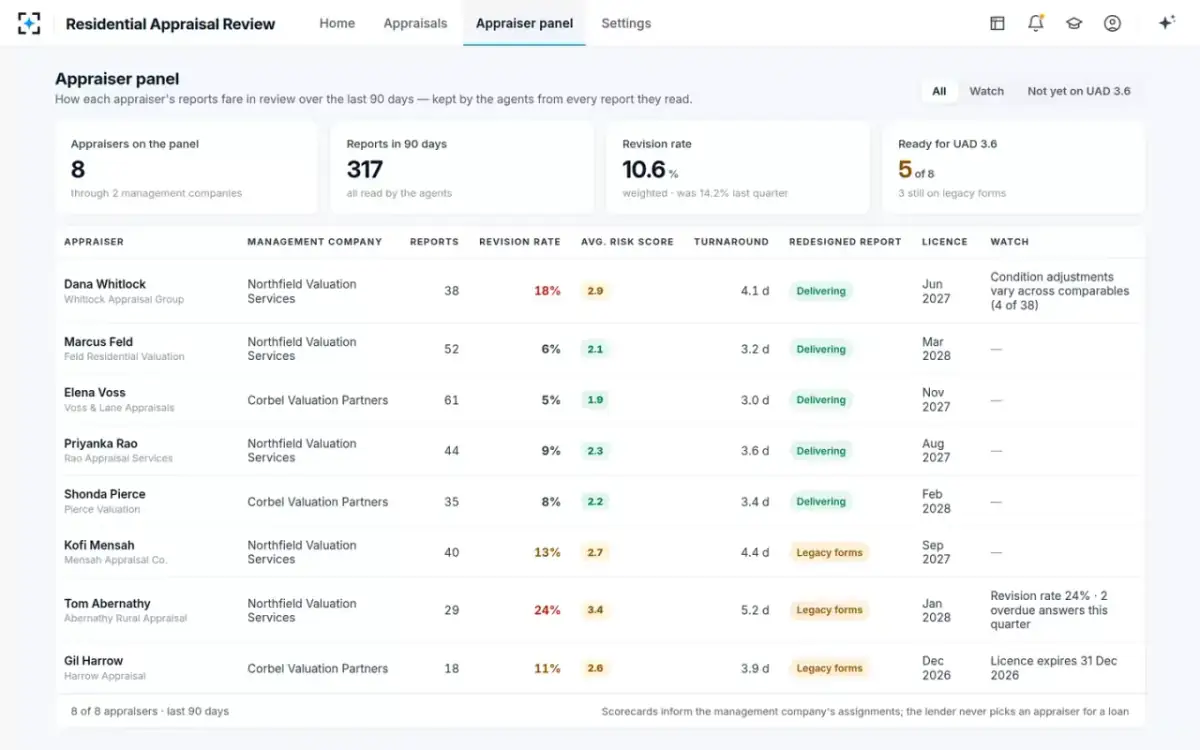
The panel view answers a requirement that outsourced review rarely does. Fannie Mae expects lenders to "continually evaluate the quality of the appraiser's work through the normal review process of all appraisal reports, as well as through the spot-check field review or desk review" (B4-1.3-12). When every report is read, each appraiser's revision rate, turnaround and recurring issues accumulate without a separate sampling exercise.
Questions to ask any appraisal review provider
Eight questions for a review service or a software vendor
- Who signs, and with what licence?
For any review that can change a value: a reviewer licensed or certified in the property's state, with local data access.
- Before or after closing?
Which reviews happen before the credit decision, and how fast.
- What does a finding contain?
The page, the evidence and the rule, or only a conclusion.
- How is independence kept?
Who writes to the appraiser, through which channel, and what stops a question naming a value.
- Can we re-review your work?
Access for the lender's own monthly re-review of at least 10% of a QC vendor's sample.
- Whose policy do you apply?
The lender's flags and tolerances, versioned, or the provider's defaults.
- What AI do you use?
Enough detail for the lender to answer a disclosure request under LL-2026-04.
- Do you read the redesigned report?
UAD 3.6 and the legacy forms, in one process.
The answers sort providers quickly. A service whose findings carry pages and rules, whose questions never carry numbers, and whose work the lender can re-review fits alongside an agent-assisted team as the escalation path. To see how much of your own review the agents would take, start from Residential Appraisal Review.
Questions people ask
Can a lender outsource all appraisal review?
It can outsource the work but not the responsibility. Fannie Mae holds the lender "fully accountable" for outsourced QC, requires its own QC plan, and requires the lender itself to re-review at least 10% of a vendor's post-closing sample each month. The lender also needs collateral expertise in-house to do that re-review.
Is an appraisal management company the same as a review service?
Not necessarily. A management company recruits, engages and pays appraisers and relays communication; some also sell reviews. Under Regulation Z both are performing "valuation management functions," which include reviewing appraisers' work, so the same independence rules bind them.
Do certified general appraisers do residential reviews?
A certified general credential generally covers residential work too, which is one reason the fall in certified residential credentials does not map one-for-one onto review capacity. Fannie Mae's test for a desk or field reviewer is licence or certification in the state, access to data, and knowledge of the property type and location.
What is the difference between appraisal QC and appraisal review?
Review is done on each appraisal before the credit decision to decide whether it supports the loan. Quality control samples funded or near-funded loans to test whether the review and origination processes worked. Fannie Mae's post-closing collateral risk assessment is part of QC; the underwriter's appraisal review is part of origination.
Does agent-assisted review need regulator approval?
The 2010 guidelines ask for prior approval when automated tools or sampling replace pre-funding review on lower-risk loans. Where agents assist a reviewer who still reviews and signs every report, the bank should still document its parameters and testing, and discuss it with its examiners.