A wrongful repossession is a taking the lender had no right to make at the moment it was made — because a statute forbade it, because the borrower had already done the thing that was supposed to prevent it, or because the car was never the lender's to take. The uncomfortable part for wrongful repossession prevention, and the reason this page exists, is that supervisors have already published the short list of how it happens, and every item on that list is a condition a lender can test on its own data. Repossession Management, the Botminds agentic solution for auto lenders, is built around those tests — and the only way to know whether they work is to let them re-run last year's closed assignments and disagree with what the desk did at the time.
This page is written for the compliance reviewer and the head of collections who has to answer an examiner, and it is deliberately specific about proof. Everything about causes and damages below is sourced to a regulator, a statute or a court-enforced settlement; everything about the replay is a protocol you can run against your own history before you buy anything.
| The cause | The condition that would have caught it | The evidence it leaves behind | Who found it |
|---|---|---|---|
| The account was coded delinquent when it was not | Days past due recomputed from posted and in-flight payments at the release minute, not from a nightly status field | The recomputed figure, the payments it used and their settlement times | Federal supervision |
| The cancellation was never acted on | A cancellation is open until the agency confirms it; an unconfirmed one past its limit is an exception with a name on it | The time sent, the route, the time acknowledged, and the escalation if it was not | Federal supervision |
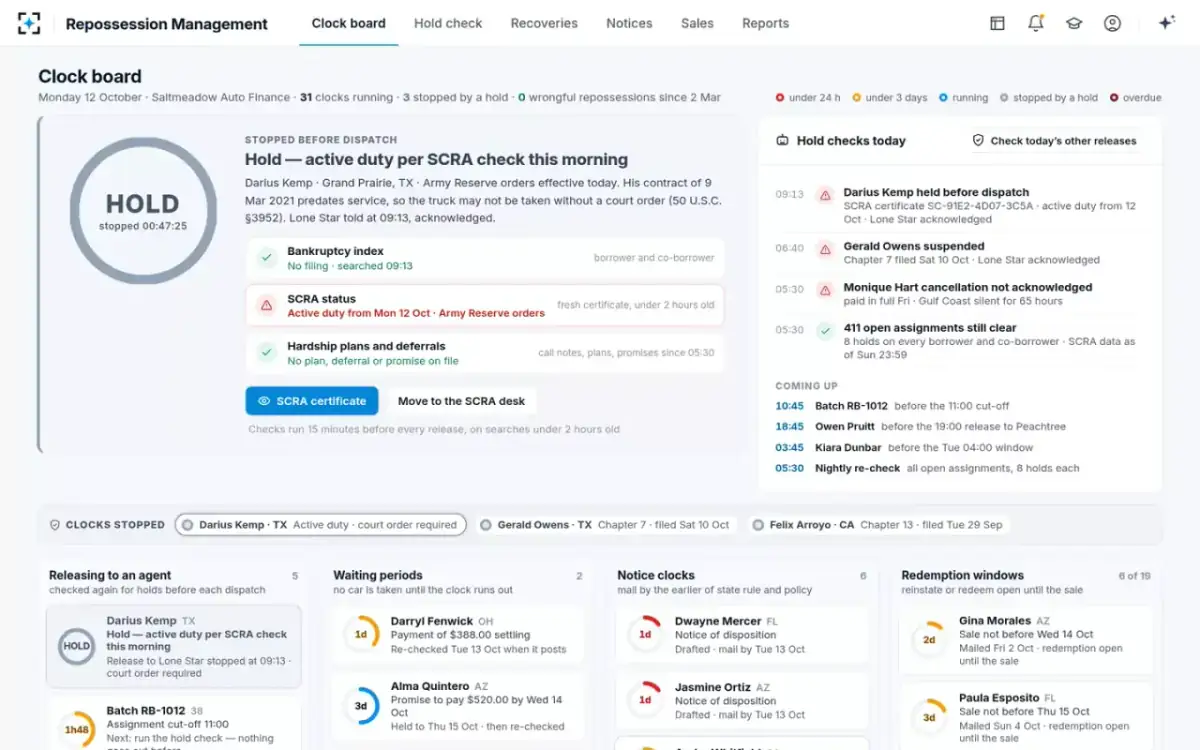
| The agent did not re-confirm the order was live | A test minutes before dispatch, on searches fresh enough to see this morning | The pre-dispatch result, its timestamp, and the certificate it relied on | Federal supervision |
| The borrower was protected and nobody looked | A bankruptcy and servicemember search for every borrower and co-borrower, no older than the policy allows, before each release | The search certificate, its time, and the comparison of the service start with the contract | The Department of Justice |
| The lender had no recorded lien on the car | The lien on title checked as a hold in its own right, not assumed from the account | The title record consulted and the date it was read | Federal supervision |
What is a wrongful repossession?
In practice it covers three different legal failures that get the same name. The first is a taking barred by federal statute: a vehicle recovered after a bankruptcy petition was filed, or taken from a protected servicemember without the court order the law requires. The second is a taking that the lender's own conduct had already ruled out — the borrower paid, agreed an extension, or did the thing the firm told them would stop it. The third is a taking from someone the lender had no security interest against at all.
Only the first has a bright statutory line. The second is judged under the unfairness standard, and the reasoning examiners have applied is worth quoting at length because it is the test a lender will be measured against: a servicer told consumers it would not repossess while they were less than 60 days past due, and maintained a policy and told consumers it would not repossess vehicles of borrowers who had agreed an extension or made a promise to pay whose date had not passed. It then repossessed from hundreds of consumers who had "made and kept promises to pay that brought the account current", "made payments that decreased the delinquency to less than 60 days past due", "made promises to pay where the date had not passed" or "agreed to extension agreements". In the supervisor's words: "Each of these actions taken by consumers should have prevented repossessions of their vehicles."
That sentence is the whole standard in miniature. The question is not whether the borrower was in default. It is whether the borrower did something the lender had said would stop the taking, and whether the lender's own machinery noticed in time. A lender with generous arrangements and poor plumbing is at more risk than a lender with neither.
The three causes examiners keep finding
Federal supervision has published the same three operational mechanics repeatedly: accounts coded as delinquent when the borrower's payment said otherwise; repossession orders that representatives never cancelled after the borrower acted; and agents who went ahead without re-confirming that the order was still live. They are not three kinds of carelessness. They are three points on one timeline, and each has a different owner.
The first is a data problem inside the lender. Delinquency is usually a status written by an overnight process, and a payment made at the weekend, a deferral agreed on the telephone or a cash-network payment still settling can all leave that status describing a world two days old. Testing the status is useless; the control is to recompute the figure from the payments and arrangements themselves at the moment of release.
The second is a messaging problem between the lender and its agencies, made worse by the intermediary most lenders now use. A cancellation is not an event but a round trip — sent, received, acted on, confirmed — and the only part of it most lenders can evidence is the first leg.
The third belongs to the agency, and it is the one lenders most often treat as somebody else's. It is not: the practices of a lender's service providers are the lender's responsibility, as examiners have said repeatedly in auto finance work. A lender that cannot show what its agency checked, and when, has outsourced the step and kept the liability. How a lender oversees that duty across its agencies and forwarders is worked through in repossession forwarder and agency oversight.
There is a fourth mechanic on the Bureau's own list that gets far less attention: repossessing a vehicle after telling the borrower, in writing, that the loan would not be treated as past due if they paid by a named date. Examiners found that servicers sent exactly such letters and then took the cars before the date in the letter had arrived. A promise made in a letter is a hold, whether or not any system models it as one.
The fourth cause: a car the lender had no lien on
This one is a category of its own because the borrower is not a borrower. Examiners found servicers that failed to record their liens and then repossessed vehicles anyway, taking cars from people who had never had any dealing with them. The injury described is not abstract: consumers suffered "lost wages, the costs of arranging alternative transportation, or being deprived of the ability to meet other important needs", and — the detail that makes the unfairness finding inevitable — "consumers could not reasonably foresee that their vehicle would be repossessed by servicers with which they did not have any prior relationship or affiliation" (CFPB, Supervisory Highlights, Special Edition: Auto Finance, October 2024).
The operational lesson is narrow and cheap to apply. A lien on title is a fact about a vehicle that can be checked against a record, it changes rarely, and checking it costs a fraction of what the alternative costs. Most lenders treat it as an assumption of the account rather than as a hold in its own right, which is why the failure is invisible until a stranger's car is on a flatbed.
What causes wrongful repossessions in practice: a worked replay
Causes in a supervisory report are abstractions. What a lender needs is the same list expressed as disagreements with its own history — the assignments it actually released, re-judged by the test it is thinking of buying.
What the file shows the lender did: Marked cancelled in the lender’s system that afternoon
What a point-in-time replay says about the same minute: Open until the agency confirmed it at 09:12 on Monday — sixty-five hours in which the car could still be taken
What the file shows the lender did: Status field read 61 days when the batch was built on Sunday night
What a point-in-time replay says about the same minute: A payment posted on Thursday takes the recomputed figure to 44 days at the release minute
What the file shows the lender did: Promise logged; account stayed in the eligible population
What a point-in-time replay says about the same minute: Held: the promised date had not passed, and the firm had told the borrower it would not take the car before it
What the file shows the lender did: Never posted to the servicing record, so never seen by the batch
What a point-in-time replay says about the same minute: Held on the note itself, timed before anything posts anywhere
What the file shows the lender did: Searched last on the 28th of the previous month — three days stale
What a point-in-time replay says about the same minute: Held: a search at the release minute sees the orders, and the contract predates the service
What the file shows the lender did: Treated as the lender’s collateral because the account said so
What a point-in-time replay says about the same minute: Held: no recorded lien on the title for this lender on this vehicle
Three of those six turn on a single idea: the facts moved after the account cleared. That is why a hold check that runs once is a different product from one that runs continuously, and why the measure that matters is not how many holds were raised but how many were raised late. The open-instruction population that creates the exposure is counted in the three in four that never complete.
How do you test a repossession hold check?
By replaying closed assignments against the data as it stood at the release minute, and reporting the disagreements in both directions. Anything less is a demonstration.
The discipline that makes or breaks the exercise is point-in-time honesty. It is trivially easy — and completely worthless — to re-run a hold check against today's database, in which the Friday deferral has long since posted, the weekend payment has settled and the bankruptcy filing is on every index. A test that can see the future always wins. The replay has to reconstruct what each source said at the moment the account was released: the payments that had settled by then, the call notes written by then, the court index as it stood that morning, the service status as it could have been certified that hour.
Eight rules for a back-test of a repossession hold check that is worth believing
- Use closed assignments, not a curated sample
A full quarter of releases, including the ones that ended in a cancellation and the ones that ended in a sale.
- Freeze every source at the release minute
Payments by settlement time, notes by written time, the court index by its own date — no field as it reads today.
- Let the test disagree in both directions
Report holds the replay raises that the desk did not, and holds the desk raised that the replay would not. A test that only ever adds holds is an alarm, not a control.
- Separate late facts from missed facts
A hold the replay raises on data that arrived after the release is an argument for re-checking; one on data that was already there is an argument about the test.
- Count the near misses as findings
An account released and cancelled four hours later is the same failure as one released and recovered; only luck differs.
- Run the federal holds separately
Bankruptcy and servicemember results are not a percentage. One miss is the finding.
- Have someone who was not involved read the disagreements
The compliance reviewer, not the recovery desk, decides whether a disagreement is a defect.
- Write down the rule version the replay used
A back-test whose rules nobody can reconstruct cannot be repeated, and a result that cannot be repeated is an anecdote.
What the replay produces is three numbers and a list. The numbers are: holds the test would have raised that the desk did not, holds the desk raised that the test would not, and the share of the first group traceable to facts that arrived after the release. The list is the accounts behind them, each with the record that decides it. A vendor that will not run this on your data, or that reports only the first number, is selling a demonstration.
The check that stops a dispatch, 47 minutes before the truck
One published figure gives a sense of what thorough checking correlates with. The borrowers with the strongest legal protection in American auto finance, and the most checking attached to them, also lose their cars least often.
Repossession or voluntary surrender within two years of origination, by borrower group
What the damages are, and who collects them
From four directions at once, which is what makes the arithmetic of a wrongful repossession so unforgiving.
Four published measures of what one wrongful repossession can cost
+10%
of the principal, plus the credit service charge: the floor a consumer-goods debtor may recover for a Part 6 failure, computed from the loan and not from the loss
$500
statutory damages for certain failures to explain a deficiency, where the failure is part of a pattern or practice
$120k
paid by one regional auto finance company over at least five servicemember vehicles — half compensation, half civil penalty
$483M
obtained by the Department of Justice for over 148,000 servicemembers since 2011 under the servicemember statute
Start with the borrower's own remedy, which needs no regulator. Where a lender fails to comply with Part 6 of Article 9, it is liable for the loss caused — and the statute spells out a head of loss lenders rarely price: loss "resulting from the debtor's inability to obtain, or increased costs of, alternative financing" (UCC §9-625(b)). A borrower who had to finance a replacement car at a worse rate for four years is describing a calculable number, not a grievance.
Add the bankruptcy stay, where the language is mandatory: an individual injured by a willful violation "shall recover actual damages, including costs and attorneys' fees, and, in appropriate circumstances, may recover punitive damages" (11 U.S.C. §362(k)(1)). Add the servicemember statute, which carries a criminal penalty as well as a civil one (50 U.S.C. §3952), and whose enforcement in September 2025 produced a settlement requiring the firm to pay compensation and a civil penalty, forgive the unpaid balances, and repair the borrowers' credit. Then add what the supervisor lists as the ordinary consequences for the borrower — missed work, the expense of alternative transport, repossession fees, adverse credit reporting and damage to the vehicle during the taking — because each of those is a line in a claim.
The costs the lender absorbs without anyone suing are covered separately in what one car really costs. They are not small, and they arrive whether or not the borrower ever makes a complaint.
The bulletin was withdrawn; the liability was not
The federal compliance bulletin that set out much of the above was withdrawn on 12 May 2025, as one of a long list of guidance documents taken back pending review. It is worth being precise about what that changed, because the two wrong readings are both expensive.
The bulletin was guidance about a statute, not a rule of its own. It described conduct the agency had already found to be unfair under the prohibition in the Dodd-Frank Act, and summarised supervisory findings that were published elsewhere. Withdrawing the summary does not repeal the prohibition, and it does not touch the bankruptcy stay, the servicemember statute, Article 9's own remedies, or the fifty states' unfair-practice laws and their private rights of action. The findings it described also remain in the published supervisory record, where examiners' observations about repossession practice are set out at length.
The clearest evidence that nothing material changed is what happened afterwards. In September 2025 — four months after the withdrawal — the Department of Justice announced a settlement requiring an auto finance company to compensate servicemembers for illegal repossessions. Federal enforcement of the taking of cars did not pause. A lender that relaxed its repossession controls in May 2025 on the strength of a withdrawn bulletin has swapped one supervisor's published expectations for every other claimant's unpublished ones.
What a defensible file looks like afterwards
Wrongful repossessions are usually litigated a year later, from a file. The file either answers the questions or it does not, and the questions are always the same: what did you know about this account at the moment you released it, how did you come to know it, who decided, and what did you do when the facts changed?
A file that answers them contains, for every assignment: the hold check and its result with the source behind each hold; the search certificates with their times; the named person who released it; every re-test run while the assignment was open and what each returned; every instruction sent to the agency and the acknowledgement that came back; and the reason the assignment closed. After a recovery it adds the property inventory and its clock, the notice with the rule version it was checked against, the signature with its stated meaning and time, and the sale and the balance worked line by line.
The signature, its meaning and its time, kept with the figures it covered
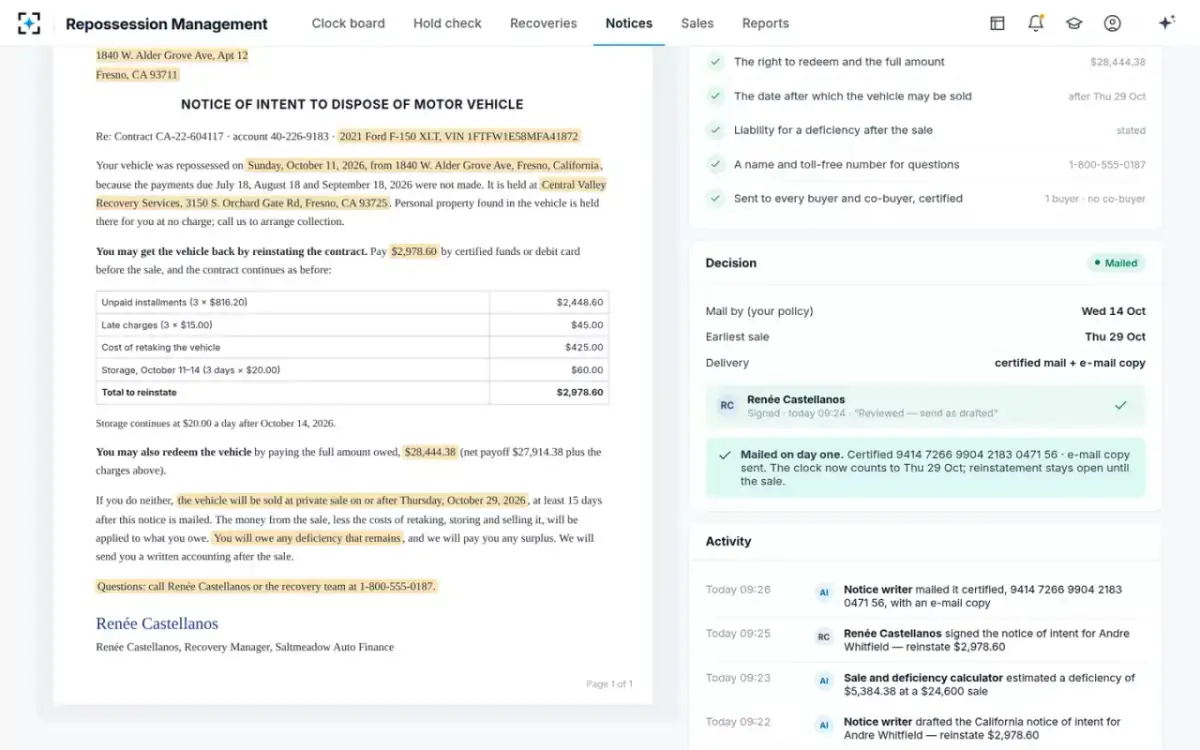
None of that is exotic, and most lenders already produce some of it. What is usually missing is the middle: the re-tests run while the assignment was open, and the acknowledgement that came back from the agency. Those two are the evidence for the two causes that produce the most findings, and they are the two a lender cannot reconstruct after the fact. How to write them into the policy, rather than hope for them, is set out in what a person must sign.
Questions people ask
Is repossessing a car in bankruptcy a violation?
Yes, where the automatic stay is in force. The stay arises on filing, not on the lender learning of it, and examiners have found it an unfair act or practice where servicers repossessed vehicles subject to a stay after receiving notice of the petition. The remedy is not discretionary: an individual injured by a willful violation recovers actual damages including costs and lawyers' fees, with punitive damages available in appropriate circumstances. Practically, this is why an overnight search of the court index is a control and a mailroom is not.
What happens if a repossession is cancelled and the car is taken anyway?
The lender is exposed on the ordinary unfairness analysis, and the fact that the cancellation was sent is not the defence it feels like. Supervisory findings in this area turn on whether the cancellation was acted on, not whether it was issued, and the recurring mechanics are a representative who never passed it on and an agent who never re-confirmed the order was live. The practical fix is to treat a cancellation as open until the agency confirms it, with a time limit and an escalation by name.
Can a lender be liable for its repossession agent?
Yes. Examiners have been explicit in auto finance work that a lender's responsibility extends to the practices of its service providers, and the enforcement finding on withholding borrowers' personal property was made against the servicer for what its agents did. A forwarder in the middle adds a hop, not a shield. In practical terms the lender should be able to show what its agency was told, when it was told, what it confirmed, and what it checked before a hook went on.
How common are wrongful repossessions?
Nobody publishes a rate, and any vendor who quotes one should be asked for the source. What is published is suggestive rather than conclusive: in the largest federal dataset, servicemembers — the group with the strongest legal protection and the most checking attached — had their vehicles repossessed or surrendered within two years of origination at roughly half the rate of other borrowers, as the figure above shows. That gap is consistent with protections working, and it is the closest thing to a measurement in the public record.
How do you prevent a wrongful repossession?
By making every published cause a standing test rather than a policy sentence: recompute delinquency from payments at the release minute; treat a cancellation as open until confirmed; re-test every live assignment nightly and again minutes before dispatch; search for a bankruptcy filing and service status for every borrower and co-borrower on a freshness rule; check the lien on title as a hold in its own right; and hold the account on any arrangement the firm has told the borrower would stop the taking. Then prove the tests work by replaying closed assignments against them.
Is a repossession wrongful if the borrower really was behind?
It can be. Default is necessary but not sufficient: a taking can still be unlawful because a statute barred it, because the borrower had done something the firm said would prevent it, because the notice or sale that followed did not comply, or because the lender had no perfected interest in the car. The supervisory record is full of accounts that were genuinely delinquent at some point and were taken anyway at a moment when they should not have been. The question is always about the minute of the taking, not the month.