A lender's repossession personal property policy has to cover what the law of repossession barely mentions. The personal property in a repossessed car — the child seat, the tool chest, the work boots, the folder of paperwork in the glovebox — is not the collateral, and almost nothing in the law of repossession is about it. Article 9 of the Uniform Commercial Code says a secured party "may take possession of the collateral" after default (UCC §9-609) and then spends twenty sections on how to sell it. It says nothing at all about what was in the back seat. The belongings are governed instead by a thin layer of state licensing statutes, by the contract between the lender and its recovery agency, and by the ordinary law against keeping something that belongs to someone else. Repossession Management, the Botminds agentic solution for auto lenders, treats the inventory, its own clock and the fee attached to it as part of the case, because the gap between the car's rules and the property's rules is where a lender quietly inherits someone else's practice.
The argument of this page is narrow and practical: the belongings run on a different clock from the vehicle, that clock is set by a different body of law, and the person holding the box is usually not the person the borrower will sue. Everything below is sourced to a statute, a state regulator or a federal supervisor; the worked call at the end is sample data on fictional people.
Two states, two clocks: what the property is doing while the car is being sold
- Inventory, then notice of whereabouts≈1 week
- Notice of intent to dispose mailed, then at least 45 days before the agency may dispose45 days
- List and notice to the last known address within 48 hours, then held for the borrower to claimabout 60 days from the recovery
What happens to personal property after a repossession
In the ordinary case: the agent lists what is in the vehicle, the list and the belongings travel to the agency's yard, the agency writes to the borrower telling them where their things are and what it will cost to collect them, and the borrower has a few weeks to turn up. If they do not, the agency may dispose of the property and must keep a record of how it did so. The car, meanwhile, is on an entirely separate path — notice, redemption window, sale, deficiency — and nothing in that path waits for the child seat.
Two consequences follow, and both surprise people. The first is that a borrower can lose the car lawfully and lose the belongings unlawfully in the same week, because the two are judged under different rules. The second is that the lender's own systems usually know nothing about the second event: the car's status comes back from the agency as a recovery report, while the property is handled agency-to-borrower, off the lender's screens, until someone calls to complain.
The federal supervisor put the stakes in one sentence that is easy to skip past. Borrowers' items, it wrote, "often are not merely incidental but can be of substantial practical importance or emotional attachment to borrowers" — which is why the practice around them produces complaints out of all proportion to the dollars involved.
Who is actually holding it: the agent, the yard or the lender
Almost always the agency, or a storage lot the agency uses. The lender holds a security interest in a vehicle; it does not usually hold a cardboard box of belongings, and in most cases nobody at the lender has ever seen the yard the box is in. Where a forwarder sits between the lender and the agency, the lender is two hops away from the person who can physically hand the property back.
That distance does not travel with the liability. In its enforcement work the federal supervisor was explicit that the duty stayed with the lender's servicer: it found "that the servicer was responsible for its agents withholding consumers' personal property unless the consumer paid an upfront fee to recover it", having found that the agents "often refused to return consumers' personal property unless and until the consumers paid the fees". The agency set the practice; the servicer owned it.
The borrower's position mirrors that. California's licensing bureau tells borrowers that damage to a vehicle during or after a repossession is the agency's responsibility, and then says plainly that it "cannot enforce this responsibility by making the repossession agency pay you for any damage to your car" — the route is small claims court, plus a complaint to the bureau. A borrower who has lost a tool chest is not going to file in small claims against a towing company in another county. They are going to call the lender whose name is on the loan, and then a regulator. Treating the property as the agency's own business is therefore a choice to be told about problems last. What the lender must verify about the agencies and forwarders that do the taking is the subject of overseeing repossession forwarders and agencies.
Can a repossession agency charge the borrower to release belongings?
In many states, yes — for what it actually cost to inventory and store the property, if that charge is disclosed. What has been found unlawful is something narrower and more specific: refusing to hand the property over until an upfront fee is paid.
the Bureau found that an entity engaged in an unfair act or practice by withholding consumers' personal property unless the consumers paid an upfront fee to recover the property
Consumer Financial Protection Bureau, Bulletin 2022-04 (withdrawn 12 May 2025)
Hold the two ideas apart, because the difference is the whole compliance question. Florida's statute says that when the borrower or their lawful designee appears before the disposal date, the licensee "shall surrender the personal property to that individual upon payment of any reasonably incurred expenses for inventory and storage" — a fee is contemplated, and it is bounded by what was reasonably incurred. The same chapter makes it a disciplinable act to charge for expenses not actually incurred in a recovery, transportation, storage or disposal (Fla. Stat. §493.6118). California's bureau is blunter still about the practice on the ground: "most repossession agencies charge a fee for storage of personal items that were in the vehicle at the time it was repossessed", the amount "must be given on the personal property notice prepared by the repossession agency", it is collected when the borrower picks the items up, and "many repossession agencies require that these charges be paid in CASH."
So the answer a lender's policy should rest on is: a disclosed, actually-incurred storage charge is lawful in the states that address it; a charge that has to be paid before the borrower is allowed to see their own property is the practice a federal supervisor called unfair. The bulletin that said so was withdrawn on 12 May 2025, and the withdrawal notice said in terms that "such withdrawal is not necessarily final" (Federal Register, 12 May 2025). The unfairness standard the finding rested on is a statute and was not touched. A lender reading the withdrawal as permission is reading it wrongly.
There is also a quieter trap in the contract. Among the steps the same bulletin asked firms to take was to "review consumer contracts to validate that any fees charged to consumers are authorized under the terms of applicable contracts". A property fee that the agency invents, the lender passes through and the retail instalment contract never mentions is a fee with no authority behind it, whatever the state licensing statute allows the agency to charge.
The inventory: what a complete one looks like
A personal property inventory is the list of everything not covered by the security agreement that was in or on the vehicle when it was recovered. Where a state regulates it, it regulates the list tightly, and the tightness is the point: an inventory written loosely is useless to the borrower who says an item is missing and useless to the lender defending the agency.
Florida requires that "a complete and accurate inventory shall be made of such personal effects or property", that "the date and time the inventory is made shall be indicated", and that it be signed by the licensee who actually took the property. The inventory and the disposal records must then be kept for two years in the agency's permanent records and produced on demand to an investigator from the department. California requires the agency to list all personal belongings found in the vehicle at the time of the repossession and to send the borrower, at their last known address of record and within 48 hours, "a notice containing this list and informing you how to recover your personal belongings and the amount of storage fees owed, if any".
What belongs on the list is its own small art. California's bureau draws the line at installation: stereo and navigation systems or mag wheels fitted as a permanent part of the vehicle stay with it, and so do things like a spare tyre or a tyre iron that a car normally carries; a removable camper shell that was not in the original contract for the vehicle "should be returned to you, although you may be asked to prove that you bought the camper shell separately". Personalised plates, on the bureau's advice from the state's motor vehicle department, come off and are stored with the personal effects — and if they are not claimed, go back to the department rather than into a skip.
The ten lines Repossession Management expects on a property inventory before a case can advance
- Date and time the inventory was made
Florida requires both on the face of the list; everywhere else it is the only way to show when the clock started.
- The name and licence of the person who made it
The statute wants the signature of the licensee who obtained the property, not the agency as an abstraction.
- Item by item, in words a borrower would recognise
"Child restraint, grey, rear seat" rather than "misc. 1 bag". A borrower disputes what they cannot find on the list.
- What was left with the vehicle, and why
Installed equipment and normal vehicle kit stay; say so, so the absence is a decision rather than a gap.
- What the borrower removed at the scene
Property handed over in front of the agent never enters the hold, and the inventory should show that it did not.
- Where the property is being held, with an address and a telephone number
The first thing the borrower needs is not a policy; it is a street and a time.
- The charge, itemised, and whether the lender is paying it
A figure that is not itemised cannot be shown to be an expense actually incurred.
- The date the written notice of whereabouts went out, and how
Five working days in Florida; 48 hours in California; a date on the case either way.
- The date the property may be disposed of, counted from the notice
Not from the recovery. The disposal clock in Florida runs from the notice of intent, not from the hook.
- Anything unlawful, and the receipt from the agency it went to
Florida requires contraband to be surrendered to a law enforcement agency and the receipt kept with the inventory records.
How long must personal property be held after a repossession?
Between about six weeks and two months in the two states that set a period, counted from different events. Florida's licensee must give at least 45 days' warning before disposing of the property, by proof of mailing or certified mail, and may dispose of it at its discretion if it is not claimed within 45 days of that notice. California's bureau describes a 60-day window for the borrower to claim, after which the agency may discard what is left — with the inventory and the disposal details kept for four years.
Two practical points follow. First, the Florida clock is startable: it does not begin until the notice of intent goes out, so an agency that delays the notice extends the hold at its own cost and a borrower who moved house may never see it. Second, the period is a floor for the agency, not a ceiling for the lender. A lender may require its agencies to hold longer and to charge nothing, and many do — which is a policy decision with a price attached, not a legal necessity.
What the belongings cost, and who has been found to be paying
48 h
the California window for the list and the notice to reach the borrower's last known address
45 d
Florida's minimum warning before a licensee may dispose of the property
2 yrs
how long a Florida agency must keep the inventory and the disposal records, producible on demand
$75
the release fee the sample agency charges, billed to the lender and never to the borrower
What the states do differently
Less than the volume of search traffic suggests, because most states' codes do not address the question at all. The states that do, do it in their repossession licensing chapter rather than in their enactment of Article 9 — which is why a lender's state rule work for notices and sale dates does not produce the property answer as a by-product. Where no statute speaks, the lender's own agency agreement and the general law of conversion are the only rules in the room, and the federal supervisor's summary is the safest statement of the baseline: "State law typically requires auto loan servicers and repossession companies to secure and maintain borrowers' property so that it may be returned to the borrower upon request."
| What the rule covers | Florida | California | A state whose code is silent |
|---|---|---|---|
| Where the rule lives | The repossession licensing chapter, Fla. Stat. §493.6404 | The Collateral Recovery Act, as the state's licensing bureau explains it | Nowhere — Article 9 governs the car, not the contents |
| Inventory | Complete and accurate, dated, timed and signed by the licensee who took it | A list of all belongings found in the vehicle at the time of the repossession | Whatever the lender requires of its agency by contract |
| Notice to the borrower | Written notice of whereabouts within 5 working days | Notice with the list, how to recover and the fee owed, within 48 hours to the last known address | None required; a borrower may simply telephone and ask |
| Before disposal | At least 45 days, by proof of mailing or certified mail | The borrower has about 60 days from the recovery to claim | The general law against keeping another person’s property |
| Charges | Surrender on payment of expenses reasonably incurred for inventory and storage | A storage fee is common; it must be stated on the property notice and is collected at pickup | Only what the contract with the borrower authorises |
| Records afterwards | Inventory and disposal records kept 2 years, produced on demand | Inventory and disposal details kept 4 years | Only what the lender asks its agency to keep |
The call at 08:05, and what the desk should be able to answer
Here is the whole problem at the scale it actually appears. On a Monday morning at a fictional sample lender, Saltmeadow Auto Finance, a borrower named Andre Whitfield rings the customer-service team at 08:05 about a child seat and a tool chest left in a truck recovered in Fresno at 02:14 that morning. Six items are inventoried at the agency's yard. The agency, Central Valley Recovery, holds them for 60 days at no storage charge and bills $75 to release them — to the lender, because under Saltmeadow's own policy a borrower never pays to get their own property back.
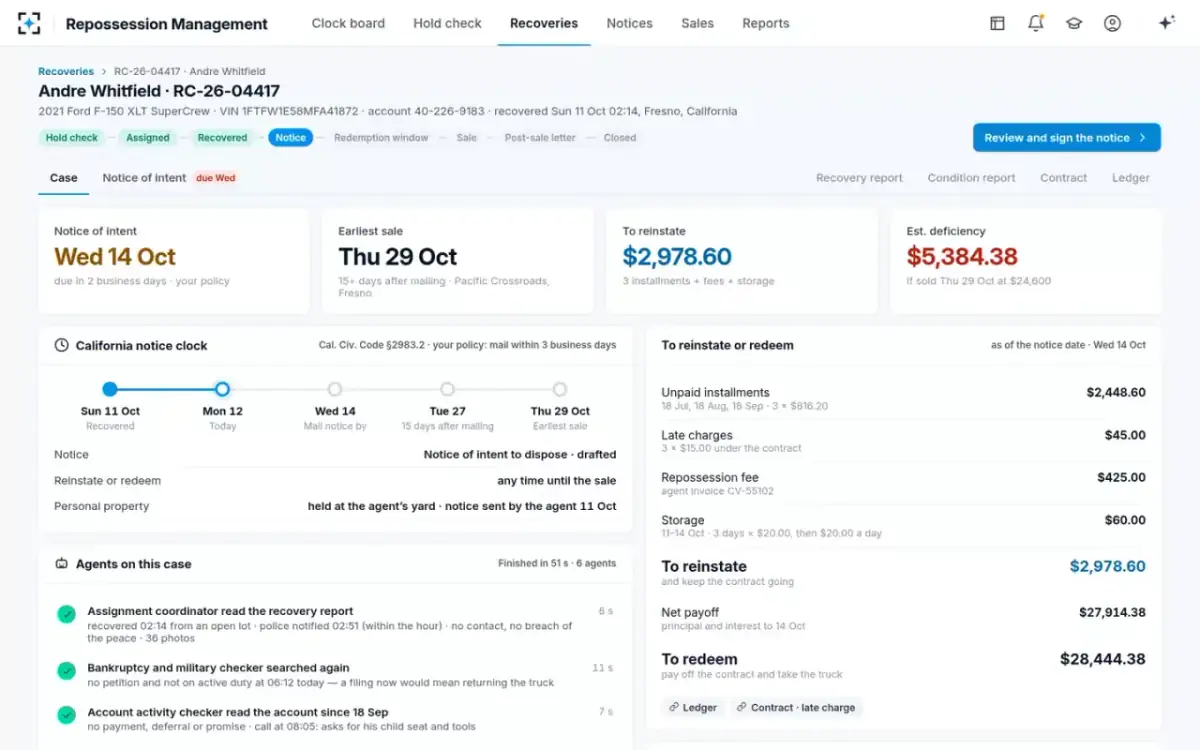
What makes that call easy or hard has nothing to do with goodwill. It is whether the person answering can see the inventory, the yard's address, the hours, the clock and the fee on the same screen as the case, or has to telephone an agency that may not answer before the borrower's patience runs out. In Repossession Management the property sits on the case beside the notice clock, and the return is booked from there: six items, a collection time, and the release fee routed to the lender rather than to the borrower.
The belongings, their clock and their fee, on the case rather than in the yard
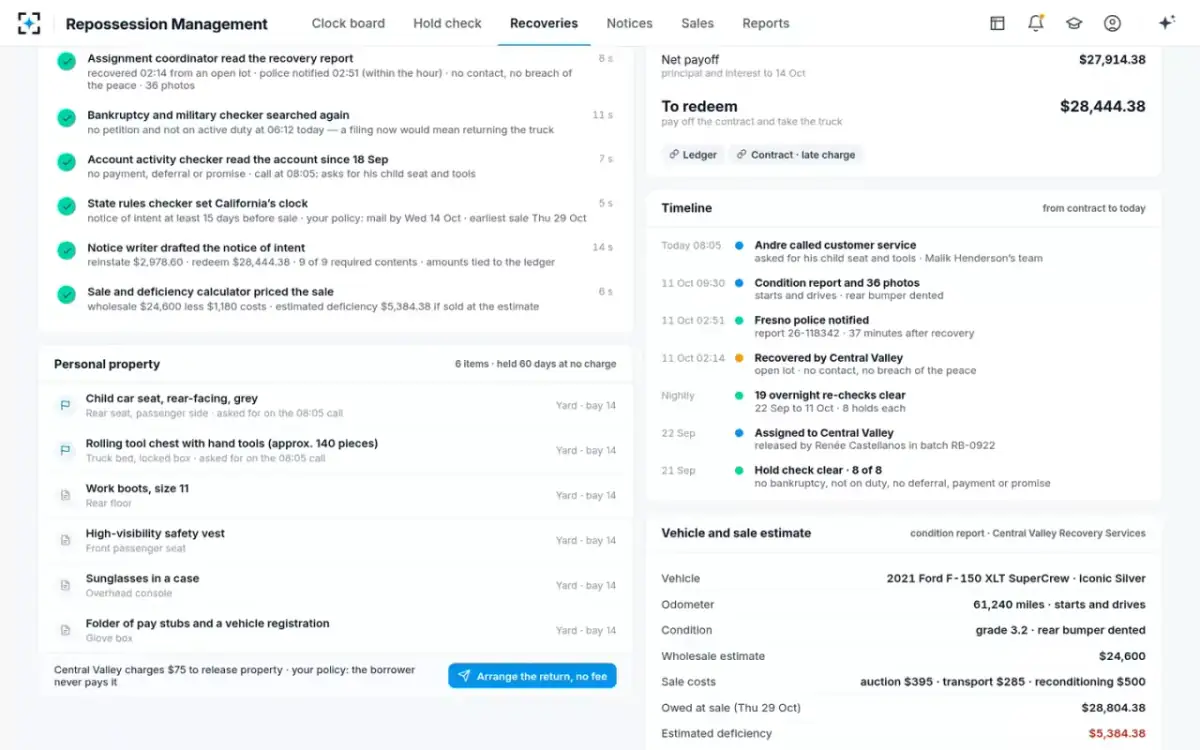
The second screen is the one that makes the first one possible. A property return is only ever as good as the report that comes back from the agency, and the usual failure is silence: the car is marked recovered, and the condition report and the inventory arrive a day or two later, or not at all. Treating a missing inventory as an exception on the case — rather than as something noticed when the borrower rings — is what turns the policy into an answer.
One recovered vehicle, with the property beside the amounts and the clock
Writing a personal-property rule a borrower can read
A property rule that only compliance can read will be applied by nobody at 08:05. The test is whether a borrower could be read the rule down the telephone and recognise it as a promise. Three sentences usually do it: we will tell you within a set time where your things are and how to collect them; we will not ask you for money before you can have them back; and if the yard charges a release fee, we pay it.
Whether the third sentence is affordable is a real question, and it belongs in the open — a release fee absorbed on every recovery is a line in the unit cost of recovery, which is counted term by term in what one car really costs the lender. Whether it is necessary is a different question, and the answer in most states is no: the law requires the property back, not the fee waived. What the law does not permit anywhere is the version that produced the enforcement finding — the borrower told they may collect their property once they have paid.
The last piece is measurement, because a promise nobody counts is a slogan. Three counts are enough: inventories received within the window the policy sets, property returns completed within it, and fees charged to borrowers for their own property — a figure whose only acceptable value is zero. The same discipline of writing the rule as settings rather than prose is set out in what a person must sign, and the state layer the property rule sits on is in the four layers that decide one case.
Questions people ask
May an agency keep a borrower's belongings after repossession?
No. The security agreement covers the vehicle, not the contents, so the belongings remain the borrower's and the agency holding them holds them for the borrower. In Florida the licensee must surrender them to the borrower or a designee on payment of the expenses reasonably incurred for inventory and storage; in California the agency must tell the borrower within 48 hours where they are and how to get them. What the agency may eventually do is dispose of property nobody claims — in Florida no earlier than 45 days after a mailed notice of intent, in California after about 60 days.
What should a lender tell a borrower who wants belongings back?
To go to the agency that took the vehicle, not the auction and usually not the lender: the property is at the agency's yard or a lot it uses, and the notice the borrower receives should carry the address and the amount owed, if any. A good desk tells the borrower to bring identification, come inside the claiming window and check the items against the inventory before leaving, and to note anything missing on the release form and in writing to the agency with a copy to the lender — the steps California's licensing bureau itself advises.
What happens to a child seat in a repossessed car?
It is personal property, not vehicle equipment, so it goes on the inventory and must be available for the family to collect — and it is the single item most likely to turn a routine recovery into a complaint, because a family may need it the same day. Nothing in the law requires the agency to release it faster than anything else in the box, which is why some lenders write a same-day rule for items a borrower names as urgent. A child restraint involved in a crash, or one whose history the agency cannot vouch for, is a safety question for the family rather than a legal one for the lender.
What are illegal personal property fees?
The practice federal supervisors identified was withholding a borrower's belongings until an upfront fee was paid — found to be an unfair act or practice, and attributed to the servicer even though its agents were the ones charging. Two near relatives fail for different reasons: a charge for expenses that were not actually incurred, which Florida makes a disciplinable act for a licensee, and a charge the borrower's own contract never authorised, which the supervisor asked firms to go looking for in their own paperwork.
Does the lender or the repossession agency hold the borrower's property?
The company, in nearly every case, and often at a storage lot it does not own. That is why the lender's screens frequently show a recovered vehicle and nothing about the box of belongings, and why the first reliable sign of a property problem is a telephone call. It does not divide the responsibility: the lender's servicer has been held answerable for what its agents did with borrowers' property, so a lender that cannot see the inventory is carrying a risk it cannot inspect.
Can the agency charge the borrower storage for their own property?
Where the state addresses it, yes, within limits. Florida ties it to the expenses reasonably incurred for inventory and storage; California requires the amount to be stated on the property notice and collected when the borrower picks the items up, and notes that many agencies ask for cash. What it may not be is a condition of being allowed to see or recover the belongings, and a lender may of course agree to pay it for the borrower — an increasing number do, as a policy rather than as a legal requirement.