For lenders, repossession compliance by state looks like fifty rulebooks and behaves like four layers. Underneath every state sits the same Article 9 of the Uniform Commercial Code, enacted almost word for word in each one: it says a lender may take the car without going to court so long as it does so without a breach of the peace, must send a notification before it sells, and must explain the balance afterwards. Above Article 9 sit two federal holds that override everything, and on either side of the taking sit the state's own additions — a right to cure in a minority of states before the car may be touched, and a licensing, notice and personal-property regime afterwards. Repossession Management, the Botminds agentic solution for auto lenders, is built on that shape: it tests every account against the federal holds, runs the Article 9 clock, applies the state's cure period and notice deadline, and shows the recovery manager which layer stopped a car and why.
What makes the work hard is not that the layers are complicated. It is that they move at different speeds and are checked by different people. A servicing system knows the borrower's state; it does not know a Chapter 13 petition was filed on Friday afternoon. A letter template knows the notice contents; it does not know this borrower is in a cure-period state and the clock never started. The examples on this page come from a fictional sample lender, Saltmeadow Auto Finance, as it runs through the solution. The law comes from the statutes themselves, linked where it appears.
The two holds that no state law, and no contract, can switch off
Court order
required before repossessing a servicemember’s vehicle on a contract that predates service
Any act
to obtain possession is barred by the automatic stay from the moment a bankruptcy petition is filed
1 yr
maximum imprisonment for knowingly resuming possession in violation of the servicemember statute
What repossession laws by state really are: four layers, not fifty rulebooks
Ask the question as a lawyer would and the answer is a fifty-row table. Ask it as a recovery manager who has to release a batch of thirty-eight accounts across seven states before ten o'clock, and the answer is better written as four layers, because each layer is checked by a different signal at a different moment.
The four layers, and what each one decides
1
Federal holdsCongress
Two statutes that forbid the taking outright, whatever the contract and whatever the state says.
The automatic stay in bankruptcy; a servicemember on active duty whose contract predates service.
2
Article 9Each state, from one model
The spine every state enacted: how the car may be taken, who must be told before the sale, what the notice says, how the balance is worked out.
No breach of the peace; a reasonable notification of disposition; the right to redeem until the sale.
3
The state overlay before the takingThe state legislature
Extra steps a minority of states insert in front of repossession, usually a written right to cure a stated number of days before the car may be touched.
Iowa: twenty days. Virginia title loans: ten days, and no deficiency judgment at all.
4
The state overlay after the takingThe state legislature and its licensing department
Who is licensed to do the taking, what they must do on the scene and in the yard, and what the lender must add to the Article 9 notice.
Florida: a licensed recovery agent, police told within two hours, every loose item inventoried.
The layers are not equal in size. Layer two is nearly the same everywhere. Layer one is two statutes. Layers three and four are where the variation lives, and they are also the layers a national letter template usually gets wrong, because they change what the notice must say and when the clock may start.
Layer one: the two federal holds that stop every state's clock
Two federal statutes do not modify the repossession process; they forbid it. The first is the automatic stay. From the moment a bankruptcy petition is filed, section 362(a)(3) bars "any act to obtain possession of property of the estate or of property from the estate or to exercise control over property of the estate" (11 U.S.C. §362). The stay does not wait for the lender to be served. Section 362(k)(1) adds that an individual injured by a willful violation "shall recover actual damages, including costs and attorneys' fees, and, in appropriate circumstances, may recover punitive damages".
The second is the servicemember protection. Where a deposit or an instalment was paid before the borrower entered military service, the vehicle may not be "repossessed for such breach without a court order" (50 U.S.C. §3952). The comparison that matters is between two dates — when active duty started and when the contract was signed — and it is a comparison a servicing system does not make on its own. A knowing violation is a criminal offence as well as a civil one.
Both holds share an operational property that shapes everything else: they can become true between the moment an account is released and the moment the hook goes on. That is why the solution re-tests every open assignment nightly and again minutes before each dispatch, on a certificate under two hours old, and why a live assignment is not the same thing as a lawful one.
Layer two: Article 9, the spine every state shares
Article 9 of the Uniform Commercial Code is enacted in every state, which is why most repossession questions have the same answer in Dallas and in Des Moines. Four of its sections carry almost the whole process.
A secured party may proceed … without judicial process, if it proceeds without breach of the peace.
UCC §9-609(b)
Section 9-609 permits self-help repossession and sets its only limit. Section 9-611 requires that before the car is sold the lender "shall send … a reasonable authenticated notification of disposition" to the debtor and to any secondary obligor — the co-signer (UCC §9-611). Section 9-614 lists what that notification must contain when the collateral is consumer goods, and sets out a form that is sufficient if it is completed correctly (as enacted at RCW 62A.9A-614). Section 9-623 keeps the borrower's right to redeem alive until the lender has sold the car or contracted to sell it, and redemption means the whole obligation plus expenses, not the arrears (UCC §9-623).
One Article 9 rule is a trap for multi-state lenders. The ten-day notice period everyone quotes is in section 9-612, and it is explicitly not for consumers: "In a transaction other than a consumer transaction, a notification of disposition sent after default and 10 days or more before the earliest time of disposition set forth in the notification is sent within a reasonable time" (UCC §9-612). In a consumer deal, whether a notification was sent within a reasonable time "is a question of fact". Ten days is a floor most lenders adopt as policy; it is not a safe harbour on a car loan. The contents of that notice, and the states that add to the list, are worked through in every line the law makes you write.
Layer three: the right to cure, and which states have one
A minority of states insert a step in front of repossession: a written notice of the borrower's right to cure the default, a fixed number of days in which to do it, and a bar on taking the car until that period runs out. Iowa's is representative and is worth reading in full because it shows how much the layer changes the operating process rather than the paperwork.
Under Iowa Code §537.5110(4)(a), a creditor "shall not accelerate the maturity of the unpaid balance of the obligation, demand or take possession of collateral … or otherwise attempt to enforce the obligation until twenty days after a proper notice of right to cure is given" (Iowa Code §537.5110). The right is not unlimited: under subsection 3 the borrower has it unless the creditor already gave a proper notice "with respect to a prior default which occurred within three hundred sixty-five days of the present default". And the notice itself is prescribed — §537.5111 sets out the content and a model form that tells the borrower, in those words, "You have a right to correct this default until … If you do so, you may continue with the contract as though you did not default" (Iowa Code §537.5111).
Four states, read on their own legislature's site: what each layer adds
| State | Before the car is taken | After the car is taken | Who may do the taking |
|---|---|---|---|
| Iowa | Twenty days after a notice of right to cure, in the statute’s own form — once in any 365 days | Article 9 notice and explanation | No separate recovery-agent licence in the consumer credit code |
| Virginia (title loans) | Ten days’ written notice by first-class mail, or the costs of repossession and sale may not be charged | Fifteen days’ notice before sale, with a written accounting of the redemption amount; no personal money judgment for a deficiency | Licensed title lender |
| Washington | Article 9 only | The Article 9 notice, in the enacted safe-harbour form headed “NOTICE OF OUR PLAN TO SELL PROPERTY” | Article 9 only |
| Florida | Article 9 only | Police told within two hours of recovery; every loose item inventoried, dated and signed; the borrower told in writing within five working days where it is | Class “E” recovery agent: 40 hours’ training, a year’s experience, working for a licensed Class “R” agency |
Virginia's title-loan rule shows how far an overlay can go. A licensee must send written notice at least ten days before repossessing, and if it does not, it "shall not collect or charge the costs of repossessing and selling the motor vehicle"; it must give fifteen days' notice before sale with a written accounting of the redemption amount; and it "shall not seek or obtain a personal money judgment against a borrower for any amount owed under a loan agreement or any deficiency resulting after the sale" (Va. Code §6.2-2217). A lender that runs one national deficiency process will pursue a balance in Virginia that it is not entitled to pursue.
Must a lender notify the borrower before repossessing?
In most states, no — and that is the single most misunderstood point in this area. Article 9 requires notice before the sale, not before the taking. A lender in a state without a cure statute may repossess the day after default without telling the borrower first, provided it takes the car without a breach of the peace and sends the notification before disposing of it.
The exceptions are layer three. In a cure state the notice must go first and the clock must run out. In Virginia's title-loan chapter the notice must go ten days ahead, and the penalty for skipping it is that the repossession costs become uncollectable. The practical consequence for a multi-state lender is that "was notice required here?" is a per-account question with three possible answers — none, a cure notice, or a chapter-specific pre-repossession notice — and it has to be answered from the borrower's state and product, not from a default setting.
Layer four: who may do the taking, and what they must do on the scene
Article 9 says nothing about who may tow the car. Several states do, and their rules reach the lender through the conduct of its agent. Florida is the clearest written example. A person performing repossessions must hold a Class "E" recovery agent licence, which requires "proof of successful completion of 40 hours of professional training at a school or training facility licensed by the department" and a year of verifiable full-time experience (Fla. Stat. §493.6403). The agency itself holds a Class "R" licence, and a manager a Class "MR".
The conduct rules are the part a lender's oversight should read. A Florida recovery agent may not recover a vehicle "before authorization has been received from the legal owner or mortgagee", may not charge "for expenses not actually incurred", must notify "the police or sheriff's department of the jurisdiction in which the repossessed property is recovered within 2 hours after recovery", may not carry a weapon on private property while performing the work, and may not wear or display a badge (Fla. Stat. §493.6118). Each of those is a question a lender's vendor file should be able to answer about every agency it uses — which is the subject of what a lender must verify in its forwarders and agencies.
The fourth layer also covers the belongings in the car, which run on their own clock and their own notice, separate from the vehicle.
Is the CFPB repossession bulletin still in effect?
No. Bulletin 2022-04, Mitigating Harm from Repossession of Automobiles, 87 FR 11951, was withdrawn on 12 May 2025 as item 20 of a list of guidance the Consumer Financial Protection Bureau withdrew in one notice (Interpretive Rules, Policy Statements, and Advisory Opinions; Withdrawal). The Bureau said the withdrawal "is not necessarily final" and that the material "should not be enforced or otherwise relied upon by the Bureau while this review is ongoing".
What the withdrawal did not do is change any of the four layers. The automatic stay and the servicemember statute are acts of Congress. Article 9 is state law. The cure periods and licensing regimes are state law. The unfairness standard the bulletin interpreted is itself a statute, and the same notice records that the Bureau's authority over unfair practices is shared: state attorneys general may bring actions under the federal consumer protection statute, the Federal Trade Commission has its own unfairness authority, and the banking agencies supervise depository institutions. A lender that read the bulletin as the source of its repossession controls has lost a reading guide; a lender that read it as a summary of statutes has lost nothing. The practical reading of what remains is set out in what happens to the three in four assignments that never complete.
One more supervisory finding is worth keeping in view, because it is the layer-two rule people forget they are relying on. In October 2024 the Bureau reported that examiners found servicers who "failed to record liens and then repossessed vehicles without a valid lien … they repossessed vehicles from consumers who did not have any prior affiliation with the servicers" (Supervisory Highlights, Special Edition: Auto Finance). Self-help repossession is a right that exists only because a perfected security interest exists. If the lien was never recorded, there is no layer two at all.
How a multi-state lender keeps four layers current
The layers do not change at the same rate. Layer one changes rarely. Layer two changes when a state adopts an Article 9 amendment, which happens in waves. Layers three and four change with ordinary state legislative sessions, and the change that matters is usually a number — a cure period, a notice window, a licensing requirement — rather than a new concept.
Eight questions a multi-state repossession file should be able to answer about one account
- Is there a bankruptcy petition, as of a search run in the last 24 hours?
The stay runs from filing. A search from last week is evidence of nothing.
- Is the borrower — or any co-borrower — on active duty, and does the contract predate service?
Two dates, compared. Not a status flag.
- Is this a cure state, and did a proper notice go?
In Iowa the car may not be taken until twenty days after the notice, and the right resets only after 365 days.
- Does the product have its own pre-repossession notice?
Virginia title loans need ten days’ notice or the repossession costs cannot be charged.
- Is the lien recorded, in this state, on this vehicle?
Without a perfected interest there is no right of self-help at all.
- Has anything happened on the account in the last 72 hours?
A payment in flight, a deferral agreed by phone, a promise to pay inside its window.
- Is the assignment still live, and did the agency acknowledge the last instruction?
A cancellation nobody confirmed is the commonest route to a wrongful repossession.
- Who may do the taking here, and what must they do within two hours of it?
In Florida, a licensed Class “E” agent who notifies local law enforcement.
In Repossession Management each of those questions is a hold with a source attached, and each state's cure period, notice deadline and earliest sale date is a clock rather than a cell in a spreadsheet. A held account shows the rule, the source and what happens next, and the recovery manager releases the batch; nothing goes to an agency that the hold check did not clear.
Forty-six recovered vehicles, each on its own state's clock
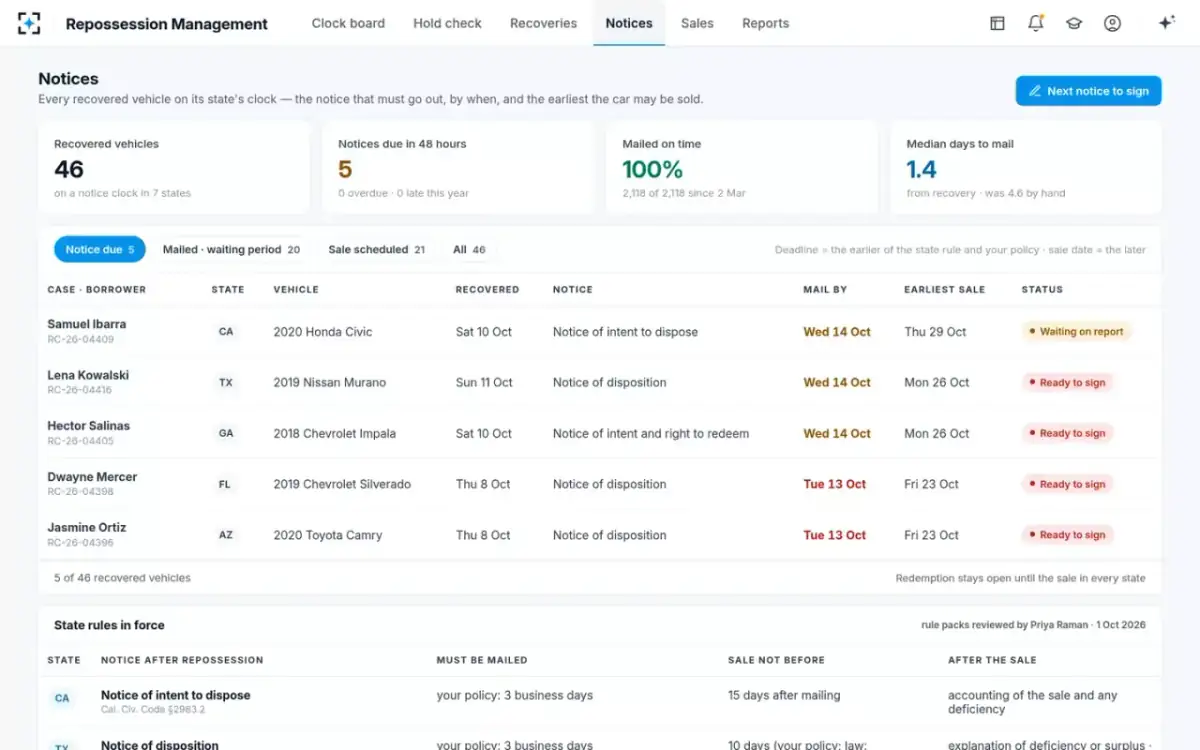
That is the whole argument for treating the layers as layers. A lender that keeps one national procedure will be right in most states and quietly wrong in the ones with an overlay. A lender that keeps fifty procedures will keep none of them current. Four layers, each with its own owner and its own review rhythm, is the shape the law actually has.
Questions people ask
How many days notice before repossession is required?
In most states, none. Article 9 requires a notification before the sale of the car, not before the taking. The exceptions are the cure states and some product-specific chapters: Iowa gives twenty days after a notice of right to cure before the car may be taken, and Virginia's title-loan chapter requires ten days' written notice or the lender may not charge the costs of repossession and sale.
Can a lender repossess without notice once payments are behind?
In a state without a cure statute, yes — provided the lender has a perfected security interest, the borrower is in default under the contract, and the car is taken without a breach of the peace. The notice obligation attaches before disposal. A lender should still check whether its own contract promises a notice, because a promise made in the agreement is enforceable even where the statute does not require one.
Which states have a right to cure on a car loan?
A minority do, and the detail varies more than the headline: the length of the period, whether it runs from mailing or receipt, the prescribed wording, and how often a borrower may use it. Iowa's is twenty days, in a form the statute prints, available once in any 365-day period. Because the list and the numbers move with state legislative sessions, the only safe method is to read the statute for each state you lend in rather than rely on a published list.
What is a notice of intent to sell after repossession?
It is the Article 9 notification of disposition, under one of the names states give it. It must describe the debtor, the secured party and the car, say how the car will be sold, state the time of a public sale or the date after which a private sale may happen, and tell the borrower they are entitled to an accounting. In a consumer deal it must also describe any liability for a deficiency and give a telephone number for the redemption figure.
Which states require a repossession licence?
Several do, and the structure differs. Florida licenses the individual agent, the agency, the branch, the manager, the training school and its instructors, and requires forty hours of training plus a year of experience for an agent's licence. Other states license the agency only, or regulate the tow operator rather than the recovery agent. Because the obligation falls on the agency, a lender's control is a vendor control: confirm the licence, confirm it is current, and confirm it covers the state the car is in.
Does federal law override a state repossession rule?
The two federal holds do. A bankruptcy stay and the servicemember court-order requirement forbid a repossession that state law would otherwise permit, and no contract term can waive them for the lender's benefit. The rest of the relationship runs the other way: Article 9 is state law, and state overlays add to it rather than being displaced by anything federal.