A repossession forwarder is a company that places and manages a lender's repossession assignments with local recovery agencies, so the lender deals with one counterparty instead of dozens. Using one changes who the lender talks to, not who answers for the outcome: federal banking supervisors say a bank's use of third parties "does not diminish its responsibility" to comply with the law, and the Consumer Financial Protection Bureau says the same of repossession specifically. What a lender must verify, therefore, is the whole chain: the forwarder, every agency under it, the licence of each person who takes a car, and how fast a stop order travels to the truck. Botminds' Repossession Management is built for that chain: it checks every account before release, sends the assignment, times each acknowledgement and keeps what came back.
The page is written for the recovery manager, the vendor-management lead and the compliance officer who share that chain. The worked examples use a fictional sample lender, Saltmeadow Auto Finance, and the rules come from the statutes and the supervisors' own publications.
The chain got longer while the duty stayed put
66%
of repossessions in the Bureau’s data used a forwarder by December 2022, up from 31% in January 2018
2hops
a cancellation now travels, lender to forwarder to agent, and the acknowledgement travels back the same way
0
reduction in the lender’s responsibility for what its service providers do in its name
What is a repossession forwarder, and why do most lenders now use one?
A forwarder is an intermediary that receives a lender's assignments, chooses an agency near the collateral, chases updates and consolidates invoices. Lenders use them because the alternative is a direct relationship with every agency in every county where a borrower might live, each with its own licence, insurance, contract and reporting habits.
The shift is measured. In the loans the Bureau studied, forwarder use "increased from 31 percent at the beginning of the data collection in January 2018 to 66 percent at the end of the data collection in December 2022" (CFPB, Repossession in Auto Finance, 2025). The same report found that repossession fees charged to consumers were higher where a forwarder was involved. Whether the premium buys enough coordination to be worth it is a question of the lender's own invoices, worked through in the cost of a repossession counted from the lender's side.
What the arrangement does to risk is less often priced. A forwarder adds a party between the lender's decision and the person who acts on it, and every message that matters (a release, a hold, a cancellation, an incident at the scene) now crosses one more system and one more set of working hours. The Bureau put it in operational terms:
“If a borrower takes a last-minute step to avoid repossession (such as catching up on missed payments or negotiating an accommodation), the lender notifies the forwarder rather than communicating directly with the agent. The forwarder must then ensure the repossession agent is promptly notified to avoid a wrongful repossession.”
CFPB, Repossession in Auto Finance, January 2025
Does using a forwarder or agency move the lender's liability?
No. The right to take the car without a court order belongs to the secured party, and so does the limit on it: under Article 9 a secured party may repossess "without judicial process, if it proceeds without breach of the peace" (UCC §9-609(b)). The agent exercises the lender's right, so what the agent does at the curb is judged as the lender's act.
Supervisors say so without qualification. "Loan holders and servicers are responsible for ensuring that their repossession-related practices, and the practices of their service providers, do not violate the law," the Bureau wrote in its October 2024 auto-finance edition of Supervisory Highlights, where examiners also found unfair acts when lenders "or service providers failed to cancel orders to repossess vehicles, or act on those cancellations, when consumers had made payments or obtained extensions that should have prevented repossessions" (CFPB, Supervisory Highlights, 2024). For a bank, the interagency guidance adds the safety-and-soundness frame: the use of a third party does not lower the standard by one degree.
The practical reading is that a forwarder contract allocates cost and indemnity between two companies, but it cannot allocate the duty owed to the borrower or the examiner's finding. A lender that cannot show what its chain was told and when has outsourced the work and kept the exposure. The three documented causes of a wrongful repossession, and how to test for each, are set out in wrongful repossession: the three causes.
Is repossession a critical activity under third-party risk guidance?
For most auto lenders it meets the description. The 2023 interagency guidance asks for "more comprehensive and rigorous oversight" of third parties supporting critical activities, which it characterises as activities that could "cause a banking organization to face significant risk if the third party fails to meet expectations", "have significant customer impacts", or have a significant impact on financial condition or operations (Interagency Guidance on Third-Party Relationships, 2023).
A repossession is the clearest customer impact a lender's vendor can have: a household loses its transport, often its way to work, on the strength of a message the lender sent. A wrongful one is a supervisory finding, a remediation programme and frequently a lawsuit. That puts recovery agencies and forwarders in the higher-risk tier of the vendor inventory, with board-level visibility, rather than in the long tail of low-risk suppliers reviewed on a questionnaire every few years. The guidance does not name repossession; the classification is the lender's own, and the reasons for it should be written down.
Repossession agency licences: what the vendor file must prove
The vendor file has to show that every agency and every individual who takes a car holds the licence the state of recovery requires, for the class of work done, on the date of the assignment. The interagency guidance lists the same check in general terms: due diligence asks "whether the third party has the necessary legal authority to perform the activity, such as any necessary licenses or corporate powers".
That is harder than it sounds because states regulate the work very differently. Some license the individual agent and the agency; some license only the agency; some regulate the tow operator and leave recovery alone; some do neither. Florida's chapter 493 is the most fully written example, and it shows how many licences a single recovery can involve.
Florida's licence classes: one recovery can touch four of them
| Class | Who holds it | What the lender’s file should show |
|---|---|---|
| R | The recovery agency | The licence for the location that took the assignment. A Class “R” licence is valid for one location only, and for three years. |
| RR | Each branch office | A separate licence for every branch the agency dispatches from. |
| MR | The agency manager | The named manager, or a Class “E” licensee designated in that role. |
| E | The individual recovery agent | The agent on the truck, licensed for two years and owned by or employed by a Class “R” agency. |
| EE | A recovery agent intern | The intern, and the Class “E” or “MR” licensee sponsoring them, because interns work only under that direction and control. |
Three details in the Florida text produce real findings. First, the licence is tied to a location and a term, so a vendor file that captured a licence number at onboarding is stale on a predictable date. Second, the statute says a licence is not "valid to protect any licensee who is engaged in the business under any name other than that specified in the license" (§493.6111(4)): the name on the agency's invoice should match the name on its licence. Third, the work is often subcontracted, and the forwarder's network may include agencies the lender has never seen.
The lender's own staff are a different matter. Florida's chapter 493 does not apply to a bank, a credit union or a small loan company operating under the state's consumer-finance chapters, or to its permanent employees (§493.6102(7)), so a lender recovering cars with its own staff in that state is not running an unlicensed agency. The exemption is the lender's, though, and does not pass to a contractor it hires.
The conduct rules a lender can audit an agency against
A licensing statute is most useful to a lender for its conduct list, because each prohibited act is something a vendor review can test. Florida's §493.6118(1)(x) bars Class “R” agencies, Class “E” agents and Class “EE” interns from a list of acts, and the first six read like a control framework a lender would write anyway.
Six Florida conduct rules, each one testable from the lender's side
- No recovery before authorisation from the legal owner.
Test: every recovery in the period has a release on the lender’s side dated before it.
- No charges for expenses not actually incurred.
Test: invoice lines reconcile to the recovery, transport, storage and disposal actually performed.
- No personal use of the vehicle or the property in it.
Test: mileage on the condition report at recovery against mileage at the auction.
- No sale of recovered property without written authorisation.
Test: each disposal instruction is in writing and signed on the lender’s side.
- Police or sheriff notified within two hours of recovery.
Test: the recovery report carries the time of notice and the agency notified.
- Money collected in lieu of recovery remitted within ten working days.
Test: in-lieu collections reconcile to receipts within the period.
A lender operating in many states does not need fifty conduct frameworks. It needs the strictest version of each control written into its own agency standards and contract, so that an agency in a state with no recovery statute is held to the same written rule as one in Florida. The state-by-state layers that sit underneath (cure periods, notices, who may tow) are mapped in repossession laws by state.
Where the stop order dies: the chain between the desk and the truck
The control that most often fails is not a licence; it is a message. The Bureau's 2022 repossession bulletin listed the recurring causes of wrongful repossessions as servicers that "incorrectly coded consumers as delinquent", representatives that "failed to cancel repossession orders that had previously been communicated to repossession agents", and agents that failed to confirm the order was still active before acting (CFPB Bulletin 2022-04). Two of the three sit inside the lender. A forwarder adds a fourth place for the same message to stall.
One cancellation, four hands: what each must do, and what none may do
A person decides
Customer service leadAgrees a payment or an extension on a call at 15:00 and notes it on the account.
Never: Assumes recovery will see the note before the truck goes out.
Agent
Hold checkReads the note, the payment in flight and the account status, and suspends the open assignment the same hour.
Never: Waits for the payment to post overnight before acting.
Agent
Assignment coordinatorSends the cancellation to the forwarder and starts the acknowledgement clock.
Never: Treats a sent message as a received one.
A person decides
Forwarder and agencyPass the cancellation to the agent in the field and confirm it back, agent to forwarder to lender.
Never: Act on an order without confirming it is still live.
A person decides
Recovery managerIs told when an acknowledgement is late and calls the forwarder directly.
Never: Lets an unconfirmed cancellation sit until the morning.
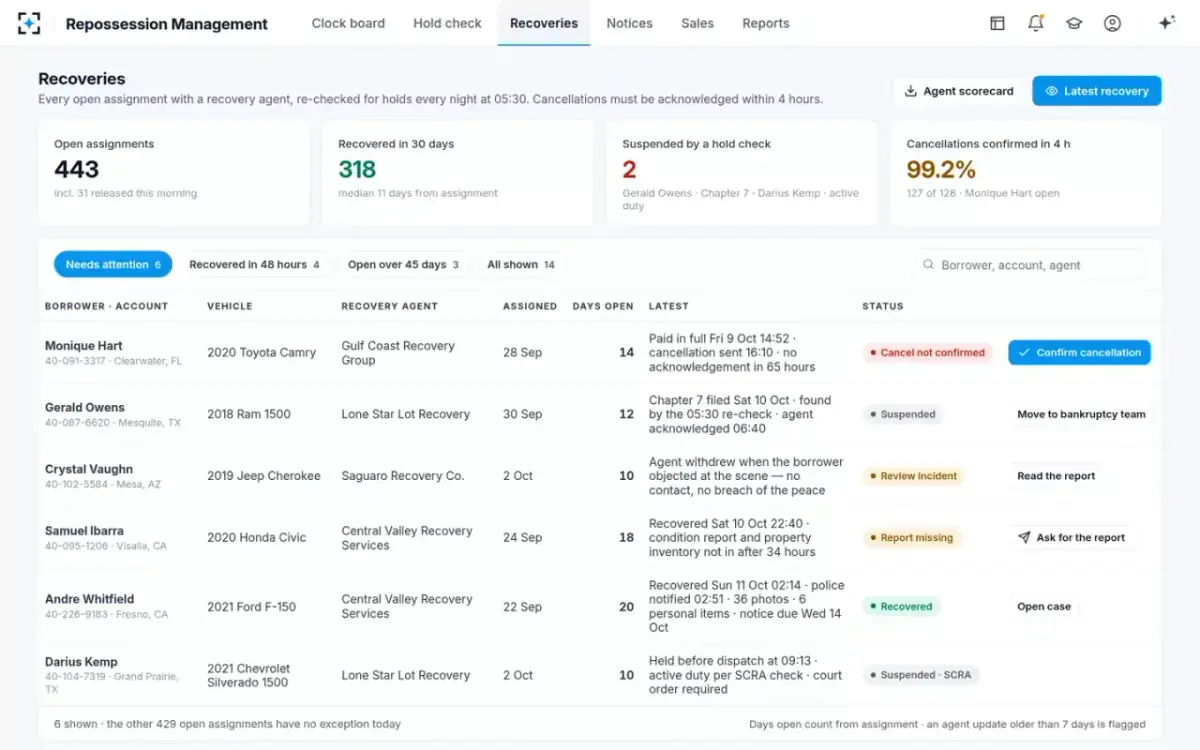
The test that matters is the acknowledgement, not the send. A cancellation e-mailed to a forwarder at 15:05 has been sent; it has not reached the agent who is parked outside the borrower's workplace at 16:30. A lender's standard should name a time by which every cancellation is confirmed back from the agent, and should treat a missing confirmation as an incident in its own right, whatever happened next. How often assignments are cancelled, and why the cancelled ones carry most of the risk, is counted in the three in four assignments that never complete.
Every open assignment, the unconfirmed cancellation first
The third-party life cycle, applied to recovery vendors
The interagency guidance organises oversight into five stages (planning, due diligence and selection, contract negotiation, ongoing monitoring, and termination), surrounded by oversight and accountability, independent reviews, and documentation and reporting. Applied to a forwarder and its agencies, each stage has a specific job.
Five stages of vendor oversight, written for repossession
| Stage | What it means for a forwarder and its agencies |
|---|---|
| Planning | Decide whether recovery is a critical activity, which states the portfolio needs covered, and whether the lender will contract with agencies directly, through a forwarder, or both. |
| Due diligence and selection | Licences by state and class, ownership, complaint and litigation history, insurance, incident history, the forwarder’s list of agencies and its own process for approving them. |
| Contract | Cancellation and acknowledgement times, incident reporting, property handling and fees, the right to audit the forwarder and its agencies, subcontracting limits, and data security. |
| Ongoing monitoring | Licence expiries, acknowledgement times, report timeliness, complaints, incidents, invoice exceptions, measured continuously, not from an annual questionnaire. |
| Termination | Recalling open assignments, transferring vehicles and property in storage, and keeping the evidence the lender will need if a past recovery is disputed. |
Two rows deserve emphasis. Due diligence on a forwarder is partly due diligence on its due diligence: the lender should see how the forwarder approves an agency, how often it re-checks licences, and what it does when an agency fails. And termination is a live operational event in recovery, because there may be vehicles on the agency's lot and borrowers' belongings in its storage on the day the relationship ends.
What a forwarder contract should say that a generic vendor contract does not
A forwarder contract should fix, in numbers, the timings and evidence that the lender's own compliance depends on, because a general obligation to "comply with applicable law" gives the lender nothing to measure. Five clauses carry most of the weight.
Message timing. A maximum time from the lender's cancellation to the agent's confirmation, with the confirmation returned through the same channel and each step timestamped. Licence currency. A duty to keep every agency and agent licensed for the state of recovery, to report any lapse or discipline at once, and to supply the licence evidence on request. Subcontracting. A list of the agencies used, notice before one is added, and the same obligations flowing down; the guidance itself names "use of subcontractor(s)" as a planning consideration. Incidents. A definition broad enough to include an objection at the scene, any police involvement and any damage, with a report to the lender within a fixed time. Fees and property. A schedule of what may be charged to the lender and to the borrower, mirroring the Florida rule against charges "not actually incurred" and the Bureau's findings on personal-property fees.
Each clause should map to something the lender will actually monitor. A contract term that no report ever tests is decoration, and an examiner reading the contract next to a year of unmeasured performance will notice.
The same agency, overseen two ways
Vendor file built at onboarding: Number captured when the agency signed; expiry not tracked.
Vendor file kept live: Class, state, location and expiry held per agency, with a warning before it lapses.
Vendor file built at onboarding: Sent by e-mail; success assumed.
Vendor file kept live: Each one timed from send to the agent’s confirmation; late ones escalated.
Vendor file built at onboarding: Reported when the agency chooses to.
Vendor file kept live: A recovery cannot close without a report stating whether anything happened at the scene.
Vendor file built at onboarding: Invoices paid after a spot check.
Vendor file kept live: Each invoice line matched to the work the assignment shows was done.
Vendor file built at onboarding: Annual questionnaire.
Vendor file kept live: Monthly scorecard from the same data the desk works from.
Measuring forwarders and agencies: the five numbers worth a monthly review
Five measures tell a recovery leader most of what an annual questionnaire cannot: how fast cancellations are confirmed, how fast recovery and condition reports arrive, how many incidents are reported per hundred recoveries, how many complaints name the agency, and how many invoice lines needed correction. Each one is a count from the assignment history, not an opinion.
The incident rate needs the most care in reading. An agency that runs hundreds of recoveries for a lender and reports no incidents at all is more likely under-reporting than flawless, because objections at the scene are an ordinary part of the work. The guidance asks lenders to confirm that a third party has "clearly documented processes, timelines, and accountability for identifying, reporting, investigating, and escalating incidents". The useful test is whether those processes produce reports.
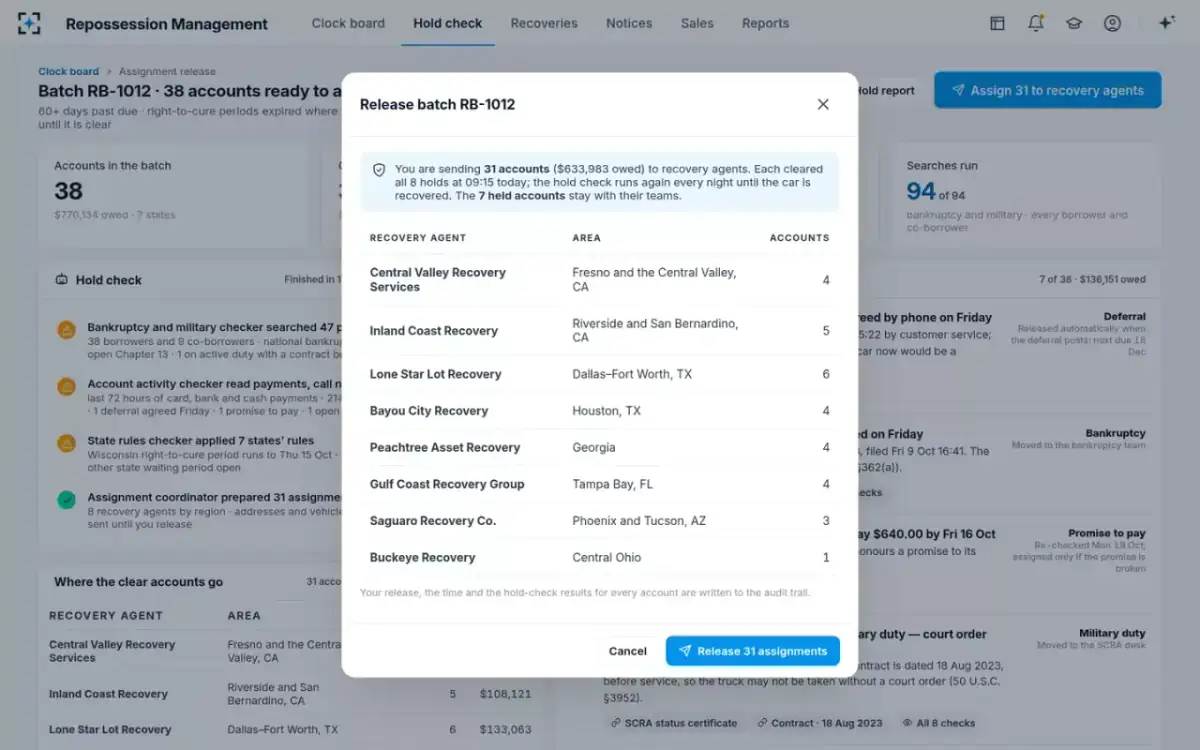
Take Saltmeadow's sample book on one morning: 38 accounts tested against eight holds, 31 cleared and released across eight agencies, 7 held with their reasons. Overnight, the re-check suspended one open assignment after a Chapter 7 filing and flagged one agency for a cancellation unconfirmed for 65 hours on an account paid in full. Those two lines are the monthly review in miniature: one control that worked, and one vendor that did not.
Releasing the batch: which agency gets which car, signed by the recovery manager
What examiners ask for, and the evidence that answers it
An examiner reviewing repossession will ask for the policy, the vendor inventory and risk ratings, the forwarder and agency contracts, evidence of due diligence and monitoring, the complaint log, and a sample of repossessions with everything that happened to each. The last item is where most programmes are thin, because the evidence is scattered across the servicing system, e-mail and the forwarder's portal.
For each sampled repossession the file that answers the examiner shows: the account's status and every hold checked on the day of release, with the source of each check; who released it and when; the assignment as sent; every later message, including any cancellation and the time it was confirmed; the recovery report, police notice, condition report and property inventory; and the notices that followed. If that sequence can be produced for one account in minutes, the vendor-oversight programme has evidence behind it. If it takes a week of e-mail, the programme has a policy and not much else.
Where Repossession Management fits, and where it does not
Repossession Management sits on the lender's side of the chain. Its agents check each account against the holds before release and again each night, send assignments only after a recovery manager releases them, time every acknowledgement from a forwarder or agency, escalate a late cancellation to the manager, and require the reports, inventory and notices before a recovery closes. Every step carries who did it and when, which is the sequence an examiner samples.
It does not license anyone, inspect an agency's lot, or replace the vendor-management programme's due diligence, contract negotiation and onsite review. Licence data and contract terms come from the lender's own vendor files; the solution makes them visible on the assignment and warns when one lapses, but the decision to approve or terminate an agency stays with the people who own the relationship. What it changes is the evidence: the monthly review and the examiner's sample are built from the same assignment history the desk worked from, rather than reconstructed afterwards.
Questions people ask
Is the lender liable if a repossession agent breaches the peace?
The lender should expect to answer for it. Article 9 lets a secured party repossess without a court only "if it proceeds without breach of the peace", and the agent is exercising the lender's right. The Bureau states that loan holders are responsible for the repossession practices of their service providers, so a forwarder contract can shift cost between companies but not the duty to the borrower.
What licences should a lender check before using a repossession agency?
The licence the state of recovery requires, for the agency, its branch, its manager and the individual agent, current on the date of the assignment. In Florida that means a Class “R” licence for the location, valid three years, and Class “E” licences for agents, valid two. States differ widely, so the vendor file should hold licences by state and class, with expiry dates.
What does a repossession forwarding company do for a lender?
It receives the lender's assignments, places each with a local agency, chases updates and consolidates billing. The Bureau found forwarder use rose from 31% to 66% of repossessions between 2018 and 2022 in its data. It also found fees charged to consumers were higher where a forwarder was used, and that every message to the agent now has an extra hop.
Do the interagency third-party guidelines apply to repossession agencies?
The 2023 guidance applies to all of a banking organisation's third-party relationships, and repossession vendors usually meet its description of higher-risk or critical activities because of their direct customer impact. That calls for fuller due diligence, contract terms including audit rights over the vendor and its relevant subcontractors, and ongoing monitoring proportionate to the risk.
How quickly should a forwarder confirm a cancelled repossession?
No federal rule sets a number, so the lender should set one in the contract and measure it. Examiners have found unfair acts where service providers failed to act on cancellations after a borrower paid or obtained an extension. A confirmation window measured in hours, escalated to a named person when missed, is a defensible standard; a send with no expected confirmation is not.
What evidence of vendor oversight do examiners expect for repossession?
A risk-rated vendor inventory, contracts, due-diligence files and monitoring results, and a sample of repossessions traced end to end. For each sampled account that means the hold checks at release, the release itself, every message to the forwarder with its confirmation, and the reports and notices after recovery, each with a time and a name.