Ask a recovery team what a repossession costs and it will usually give one number: the fee an agency bills for taking the car, or the fee passed on to the borrower for it. It is a real number and it is the smallest term in the lender's own arithmetic. The repossession cost for lenders, counted properly, is that invoice plus the yard, plus whatever the intermediary adds, plus the two or three assignments that produced no car for every one that did, plus the expected cost of the recovery that should never have happened. Repossession Management, the Botminds agentic solution for auto lenders, exists partly because four of those five terms are invisible in most servicing systems — they are events that did not happen, or that happened to somebody else's invoice.
This page separates three kinds of number carefully, because the mixing of them is why the published figures and lenders' own figures never agree: what a federal supervisor has measured, what is arithmetic on those measurements, and what is an estimate with our name on it. Where a figure comes from the solution's sample data it is from a fictional lender and fictional borrowers, and says so.
Five terms in the cost of one recovered vehicle, four of which are usually missing
The agency invoice
per completed recovery
The number everybody quotes, and the only one that arrives as a bill with the car attached.
The recovery agency
The yard and the preparation
days held × daily rate + preparation for sale
Storage runs from the recovery until the sale, and it is lengthened by every day the notice is late.
The agency or the auction
The intermediary
completed recoveries × the premium over a direct agency
The Bureau found fees higher with a forwarder than without. The direction is published; the level is your contract.
The forwarder
The assignments that produced no car
(1 ÷ completion rate − 1) × cost per unproductive assignment
At the Bureau’s September 2022 completion rate of 27 percent, about 2.7 unproductive assignments sit behind every recovery.
The lender, always
The one that should not have happened
rate × (statutory floor + refunds + remediation + legal)
Rare, uninsurable against its own cause, and large enough that a small rate still moves the average.
The lender, always
What the average cost of a repossession usually means
It usually means the fee charged to the borrower, and the largest public measurement of that figure comes with three warnings printed on it.
The federal supervisor's auto finance data pilot collected repossession fees from nine lenders across just over 33 million loan originations. The Bureau is explicit that the costs covered are broad: they "can include (but are not limited to) vehicle recovery, towing fees, costs for use of a flatbed tow truck or specialized equipment to tow certain vehicles without damaging them, storage fees, fees for securing and storing personal property, attorney fees, or other fees". So "the repossession fee" is not one thing.
Then the warnings. First, what was collected is what lenders charged, not what they paid: "some lenders reported that they charge a flat fee to consumers regardless of the amount agents or forwarders billed to the lender". Second, the figure is not decomposable — the analysis "is confined to the total amount reported as charged to consumers in the dataset and does not analyze these fees individually". Third, it is trimmed: the Bureau "removed the top one percent of repossession fees and removed accounts where repossession fees were reported as negative to guard against outlier data".
Put those together and the published figure is a trimmed average of what some lenders decided to pass on. It is a good benchmark for what borrowers are charged and a poor one for what recovery costs you. The one fee the Bureau did publish in detail is the disposal fee charged after the sale, and its shape is interesting on its own.
Mean and median disposal fees charged after the sale, by credit tier
The five terms in the real number
Work the terms in order and the lender's figure assembles itself.
The agency invoice is the only term with a natural owner inside the business: someone in vendor management already receives it, already compares it across agencies, and already knows what an involuntary recovery costs in each region. It is the term most lenders can state to the dollar and the one with the least room to improve, because it is a competitive market price for a physical job.
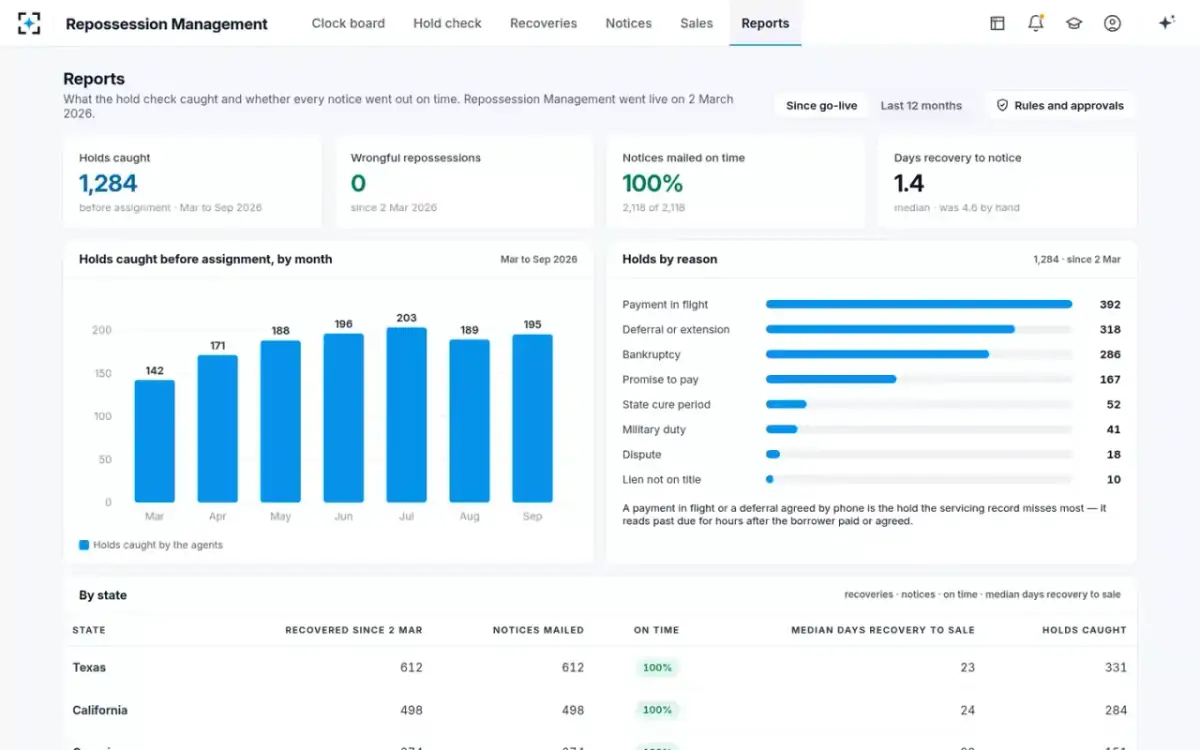
The yard and the preparation are time, priced by the day. Storage runs from the recovery to the sale, and the sale cannot happen until the notice has gone and the waiting period has run. Every day of delay between the hook and the mailed notice is therefore a day of storage the lender pays for and often cannot recover. In the solution's sample data, a fictional lender working by hand takes a median of four and a half days from recovery to a mailed notice; at a sample yard rate of twenty dollars a day that is small per car and significant per thousand.
The intermediary's premium is real but unquantified in public. The Bureau's finding is directional and careful: "average repossession fees charged to consumers in connection with completed repossessions carried out using a forwarder were higher than those carried out without the use of forwarders", and its conclusion is that repossessions through forwarders "may have resulted in increased repossession costs passed on to consumers". Note what that measures — fees charged to consumers, not the lender's own cost — so a lender using a forwarder should price the premium from its own two sets of invoices rather than from the report.
The assignments that produced no car are the term that changes the answer. In the Bureau's dataset 27 percent of assignments made in September 2022 were completed, against 38 percent three years earlier. At 27 percent, each completed recovery carries about 2.7 assignments that produced nothing — cancelled, paid, not located, or quietly left open. Whether those cost money depends on the contract: per-attempt billing makes them expensive and per-recovery billing makes the agency carry them, which it then prices into the recovery fee. Either way the lender pays for them; only the invoice line differs.
The one that should not have happened is a probability times a large number, and it is covered in its own section below.
What the lender may charge the borrower, and what it absorbs
The border is drawn in two places: Article 9 allows the reasonable expenses of retaking, holding, preparing for disposition, processing and disposing to be deducted from the sale proceeds, together with reasonable legal expenses where the agreement provides for them and the law does not prohibit them (UCC §9-615(a)); and the borrower's own contract has to authorise whatever is charged. State law then narrows the result further in some states, including by forbidding the recovery of repossession and sale costs altogether in particular lending regimes.
| The cost | Chargeable to the borrower? | Where the authority comes from | What usually happens |
|---|---|---|---|
| Recovery and towing | Usually, as an expense of retaking | Article 9, plus the contract | Passed through, sometimes as a flat fee that does not match the invoice |
| Storage until the sale | Usually, as an expense of holding | Article 9, plus the contract | Passed through, and grows with every day the notice is late |
| Preparing the car for sale | Usually, as an expense of preparing for disposition | Article 9, plus the contract | Passed through, and shows up as the disposal fee after the sale |
| Storing the borrower’s own belongings | Sometimes, where the state allows a disclosed charge | State licensing law | Increasingly absorbed as policy; never a precondition of returning the property |
| The forwarder’s management fee | Only to the extent it is an expense of retaking under the contract | Article 9, plus the contract | Usually inside the recovery fee, which is why the premium is hard to see |
| An assignment that produced no car | No — there is nothing to deduct it from | Nothing | Absorbed in full, and rarely counted |
| Putting a wrongful repossession right | No | Nothing; the statutes run the other way | Absorbed, with the balance often reduced or eliminated as well |
| Legal expenses | Where the agreement provides and the law allows | Article 9, plus the contract and state law | Varies widely by state and by lending regime |
Do repossession forwarders cost more?
On the measure the Bureau could see, yes — average fees charged to borrowers were higher over the period on recoveries carried out through a forwarder than on those carried out directly. On the measure a lender actually cares about, the answer is that it depends on what the forwarder replaces.
A forwarder is bought to replace a function: managing relationships with dozens of agencies, placing orders, chasing updates, reconciling invoices. If that function was costing a lender three full-time people, the premium per recovery may be the cheaper side of the trade. What the Bureau's work adds is a second column to the comparison that most procurement exercises leave out: the intermediary adds a hop in both directions on messages whose value decays in minutes, and the most expensive thing on this page is a cancellation that did not arrive in time.
Forwarder use in the dataset was not marginal. It rose from 55 percent of completed repossessions in August 2020 to 69 percent in October 2022, settling into the mid-sixties by the end of that year. So for most lenders the question is not whether to use one but what to require of it: a confirmation of every cancellation within a stated time, visibility of which agency holds each order, and the invoice detail needed to price the premium at all.
The cost nobody counts: three cancelled assignments per recovery
Here is the arithmetic that moves a lender's number most, done in the open so you can substitute your own figures.
Take a hundred assignments at the Bureau's September 2022 completion rate. Twenty-seven end in a recovery; seventy-three do not. Suppose the twenty-seven cost the agency fee, the yard and the preparation, and suppose the seventy-three cost something smaller — a part of an attempt fee, or nothing directly but a share of the recovery fee that the agency has priced to cover them. Divide the whole spend by twenty-seven, not by a hundred, and the unit cost of a recovered vehicle rises above the direct fee by an amount your billing model decides — which is why it has to be computed from your own invoices rather than borrowed. Nothing in that calculation is controversial. It is simply that most lenders divide by the wrong denominator because the seventy-three never arrive as a bill with a car attached.
There is a second cost inside the seventy-three, and it is the one worth managing. An open assignment is a live instruction resting on facts that were true when it was sent; every day it stays open is a day in which a cancellation can be missed. The population of open instructions is counted in the three in four that never complete, and the risk it carries is the fifth term below.
The published anchors a lender can build its own number on
27%
of repossession assignments made in September 2022 were completed — about 2.7 unproductive assignments behind each recovery
$367
mean disposal fee charged after the sale to near-prime borrowers, the highest of any credit tier
0.75%
of all outstanding auto loans were assigned to a third party for repossession in December 2022
$211B
in new auto loans appeared on credit reports in a single quarter of 2026 — the book this all runs on
What a wrongful repossession costs
Enough that a rate of one in a thousand still shows up in the unit cost. The components are knowable even though the total is not published.
Start with the statutory floor, which does not depend on proving any loss. Where the collateral is consumer goods, a debtor may recover for a Part 6 failure an amount no less than the credit service charge plus ten percent of the principal (UCC §9-625(c)(2)). Work it on a plain example: a $24,000 principal with $4,100 of credit service charge over the term gives a floor of $6,500 — calculated from the loan, not from the harm, so it does not shrink because the borrower was back in the car by Tuesday. Add the deficiency the lender may no longer be able to collect, add refunds of the fees charged, add the cost of reversing the credit reporting, add the replacement transport the borrower is claiming, add legal costs on both sides.
Then look at what an enforced settlement looks like when a statute with its own penalty is involved. In September 2025 the Department of Justice settled with a regional auto finance company over at least five servicemember vehicles taken without the required court orders: the firm agreed to pay at least $60,000 in compensation and a $60,000 civil penalty, to forgive the unpaid balances on the affected accounts and to repair the borrowers' credit (U.S. Department of Justice, 29 September 2025). Divide the cash alone across the vehicles named and the arithmetic is uncomfortable: roughly twenty-four thousand dollars a car, before the forgiven balances, the credit repair, the policy changes and the legal cost of getting there.
That is the term to hold in mind when a hold check is being priced against the fee it saves. The tests behind it, and the only honest way to prove they work, are set out in the three causes, and how to close them.
The staff hours one repossession uses
The last term is labour, and it is the one a lender can measure this week without anybody's help: count the hours one account consumes between the morning batch and the signed notice, and multiply by the book.
Where one account's hours go, before and after, on the sample lender's own estimate
By hand — 5.75 hours an account
- Drafting the notice with the reinstate and redeem figures — 1.5 h · 26%
- Clearing holds before assignment — 1 h · 17%
- Agent reports and property — 1 h · 17%
- Explaining the balance after the sale — 1 h · 17%
- Re-checking and chasing cancellations — 0.75 h · 13%
- Working out the state’s dates — 0.5 h · 10%
With agents doing the mechanical part — 1.45 hours an account
- Agent reports and property — 0.5 h · 34%
- Clearing holds — 0.25 h · 17%
- Drafting the notice — 0.25 h · 17%
- Explaining the balance — 0.25 h · 17%
- Re-checks and cancellations — 0.1 h · 8%
- State dates — 0.1 h · 7%
Two things are worth saying plainly about that figure. It is an estimate, it is ours, and it describes a fictional lender's process rather than yours. And the second bar is not a staffing plan — the hours that remain are the ones with a signature attached, which is exactly where a lender should want its people. Which steps those are, and why, is set out in what a person must sign.
Putting a number on your own book
The exercise takes a day and needs no vendor in the room. Pull one quarter of assignments, not recoveries. Count them, count the completions, and compute your own completion rate rather than using the Bureau's. Total every invoice from every agency and forwarder for the quarter, including the ones on assignments that produced nothing, and divide by completions — that is your unit cost of a recovered vehicle, and it is almost always a long way above the figure in the recovery fee.
Then add three lines. Storage days between recovery and the mailed notice, at your agencies' rates, which is the term a faster notice actually reduces. Hours per account, from the list above or from your own observation, at your own loaded rate. And the expected cost of error: your own count of repossessions that should not have happened in the last two years, multiplied by a conservative figure for putting one right — the statutory floor on a typical loan is a defensible starting point.
The measures a cost model needs, counted where the work happens
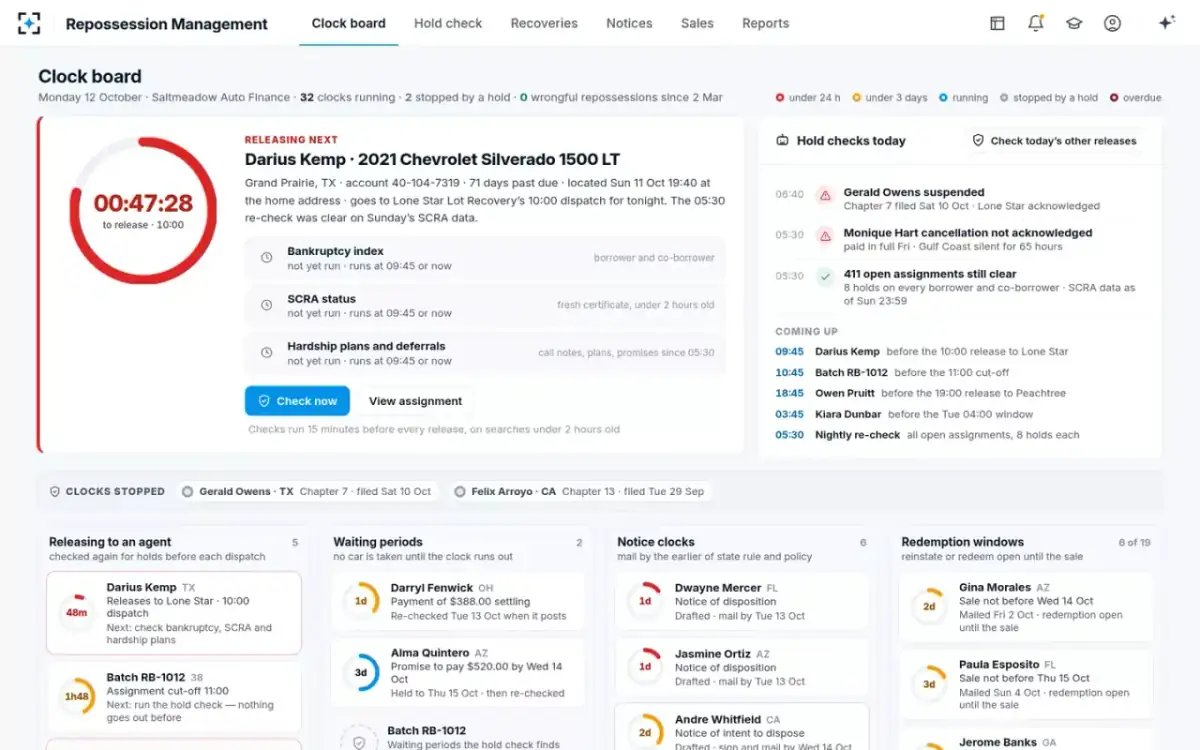
One last piece, and it is the cheapest of all to instrument: the clock. Most of the cost terms above are made of elapsed time — days in a yard, days an instruction stayed open, days between a recovery and a notice that had to go. A board that shows every car's clock, and what each one is waiting for, turns a cost model into a daily operating decision rather than a quarterly post-mortem.
Every car as a clock, because most of the cost is elapsed time
Questions people ask
What does a repossession cost the lender?
More than the agency's invoice, and by a margin that grows once the yard, the intermediary's premium and the unproductive assignments are divided into the recoveries that actually happened. The lender's number also includes things no borrower is ever charged for: the assignments that produced no car, the labour between the batch and the signed notice, and the expected cost of a recovery that should not have happened. The only number that is reliably available in public — the fee charged to borrowers — excludes all four by construction.
What fees can be charged after a repossession?
Those the borrower's contract authorises and the law allows to be deducted from the proceeds: broadly the reasonable expenses of retaking, holding, preparing for disposition, processing and disposing, plus reasonable legal expenses where the agreement provides for them and the law does not prohibit them. Several states narrow this further, and in some lending regimes the costs of repossessing and selling may not be charged at all. A fee that is not in the contract has no authority behind it, whatever the agency billed.
How much are repossession storage fees?
They are charged by the day, so the amount is a function of how long the car sits rather than of a price list — and the length is largely within the lender's control, because the car cannot be sold until the notice has gone and the waiting period has run. Storage is one of the cost lines the federal supervisor lists as commonly charged to borrowers in a repossession, along with recovery, towing, specialist equipment and the cost of securing personal property. Reducing days between the hook and the mailed notice is one of the cheapest cost reductions available in this process, because it needs no new contract.
What does a cancelled repossession cost?
Directly, whatever your contract says — an attempt or dry-run fee on per-attempt billing, nothing visible on per-recovery billing, where the agency has priced it into the recovery fee instead. Indirectly it costs more than either, because the cancelled order is the one that can still be executed by an agency that never confirmed it, and that is the most expensive outcome in this entire process. Count cancellations and their acknowledgement times as a cost measure, not as an operations statistic.
What is a disposal fee after a repossession?
The charge associated with selling the recovered vehicle — auction and sale costs, passed to the borrower where the contract allows — and it is a separate line from the repossession fee itself. It is the one fee the Bureau published in detail: near-prime borrowers were charged the most, with a mean of $367 and a median of $339, and superprime borrowers the least, at a mean of $300 and a median of $294. Disposal fees were consistent across income levels but not across credit tiers.
What is the total cost of a repossession to a lender?
There is no published total, and a vendor quoting one is quoting an estimate. What can be stated honestly is the structure: the agency invoice, plus the yard and preparation, plus any intermediary premium, all divided by your own completion rate rather than by the number of cars recovered, plus labour, plus the expected cost of error. Build it from your own invoices for one quarter and you will have a number you can defend — and you will almost certainly find that the term you had never counted is larger than the one you negotiate hardest over.