A repossession policy and procedures document is the paper a lender is judged against when one recovery goes wrong, and most of them are written as a narrative when they should be written as a boundary. Read any good one closely and the same split appears on every page: some steps are a search, an arithmetic or a draft — work that should happen continuously, with its source shown — and the rest are decisions with legal consequence, which one named person must make and sign. Repossession Management, the Botminds agentic solution for auto lenders, is built on that line: agents search, calculate and draft; the recovery manager releases, approves and signs; and the two federal holds are not decisions at all, because nobody in the building is allowed to overrule them.
This page is about how to write the document, not about what the law requires in any one state. It uses the federal holds, the supervisory expectations published for this work, and one fictional sample lender's settings as a worked example of the difference between a policy that can be audited and a policy that can only be admired.
Eight steps, and the four that cannot move off a person's desk
Agent
Account activityReads the servicing record, the payment processors and the call notes for deferrals, extensions, payments in flight, promises to pay, disputes and cancellation requests.
Never: Never reads a promise or a deferral as kept before its date.
Agent
Bankruptcy and militarySearches the national bankruptcy index and the servicemember status site for the borrower and every co-borrower, and keeps the certificate it was given.
Never: Never clears an account on searches more than 24 hours old.
Agent
State rulesApplies the borrower's state: cure notices and their periods, waiting periods, the lien on title, the notice type, the mailing deadline and the earliest sale date.
Never: Never sets a deadline later than the state rule or the stricter house policy.
A person decides
Recovery manager — releaseReviews the batch with every hold and its source in front of her, and releases the accounts that cleared.
Never: Never releases an account the hold check held; a held account is not sent to an agency.
Agent
Assignment coordinatorRoutes released accounts to agencies by region, sends cancellations, and chases the acknowledgement that each one was received and acted on.
Never: Never sends an assignment the manager has not released.
Agent
Nightly re-checkTests every open assignment against the holds again, suspends any that a new fact has caught, and tells the agency the same night.
Never: Never leaves a newly held assignment live while someone decides what to do about it.
Agent
Notice writerDrafts the state's post-repossession notice, works the reinstatement and redemption figures from the account and the contract, and checks every required content.
Never: Never sends a notice; it produces a draft and stops.
A person decides
Recovery manager — signatureSigns the notice and, after the sale, the explanation of the deficiency or surplus, with a password and the meaning of the signature recorded beside it.
Never: Never a signature without a stated meaning, a time and the figures it covered.
What a repossession policy and procedures document has to cover
Eight things, and they are not the eight most policies spend their words on. A policy that opens with four pages on the firm's commitment to treating customers fairly and closes with a page on roles has usually skipped the part a reviewer will actually test: which facts stop a repossession, how fresh those facts have to be, who may act on them, and what is written down when someone does.
Ten sections, and the question each one has to answer in a sentence
- What makes an account eligible
Days past due, the contract clause relied on, and anything the firm has told borrowers would prevent a repossession — because telling a borrower one thing and doing another is where the supervisory findings start.
- The holds, with their source for each
Each fact that stops a taking, where the fact is read from, and how old it may be before it must be read again.
- Which holds may never be overridden
The bankruptcy stay and the servicemember protection are statutes. The policy should say that in terms, so nobody has to decide it at 09:12 on a Monday.
- Who releases an account to an agency
One named role, with an alternate, and the rule that a held account never leaves the building.
- What an override needs
A reason, a second approver, and a record of both. An override nobody can find afterwards did not happen.
- How often open assignments are re-tested
A schedule, plus a check close enough to dispatch that nothing can change between the test and the hook.
- The cancellation round trip
Sent, received, acted on, confirmed — with a time limit on the confirmation and a named person it escalates to.
- What happens after the recovery
The property inventory and its clock, the notice type and its deadline, the earliest sale date, and who signs each.
- What is written down at every step
The search and its certificate, the hold and its source, the release and who made it, the signature and its meaning.
- What is measured, and reported to whom
Holds caught before assignment by reason, cancellations unacknowledged, notices mailed on time, and the count of repossessions that should not have happened.
The boundary: search, arithmetic, draft — decision, signature
Take any repossession procedure and mark every step with one of two letters. W is work: reading a record, running a search, comparing a date, applying a state's rule to produce a deadline, writing a first draft of a letter. D is a decision: this car may be taken, this hold may be set aside, this notice is correct and goes out over my name, this balance is owed.
The W steps have three properties in common. They are checkable against a source, they are worth doing far more often than a human can do them, and they are where the errors that cause wrongful repossessions actually live — a stale search, a payment that had not settled, a call note nobody read. The D steps have the opposite properties: they are judgements about a person's property, they are made once, and they are the ones a court or an examiner will ask a human being to explain.
The useful consequence is that a policy written this way stops being a debate about technology. The question "should this be automated" dissolves into two much easier questions: can this step be checked against a source, and does this step have a legal consequence? A policy that answers those two questions for every step is also, almost accidentally, a specification.
The holds, and which of them nobody may override
Two of the holds in any US auto lender's policy are not risk appetite. They are statutes, and the policy's only job is to say so clearly enough that nobody treats them as a service-level target.
The first is the automatic stay. From the moment a bankruptcy petition is filed, collection activity against the borrower is barred — and the stay runs from the filing, not from the lender learning of it, which is why an overnight search is a control and a mailbox is not. An individual injured by a willful violation of the stay recovers actual damages including costs and lawyers' fees, and may recover punitive damages in appropriate circumstances (11 U.S.C. §362).
The second is the servicemember protection, and its scope is narrower than most policies state it. The protection applies, in the statute's own words, "only to a contract for which a deposit or installment has been paid by the servicemember before the servicemember enters military service" (50 U.S.C. §3952(a)(2)). Where it applies, the vehicle may not be repossessed for a breach without a court order — and the sanction is not only civil.
A person who knowingly resumes possession of property in violation of subsection (a) … or who knowingly attempts to do so, shall be fined as provided in title 18, or imprisoned for not more than one year, or both
50 U.S.C. §3952(b)
A policy that files that under "compliance risk" has mis-filed it. And the failure mode is not exotic. In a 2025 settlement the Department of Justice alleged that an auto finance company "took no steps to determine whether the owners of these vehicles were in military service prior to repossessing their cars, and, in some cases, went forward with repossessions even after they were told that the owner was on active duty" (U.S. Department of Justice, 29 September 2025). The first half of that sentence is a missing search. The second half is a missing rule about who may decide what — which is the subject of this page.
Beyond the two federal holds, every other hold in the policy is the lender's own: a deferral agreed on the telephone, a payment still settling, a promise to pay inside its window, an open dispute, a state cure period still running, and whether the firm actually holds a recorded lien on the vehicle it is about to take. Those are policy, they can be tuned, and the policy should say what each one is for. The four layers of law they sit on are set out in the four layers that decide one case.
Can AI decide to repossess a car?
No — and a policy that says so in one line has solved less than it thinks. The honest version is longer, because the question hides a second one: which parts of the work is a system allowed to do at all?
Here is the division worth writing down. A system may search, and should, far more often than a person could: the bankruptcy index, the servicemember status site, the payment processors, the call notes, the state rule in force today. It may calculate — days past due, the end of a cure period, the earliest lawful sale date, the figure to reinstate and the figure to redeem — provided every number ties back to a line in the account that a person can open. It may draft the notice and check it against the list of required contents. It may re-test every open assignment all night.
It may not decide that a borrower's car will be taken, set aside a hold, send a notice, sell a vehicle, waive or demand a balance, or agree that a fee is reasonable. Those are the D steps, and the reason they stay with a person is not sentiment: each one is an act whose legality the lender may later have to defend, and a defence requires someone who can say what they knew and why they acted. Article 9 puts the same idea in commercial language — every aspect of a disposition must be commercially reasonable (UCC §9-610) — and reasonableness is a judgement with a name on it.
There is a drafting trap here too. Policies often say a step is "automated with human oversight", which in practice means a person clicks through a queue of two hundred items. Oversight that cannot be exercised is not a control. A better test for every D step: if this one went wrong, could the person named reconstruct what they were looking at when they approved it? If the answer is no, the step is not supervised; it is unattended with a name attached.
How often should a repossession hold be re-checked?
As often as the underlying fact can change, and always once more immediately before the irreversible act. That is the whole rule, and every number below it is a lender's own choice.
The reasoning is simple. A bankruptcy petition can be filed on a Saturday. Active-duty orders can start on the morning of the dispatch. A deferral can be agreed by telephone at 15:22 on a Friday and not post until Tuesday. A card payment can be made at the weekend and settle on Monday afternoon. Every one of those facts forbids or should prevent a taking, and every one of them can arrive after the account cleared its morning batch. A hold check run once, at the start, tests the account against a world that no longer exists by the time the truck arrives.
| Setting at the sample lender | What it means | Why that number | Whose number it is |
|---|---|---|---|
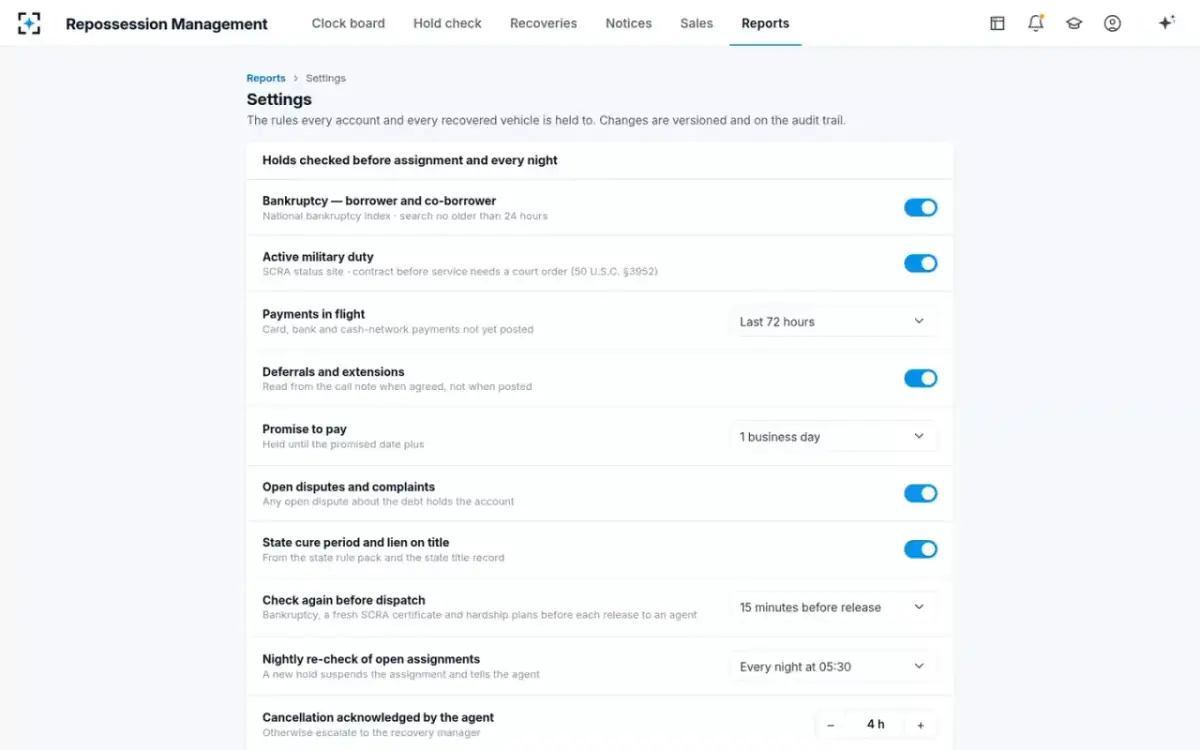
| Searches no older than 24 hours | An account cannot clear on a bankruptcy or servicemember search run yesterday morning | A filing or an active-duty start can appear on any day; a day-old search cannot see today | The lender's |
| Payments in flight: last 72 hours | A card, bank or cash-network payment not yet posted still holds the account | Settlement lags the payment, and the borrower believes they have paid | The lender's |
| Promise to pay: its date plus one business day | The account is held until the promised date has passed with a day to spare | A promise kept on its last day should not race the dispatch board | The lender's |
| Re-check 15 minutes before release | A final test on a servicemember certificate under two hours old | It is the last moment at which stopping costs nothing but a cancelled run | The lender's |
| Nightly re-check of open assignments at 05:30 | Every live instruction is tested again and suspended if a new fact catches it | Assignments stay open for weeks; the facts under them do not stay still | The lender's |
| Cancellation acknowledged within 4 hours | An unacknowledged cancellation escalates to the recovery manager by name | A cancellation that has not been confirmed is not a cancellation | The lender's |
| The bankruptcy stay | Runs from the filing, whether or not the lender has been told | It is a statute | Congress |
| The servicemember court-order requirement | No taking for breach without a court order, where the protection applies | It is a statute, with a criminal sanction attached | Congress |
Who approves a repossession?
One named role, with a named alternate, and nobody else. In the sample lender's policy that is the recovery manager: she reviews the morning batch with every hold and its source in front of her, releases the accounts that cleared, and signs each notice and each post-sale letter. The agents never assign, send, sell, waive or demand on their own.
Two refinements are worth the extra paragraph in the document. The first is four eyes for overrides: setting aside a lender hold needs a reason and a second person — the compliance reviewer — because an override is the one place where a policy is being deliberately departed from, and a single person's judgement there is the thinnest control in the file. The second is that held accounts are routed, not queued: a bankruptcy hold goes to the bankruptcy team, an active-duty hold to the servicemember desk, a disputed balance to the complaints team. A single exception queue worked by whoever is free is how a specialist hold becomes a clerical decision.
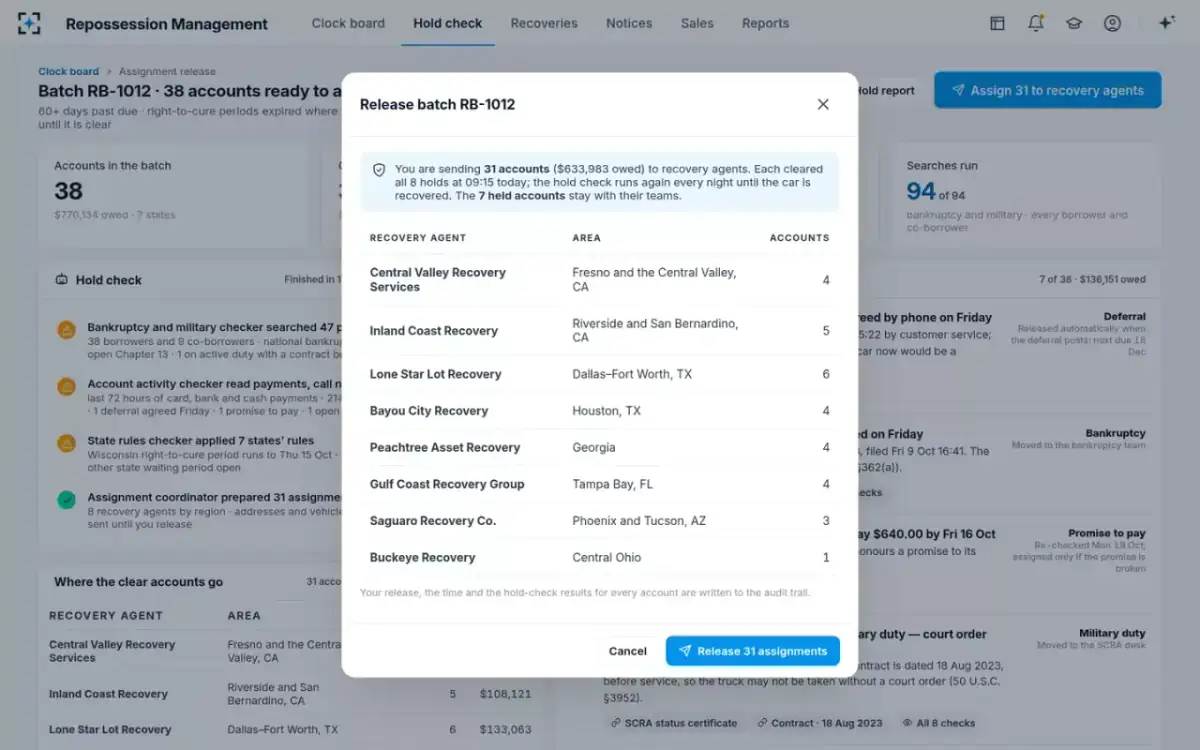
Thirty-one accounts released by a person, and seven that were not
What a procedure should say about cancellations
More than most do. Cancelling is the easiest instruction in the business to send and the easiest to believe in once sent, and the supervisory findings about wrongful repossession are, in large part, findings about cancellations that did not arrive. The federal supervisor's published expectations put the obligation in two places at once: firms should "review policies and procedures regarding cancellation of repossession orders to ensure that there is an appropriate process for cancelling repossessions if consumers take steps that should result in cancellation", and should "ensure prompt communications between the servicer and repossession service provider when the servicer cancels a repossession" (Bulletin 2022-04, withdrawn on 12 May 2025 and under review rather than disowned).
Read the two together and the procedure writes itself. The first sentence is about the trigger: the policy has to name every borrower action that should stop a repossession, and the systems have to notice each one wherever it happens — a payment on a portal, a hardship arrangement in a call note, a dispute logged by the complaints team. The second is about the round trip: sent, received, acted on, confirmed, with a time limit on the confirmation and a named person it escalates to. A lender that can show only that it sent the cancellation has shown that it tried.
The procedure should also say what happens when the confirmation does not come, because that is the live risk and it has a shape: the car is still out, the agency still believes it has an order, and the instruction decays in minutes. At the sample lender the window is four hours and the escalation is by name. The economics and the failure rates behind open assignments are worked through in the three in four that never complete.
Writing the policy so it can be audited
A policy is auditable when each of its rules exists somewhere a person can point at, and when changing one leaves a trace. Prose fails both tests: a sentence in a document says what should happen, not what does, and a reviewer comparing the sentence to the work has to take the operator's word for the gap. Rules held as settings pass both: the rule is the thing the work runs on, and a changed rule is a dated change with an author.
The policy as prose: "Accounts with recent payments should not be assigned."
The policy as settings: 72 hours, applied to every account in every batch, with the processor record cited on each hold
The policy as prose: "Searches should be conducted prior to assignment."
The policy as settings: No older than 24 hours, enforced before an account can clear — with the certificate kept
The policy as prose: When the next version of the document is circulated and read
The policy as settings: On the next batch, with the previous value, the author and the date retained
The policy as prose: Whether the document says the right thing
The policy as settings: Whether the work ran on the value the document names, on the day in question
The policy as prose: An exception noted in a monthly sample, if the sample caught it
The policy as settings: An override with a reason, a second approver and a time
The policy as prose: A page of assurance
The policy as settings: Holds caught by reason, cancellations unacknowledged, notices mailed on time, repossessions that should not have happened
Every rule in the policy, as a value with a history
One last drafting note, and it is the one most often missed. The supervisor's expectations for this work include reviewing policies and procedures — "including call scripts" — so that staff give borrowers accurate information about the steps they can take to prevent a repossession. The script is part of the policy. A borrower told on the telephone that a payment today will stop the truck, where it will not, has been given a promise the firm then breaks, and the finding that follows is not about the script but about the repossession. What happens when the boundary is drawn badly, and how a lender proves it has closed the gap, is set out in the three causes, and how to close them.
Questions people ask
What is a repossession hold?
A fact about the account that stops a repossession from proceeding, together with the rule that makes it stop. Two are federal and absolute — a bankruptcy filing and the servicemember protection where it applies. The rest are the lender's own: a deferral or extension agreed anywhere in the business, a payment still settling, a promise to pay inside its window, an open dispute, a state cure period still running, and whether the lender actually holds a recorded lien. A hold without a cited source is an assertion, and an assertion is not auditable.
What must a person approve in a repossession?
Four things, at least: the release of an account to a recovery agency, any override of a hold, the notice that goes to the borrower after the car is taken, and the demand or refund that follows the sale. Each is an act with a legal consequence for someone's property, and each is a point at which a reviewer will want a name, a time and a reason. Everything either side of those four — the searching, the date arithmetic, the drafting, the chasing — is work that benefits from being done continuously rather than once.
Can an automated system send a repossession notice?
It can prepare one, and that is where a sensible policy stops it. The notice fixes the borrower's redemption figure, the earliest date the car may be sold and the warning about a deficiency; a defect in it can reduce or eliminate the balance the lender may later claim. Drafting from the account, working the figures and checking every required content is exactly the kind of work a system should do each time; sending it over a named person's signature is the act the law will ask that person to stand behind.
Does a repossession policy have to be in writing?
No federal statute prescribes a repossession policy document, which is precisely why examiners ask for one: it is the only way to show that the firm decided these questions in advance rather than case by case. Supervisory expectations published for auto repossession are framed as reviews of "policies and procedures", including call scripts and the handling of cancellations, so the document is assumed. The practical answer is that an unwritten policy cannot be departed from, because there is nothing to depart from.
What happens when someone overrides a hold?
In a well-written policy, three things: the person gives a reason, a second person approves it, and both are recorded with the time and the account. Federal holds are outside that process entirely — there is no override of a bankruptcy stay or of a court-order requirement, and a policy that offers one is inviting an employee to commit the firm to a violation. Overrides are also the best early-warning measure a lender has: a rising count by reason usually means a hold is set wrongly, not that staff are careless.
What does a repossession procedure look like, from the first missed payment?
Collections work the account and offer the arrangements the firm has told borrowers about. Where none is taken up, the account becomes eligible under the policy's own test, is tested against every hold with its source, and — if it clears — is released by a named person to a named agency. The instruction is re-tested nightly and again minutes before dispatch. After recovery, the property is inventoried and its clock starts, the state's notice is drafted and signed on a deadline, the redemption window runs, the car is sold, and the balance is explained in writing. Each of those has a hold that can stop it and a person who owns it.