Repossession assignment management is a lender's control over the instructions it has handed to agencies and forwarders. A repossession assignment is the moment a lender tells a third party that a vehicle may be taken — and it is the least examined document in the whole process, because everyone's attention goes to the repossessions that happen. In the largest public dataset on the subject, about one in four assignments ended in a recovery: 27 percent of accounts assigned in September 2022 were completed, against 38 percent three years earlier. The other three in four were cancelled, abandoned, paid, or quietly left live. Repossession Management, the Botminds agentic solution for auto lenders, is built around that asymmetry: every open assignment is re-tested against the holds each night and again minutes before each dispatch, because an instruction that is still running is still the lender's.
The argument of this page is that the assignment file, not the repossession file, is where a lender's exposure sits. A completed repossession is a documented event with a notice, a sale and a balance. A live assignment is an open instruction to someone else, resting on facts that were true when it was sent. The figures below come from the Consumer Financial Protection Bureau's auto finance data pilot; the worked morning comes from a fictional sample lender, Saltmeadow Auto Finance.
What the only large public dataset says about assignments
27%
of accounts assigned to repossession in September 2022 were completed — against 38% in September 2019
0.75%
of all open auto loans were assigned to repossession in December 2022, up 22.5% on December 2019
96%
of completions happened within three months of the assignment — after that, an open order is mostly just open
What does a repossession assignment mean?
It means the lender has instructed an agency, or a forwarder acting for one, that a named vehicle on a named account may now be recovered. It is not a legal step — nothing in Article 9 requires one — and it does not change the borrower's position. It is an operational instruction, and like any instruction it has a date, a scope and a lifespan, all three of which a lender should be able to state for every open assignment it has.
The Bureau defines it the same way, and adds the warning in the definition: assignments occur "when lenders indicate to a repossession agent or a repossession forwarder … that a vehicle is eligible to be repossessed", and "repossession assignments may not ultimately end in repossession". Eligibility is the key word. The assignment says the account qualified at the moment it was sent, not that it qualifies now.
State law can fix the moment the instruction stops being reversible. Florida's chapter says a repossession "is complete when a licensed recovery agent is in control, custody, and possession" of the vehicle, and then defines that moment precisely: once the vehicle "is secured in preparation for transport from the site of the recovery by means of being attached to or placed on the towing or other transport vehicle" (Fla. Stat. §493.6101). Everything a lender wants to do about a changed account has to happen before a hook is latched in a driveway.
What happens to 100 assignments
Nobody publishes the full outcome tree, so here is one assembled from the Bureau's own published rates. The percentages come from different months of the same dataset and are combined by us; treat the shape as reliable and the individual cells as approximate.
One hundred repossession assignments, and the twenty-seven that became recoveries
100 assignments, September 2022
- Completed — 27 · 27%
- Not completed — 73: cancelled, paid, not located, or still open · 73%
The 27 completions, by what happened next
- Redeemed before sale — about 8 · 30%
- Disposed of, usually at auction — about 18 · 67%
- Outcome not recorded — about 1 · 3%
Read down the first row and the operating picture changes. A lender working a thousand assignments a month is not running a thousand repossessions; it is running two hundred and seventy repossessions and seven hundred and thirty open instructions, each of which has to be withdrawn correctly or left live safely. Read down the second row and the point sharpens again: of the cars actually taken, nearly a third went back to the borrower before sale.
Something else sits behind these numbers. The Bureau noted that for the eight lenders that reported every repossession, "54 percent of their accounts assigned to repossession were assigned to repossession only once" — so nearly half of assigned accounts were assigned more than once. The assignment is not a one-shot event per account. It is a recurring instruction on a revolving population, which is precisely the condition under which stale instructions accumulate.
How many repossession assignments end in a repossession?
Fewer than used to, and the trend is the interesting part. Before 2020 the lenders in the dataset completed 41 percent of assignments in an average month. By September 2019 the figure was 38 percent; by September 2022 it was 27 percent. The Bureau's own framing is that the share "decreased in 2022 compared to 2019" while assignments themselves rose.
Share of repossession assignments completed, at three points
Two readings are available and both matter. The charitable one is that borrowers caught up: assignments were sent earlier and more often, and more accounts cured before anyone found the car. The uncharitable one is that cars were harder to find and orders stayed open longer. Either way the consequence for a lender is the same — the ratio of live orders to recoveries roughly doubled between 2019 and 2022, and live orders are the risky ones.
How long does a repossession assignment take?
Where it completes, quickly. The Bureau measured mean days from assignment to completion ranging "from 15.9 days for consumers with superprime credit scores to 23.1 days for consumers with subprime credit scores", with the median well below the mean — a long tail of assignments that took much longer. Excluding voluntary surrenders adds two to four days to the mean.
From assignment to recovery, where a recovery happens at all
- Assignment to recovery15.9 d
- Remaining three months in which 96% of completions occurthe rest of the window
- Assignment to recovery23.1 d
- Remaining three monthsthe rest of the window
Sixteen to twenty-three days is a long time in the life of a delinquent account. Three or four payment dates may fall inside it. A hardship conversation may happen. In the second quarter of 2026 about 137,000 consumers had a bankruptcy notation added to their credit reports (Federal Reserve Bank of New York, Household Debt and Credit, 2026Q2) — a reminder that the one fact which forbids the taking outright can arrive on any day of that window, from a court rather than from the borrower.
Can a repossession assignment be cancelled — and who has to hear about it?
Cancelling is easy. Making sure it took effect is the whole problem, and supervisors have described exactly how it fails. Examiners found unfair acts where representatives "or service providers failed to cancel orders to repossess vehicles, or act on those cancellations, when consumers had made payments or obtained extensions that should have prevented repossessions" (CFPB, Supervisory Highlights, Special Edition: Auto Finance, October 2024).
An earlier Bureau publication set out the three recurring mechanics: servicers "incorrectly coded consumers as delinquent"; representatives "failed to cancel repossession orders that had previously been communicated to repossession agents"; and agents "failed to confirm that the repossession order was still active prior to repossessing a vehicle" (Bulletin 2022-04). That bulletin was withdrawn on 12 May 2025 (87 FR 11951, item 20 of the Bureau's withdrawal notice), and the withdrawal changed nothing about the three mechanics: they are descriptions of how operations break, and the statutes they were measured against — the unfairness standard, the automatic stay under 11 U.S.C. §362, the court-order requirement under 50 U.S.C. §3952 — are untouched.
A cancellation is therefore not an event but a round trip: sent, received, acted on, confirmed. A lender that can show only the first leg has shown that it tried. On the sample lender's board the window is four hours, after which the unacknowledged cancellation goes to the recovery manager by name — and on one Monday morning a cancellation for a borrower who had paid in full on Friday had been sitting unacknowledged for sixty-five hours.
The forwarder in the middle
Most assignments now travel through an intermediary. Forwarder use among completed repossessions in the dataset rose "from 31 percent at the beginning of the data collection in January 2018 to 66 percent at the end of the data collection in December 2022", peaking at 69 percent in October 2022.
The Bureau also described the failure mode in terms any operations lead would recognise: "If a borrower takes a last-minute step to avoid repossession … the lender notifies the forwarder rather than communicating directly with the agent. The forwarder must then ensure the repossession agent is promptly notified to avoid a wrongful repossession. This same dynamic may also affect communications from a repossession agent back to the lender." Two hops, both directions, on a message whose value decays in minutes. The licensing and oversight questions that follow from that are in what a lender must verify in its forwarders and agencies.
One Monday morning, 38 accounts
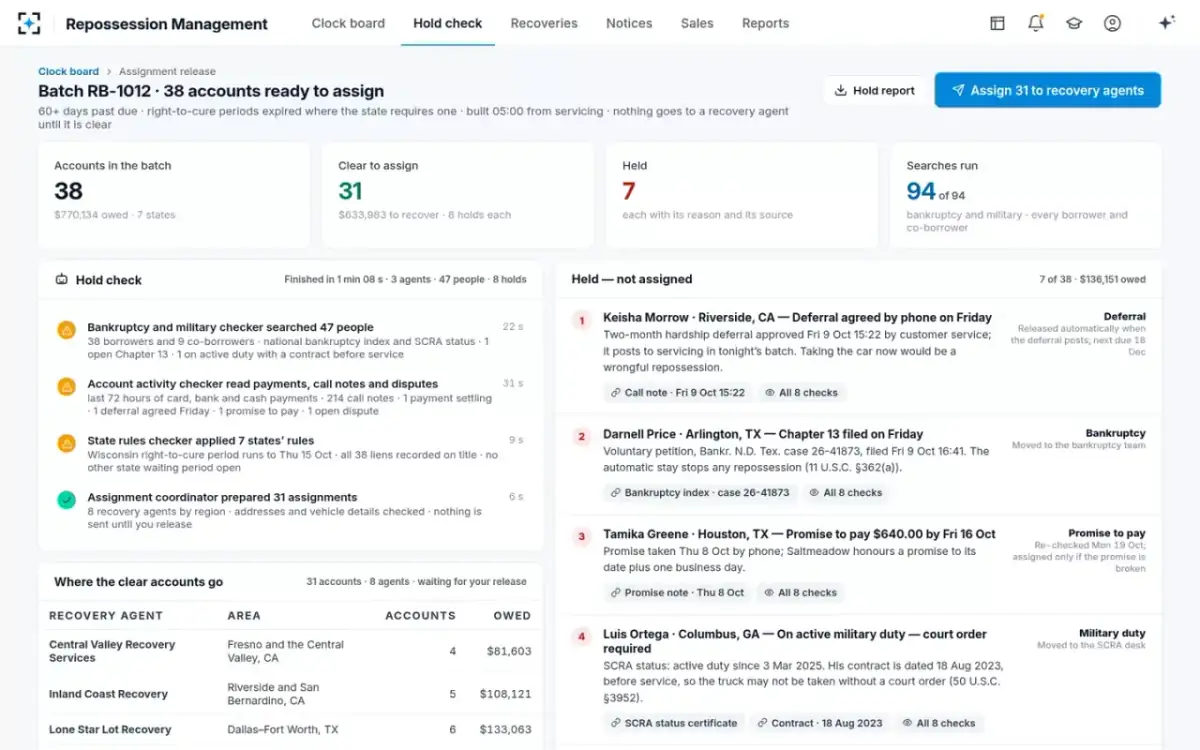
Here is what the asymmetry looks like at the level of a single batch. At the fictional sample lender, thirty-eight accounts in seven states were waiting for assignment at 09:12 on a Monday, with $770,134 owed between them. Three checking agents ran ninety-four bankruptcy and servicemember searches across thirty-eight borrowers and nine co-borrowers, read 214 call notes and seventy-two hours of payments, and applied seven states' rules. The batch took one minute and eight seconds. Thirty-one accounts cleared; seven were held.
The account as the servicing system had it: Clear on Sunday night’s servicemember data; truck booked for the 10:00 run
The account as the hold check found it: Active duty from this morning, Army Reserve orders; contract predates service, so no taking without a court order
The account as the servicing system had it: Still shows 60 days past due — the deferral has not posted
The account as the hold check found it: Held on the call note itself, timed at 15:22 Friday, before anything posts anywhere
The account as the servicing system had it: No filing on the index when the batch was built
The account as the hold check found it: Petition on the court index this morning; the stay runs from filing, not from notice
The account as the servicing system had it: Not yet settled, so not yet visible on the balance
The account as the hold check found it: Held as a payment in flight inside the 72-hour window
The account as the servicing system had it: Eligible by days past due
The account as the hold check found it: Held: the state’s cure period is still running
The account as the servicing system had it: Still live with the agency
The account as the hold check found it: Suspended by the 05:30 re-check after a Chapter 7 filing on Saturday, and the agency told
Six of those seven holds depended on something that happened after the batch was built — a weekend filing, a Friday afternoon phone call, a card payment still settling, orders signed this morning. That is the practical case for re-checking rather than checking.
Thirty-eight accounts, eight holds each, in sixty-eight seconds
What a live assignment should be re-tested against
If an assignment is an instruction that outlives the facts it rested on, the control is to re-establish the facts on a schedule and before the irreversible moment. In practice that means three tests rather than one: the batch test when the account is first put forward, a standing re-test of every open assignment, and a final test close enough to dispatch that nothing can change in between.
The sample lender runs the second nightly at 05:30 and the third fifteen minutes before each release, on a servicemember certificate under two hours old. Those numbers are its own policy, not a rule anyone published — the rule is only that the facts must be current, and the lender decides what current means. What the schedule has to cover is the set of facts that can change: a bankruptcy filing, an active-duty start, a payment in flight, a deferral or extension agreed anywhere in the business, a promise to pay inside its window, a state cure period, an open dispute, and whether the lien is recorded at all. That last one is not hypothetical — examiners have found servicers that "did not verify that they had a valid lien" when assigning vehicles and consequently repossessed cars from people who had never been their customers.
The assignment file is the one examiners read
There is a quiet asymmetry in how this work is reviewed. A lender's repossession file is tidy by construction: it has a notice, a sale, a balance and a letter, because the law demands each of them. The assignment file has none of that unless the lender built it.
What a reviewer looks for in it is short. For every assignment: what the account looked like when it was sent, every re-test run against it and what each one returned, every instruction sent to the agency and the acknowledgement that came back, and the reason it closed. For every cancellation: the time it was sent, the route, the time it was acknowledged, and what happened if it was not. That record is also the only way to answer the question an examiner actually asks — not "did you have a policy" but "show me the one that went wrong". Where it did go wrong, and how a lender proves it has closed the gap, is the subject of what the balance looks like afterwards and of the state rules in the four layers that decide one case.
Questions people ask
What is a repossession assignment date?
It is the date the lender told an agency or forwarder that the vehicle could be recovered, and it is the clock most operational measures run from: days to recovery, days an order has been open, and the age of the facts the assignment rested on. It is not a legal date — it appears nowhere in Article 9 — but it is the date a reviewer will ask about first, because it fixes the moment after which everything that changed on the account needed to reach a third party.
What happens when a repossession is cancelled?
The instruction is withdrawn, and the agency should stop looking and confirm that it has. In the lender's own records the account returns to the collections or hardship path that caused the cancellation. The risk is entirely in the gap: between the cancellation being sent and being acted on, the car can still be taken, and a repossession that happens after a cancellation the agency never confirmed has been treated by examiners as an unfair practice rather than an honest mistake.
How long does a repo agent look for a car?
In the Bureau's data, completions averaged between 15.9 and 23.1 days from assignment depending on credit tier, and about 96 percent of completions happened within three months. How long an agency continues beyond that is a contractual matter — some orders are closed after a set period, some are left open indefinitely. An order left open indefinitely is also a lender obligation left open indefinitely, which is a good reason to set a close-out period deliberately rather than by default.
What is a voluntary surrender, and does it count as a repossession?
It is where the borrower hands the car over rather than having it taken, usually after falling behind or after being told the car is subject to repossession. It counts as a completed repossession in the data and in the process that follows: the car is still sold, the notice is still required, and any balance is still owed. Voluntary surrenders ran between 15 and 19 percent of completed repossessions in 2018 and 2019 and settled around 10 percent through 2021 and 2022.
Can a lender assign the same account to repossession more than once?
Yes, and it is common. In the Bureau's dataset only 54 percent of accounts assigned to repossession were assigned exactly once, so close to half were assigned again after an earlier order ended. Repeat assignment is why "has this account ever been assigned" is a much weaker question than "is there a live assignment on this account right now", and why the controls have to work on the open population rather than on a history.
Does an assignment mean the car will definitely be taken?
No. An assignment means the account was eligible when the instruction went out. In the largest public dataset roughly three in four assignments did not end in a recovery, and of the ones that did, close to a third of the cars went back to the borrower before sale. A borrower who has been told their account has been assigned still has every one of the routes that would have stopped it — paying, agreeing an arrangement, or any protection that forbids the taking outright.