A notice of disposition of collateral is the letter a lender must send before it sells a repossessed car, and the law is unusually specific about it: five contents in any secured transaction, four more when the collateral is consumer goods, a named set of people who must each receive one, and two statutory forms that are sufficient if they are completed to the letter. The thing the law is vague about is timing, and only for consumers. Repossession Management, the Botminds agentic solution for auto lenders, drafts each notice from the account itself — the amounts worked out from the contract and the balance, the dates from the borrower's state and the lender's own policy — and checks every required content against the state's rules before the recovery manager signs.
The reason to take the document this seriously is in section 9-626: when a borrower puts the lender's compliance in issue, the lender has to prove it, and a presumption runs against it if it cannot. The examples below come from a fictional sample lender, Saltmeadow Auto Finance, and the law from the statutes, linked where it appears.
What the notice has to carry, and what it buys the borrower
5
contents required in any transaction, under the general rule
+4
further contents when the collateral is consumer goods, such as a car bought for personal use
22–29%
of completed repossessions were redeemed before sale in the years to 2020, rising above 30% through 2021
What a notice of disposition of collateral is, and when it has to go
Section 9-611 states the duty in a sentence: a secured party that disposes of collateral "shall send to the persons specified in subsection (c) a reasonable authenticated notification of disposition" (UCC §9-611). Two words in it do work. Authenticated means signed or otherwise adopted, which is why these letters carry a named signatory rather than a department. Send means dispatched, not received — the obligation is discharged by sending it properly, which is why the mailing record matters as much as the letter.
Subsection (c) names who gets one: the debtor, and "any secondary obligor". On a car loan the secondary obligor is the co-signer, and missing them is one of the two most common defects, because a servicing system often treats a co-signer as an address rather than as a party. In a non-consumer deal the list extends to other secured parties who have filed or given notice of their interest; in a consumer-goods deal it stops at the debtor and the secondary obligor.
There is one narrow exemption. Subsection (d) switches the duty off where the collateral "is perishable or threatens to decline speedily in value or is of a type customarily sold on a recognized market". A used car is not any of those: a wholesale auction is not a recognised market in the statute's sense, because each car is a distinct item that has to be appraised rather than a fungible unit with a published price.
The five contents every notice needs
Section 9-613 sets the general list, and it is short enough to check line by line. The contents are sufficient if the notification describes the debtor and the secured party, describes the collateral, states the method of intended disposition, states that the debtor is entitled to an accounting of the unpaid indebtedness and the charge for one, and states the time and place of a public disposition or the time after which any other disposition is to be made (as enacted at RCW 62A.9A-613).
Three forgiving rules travel with it, and they are worth knowing before anyone redrafts a template. A notice that lacks one of the five is not automatically bad: "whether the contents … are nevertheless sufficient is a question of fact". Extra information does not spoil it, nor do "minor errors that are not seriously misleading". And "a particular phrasing of the notification is not required" — there is no magic wording, only required substance.
The four extra contents in a consumer deal
When the collateral is consumer goods the list grows and the forgiveness shrinks. Section 9-614 requires all five general contents, plus "a description of any liability for a deficiency of the person to which the notification is sent", "a telephone number from which the amount that must be paid to the secured party to redeem the collateral under Section 9-623 is available", and "a telephone number or mailing address from which additional information concerning the disposition and the obligation secured is available" (UCC §9-614).
The nine required contents, and the section each one comes from
| What it says | In the statute’s words | Applies to | Section |
|---|---|---|---|
| Who the parties are | Describes the debtor and the secured party | General | §9-613(1)(A) |
| What is being sold | Describes the collateral that is the subject of the intended disposition | General | §9-613(1)(B) |
| How it will be sold | States the method of intended disposition — public or private | General | §9-613(1)(C) |
| The right to an accounting | States that the debtor is entitled to an accounting of the unpaid indebtedness, and the charge for one | General | §9-613(1)(D) |
| When | The time and place of a public sale, or the time after which a private sale may be made | General | §9-613(1)(E) |
| Who else owes | A description of any liability for a deficiency of the person the notice is sent to | Consumer goods | §9-614(1)(B) |
| How to get the car back | A telephone number from which the redemption amount is available | Consumer goods | §9-614(1)(C) |
| Where to ask | A telephone number or address for more about the sale and the obligation | Consumer goods | §9-614(1)(D) |
| Everything above | The consumer notice must also carry all five of the general contents | Consumer goods | §9-614(1)(A) |
The telephone number for the redemption figure is the line most templates get wrong, and it is wrong in an interesting way: it is a number, not an amount. The statute does not ask the lender to print the redemption figure in the letter, because the figure moves with storage and interest. It asks the lender to publish a way of getting today's figure. A notice that prints a stale amount and no number has given the borrower less than the law requires, not more.
What is a notice of our plan to sell property?
It is the statutory safe-harbour form for a consumer-goods notice, reproduced in section 9-614(3) and enacted in each state. Completed in accordance with the instructions, it "provides sufficient information" — which is as close to certainty as this area gets. Its plain language is deliberate: "We have your (describe collateral), because you broke promises in our agreement."
The safe-harbour consumer form, marked up
NOTICE OF OUR PLAN TO SELL PROPERTY
Public sale. "We will sell (describe collateral) at public sale … You may attend the sale and bring bidders if you want." Date, time and place all stated.
Private sale. "We will sell (describe collateral) at private sale sometime after (date)." One of {1} or {2} — not both.
The deficiency warning. "If we get less money than you owe, you (will or will not, as applicable) still owe us the difference. If we get more money than you owe, you will get the extra money."
Redemption. "You can get the property back at any time before we sell it by paying us the full amount you owe, not just the past due payments, including our expenses." Then the telephone number for the exact figure.
The right to an explanation. How to ask for a written explanation of how the amount owed was figured, and by what route.
The charge, if any, for a second written explanation inside six months.
Where to ask for more information about the sale.
Everyone else who gets a copy — "the following other people who have an interest in (describe collateral) or who owe money under your agreement".
Item {10} is the co-signer line, and it is the second of the two common defects. The form asks the lender to list the other people being notified, which means a lender that has not worked out who they are cannot complete the form correctly.
What must a notice of disposition contain when a state adds to the list?
Several states add contents, add a second notice, or add a right the notice has to describe. Virginia's title-loan chapter requires a notice at least fifteen days before sale which must itself carry "a written accounting of the redemption amount", defined as principal, interest accrued to the date of possession, and reasonable expenses of taking, preparing and selling (Va. Code §6.2-2217). A lender using a single national template there will send a compliant Article 9 notice and still be short of the state's requirement.
The other common overlay sits before the repossession rather than before the sale. Iowa's notice of right to cure has its own prescribed contents — the creditor's name, address and telephone number, a brief identification of the transaction, "a statement of the nature of the right to cure the default", the total payment needed, and "the exact date by which the amount must be paid" — and the statute prints a model form (Iowa Code §537.5111). That notice is a different document with a different trigger, and the two are frequently confused because both are "the repossession letter" in ordinary speech. The layer each one belongs to is set out in the four layers that decide one case.
How many days notice before selling a repossessed car?
On a consumer car loan, the honest answer is that no number is guaranteed. Section 9-612 makes timeliness "a question of fact", and then gives a safe harbour that expressly excludes consumers: "In a transaction other than a consumer transaction, a notification of disposition sent after default and 10 days or more before the earliest time of disposition set forth in the notification is sent within a reasonable time before the disposition" (UCC §9-612).
Ten days is therefore a sensible minimum and not a defence. Most lenders set a longer internal standard, and many states set their own floor. The practical rule a recovery team can work to is: the earliest sale date on the notice is the later of the state's minimum and the lender's own policy, and the mail-by date is the earlier of the state's deadline and the lender's own policy. That is two different directions for two different numbers, which is exactly the kind of arithmetic that goes wrong on a spreadsheet and does not go wrong when it is computed per account.
One recovered vehicle, from the hook to the explanation
- Recovery to notice mailed · 3 business days3 d
- Notice to earliest sale · at least 10 days15 d
- Sale to the explanation of the balance13 d
- Open from the moment of recovery18 d
- Closed — §9-623(c)closed
What is the difference between redemption and reinstatement?
Redemption is a right every state gives, and it is expensive. Under section 9-623 a debtor, a secondary obligor or another lienholder may redeem the car by tendering "fulfillment of all obligations secured by the collateral" plus the lender's reasonable expenses and attorney's fees, and the right dies once the lender has disposed of the car or "entered into a contract for its disposition" (UCC §9-623). Redeeming means paying the loan off, not catching up.
Reinstatement is cheaper and is not in Article 9 at all. It is a right some states give by statute, and some lenders give by contract or by policy: pay the arrears, the late charges and the costs of the repossession, and the contract continues as though the default had not happened. Where a state gives it, the notice usually has to describe it, and the amount has to be itemised. Where no state statute gives it, offering it is a commercial decision.
The distinction matters at the counter. A borrower who asks "what do I have to pay to get my car back" is usually asking about reinstatement and will be quoted redemption if the desk does not know the difference. On the fictional sample lender's file the two numbers were $2,978.60 and $28,444.38 — three missed instalments, late charges, the repossession fee and three days' storage, against the whole balance. The data suggests borrowers act fast when they act at all: more than ninety-five percent of redemptions in the Bureau's sample happened within thirty days of the repossession being completed.
What happens when the notice is wrong
Three consequences stack, and they get worse in that order. The first is the accounting one: section 9-626 says a lender "need not prove compliance … unless the debtor or a secondary obligor places the secured party's compliance in issue", but once it is in issue and the lender cannot prove it, the amount the sale would have realised "is equal to the sum of the secured obligation, expenses, and attorney's fees unless the secured party proves that the amount is less than that sum" (UCC §9-626). The deficiency is presumed to be nothing.
The second is that section 9-626 by its own terms applies to transactions other than consumer transactions, and the official position is that the consumer rule "is intended to leave to the court the determination of the proper rules in consumer transactions". Some courts apply the same rebuttable presumption; others bar the deficiency outright. A lender with a defective notice in a consumer deal does not know which rule it is under until it is there.
The third is statutory damages. Section 9-625(c)(2) provides that where the collateral is consumer goods the debtor or secondary obligor may recover "in any event an amount not less than the credit service charge plus 10 percent of the principal amount of the obligation" (UCC §9-625). That figure is calculated from the loan, not from the loss, so it does not shrink because the borrower was not harmed. What that does to the balance is worked through in the six lines that make the number.
One further document follows the sale and is often forgotten: section 9-616 requires an explanation of how the surplus or deficiency was calculated, with its own contents and its own clock — before or when the lender first demands the deficiency, and "within 14 days after receipt of a request" (UCC §9-616).
How the notice gets written here
The argument of this page is that a notice assembled by hand from a template, a spreadsheet of dates and a balance screen will be right most of the time and wrong in the ways that cost most: a missing co-signer, a stale redemption amount, a date computed from the wrong of two rules. All three are arithmetic, and arithmetic is the part a system should do.
A notice drafted from the account, with every required content checked
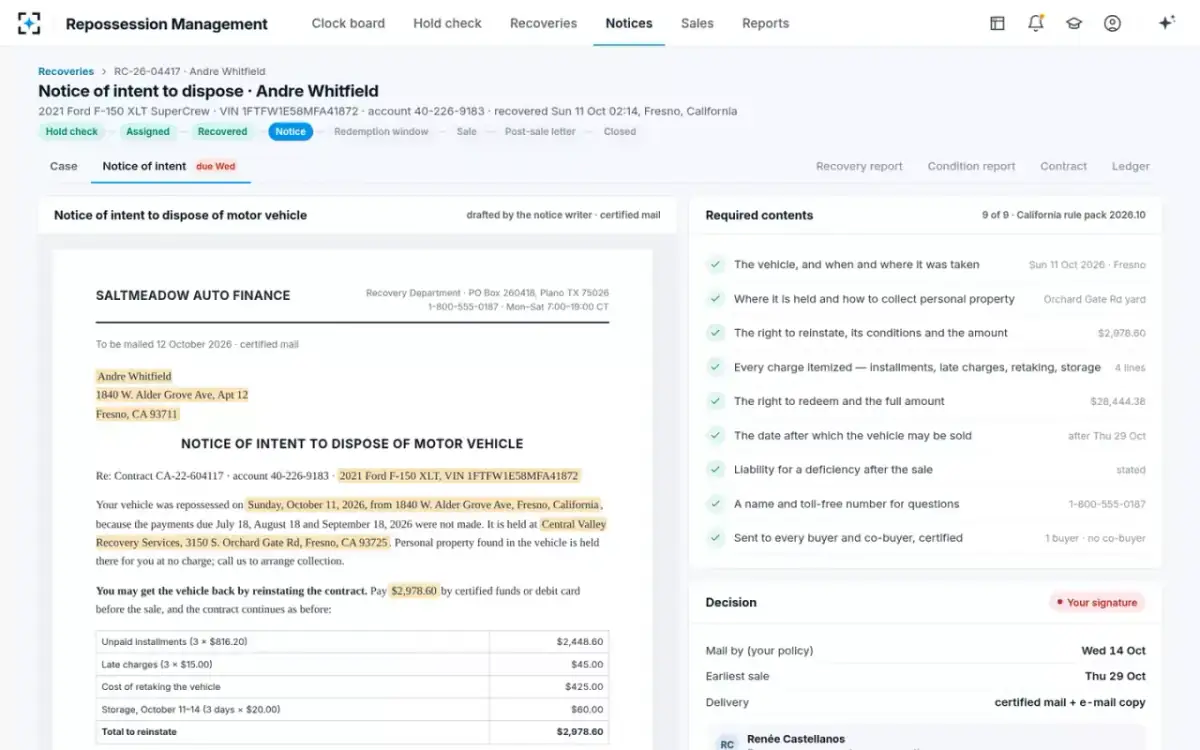
Nine checks before a post-repossession notice is signed
- Every party is on the list, including every co-signer.
§9-611(c) names the debtor and any secondary obligor. Missing a co-signer is a defect, not an omission.
- The car is described well enough to be identified.
Year, make, model and vehicle identification number, matching the contract.
- The method of sale is stated, and only one method.
Public or private. The safe-harbour form uses one of two paragraphs, never both.
- The date is right in the right direction.
Earliest sale is the later of the state minimum and your policy; mail-by is the earlier of the state deadline and your policy.
- The redemption telephone number is there, and answers.
§9-614(1)(C) requires a number from which the figure is available, not a printed figure.
- Deficiency liability is described, and matches the state.
In Virginia’s title-loan chapter there is no personal judgment for a deficiency at all.
- The reinstatement itemisation adds up to the figure quoted.
Instalments, late charges, repossession costs and storage, each traceable to the account.
- The accounting right and the explanation route are stated.
§9-613(1)(D), and items {5} to {7} of the consumer form.
- The mailing is evidenced.
Sending discharges the duty, so the proof of sending is the proof of compliance.
Done that way the notice stops being a letter somebody writes and becomes a reading of the account, which is also what makes it defensible: every figure on the page can be traced back to the line it came from, and the version of the state's rules it was checked against is recorded beside it.
Questions people ask
Does a notice of disposition have to be sent by certified mail?
Article 9 does not require certified mail. It requires that a reasonable authenticated notification be sent, and reasonableness of the manner is judged on the facts. Certified mail is common because it produces evidence of sending, which is what the lender has to prove if compliance is put in issue; many lenders send certified plus an ordinary copy or an email copy for speed. Some state statutes do specify a method, so the contract and the state chapter both need reading.
Who else has to get a notice of disposition?
In a consumer-goods transaction, the debtor and any secondary obligor — in practice the borrower and the co-signer. In other transactions the list extends to anyone who has notified the lender of a claim of interest, any other secured party with a financing statement filed against the debtor's name covering the collateral ten days before notification, and anyone with a security interest perfected by statute. The consumer list is shorter, which is why missing a co-signer is so often the only defect in an otherwise careful file.
What happens if the notice of disposition is defective?
The lender loses the easy path to its deficiency. Once compliance is put in issue the lender must prove it, and if it cannot, the proceeds a compliant sale would have produced are presumed equal to the whole obligation plus expenses and fees — leaving nothing to collect. In consumer transactions the governing rule is left to the courts, and some bar the deficiency entirely. Separately, where the collateral is consumer goods, statutory damages of the finance charge plus ten percent of principal are available whatever the actual loss.
Can the notice be sent before the car is repossessed?
It can, and in some structures it must. Article 9's notice relates to the sale, not the taking, so it can be sent any time after default that leaves a reasonable period before disposal. Where a state requires a pre-repossession notice — a right-to-cure notice, or Virginia's ten-day title-loan notice — that is a separate document with separate contents, and sending one does not satisfy the other.
Does a voluntary surrender change what the notice must say?
No. A voluntary surrender changes how the car was obtained, not what happens next: the lender still intends to dispose of collateral, so sections 9-611 to 9-614 apply in full, the redemption right under section 9-623 is still open until the sale, and the explanation of the balance under section 9-616 is still owed. Surrender is also not an acceptance of the car in satisfaction of the debt unless the lender agrees to that in writing.
How long does the lender have before it must sell the car?
Article 9 sets no deadline for selling, only a standard: every aspect of the disposition must be commercially reasonable. Delay is not free, though, because storage accrues and the car depreciates, and both affect the balance the borrower is left with. In practice the shape of the timetable is set at the front — recovery, notice, the earliest permitted sale — and the useful control is measuring the days between those events rather than the days to sale alone.