Repossession software is the system that runs a vehicle recovery from the decision to assign it through to the letter after the sale: clearing the legal holds before an account goes to an agency, keeping the instruction honest while the car is out, and then running the state's notice clock, the redemption window, the sale and the explanation of whatever balance is left. Everything useful it does rests on eight inputs a lender already has, plus one document most lenders have never written down — a hold policy with the source named for every hold. Repossession Management, the Botminds agentic solution for auto lenders, is no exception, and this page is written as a buyer's guide rather than a brochure: what to load, what to keep, what to ask, and what a pilot has to be allowed to do before the answer means anything.
It is also written with one thing deliberately left out: no competitor is named, and no implementation duration here is a measurement. Nobody publishes one, including us. What is published — the federal data on repossession assignments, and the supervisory expectations this software exists to make satisfiable — is cited where it is used.
The eight inputs, and what each one is for
- The servicing system
The account, the contract and the payment history — and the eligible population each morning. This is the only input most vendors ask about, and on its own it is the one that produces stale-delinquency errors.
- The payment processors
Card, bank and cash-network payments that have been made but not posted. Without them the system cannot tell the difference between a borrower who has not paid and one whose payment is still settling.
- Call notes and arrangements
Deferrals, extensions, promises to pay, disputes and cancellation requests, wherever the business records them. A deferral agreed at 15:22 on Friday is a hold at 15:22, not when it posts.
- The bankruptcy index
Searched for the borrower and every co-borrower, with the result kept. The stay runs from filing, so a daily search is a control and an inbox is not.
- The servicemember status service
A certificate per borrower, with the active-duty start comparable against the contract date. This one has a criminal sanction behind it; freshness is not a preference.
- The agency or forwarder channel
Assignments out, cancellations out, and back again: acknowledgements, recovery and condition reports, and property inventories. The return leg is the half most lenders cannot evidence.
- State rules and title records
Cure periods, notice types, mailing deadlines, earliest sale dates — and whether your lien is actually recorded against the vehicle you are about to take.
- Letters and certified mail
Your own letterhead and templates, and the mailing channel with its proof. A notice the lender cannot prove it sent is a notice it did not send.
What repossession software is, and what it is not
It is three things joined together, and most products on the market are strong at one of them. The first is a hold engine: the set of tests that decide whether an account may be assigned this morning, run against the facts as they are at that minute. The second is an assignment channel: the traffic to and from the agencies and forwarders, including the cancellations and the reports that come back. The third is a clock and letter engine: the state's notice type, its deadline, the earliest sale date, the amounts to reinstate and redeem, and the explanation after the sale.
It is not a collections platform, and it is not a dialler. It is not an auction system, though it has to receive the sale result. And — the distinction that matters most in a demonstration — it is not a decision-maker. A lender buying this category is buying continuous checking, reliable messaging and accurate drafting, and keeping every decision that has a legal consequence. Where exactly that line falls is set out in what a person must sign.
What it exists to make possible is also written down, in the supervisory expectations published for this work. Firms are asked to "monitor repossession service providers for compliance with repossession cancellations", to "incorporate monitoring of wrongful repossession in regular monitoring and audits of communications with consumers", to "monitor for illegal fees charged after repossession", and to have a corrective action programme to address violations and "to reimburse consumers for the direct and indirect costs incurred as a result of unlawful repossessions when appropriate" (Bulletin 2022-04, withdrawn on 12 May 2025 pending review). Every one of those is a monitoring obligation, and monitoring obligations are what distinguish this software from a work queue.
The eight inputs it runs on
The checklist above is the shopping list; what follows is the part that decides how long it takes. Six of the eight are reads, and reads are easy. Two are harder, and both of them are where projects slip.
The first hard one is call notes. Most lenders keep arrangements in three or four places — the collections platform, a hardship team's own system, a complaints log, sometimes free text in the servicing record — and the promise that matters is as likely to be in the one nobody listed. The question to answer before a project starts is not "can you read our notes" but "where, in this business, can a borrower be told something that should stop a repossession?"
The second is the agency channel, because it is the only two-way input. Sending an assignment is trivial. Receiving an acknowledgement, a condition report and a property inventory in a form a system can act on is a vendor-management exercise, not an integration, and it is worth starting before the software is chosen. The intermediary most lenders now use makes this both easier and more fragile at once: forwarder use among completed recoveries in the federal dataset rose from 55 percent in August 2020 to 69 percent in October 2022 (CFPB, Repossession in Auto Finance, January 2025), and each hop is a place a cancellation can stop.
The one document most lenders have to write first
A written hold policy, with the source named for every hold and a freshness rule attached to each. Not a list of risks — a list of tests, each of which is either true or false about an account at a moment in time, and each of which says where the fact is read from.
Most lenders discover during a selection that they have the policy in three incompatible forms: a paragraph in a procedures document, a set of conditions buried in a servicing system's rules, and the practice of whoever has worked the morning batch for nine years. Writing the single version is uncomfortable and is also the whole project. It takes a day with the head of collections, the compliance reviewer and the person who actually runs the batch, and it produces answers to questions like: how old may a servicemember certificate be at the moment of release? Does a promise to pay hold the account to its date, or to its date plus a grace period? Does a disputed balance hold the account, and whose dispute counts?
The reason to write it before buying rather than during implementation is that it is the specification. A vendor that offers to write it for you is offering to decide your risk appetite, and a vendor that does not ask for it is planning to ship its own defaults.
What data does repossession software need from the servicing system?
Less than people expect, and more precisely than they expect. Six things: the account and its contract terms, the full payment history with posting and settlement times, the current delinquency inputs rather than the delinquency status field, the borrower and every co-borrower with the identity details a search needs, the vehicle with its identification number and title position, and the arrangements in force.
The emphasis on inputs rather than the status field is the one technical point worth arguing about in a selection. A days-past-due field is usually written by an overnight process; a system that reads it inherits every lag in that process, and stale delinquency is the first of the causes examiners have repeatedly found behind wrongful repossessions. A system that recomputes days past due from the payments themselves — including the ones still settling — will sometimes disagree with the servicing system, and those disagreements are the point.
After the recovery the data flow reverses: the software produces the notice contents, the amount to reinstate, the amount required to redeem, and later the sale proceeds and the balance. Article 9 fixes what a consumer notice must carry, including a telephone number the borrower can call for the redemption figure (UCC §9-614), so the figures have to be defensible line by line rather than approximate. The notice's contents are worked through in every line the law makes you write.
Rules you keep, decisions you keep
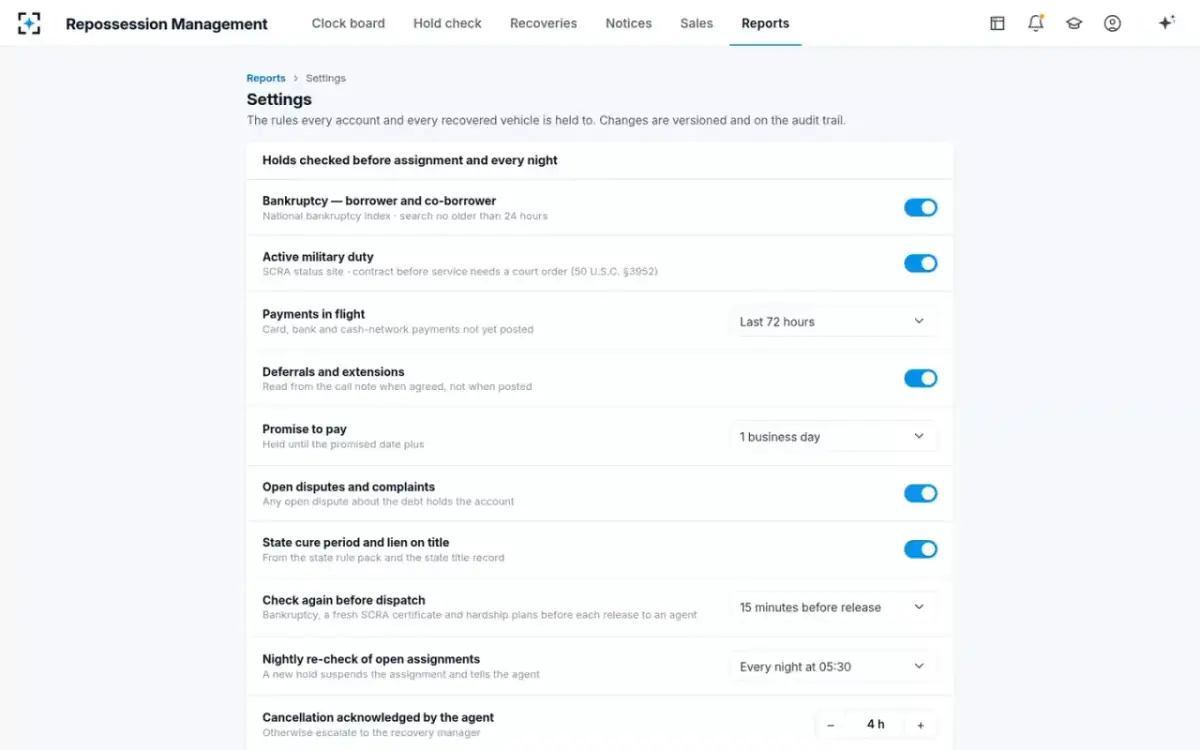
The rules are yours and should be visible as values, not buried as behaviour: each hold and its window, the pre-dispatch and overnight re-checks, the cancellation acknowledgement limit, the mailing policy, the earliest sale rule, how personal property is handled and who approves what. A rule you cannot see is a rule you cannot show an examiner you were following on a particular Monday.
State law sets the floors those settings sit on, and the floors differ: Iowa, for example, bars enforcement until twenty days after a proper notice of the right to cure (Iowa Code §537.5110). A lender's policy can be stricter than a state's rule and never looser, which means every date the software produces is the stricter of the two — and that the software has to hold both.
Every rule a value, every change dated
How long does repossession software take to implement?
Nobody can honestly tell you, including us, and any number offered without seeing your inputs is a sales figure. What can be said is what the time is spent on, and in what order, because that determines whether the answer is weeks or quarters.
The variable is almost never the software. It is the second and third items on the input list: where arrangements are recorded, and what your agencies and forwarders can send back. A lender whose call notes are in one place and whose agencies already return structured reports is a different project from a lender with four note systems and a forwarder that sends PDFs. The honest sequence is: write the hold policy, inventory the eight inputs and name an owner for each, load the ones that are reads, replay history, and only then run live in parallel.
A pilot shaped so that it can fail: four weeks, as we would run one
- Load the reads and the state rules for your lending statesweek 1
- Replay a full quarter of closed assignments, point-in-timeweek 2
- Read the disagreements with compliance, both directionsweek 3
- Run alongside the live batch without releasing anythingweek 4
What an honest pilot looks like
It re-runs your closed assignments and is allowed to be wrong in public. That is the whole test, and it is the single thing that separates a pilot from a demonstration.
A demonstration on the vendor's data: Sample accounts shaped by the vendor, where every hold fires neatly
A pilot on yours: A full quarter of your own closed assignments, including the messy ones
A demonstration on the vendor's data: Today's database, in which every fact has long since arrived
A pilot on yours: Each source frozen as it stood at the release minute — no field as it reads now
A demonstration on the vendor's data: The number of holds the system raised
A pilot on yours: Holds it raises that your desk did not, and holds your desk raised that it would not
A demonstration on the vendor's data: The room, during the session
A pilot on yours: The compliance reviewer, afterwards, with the records behind each disagreement
A demonstration on the vendor's data: There is no failure condition
A pilot on yours: A disagreement that turns out to be wrong — and is written down as such
A demonstration on the vendor's data: Nothing
A pilot on yours: Where your arrangements are recorded, how stale your delinquency field runs, and which agencies confirm
Two further conditions make the result worth having. The federal holds are reported separately and not as a percentage: one missed bankruptcy filing or active-duty start is the finding, not a rounding error. And a disagreement that is traced to a fact that arrived after the release is filed differently from one traced to a fact that was already there — the first is an argument for re-checking, the second an argument about the test. The full protocol is set out in the three causes, and how to close them.
Who has to be in the room in week one, and what each one brings
Today
Owns the practice: the eligibility rule, the release decision and whatever the batch has always done.
With agents
Writes the hold policy down and decides each window, because the pilot has no defaults she has not chosen.
Still theirs: The release decision, every batch
Today
Samples notices and assignments after the fact, finding the one mailed late.
With agents
Reads the replay disagreements and decides which are defects — before anything runs live.
Still theirs: The second signature on any override
Today
Knows where the payment, arrangement and delinquency data actually lives, including the exceptions.
With agents
Names an owner and a read path for each of the eight inputs, and flags the fields that are written overnight.
Still theirs: The source of truth for the account
Today
Holds the agency and forwarder contracts and the invoices behind them.
With agents
Gets acknowledgements, condition reports and property inventories into a form a system can act on.
Still theirs: The agency relationships
Today
Agrees a deferral at three in the afternoon and hopes recovery sees it in time.
With agents
Says where every promise a borrower is given gets recorded — the input most projects miss.
Still theirs: The conversation with the borrower
Nine questions to ask before you buy
Each of these has a good answer and a bad one, and the bad ones are specific rather than evasive — that is what makes them useful in a room.
| Ask | What a good answer sounds like | What should worry you |
|---|---|---|
| How do you decide an account is delinquent? | We recompute days past due from posted and in-flight payments at the moment of the check | We read the delinquency status from your servicing system |
| How fresh are the searches when an account clears? | A freshness rule you set per hold, enforced — an account cannot clear on a stale search | We search nightly |
| What happens to an assignment that is already out? | Re-tested on your schedule and again before dispatch; a new hold suspends it and tells the agency the same night | The check happens at assignment |
| When is a cancellation finished? | When the agency confirms it, with a time limit and an escalation by name if it does not | When we send it |
| Can your system override a federal hold? | No, by construction, and we will show you where that is enforced | With the right permission, yes |
| Who sends the notice? | A named person signs; we draft, check the required contents and stop | It goes out automatically once the clock is set |
| Where does a state rule come from, and who checks it? | A rule set your compliance team reviews and versions, with the date each notice was checked against it | Our team keeps it up to date |
| Will you replay our closed assignments, point-in-time? | Yes — a full quarter, reporting disagreements in both directions | We can show you on our sample data |
| What do we get if it goes wrong? | Every search, hold, release, instruction, acknowledgement and signature, with times, in a form you can export | A dashboard |
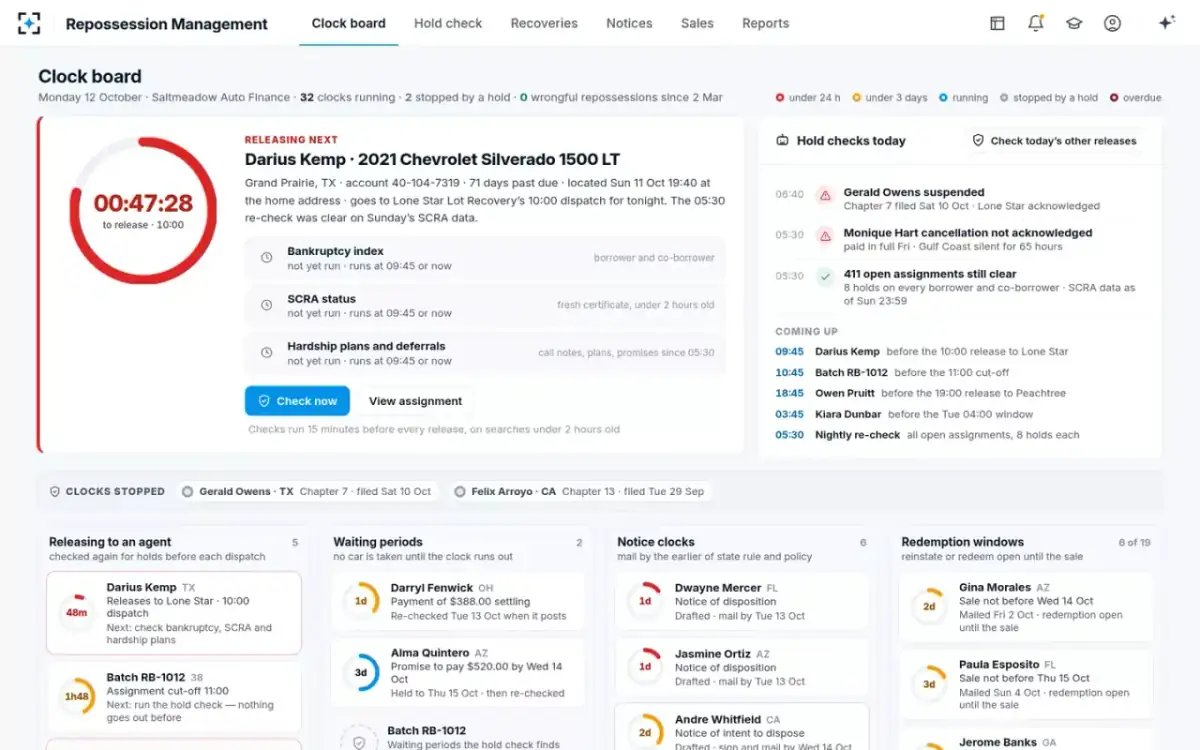
What the first week ends with: every car on one clock
Questions people ask
What does repossession management software do?
It clears the legal holds before an account is assigned, keeps the instruction honest while the car is out, and then runs the state's clock afterwards: the notice and its deadline, the redemption window, the earliest sale date, and the explanation of the deficiency or surplus. Underneath that it does three mechanical things continuously — searching, date arithmetic and drafting — and leaves the release, the overrides, the signature and the demand to named people.
Can repossession software connect to a servicing system?
It has to, and the useful question is what it asks for. A product that wants only the account and the delinquency status is inheriting whatever lag that status carries; a product that wants the payment history with settlement times, the arrangements and the co-borrowers is doing the work that prevents the most common cause of wrongful repossession. The return path matters too: the amounts, the dates and the sale result have to go back somewhere, and the activity trail has to be exportable.
What is a repossession forwarder platform, and is it the same thing?
No. A forwarder is a company that manages agency relationships on a lender's behalf, and its platform is the channel through which assignments and reports travel. Repossession software sits on the lender's side of that channel: it decides whether an account should be assigned at all, holds the ones that should not be, and keeps the lender's own clocks and letters. Most lenders need both, and the join between them — specifically, whether cancellations are confirmed — is where the risk sits.
How do you load state repossession rules?
As a reviewed set, versioned, with each notice recording the version it was checked against — not as a spreadsheet somebody updates when they hear about a change. The practical test is whether your own compliance team can read the rule for a state, see when it was last changed and by whom, and tell which notices went out under which version. Rules also have to combine with your own policy, with the stricter of the two winning on every date.
Is repossession software available free?
Not in any form worth using in a regulated lender. What exists free or cheap is assignment tracking — a way to place orders with agencies and watch their status — which is the easiest third of the problem and the one least likely to cause a finding. The parts that carry the risk are continuous hold checking against live sources, state clocks and letters with their contents checked, and an activity trail that will stand up a year later.
What should you ask a repossession software vendor first?
Whether they will replay a quarter of your own closed assignments against the data as it stood at the time, and report where they disagree with what you did. Everything else about a product in this category can be demonstrated persuasively on somebody else's data; that one exercise cannot. If the answer is yes, the rest of the selection is detail — and if it is no, you have learned what you needed to know in the first meeting.