A deficiency balance after repossession letter is the written explanation UCC 9-616 requires once a repossessed car has been sold: it states what is still owed, or what is owed back, shows the six-line subtraction that produced the figure, and must reach the borrower before or with the lender's first written demand for payment. The lines, in the statute's order, are what was owed, the proceeds of the sale, what was owed after deducting them, the expenses of retaking, holding, preparing and selling (with any attorney's fees the agreement allows), the credits the borrower is entitled to, and the resulting surplus or deficiency. Repossession Management, the Botminds agentic solution for auto lenders, works the six lines from the account itself and drafts the letter from them, so the arithmetic and the letter are produced together rather than reconciled afterwards.
That matters more than it sounds, because almost every way a deficiency becomes uncollectable runs through one of these lines: an expense that was not actually incurred, a credit that was never applied, a sale nobody can show was commercially reasonable, or an explanation that never went. The worked example below is a fictional sample file at Saltmeadow Auto Finance; the market figures come from the Consumer Financial Protection Bureau's auto finance data pilot.
What usually happens to the balance after a repossession sale
94%
of 905,000 disposals in the Bureau’s dataset ended with a deficiency balance
$11,340
mean deficiency balance in December 2022, among accounts that had one
$11,620
median deficiency balance in December 2022 — above the mean, after used-car prices fell
What a deficiency balance after repossession is
Section 9-615(d) of the Uniform Commercial Code states both halves of the outcome in one breath: the secured party "shall account to and pay a debtor for any surplus", and "the obligor is liable for any deficiency" (UCC §9-615). Which of the two a file produces depends on four things the lender controls — the price obtained, the expenses charged, the credits applied and the date the balance is struck — and on nothing else.
It is worth being precise about what a deficiency is not. It is not the difference between the loan balance and the car's book value. It is not an estimate made before the sale, although a sensible lender makes one. And it is not the amount the borrower would have had to pay to get the car back: that is redemption, which under section 9-623 requires fulfilment of the whole obligation plus expenses and dies the moment the lender sells the car or contracts to sell it (UCC §9-623).
How is a deficiency balance calculated? The six lines
Section 9-615(a) sets the order of application, and section 9-616(c) sets the order of explanation; between them they give the six lines. Below they are worked on one sample file, and the file is deliberately one that produced a surplus rather than a deficiency, because surpluses are where the arithmetic is tested hardest.
The six lines, worked on one sample file: a 2019 Camry sold in Dallas
| Line | What goes in it | Amount |
|---|---|---|
| 1. What was owed | Principal, earned interest and any charge the contract allows, as at a date the statute fixes | $17,322.50 |
| 2. The proceeds of the disposition | What the car actually sold for, gross | $18,900.00 |
| 3. What was owed after deducting the proceeds | Line 1 less line 2 — here the sale more than covered the loan | −$1,577.50 |
| 4. Expenses known to the lender | Retaking and holding $655.00 (agency invoice and storage, as incurred); preparing and selling $510.00; attorney’s fees $0.00 | $1,165.00 |
| 5. Credits the borrower is entitled to | Rebates of unearned charges, cancelled add-on products, insurance proceeds not already in line 1 | $0.00 |
| 6. Surplus owed to the borrower | Line 3 plus line 4 less line 5 comes to −$412.50; below zero, it is a surplus the lender pays back | $412.50 |
Change one input and the sign flips. Had the same car sold for $16,000, the file would have produced a deficiency of $2,487.50 and a letter demanding it. That is the whole sensitivity of the exercise: on a typical auto file the expenses are one to two thousand dollars and the gap between a good sale and a poor one is several thousand, so the sale price decides the outcome and the expenses decide whether the outcome survives a challenge.
What may be added, and what may not
The permitted deductions are drawn narrowly. Section 9-615(a)(1) allows "the reasonable expenses of retaking, holding, preparing for disposition, processing, and disposing, and, to the extent provided for by agreement and not prohibited by law, reasonable attorney's fees and legal expenses". Three qualifiers sit in that sentence and each one is a control.
Reasonable excludes a flat fee that bears no relation to what was done. To the extent provided for by agreement means attorney's fees come out only if the contract says so and the state permits it. And not prohibited by law is where state overlays bite: Virginia's title-loan chapter removes the repossession and sale costs altogether where the required ten-day pre-repossession notice was not sent, and bars a personal money judgment for a deficiency unless the borrower damaged, hid or double-pledged the car (Va. Code §6.2-2217).
Two charges show up on files where they do not belong. The first is force-placed insurance premium charged for periods after the repossession, which the coverage no longer covered. The second is a personal-property release fee billed to the borrower — the belongings in the car are a separate matter on a separate clock, and charging to hand them back has been treated as an unfair practice. Both are additions to the deficiency that make the whole balance harder to defend rather than larger.
On the other side of the sum, credits are frequently missed. An early-terminated service contract or a cancelled add-on product usually generates a refund due to the borrower, and the Bureau has reported servicers that failed to credit such refunds, or credited them very late. A credit applied after the demand letter has gone means the demand letter was wrong.
What makes a sale commercially reasonable
Everything in line two rests on the sale standing up. Section 9-610(b) is unusually sweeping: "Every aspect of a disposition of collateral, including the method, manner, time, place, and other terms, must be commercially reasonable" (UCC §9-610). A wholesale auction is the usual route and is usually reasonable, but the standard attaches to every aspect, which in practice means a lender should be able to show where the car was sold, how it was advertised or catalogued, what condition it was in and what was done to it, how many bidders there were, and what comparable cars made at the same venue.
One subsection deserves its own line in a procedure. Where the car is bought by the lender, by someone related to the lender, or by a secondary obligor, section 9-615(f) replaces the actual proceeds in the calculation with the proceeds a compliant sale to an unrelated buyer would have produced, whenever the actual price is significantly below that. Self-purchase at a low price does not reduce what the lender may collect; it only reduces what the lender received.
What must a deficiency balance letter say?
Section 9-616 turns the arithmetic into a document, which the statute calls an explanation of calculation of surplus or deficiency. An explanation is a writing that "states the amount of the surplus or deficiency", explains how the secured party calculated it, states where applicable "that future debits, credits, charges, including additional credit service charges or interest, rebates, and expenses may affect the amount", and gives a telephone number or address for more information (UCC §9-616).
What the explanation has to contain, in the statute’s order
The aggregate amount of obligations secured by the security interest, calculated as of a date no more than 35 days before the lender took the car, and saying so if it reflects a rebate of unearned interest.
The amount of proceeds of the disposition.
The aggregate obligations after deducting those proceeds.
The expenses, including attorney’s fees, known to the lender and relating to the current disposition.
Any credits to which the obligor is entitled.
The amount of the surplus or deficiency, stated as a figure.
Two standing lines: that future debits, credits, charges, rebates and expenses may change the figure; and a telephone number or address for more information.
Two timing rules attach. The explanation must go "before or when the secured party accounts to the debtor and pays any surplus or first makes written demand on the consumer obligor after the disposition for payment of the deficiency", and separately "within 14 days after receipt of a request". A lender whose collections letter goes out before its explanation has inverted the order the statute sets.
What is the average deficiency balance after repossession?
The best public figures come from the Bureau's auto finance data pilot, and they move with used-car prices rather than with lending practice. Among accounts that had a deficiency, the mean rose from a low of $9,897 in July 2018 to $11,201 in March 2020, dipped and recovered through 2020, fell 27 percent from $10,544 in November 2020 to $7,692 by September 2021 as used values climbed, and then rose 47 percent to $11,340 by December 2022 as they fell back. The median followed the same shape, from $9,833 in November 2020 down to $6,660 and back to $11,620.
Mean deficiency balance among accounts with one, at four points in the cycle
A lender reading its own book against those numbers should compare like with like. The Bureau's figures are means among accounts that had a deficiency, not across all disposals, and 94 percent of disposals in that dataset had one. A portfolio with a materially lower share is either selling better or crediting more — and the second of those is worth confirming rather than assuming.
What a surplus looks like, and why it is rarer than it sounds
Six percent of the disposals in the Bureau's data produced no deficiency, and only some of those produced a surplus the lender had to pay back. When one appears, the obligation is unambiguous: the lender "shall account to and pay a debtor for any surplus". The explanation has to go at the same time, not afterwards, and the refund is owed whether or not the borrower asks.
Surpluses are rare because of negative equity rather than because of poor sales: a loan written above the car's value, on a long term, meets a depreciated car at the moment of default. They become commoner when used values rise sharply, which is also when the risk of a careless lender simply keeping one is highest. The practical control is that a surplus and a deficiency are the same calculation with a different sign, so a process that can only produce demand letters will quietly mishandle every surplus it creates.
When the deficiency becomes uncollectable
Three failures take the balance off the table, and none of them is about the arithmetic being wrong.
The amount of proceeds that would have been realized is equal to the sum of the secured obligation, expenses, and attorney's fees unless the secured party proves that the amount is less than that sum.
UCC §9-626(a)(4)
The first is the notice. Once a borrower puts compliance in issue, the lender must prove it complied, and if it cannot, the presumption above applies: the sale is treated as having realised the entire balance plus costs, and there is nothing left to collect. The contents that have to be proved are set out in every line the law makes you write.
The second is the sale. The same presumption applies where the lender cannot show the disposition was commercially reasonable — and note that the burden is on the lender once the issue is raised, which is why the evidence has to be gathered at the time rather than assembled later.
The third is the consumer carve-out. Section 9-626 applies by its terms to transactions other than consumer transactions, and the drafters left the consumer rule to the courts. Some adopt the same rebuttable presumption; others apply an absolute bar, under which a lender that failed on notice or on the sale recovers no deficiency at all regardless of what a compliant sale would have produced. On top of either outcome, section 9-625(c)(2) gives a consumer-goods debtor "an amount not less than the credit service charge plus 10 percent of the principal amount of the obligation" (UCC §9-625) — computed from the loan, so it does not shrink because the borrower lost nothing.
Doing the sum and the letter as one job
Read together, the sections describe a single piece of work: strike the balance at the right date, apply only expenses actually incurred, apply every credit due, test the sale, and explain all of it in a letter that goes before the demand. Splitting that across a recoveries spreadsheet, an auction report and a letter template is what produces files where the letter says one thing and the account says another.
The balance worked line by line, and the letter drafted from it
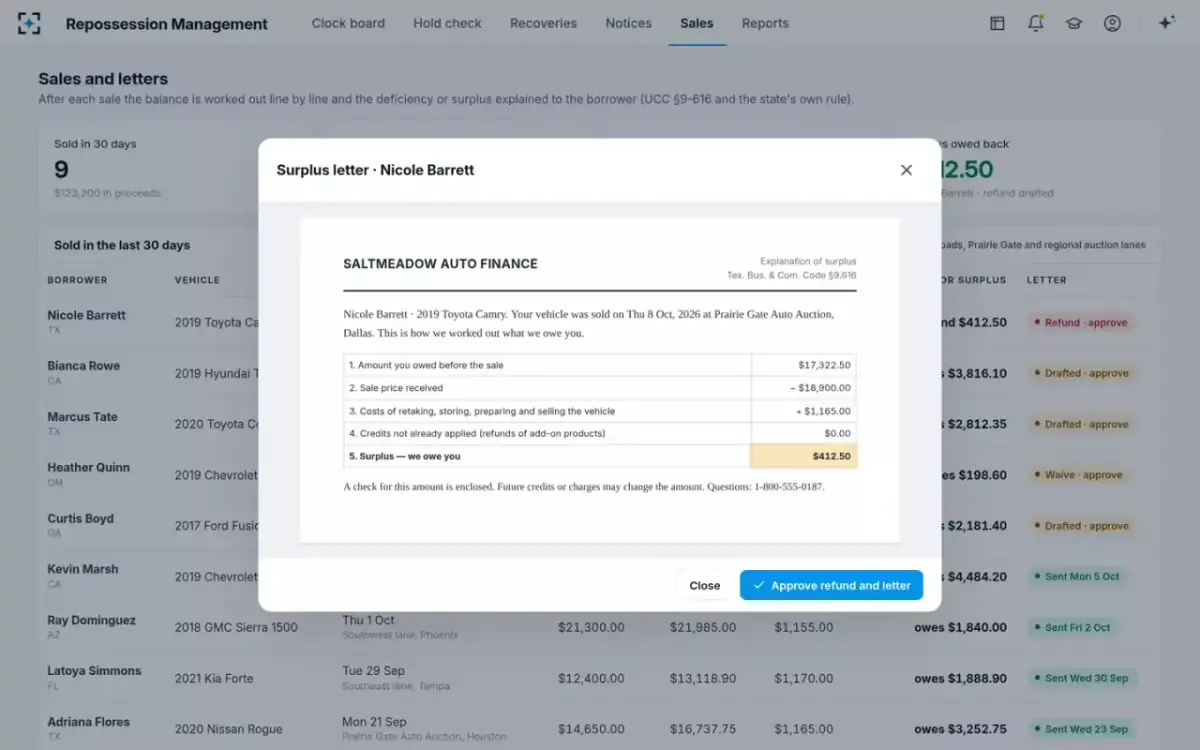
Two numbers are worth watching once the work is in one place: the share of disposals that produce a surplus, which should move with the used-car market and not with staffing, and the days from sale to explanation, which should be a small number and should never be larger than the days from sale to first demand. Where those two sit is also one of the questions to ask about what happens to an assignment after it completes.
Questions people ask
Can a lender sue for a deficiency balance?
Generally yes — the obligor is liable for any deficiency under section 9-615(d), and the lender may sue for it like any other debt. The exceptions are substantial. Some state statutes bar a deficiency in specific products, as Virginia's does for title loans. Some bar it where the amount financed was below a threshold. And in any case a lender that cannot prove a compliant notice and a commercially reasonable sale may find the deficiency presumed away or barred outright once the borrower raises the issue.
What must a lender do if the car sells for more than is owed?
The lender must account to the borrower and pay the surplus, and must send the written explanation of how it was calculated before or at the same time. The surplus is what is left after the balance and the lender's reasonable expenses of retaking, holding, preparing and selling. It is owed whether or not the borrower asks for it, and a lender that simply keeps it has both failed to account and created a claim.
How long does a lender have to send a deficiency letter?
The explanation of the calculation must go before or when the lender first makes written demand for the deficiency after the sale, and within fourteen days of a borrower's request for one. There is no separate deadline for the demand itself, so the practical rule is that the explanation sets the earliest date the demand can go. Where the lender owes a surplus instead, the explanation goes with the payment.
What can be added to a deficiency balance?
Only the reasonable expenses of retaking, holding, preparing for disposition, processing and disposing, plus attorney's fees and legal expenses where the agreement provides for them and the law does not prohibit them. "Reasonable" means actually incurred and proportionate, which is why a flat repossession fee unrelated to the agency's invoice is hard to defend. Charges for insurance covering periods after the repossession, and fees for returning the borrower's own belongings, do not belong on the balance at all.
Does a voluntary surrender avoid a deficiency balance?
No. Surrendering the car changes how the lender obtained it, not what happens next: the car is still sold, the proceeds are still applied in the same order, and whatever is left is still owed. A surrender only extinguishes the debt if the lender accepts the car in full satisfaction of it and says so in writing. Borrowers who surrender voluntarily do tend to avoid the repossession fee itself, which is a smaller saving than most expect.
Why is a deficiency often higher than the car's value when it was taken?
Because three things sit between the two numbers. The car sells at wholesale rather than retail, often for less than any published value. The expenses of retaking, storage, transport, reconditioning and auction are added. And interest continues to accrue on the balance until the sale. On a loan that already had negative equity — a long term, a small deposit, an older trade-in rolled in — those three can easily turn a car worth thousands into a balance of a similar size.