The first line of defense in risk management is business unit management: the product, operations, technology and support functions that create risk are accountable for identifying it, assessing it, controlling it and reporting what is left. The second line, independent risk management and compliance, oversees and challenges that work; the third line, internal audit, gives independent assurance over both. In operational risk, the first line's main assessment tool is the risk and control self-assessment (RCSA), in which each unit rates its own risks and controls. That assessment now carries regulatory weight: the Federal Reserve presumes that a deficiency a bank identifies itself and promptly starts to fix is a supervisory observation rather than a matter requiring attention. Botminds' Risk & Control Self-Assessment (RCSA) is built so the first line's assessment rests on the year's incidents, losses, tests and findings, which is what it takes for a self-assessment to find anything.
Examples come from a fictional sample credit union as it runs through the solution: Norrell Federal Credit Union, whose 14 business units rate 186 operational risks in the 2026 cycle.
First line and second line of defense in an RCSA, duty by duty
First line: business unit management: Identifies and assesses the operational risks inherent in its own unit, and how material they are.
Second line: independent risk management: Forms an independent view of the unit's material risks.
First line: business unit management: Establishes controls and assesses their design and effectiveness.
Second line: independent risk management: Forms an independent view of the design and effectiveness of key controls.
First line: business unit management: Rates inherent risk, control effectiveness and residual risk, and answers for them.
Second line: independent risk management: Challenges ratings for relevance and consistency, and keeps evidence of the challenge.
First line: business unit management: Reports residual risk: loss events, control deficiencies, process gaps, tolerance breaches.
Second line: independent risk management: Reviews and contributes to the reporting of the risk profile.
First line: business unit management: Uses the tools the framework provides, and says when it lacks resources or training to do so.
Second line: independent risk management: Develops and maintains the policies, standards and tools; designs the training.
What is the first line of defense in risk management?
The first line of defense is the management of the business units that take the risk. The Basel Committee's principles say it plainly: "In industry practice, the first line of defence is business unit management", which "is responsible for identifying and managing the risks inherent in the products, activities, processes and systems for which it is accountable" (BCBS, 2021). Business unit is meant broadly; the principles include finance, human resources, operations and technology.
The OCC's Comptroller's Handbook uses the same model for US banks: the first line is "the frontline units, business units, or functions that create risk", and "These groups are accountable for assessing and managing that risk" (OCC, Corporate and Risk Governance, 2019). For banks of $50 billion or more, the OCC's heightened standards turn the expectation into a guideline: each front line unit should "Assess, on an ongoing basis, the material risks associated with its activities" and use those assessments to decide whether to strengthen risk management (12 CFR part 30, Appendix D).
What are the three lines of defense? Four sources, one model
The three lines of defense are the business that owns risk, the independent functions that oversee and challenge it, and internal audit, which assures both. The model is not a regulation; it is a convention that regulators, the Basel Committee and the internal audit profession describe in slightly different words.
The three lines of defense as four authorities describe them
| Source | First line | Second line | Third line |
|---|---|---|---|
| Basel Committee, 2021 | Business unit management | An independent corporate operational risk management function, typically with compliance | Independent assurance, usually internal or external audit |
| OCC Comptroller's Handbook, 2019 | Frontline units, business units or functions that create risk | Independent risk management, loan review, compliance officer, chief credit officer | Internal audit, in-house, outsourced or co-sourced |
| OCC heightened standards ($50bn+) | Front line units that generate revenue or reduce expenses, provide operational support or provide technology services | Independent risk management, led by a Chief Risk Executive with unrestricted access to the board; no front line executive oversees it | Internal audit, its Chief Audit Executive with unrestricted access to the board's audit committee |
| The IIA's Three Lines Model, 2020 | Roles most directly aligned with delivering products and services, including support functions | Roles that assist with managing risk: expertise, support, monitoring and challenge | The internal audit function, independent of management |
The differences are mostly about formality, and the Basel Committee itself notes the cost of getting them wrong: despite wide adoption, "confusion around roles and responsibilities sometimes hampers its effectiveness" (BCBS, 2021). The OCC adds a practical note for smaller institutions: "While many banks have not formally adopted the three lines of defense, most banks have the basic elements", and in smaller, noncomplex banks risk management and controls "are often integrated in the frontline units" (OCC, 2019).
Responsibility for managing risk remains a part of first line roles and within the scope of management.
The IIA's Three Lines Model, 2020, updated 2024
What does the first line do in an RCSA?
In an RCSA the first line does the assessing: it rates each of its risks for inherent risk, control effectiveness and residual risk, attaches the evidence, explains any change from last year, and owns the action plans for controls that fall short. The Basel list of first-line duties reads like an RCSA job description: "identifying and assessing the materiality of operational risks inherent in their respective business units", assessing how well its controls are designed and how well they work, and reporting the residual risk its controls leave, from loss events to breaches of tolerance (BCBS, 2021).
That is a lot to ask of a process owner whose main job is running a business line, which is why most of it slides into memory and habit. At the sample credit union, Dana Whitfield, VP Card Services, owns 14 risks and 33 controls. Before the solution she rated them in an afternoon during the busiest fraud season; in the 2026 cycle the agents put each risk's evidence in front of her first, and she accepts, changes with a reason, or asks. The assessment stays hers. What the agents ask, and when they decline to propose, is in RCSA questions.
Who owns a risk rating, the first line or the second?
The first line owns the risk rating; the second line owns its challenge and, in most RCSA designs, the signature. The two must not be the same person. The Basel principles add a rule for units that hold both roles: "banks should document and distinguish the responsibilities of such functions in the first and second line of defence, emphasising the independence of the second line of defence" (BCBS, 2021).
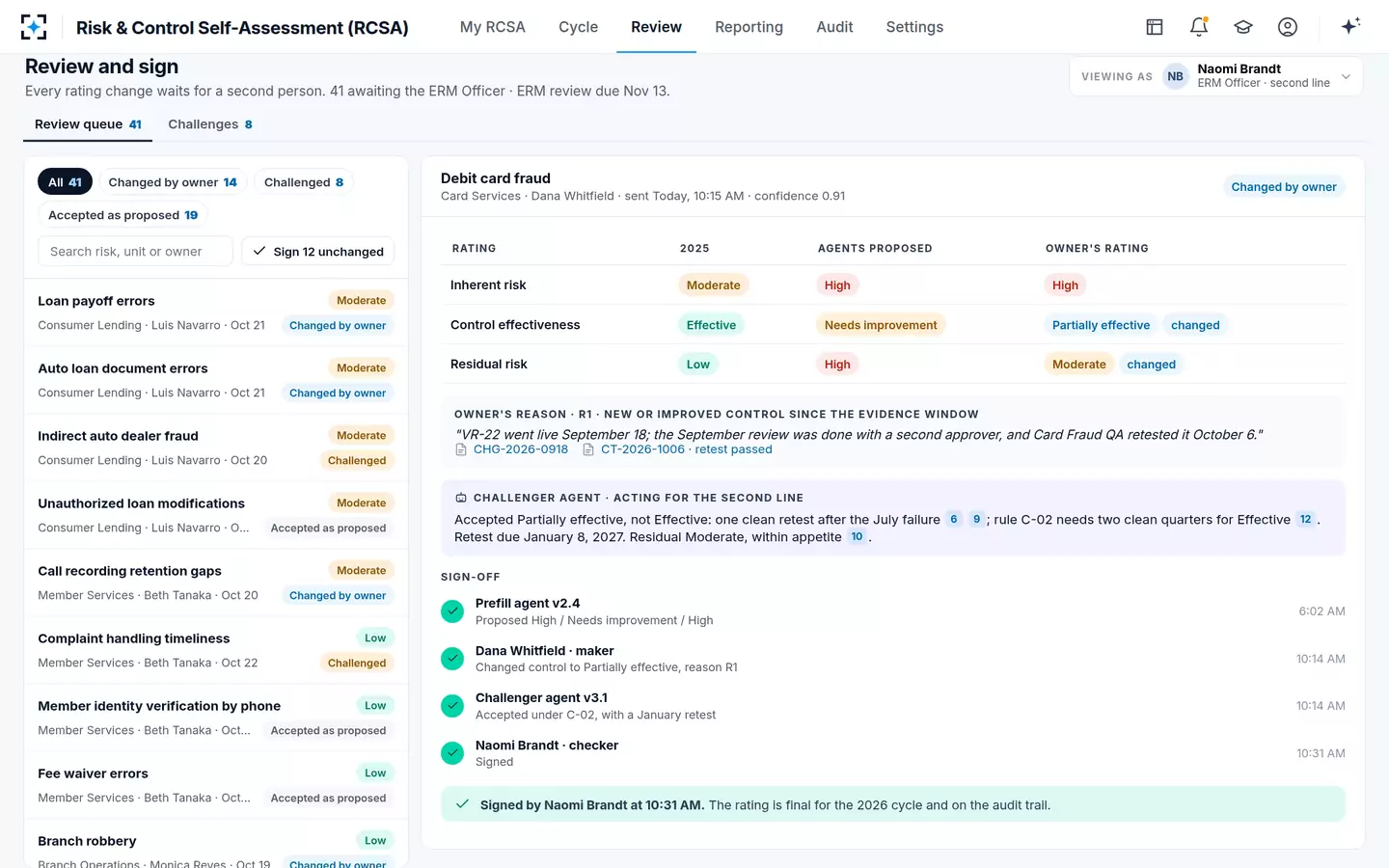
At the sample credit union the line is enforced rather than trusted. The process owner rates; the ERM Officer signs every change as the checker; nobody can sign a rating they made, so viewed as the owner the sign button is disabled; the ERM Officer never rates; and internal audit is read-only on every screen. The IIA's model explains why the second line is still not the third: second line roles "are part of management's responsibilities and are never fully independent from management, regardless of reporting lines and accountabilities" (IIA, 2020).
The first line rates, the second line signs: one screen, two people
What the first line gains when it finds the issue first
The Federal Reserve now presumes that a self-identified issue does not become an MRA. Under its updated Statement of Supervisory Operating Principles, a Board-supervised banking organization that identifies a deficiency serious enough for an MRA or MRIA, and promptly starts remediating it in a way supervisors judge reasonable, will presumptively receive a supervisory observation instead (Federal Reserve, 2026). The Fed's June 2026 report confirms the shift is in use: examiners "have also begun utilizing supervisory observations to identify shortcomings that do not rise to the level of MR(I)As" (Federal Reserve, Supervision and Regulation Report, June 2026).
For OCC- and FDIC-supervised banks, the two agencies' final rule redefining MRAs takes effect on November 2, 2026; its terms are explained in the MRA and supervisory observation rule, and how self-identified issues should be tracked so the presumption holds is the subject of self identified issues. Neither text covers federally insured credit unions, which NCUA supervises, so for the sample credit union the case for self-identification rests on the older argument: a weakness the institution finds is cheaper, quieter and faster to fix than one an examiner writes up.
How a first-line RCSA turns a weak control into a self-identified, remediated issue
Agent
Evidence readA failed control test, a red indicator or a loss over the trigger amount reaches the risk's evidence file.
Never: hides an item the owner should see
Agent
Rating proposedControl effectiveness proposed as Needs improvement, with the failed test cited.
A person decides
Owner ratesAccepts, or changes with a reason code and evidence; the weakness is now on the first line's own assessment.
Agent
Action plan draftedA plan with steps and a due date, linked to the issue register.
Never: accepts or closes a plan
A person decides
Owner and ERM Officer approveThe owner accepts the plan; the ERM Officer approves it.
A person decides
Internal audit validatesValidates the remediation once the evidence shows it holds.
Why finding it yourself only pays if the RCSA really finds things
The regulatory credit for self-identification is only as good as the self-assessment that earns it. An RCSA that rates every control Effective self-identifies nothing, and the deficiency waits for internal audit or the examiner. The open findings show where that is most likely: at year-end 2025, IT and operational risk was the largest category of outstanding MRAs and MRIAs at the Federal Reserve's community and regional banking organizations, followed by risk management and internal controls (Federal Reserve, June 2026).
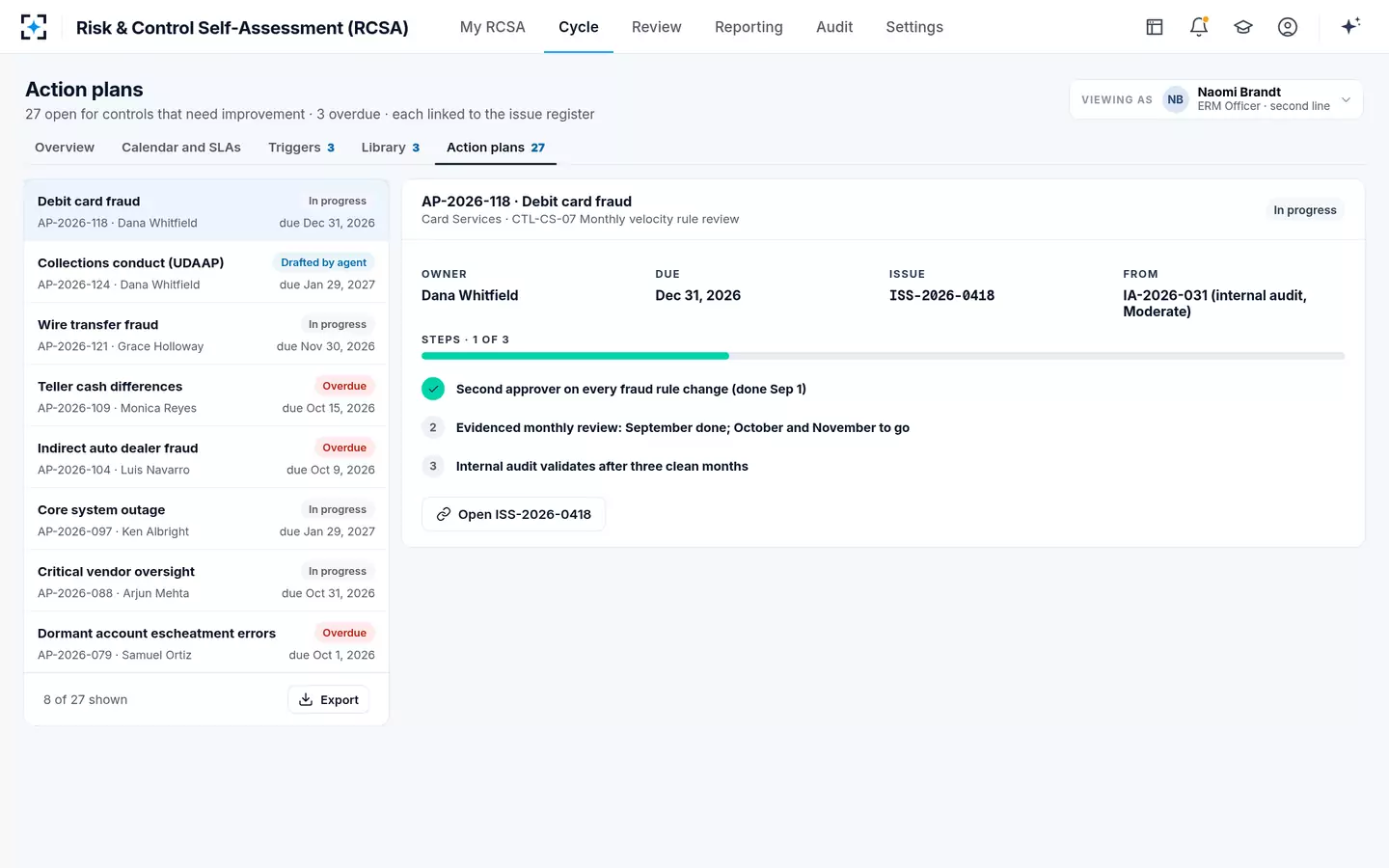
The sample credit union's debit card fraud risk shows the gap a first-line RCSA has to close. The monthly velocity rule review failed its July 14 test with two of six months not evidenced, and internal audit's finding IA-2026-031 found that rule changes were being self-approved. Last year's RCSA had rated the same control Effective, so this weakness was found by the third line, not the first: the opposite of what the presumption rewards. In the 2026 cycle the evidence-first interview put the failed test and the finding in front of the owner before she rated, the control was rated below Effective, and the rating now carries action plan AP-2026-118, due December 31, 2026. The new velocity rule that followed was the first line's own work; the lesson is that last year's assessment should have found the gap before audit did.
A weak control keeps its action plan, linked to the issue it answers
How should the first line document a self-identified issue?
The first line should document a self-identified issue the way an examiner would want to read it: what was found, how, when, against which control, how serious, what the fix is and by when. The date found and the date remediation started matter most, because "promptly" is a question of days, and an issue first documented weeks after the evidence appeared is hard to call self-identified.
What a first-line self-identified issue should carry from day one
- How it was found
The RCSA, a control test, a key risk indicator, a loss review; with the evidence attached.
- When
The date the evidence appeared and the date the issue was opened. The gap between them is the first thing anyone will ask about.
- Which risk and control
From the library, so the issue reaches the rating it affects.
- Severity
On the institution's scale, set by someone other than the owner where policy requires.
- Root cause, not symptom
Why the control failed, not only that it did.
- Action plan
Steps, owners, due dates, linked to the issue register.
- Who validates closure
Normally internal audit, with the evidence it will need named in advance.
Closure belongs to someone else. A first line that validates its own fixes undoes the model; internal audit's role in deciding whether a remediation holds is set out in issue validation in internal audit. The first line's part is to make the evidence for that decision easy to find.
When one person holds first- and second-line roles
At smaller institutions one person often holds both roles, and the model still works if the duties are written down and the signature is separated. The Basel principles allow that at small banks independence "may be achieved through separation of duties and independent review of processes and functions" (BCBS, 2021). In an RCSA that means a simple rule enforced by the tool rather than by memory: whoever rated a risk cannot sign it, and whoever signs it did not rate it.
The same rule applies to agents. In the solution the agents gather, propose, challenge and draft, but never sign, submit, change the library or close an action plan; the owner rates, a different person signs every change, and the Risk Committee approves the cycle. That keeps the first line's assessment the first line's, which is the condition for any credit it earns. The whole cycle, from library to committee, is in the RCSA process guide, and the solution is Risk & Control Self-Assessment (RCSA).
Questions people ask
Is the first line of defense the same as the front line?
Close, but wider. The OCC's heightened standards define a front line unit as one that generates revenue or reduces expenses, provides operational support or servicing, or provides technology services. The Basel principles likewise include support functions such as finance, human resources, operations and technology in the first line.
Is compliance first line or second line?
Usually second line. The Basel principles note that the second line typically includes a compliance function alongside operational risk management, and the OCC lists a compliance officer among second-line roles. First-line staff still own compliance in their own processes.
What is the first line of defense in banking, in one sentence?
It is the business units and their managers who take risk, own it, and are accountable for identifying, assessing, controlling and reporting it, before any risk or audit function looks at it.
Does the self-identification presumption apply to credit unions?
No. The Federal Reserve's presumption applies to Board-supervised banking organizations, and the OCC and FDIC rule to the institutions those agencies supervise. Credit unions are supervised by NCUA; the practical case for finding issues first still holds, but the 2026 texts do not apply to them.
Can the first line use AI to do its RCSA?
It can use AI to gather evidence and propose ratings, but the assessment must remain the first line's: a person rates, a different person signs, and the reasons are written down. The Basel duties fall on business unit management, and a rating no one in the business has actually made does not discharge them.