Self identified issues are control deficiencies, compliance gaps or risk-management weaknesses that a bank's own people find, through the first line's monitoring, the second line's testing or a self-assessment, rather than internal audit or an examiner. Banks track them in the same register as audit findings and MRAs, usually under the name management self identified issues. In 2026 they gained regulatory weight: the Federal Reserve now presumes that a deficiency serious enough for an MRA, if the bank finds it and promptly starts remediating it reasonably, is a supervisory observation instead. The presumption only helps a bank that can show when it found the issue, when it started, and that the fix works, which is the record most self identified issues lack. Botminds' Audit Issue & MRA Tracking holds issues the business found itself to the same evidence and validation rules as MRAs, so finding it first is something the bank can prove.
The examples come from a fictional sample bank as it runs through the solution: Corvane National Bank, an OCC-supervised regional bank whose register holds 640 open issues, 190 of them self-identified.
The same deficiency, found two ways, at a Federal Reserve-supervised bank
The examiner finds it: An MRA, or an MRIA if it must be corrected on a priority basis.
The bank finds it first and starts fixing it: Presumptively a supervisory observation, if remediation started promptly in a manner examiners judge reasonable.
The examiner finds it: The examination report, in the examiner's words.
The bank finds it first and starts fixing it: The bank's own finding, root cause and plan, already under way.
The examiner finds it: Remediation to the examiner's satisfaction, on the examiner's timetable.
The bank finds it first and starts fixing it: When it was found, when remediation started, and evidence the fix works.
The examiner finds it: Internal audit; examiners rely on its validation if internal audit is effective.
The bank finds it first and starts fixing it: Internal audit or, for issues it owns, the second line: the same independent test.
The examiner finds it: The MRA stays open; slow progress can escalate.
The bank finds it first and starts fixing it: The presumption rests on prompt, reasonable remediation; a stalled fix gives an examiner reason to look again.
What are self identified issues in banking?
They are issues the bank's management finds in its own operations, as distinct from internal audit findings and regulatory findings. A business line notices that wire limit overrides are being approved by the person who requested them; a compliance tester finds complaint acknowledgments going out late on a new platform; a model owner sees that an assumption changed without approval. Each is logged, given an owner, a root cause, a rating and a plan, and tracked to closure like any other issue.
Internal audit has a stake in them too. The OCC's audit booklet says: "Auditors should assess each control deficiency that comes to their attention, including deficiencies that are self-identified by bank management" (OCC, Internal and External Audits). A self identified issue is not exempt from independent scrutiny because the business found it; if anything, the business's account of its own problem needs the independent check most.
How are self identified issues treated by regulators?
Better than they used to be, at least at the Federal Reserve. Its 2026 operating principles say that if a supervised organisation self-identifies a deficiency that would otherwise meet the standard for an MRA or MRIA on safety-and-soundness grounds, and promptly starts remediating it "in a manner determined to be reasonable by Board or Reserve Bank supervisory staff", the deficiency will presumptively be treated as a supervisory observation rather than an MRA or MRIA (Federal Reserve, Updated Statement of Supervisory Operating Principles). The conditions are the point: the bank has to have found it, have started, and have started in a way an examiner would call reasonable.
in a manner determined to be reasonable by Board or Reserve Bank supervisory staff
Federal Reserve, Updated Statement of Supervisory Operating Principles (April 2026, updated September 2026)
The OCC and FDIC rule, effective November 2, 2026, does not address self-identification directly; it narrows when those agencies may issue an MRA at all, to material financial risk or an actual violation of a banking law, and defines supervisory observations as informal and non-binding. Under the OCC's heightened standards for large banks, the bank's own ability to find and fix problems is something internal audit must report on: its reports to the audit committee include "A determination of the effectiveness of front line units and independent risk management in identifying and resolving issues in a timely manner" (12 CFR part 30, appendix D). The OCC and FDIC MRA final rule guide covers the new labels in full.
Does a self identified issue become an MRA?
It can, but at the Federal Reserve the presumption now runs the other way if the bank acted promptly and reasonably. A self identified issue becomes an MRA when the bank sat on it, when remediation was not reasonable, or when it meets the MRA standard and the presumption does not apply. Elsewhere the label depends on each agency's standard: under the OCC and FDIC rule, an MRA requires a practice that could reasonably be expected to cause material financial harm, or an actual violation of a banking law, whoever found it.
The supervisory direction of travel is visible in the numbers. The Federal Reserve began reviewing all outstanding safety-and-soundness MR(I)As in February 2026, and says "MR(I)As that are not consistent with the SSOP will be downgraded to an observation or closed" (Supervision and Regulation Report, June 2026). It also reports that outstanding MR(I)As at community and regional banking organisations fell notably in 2025, to levels roughly in line with those before the 2023 bank failures.
The Federal Reserve's findings in 2025–26: fewer MR(I)As, more observations
Feb 2026
review of every outstanding safety-and-soundness MR(I)A begins; misaligned ones downgraded to observations or closed
121
outstanding MR(I)As at the GSIB portfolio, 2025:Q4
162
at large banking organisations (LBO), 2025:Q4
174
at foreign banking organisations with over $100 billion in U.S. assets, 2025:Q4
Supervisory observation or MRA: where a self identified issue lands
A finding that does not rise to an MRA: informal, non-binding, and, under the OCC and FDIC rule, carrying no requirement that it go to the board or that the bank take corrective action (91 FR 56004). The Federal Reserve's report puts its own version in one line: "For shortcomings that do not meet the standard for an MR(I)A, examiners should note a supervisory observation." The category is new again. In 2013 the Federal Reserve's SR 13-13 told examiners "to discontinue using Observations as a separate category" (SR 13-13 / CA 13-10); the 2026 principles say the Board will amend SR 13-13 to reverse that.
Non-binding does not mean untracked. An observation describes a weakness an examiner saw, and the next examiner will read it. A bank that records each observation as an issue with a decision, act on it or accept it with a reason, can show oversight; one that lets it lapse may meet it again as something heavier.
MRA vs MRIA, and where observations now sit
At the Federal Reserve, the order of severity is observation, MRA, MRIA, then formal enforcement. The June 2026 report describes the first two steps of supervisory direction: "Typically this direction is first communicated in the form of an MRA and, for more significant deficiencies that must be corrected on a priority basis, an MRIA." The OCC and FDIC use MRAs, supervisory observations and, under their new rule, "other violations" for violations they do not make MRAs. A self identified issue at a Fed-supervised bank can sit at the bottom of that order if the bank found it first and moved.
What is prompt remediation?
Neither the principles nor the report defines "promptly" in days, and a bank should not invent a regulatory number. What a bank can control is the record: the date the issue was found, the date it was logged, the date an owner and plan were assigned, and the date the first remediation action began, each kept, not reconstructed later. An examiner judging whether remediation started promptly and reasonably will look for exactly those dates, and for whether the plan addresses the cause.
A self identified issue in Audit Issue & MRA Tracking, from finding to validated closure
A person decides
Found and reportedA first- or second-line employee reports the issue; the date found is kept from the start.
Agent
Intake proposesThe Intake agent proposes an owner, root cause, rating and due date, and searches the register so a known issue is linked, not duplicated.
Never: Proposes only; the Issue Management Office registers.
Agent
Plan checked against the causeThe Plan agent labels each action as fixing the root cause, treating a symptom or monitoring.
Never: Suggests; the owner and the validation lead decide.
Agent
Pace watchedThe Overdue agent reads milestones and evidence pace each morning and flags a stalled plan before the date.
A person decides
Validated independentlyInternal audit, or the second line for issues internal audit owns, validates against the same rules as an MRA.
How should self identified issues be tracked?
Exactly like the findings an examiner would otherwise have written: same register, same rating scale, same validation rules, same board reporting. The temptation is the opposite, a lighter process for issues nobody outside the bank knows about, and it defeats the purpose. A self identified issue tracked loosely looks, to an examiner, like an issue the bank did not take seriously.
Tracking self identified issues so finding them first counts
- Date found, by whom, and how
The first-line control, second-line test or self-assessment that surfaced it. This is the claim to self-identification.
- Date remediation started
The first real action, not the date the plan was written. Kept as it happens.
- A root cause, not a restated condition
Why it happened, so the plan can be judged reasonable.
- A plan that changes the cause
Training and reminders alone rarely do; a configuration or process change usually does.
- The same validation rules as MRAs
Months of sustained operation and sample sizes by rating, applied by someone independent.
- Links, not duplicates
When an exam letter or audit report raises the same matter, link it to the existing issue and its start date.
- Board reporting alongside MRAs
Counts, ages and overdue items, so the board sees the bank's own findings, not only the examiners'.
- Escalation when it stalls
A self identified issue that stops moving should climb the same ladder as any other.
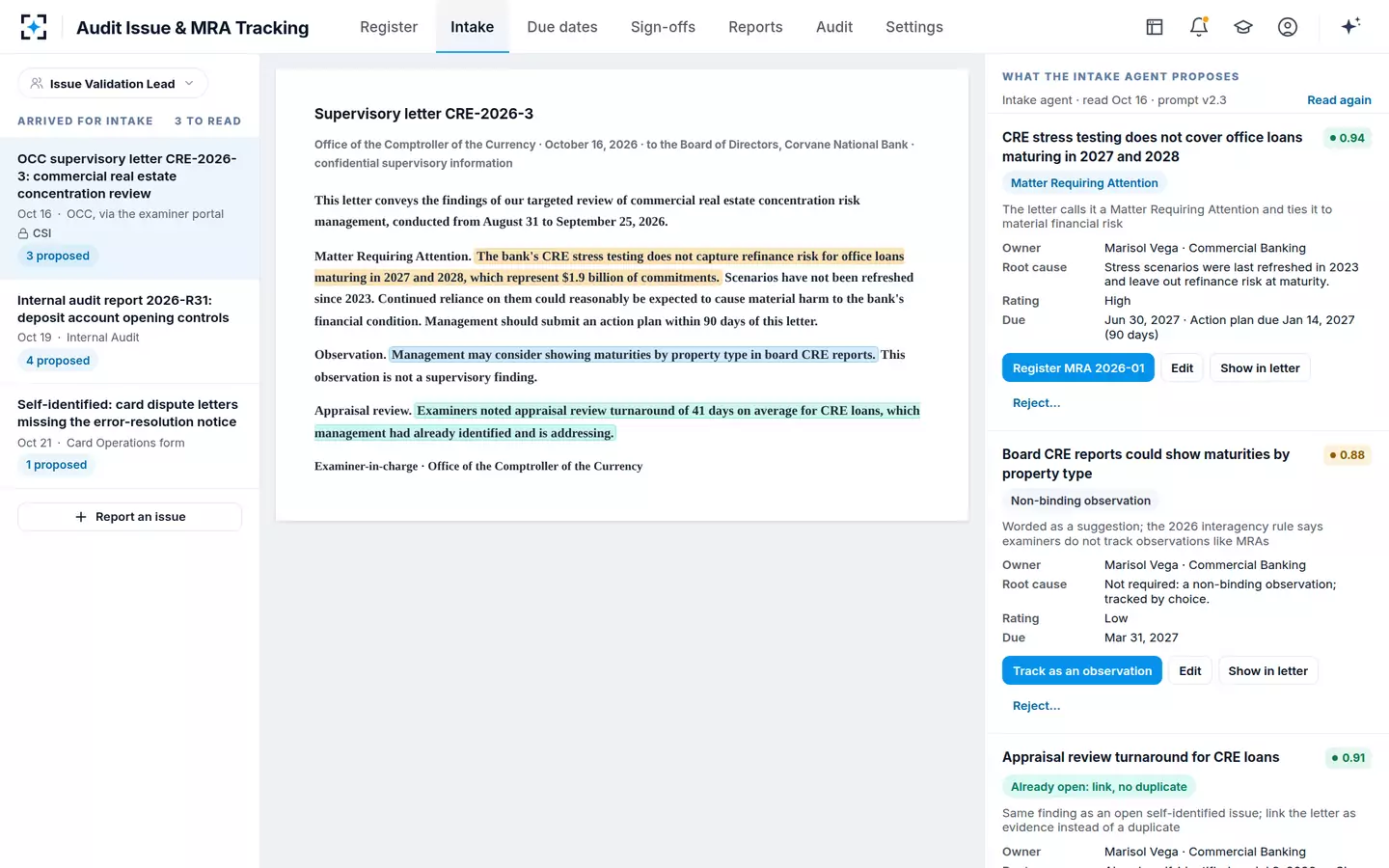
Linking matters more than it looks. When the sample bank's OCC letter CRE-2026-3 arrived on October 16, 2026, one of its three passages concerned appraisal review turnaround on commercial real estate loans, a problem the business had already logged. The Intake agent proposed a link to the open self-identified issue instead of a new one, so the bank's earlier start date and plan stayed attached to the matter.
An exam letter read into proposed issues, one of them already open as self-identified
Who validates a self identified issue?
The same independent function that validates any other issue: internal audit, with the owner excluded. Self-identification changes who found the problem, not who decides it is fixed. At the sample bank a validator who worked on the issue or reports to its owner is excluded, and issues internal audit owns are validated by the second line. The validation rules are the same as for MRAs, three months of sustained operation and a sample of 25 for a High rating, because the claim being tested is the same: the cause is fixed and the control keeps working.
One of the sample bank's open closure requests shows why. SI-2026-097, wire limit overrides approved by the requester, is a High-rated self identified issue. The Evidence agent's read on it is "needs a look": 23 of 25 sampled overrides had a second approver. Two did not. Whether that is a failed fix or two explainable exceptions is the validator's decision, and issue validation in internal audit describes how that decision is made.
Do self identified issues go to the board?
They should, in summary at least, alongside audit and regulatory findings. The board's interest is not only in what examiners found but in whether management finds its own problems, which under the heightened standards internal audit must assess for covered banks. At the sample bank, the board risk committee report opens with the whole register: 640 open issues, 410 from internal audit, 190 self-identified and 40 regulatory, with overdue items and the month's validation results.
Self-identified issues in Audit Issue & MRA Tracking, filtered from the whole register
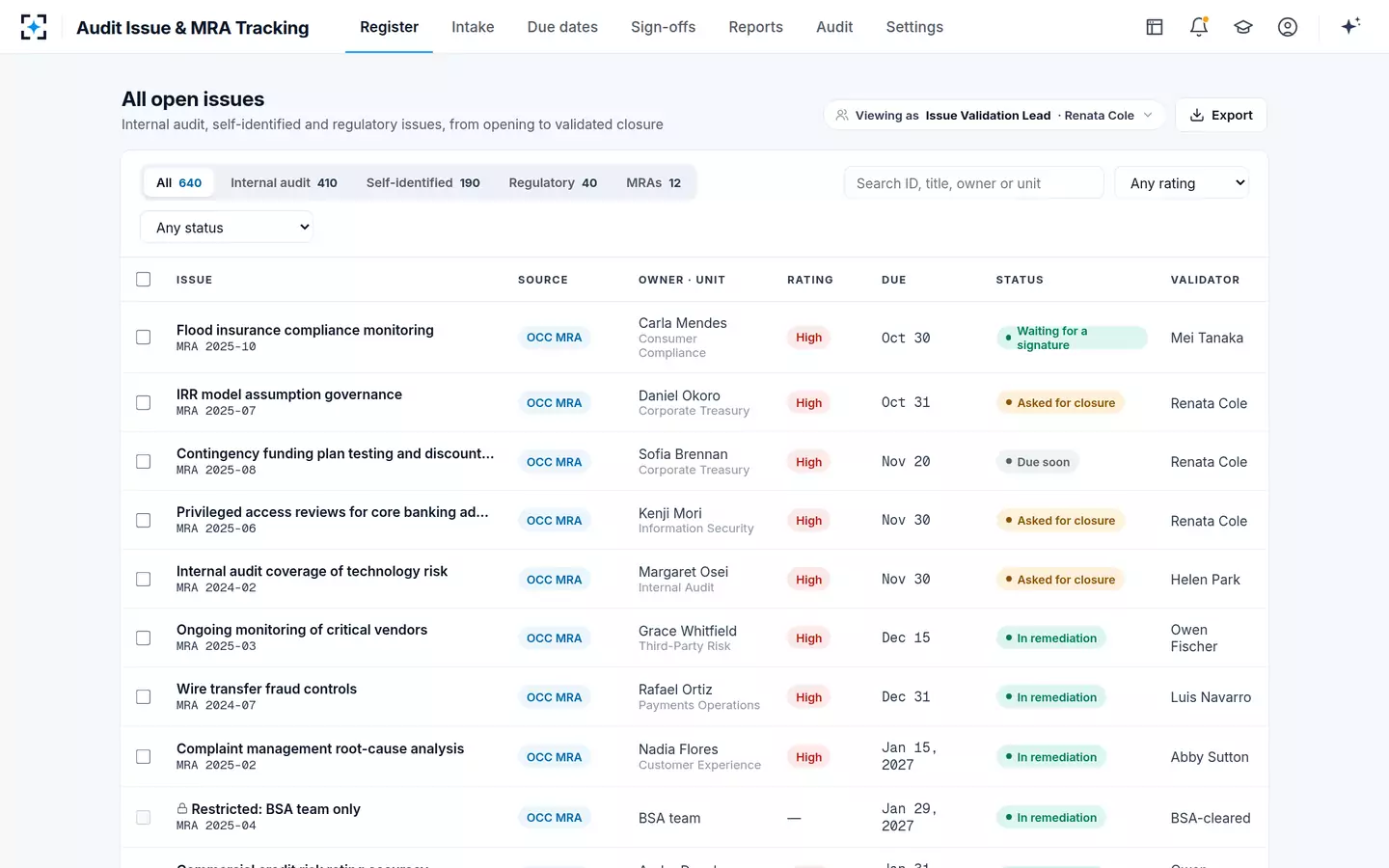
A high share of self-identified issues is good news only if they close well. Reporting their first-time validation rate and their age beside the MRAs' tells the board whether the first line is finding problems or merely logging them. For the root causes that make self-identified plans fail, see examples of root cause in audit findings; for the follow-up methodology internal audit applies to them, internal audit follow up procedures under Standard 15.2. To see the register, the links and the validation together, start from Audit Issue & MRA Tracking.
Questions people ask
What is a management self identified issue?
A deficiency found by the bank's own management, the first or second line, rather than by internal audit or an examiner. It is logged with an owner, root cause, rating and plan, and validated independently like other issues. Since 2026 the Federal Reserve presumes such an issue, promptly and reasonably addressed, is a supervisory observation rather than an MRA.
Does the self-identification presumption apply at OCC or FDIC banks?
It is Federal Reserve supervisory policy, set in its 2026 operating principles. The OCC and FDIC rule effective November 2, 2026 narrows when those agencies may issue an MRA but does not contain the same presumption. A self-found, promptly fixed issue still counts in a bank's favour as evidence of effective management.
Can a self identified issue still be cited by an examiner?
Yes. The presumption depends on prompt, reasonable remediation, and examiners judge both. An issue logged but not acted on, or fixed with a plan that misses the cause, can be treated like any other deficiency of its seriousness.
Should self identified issues use a lighter validation process?
No. The value of self-identification rests on the fix being real, so the same independent validation, sample sizes and months of operation should apply. A lighter process invites the conclusion that the bank's own findings are not taken seriously.
Are supervisory observations tracked?
By the bank, they should be. Under the OCC and FDIC rule an observation creates no requirement to take it to the board or to act, but a documented decision on each, act or accept with a reason, shows oversight, and the next examiner will read the last report.