Issue validation in internal audit is the independent check, made after an issue owner says a fix is done, that the fix was actually made and has kept working, before the issue is closed. The validator reads the owner's evidence against each promised milestone, draws a sample from the system of record to see the control operate, and either validates or returns the request with a reason. It is hard because "done" usually arrives as a policy and some minutes, while proof needs months of records the owner never attached. And in 2026 the stakes rose: the Federal Reserve told its examiners to rely on an effective internal audit's validation rather than repeat it. Botminds' Audit Issue & MRA Tracking exists for this seat. Its agents read each closure request against its evidence and the system of record and write one cited verdict line; the validator decides.
The examples come from a fictional sample bank as it runs through the solution: Corvane National Bank, an OCC-supervised regional bank carrying 640 open issues, 12 of them OCC matters requiring attention (MRAs), and about 85 closure requests a month. The regulatory and research material is linked where it appears.
What an issue validator reads: the commitment on one side, the proof on the other
The commitment
The finding
Management changed key interest rate risk model assumptions without ALCO review or approval.
Quoted from the report of examination, with its page, so the validator tests what the examiner wrote, not a summary of it.
The root cause
Approval authority for assumption changes was never assigned; model validation had no step to review back-tests.
Taken from the action plan. Every milestone should trace back to it; a milestone that does not is decoration.
The commitment
Four milestones, committed for October 31, 2026.
The date the bank gave its examiner. Moving it needs a reason and a second signature.
The proof
Design evidence
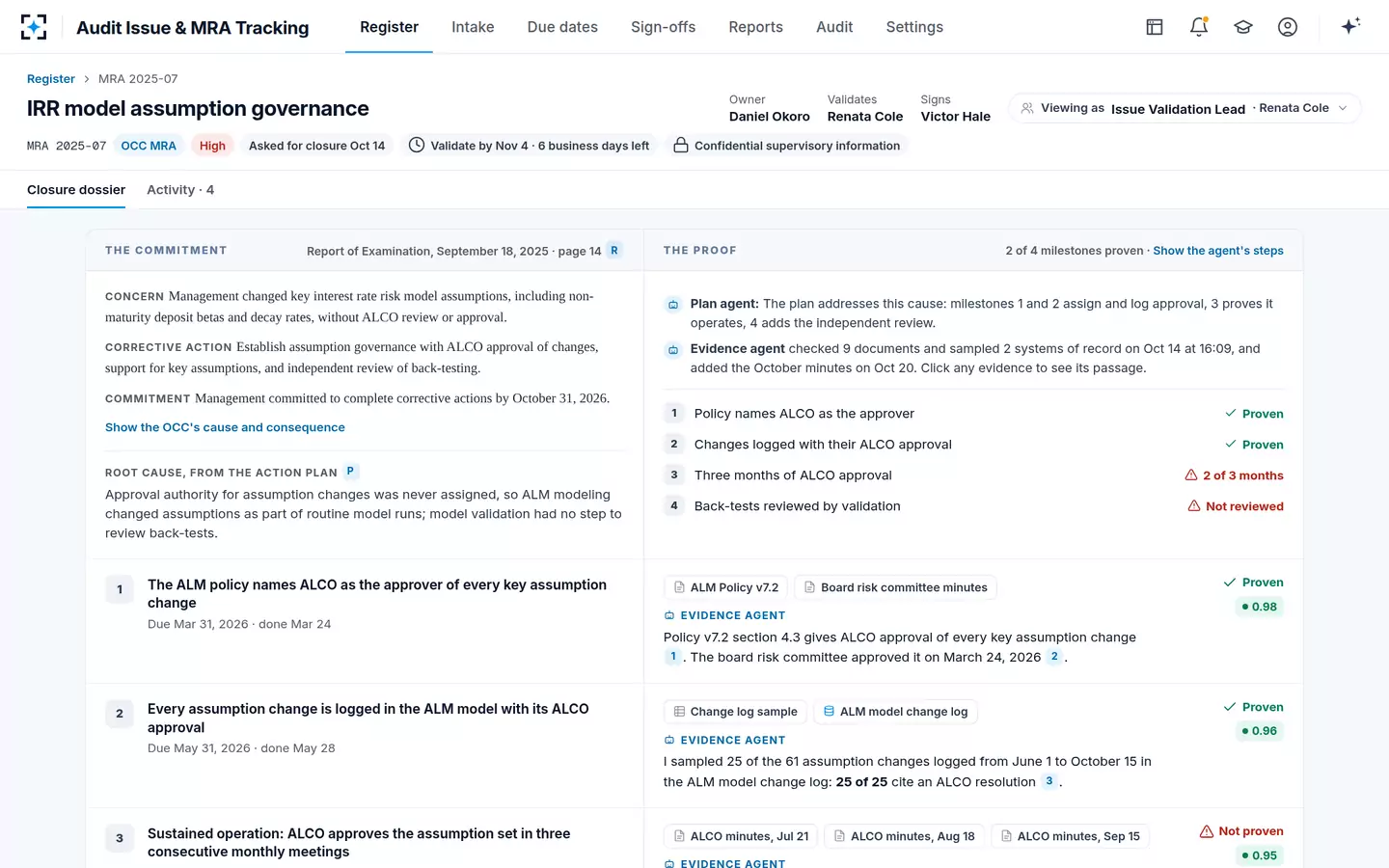
ALM Policy v7.2 names ALCO as the approver; the board risk committee approved it on March 24, 2026.
Proves the control exists on paper. On its own it proves nothing about whether anyone follows it.
Operating evidence
25 of the 61 assumption changes logged from June 1 to October 15, drawn at random: all 25 cite an ALCO resolution.
Pulled from the system of record by the validator, not chosen by the owner. The seed is kept so the draw can be repeated.
Sustained operation
ALCO approved in July, deferred in August, approved in September and October. Two consecutive months of the three the High rating needs.
The test owners fail most often. One deferred meeting resets the run.
Verdict line: Not ready for validation: 2 of 3 months of operation evidenced. Earliest realistic date November 30, 2026.
What is issue validation in internal audit?
Issue validation is the step between an owner's "complete" and an issue's "closed", and in a bank it belongs to internal audit. The OCC's audit booklet sets the expectation plainly: once an issue owner reports the work done, internal audit validates before treating the issue as closed, and status reports to the audit committee keep management's view of closure apart from internal audit's (OCC, Internal and External Audits, version 1.1). Without that separation, a register full of "closed" items can describe nothing more than what owners believe.
Validation is graded, not uniform. "The level of validation necessary may vary based on the issue's risk level," the same booklet says, and for the higher-risk issues it expects substantive testing over a period long enough to show the remediation holds. In practice that splits validation into three tests a validator runs in order: does the evidence show the promised change was made (design); does a sample from the system of record show the control operating (operation); and has it kept operating for the period the rating demands (sustained operation).
An example of issue validation in auditing makes the difference concrete. At the sample bank, a Moderate-rated issue on ALM model inputs not reconciled to the general ledger promised a documented procedure and two months of signed reconciliations. The procedure was approved in July. The July and September reconciliations were signed. August's had no reviewer signature, so only one month of the two counted, because the validation rule asks for consecutive months. Nothing about the fix was wrong; the proof of it was incomplete, and incomplete proof is a return.
Who validates audit issues, and who may not?
Internal audit validates, and the person who validates must not have done the work. That sounds obvious until a register is examined line by line: owners who mark their own issues validated, validators who helped design the fix, and issues that internal audit itself owns, where an auditor would be checking a colleague's remediation of an audit department weakness. The sample bank writes its answer into settings: a validator who worked on the issue or reports to its owner is excluded, and issues internal audit owns are validated by the second line.
For the largest national banks the independence is structural. Under the OCC's heightened standards for banks of $50 billion or more, "Internal audit maintains independence from front line units and independent risk management through the following reporting structure", with the chief audit executive's unrestricted access to the audit committee at its head (12 CFR part 30, appendix D). Smaller banks have no such appendix, but the logic travels: a validation by someone who reports to the owner is a self-assessment with an extra signature.
The issue validation lead: one seat, many hand-offs
Today
Re-performs each closure request by hand: reads the owner's evidence, pulls her own sample from the system of record, checks month by month whether the control kept working, writes the memo. Decides 20 to 30 closure requests a month against a 15-business-day clock.
With agents
Opens each request as a dossier already read against its milestones and sampled in the system of record, with one cited verdict line. Spends her time on the passages that decide it: the deferred meeting, the unsigned month.
Still theirs: the decision to validate or return, the reason code, any override of the agents, and the new date she proposes.
What evidence is needed to validate an issue?
Enough to show three things: the change was made, it operates, and it has kept operating for as long as the rating requires. Design evidence is a document: a revised policy, a configuration change, an approved procedure. Operating evidence is a population and a sample: the records the control leaves behind, drawn at random from the system that holds them, not chosen by the owner. Sustained-operation evidence is the same sample spread across time, month by month.
The sample bank's validation rules turn this into numbers. A High-rated issue needs three consecutive months of operation and a sample of 25 records; Moderate needs two months and 15; Low needs one month and 10. The rules are settings, proposed by the Issue Management Office, approved by the Internal Audit Director and versioned, because a validator who sets her own bar for each request is not applying a methodology. What a clean sample of 25 can and cannot prove is set out in the MRA closure report guide, and why the months matter more after 2026 in who proves the fix lasts.
The passage behind one month: the August ALCO deferred the decision
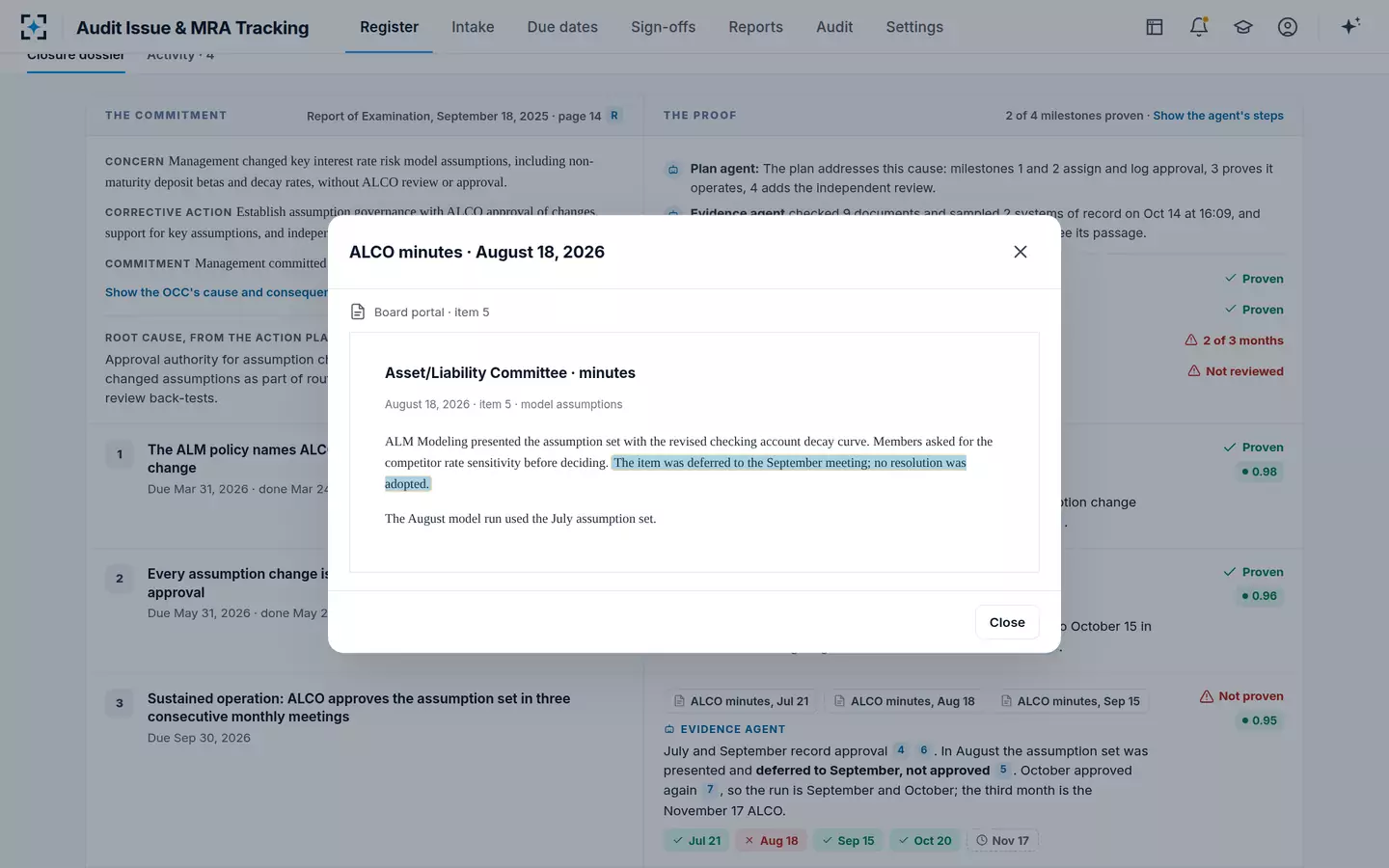
Evidence also has to be the right evidence. The August minutes above contain a presentation of the assumption set, which an owner skimming for proof could attach as "presented to ALCO in August". What they do not contain is a resolution. A validator reads for the verb: approved, adopted, resolved. Deferred, noted and discussed do not count.
How long does issue validation take?
As long as the bank's validation clock allows, and for a High-rated closure request most of that clock goes on reading and sampling rather than deciding. The sample bank gives validators 15 business days from the closure request. The estimate below splits those days for one High-rated MRA closure request, by hand and with the agents doing the reading, sampling and drafting.
Where one High-rated closure request's 15 business days go, and how many remain with agents
- Owner gathers evidence2
- Reading evidence against milestones3
- Sampling the system of record4
- Months of operation in the minutes2
- Memo and decision2
- Second signature, OCC update2
- Owner gathers evidence
- Reading evidence against milestones
- Sampling the system of record
- Months of operation in the minutes
- Memo and decision
- Second signature, OCC update
The largest single block by hand is the sample: four days to request an extract, pull 25 items, match each to its approval and count. That is also where a validator's independence shows, so it is the step the agents take over without taking it away: the Evidence agent draws the sample read-only, records the seed and the population, and shows every item, so the validator can redraw it and get the same 25.
What the validator waits on, and what waits on the validator
A validator rarely controls the date of her own decision. Upstream she waits on the owner's evidence, on meetings that have not happened yet and on other functions' sign-offs: in the sample MRA, the third month of ALCO approval cannot exist before the November 17 meeting, and the back-test review belongs to model validation, which had not started it. Downstream, everything waits on her: the Chief Risk Officer cannot sign a closure she has not validated, the quarterly MRA update to the OCC cannot report it closed, and the board risk committee report cannot count it.
That is why the most useful thing a validator can return is not "no" but "not yet, and here is when". The sample verdict proposes November 30, 2026: after the November ALCO, with time for model validation to sign the back-test. Because Renata Cole, the validation lead, is the one proposing the new date, she is its maker; the date waits for the Chief Risk Officer's signature as checker before the owner or the OCC hears it as the plan.
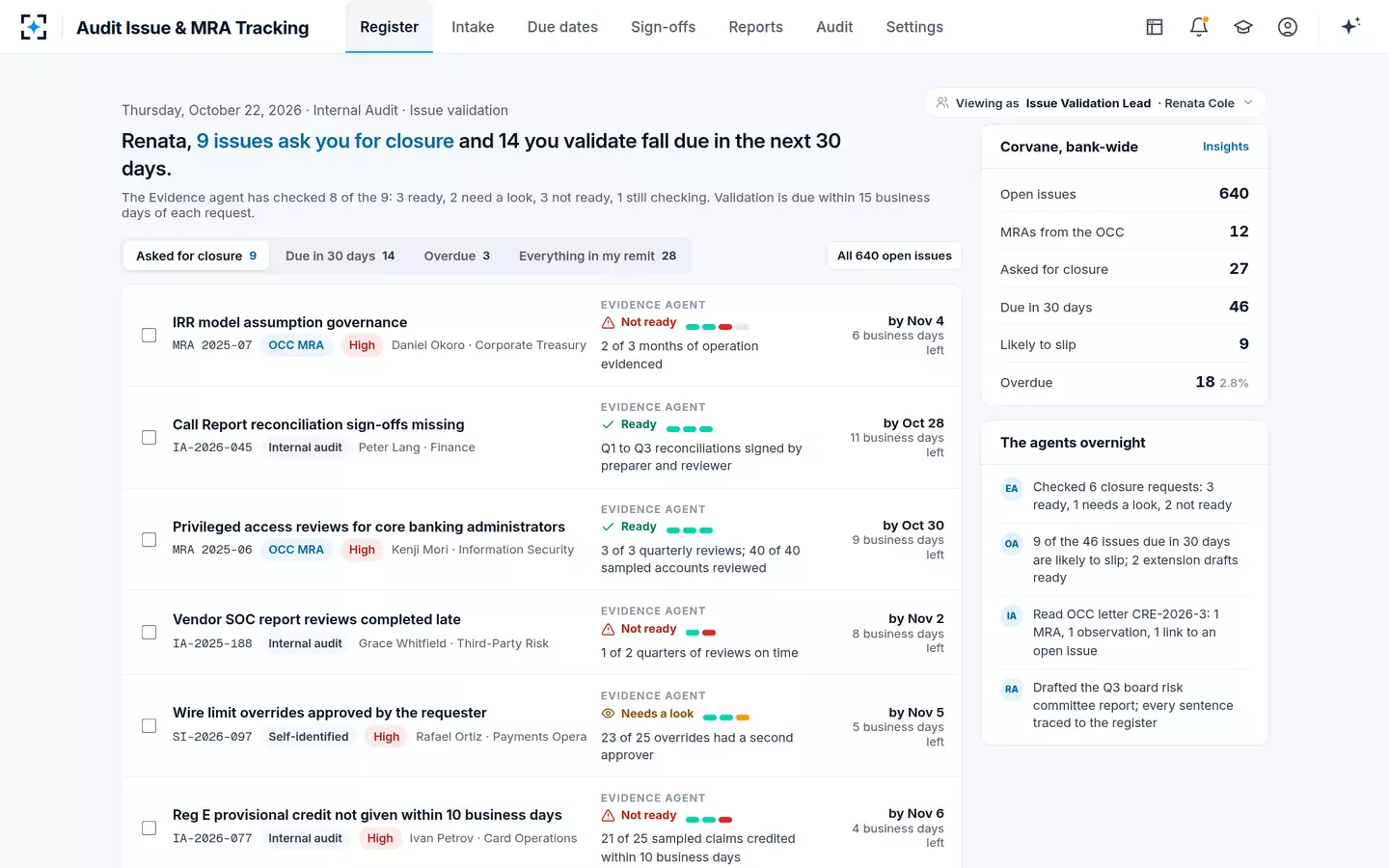
The validator's morning in Audit Issue & MRA Tracking: one sentence, then the queue
What happens when validation fails?
The request goes back to the owner with a reason code, and the issue stays open. A good return says exactly what is missing and what would make the request ready, so the owner's next submission is the last one. At the sample bank there are four return codes; the most used, RT-01, is "sustained operation not evidenced".
Most closure requests pass; most that fail lack months of proof, not the fix
A failed validation has consequences beyond the one issue. The date usually has to move, and a moved date is a second decision with its own maker and checker; at the sample bank a third change to the same issue goes to the board risk committee. A pattern of returns on one owner or one kind of plan is itself a finding about root cause, which the case of the reminder memo that failed follows from plan to return.
Do examiners rely on internal audit's validation?
At the Federal Reserve, by policy since 2026, yes, when internal audit is effective. Its updated operating principles tell examiners not to repeat validation that a satisfactory internal audit function has already done, except where internal audit is ineffective, absent or has not validated the remediation, and they say what to do instead.
Instead, they should assess internal audit's validation and, if satisfactory, rely on an institution's internal audit for validations unless one of the conditions above has been satisfied.
Federal Reserve, Updated Statement of Supervisory Operating Principles (April 2026, updated September 2026)
The Fed's June 2026 supervision report says supervisors of large firms have been doing exactly that (Supervision and Regulation Report, June 2026). The consequence for the validator is direct: at a Fed-supervised bank her signature is often the last independent test an MRA's remediation gets, and examiners will judge the validation as much as the remediation. The OCC and FDIC have their own new rule on when an MRA may be issued, effective November 2, 2026; it does not set a closure procedure, and the OCC and FDIC MRA final rule guide sets out what it does change.
Reliance cuts both ways. A validation function that cannot say no is worse than none, because it lends the bank's own signature to an unfixed problem. The Federal Reserve's review of Silicon Valley Bank found that its internal audit had raised findings on interest rate risk model governance and data inputs dating back to December 2020 but lacked the standing inside the firm to get them fixed (Federal Reserve, April 2023). Stature, for a validator, is a reason code that sticks, a date change that needs a second signature, and a register that shows the audit committee which issues internal audit has closed and which only management has.
Where the agents sit in Audit Issue & MRA Tracking, and where they stop
The agents do the reading and counting a validator would otherwise do by hand; they never validate. The Evidence agent reads each document attached to a milestone and says in one sentence what it proves, with the passage. Where a control has to operate over time, it samples the system of record read-only, records the seed, counts, and writes the verdict line with the gap and the earliest realistic date. Below a confidence of 0.80, a person decides.
The closure dossier in Audit Issue & MRA Tracking: commitment beside proof, milestone by milestone
The owner sees the same test before the validator does. On the reconciliation issue described earlier, the owner's pre-check found the unsigned August reconciliation while it was still a one-click fix, which is how the sample bank aims to move from 84% of requests validated the first time to its 95% target. The validator keeps the decision, the reason code and the right to disagree with the agent; internal audit follow up procedures under IIA Standard 15.2 describes the professional standard her methodology answers to. To see the whole seat at work, start from Audit Issue & MRA Tracking.
Questions people ask
Can the issue owner validate their own issue?
No. Validation is meant to be independent of the work, so it sits with internal audit, and the sample bank's system enforces it: the owner can attest that the work is complete but cannot mark the issue validated. Where internal audit owns the issue itself, the sample bank has the second line validate it instead.
What is the difference between issue validation and issue closure?
Validation is the test; closure is the decision that follows it. Internal audit validates that the remediation was made and works; then the issue is closed, often with a second signature for regulatory issues. The OCC expects audit committee reporting to keep issues closed by management apart from those closed by internal audit.
Do examiners still validate MRA remediation themselves?
Federal Reserve examiners are told not to duplicate validation where internal audit is effective and has validated the remediation; they assess internal audit's work and rely on it if satisfactory. Examiners still decide whether to terminate the MRA. The OCC and FDIC rule effective November 2, 2026 defines when an MRA may be issued and leaves closure practice outside it.
How many records should an issue validator sample?
There is no regulatory number; it is the bank's methodology, set by rating. The sample bank uses 25 records for a High-rated issue, 15 for Moderate and 10 for Low. With zero exceptions in 25 random items, the deviation rate can still be up to about 11% at 95% confidence, which is why months of operation are tested as well.
What does an issue validation lead do?
Decides closure requests: reads each owner's evidence against its milestones, tests the control in the system of record, validates or returns with a reason code, and proposes realistic dates when a request is not ready. The sample bank's lead decides 20 to 30 requests a month against rules the Internal Audit Director approves.