Audit finding remediation is the work of fixing the cause of an audit or regulatory finding and proving that the fix keeps working, ending in internal audit's validation and the finding's closure. The audit findings remediation process usually runs in four steps: diagnose the root cause, carry out the action plan, show the control operating over a period, and have someone independent validate it. The third step, sustainability testing, is where findings stall, and in 2026 it changed hands. The Federal Reserve told its examiners not to test whether remediation is sustainable over time and to rely instead on an effective internal audit's validation; the OCC and FDIC criticised MRAs held open to watch sustainability. The test now sits with the bank's own validators, and their months-of-operation rule is often the only proof there is. Botminds' Audit Issue & MRA Tracking writes that rule into settings and has its agents count the months in the system of record for every closure request.
Examples come from a fictional sample bank as it runs through the solution: Corvane National Bank, an OCC-supervised regional bank whose validation rules ask for three consecutive months of operation for a High-rated issue, two for Moderate and one for Low.
From fix to closure in Audit Issue & MRA Tracking: months of proof by rating
- Month 1
- Month 2
- Month 3
- Validation clock15 bd
- Month 1
- Month 2
- Validation clock15 bd
- Month 1
- Validation clock15 bd
What is audit finding remediation, and when is it done?
It is done when internal audit has validated that the cause was fixed and the control has kept working, not when the owner finishes the last task. That distinction is the source of most disagreement about remediation. An owner who has rewritten a policy, retrained staff and updated a system has finished their tasks; whether the finding is remediated depends on what the control does next month and the month after. The Institute of Internal Auditors makes confirming implementation a standing duty of internal audit, and banks' examiners expect validation before closure, as internal audit follow up procedures under Standard 15.2 sets out.
Validation can take different shapes. The OCC's audit booklet notes: "Approaches to validating issue remediation may vary, from incorporation at the next audit of the auditable entity, to a specific audit to validate multiple issues" (OCC, Internal and External Audits). Whatever the shape, a validation of a recurring control needs a period, not a moment.
What is sustainability testing in internal audit?
Sustainability testing checks that a remediated control has operated as designed over a period after the fix, not just at one point. It answers the question a single test cannot: was the fix real, or did the control work the week someone was watching? In practice it means drawing the records the control leaves behind, approvals, reconciliations, call-backs, reviews, across consecutive periods, and confirming each period on its own. One period that fails breaks the run.
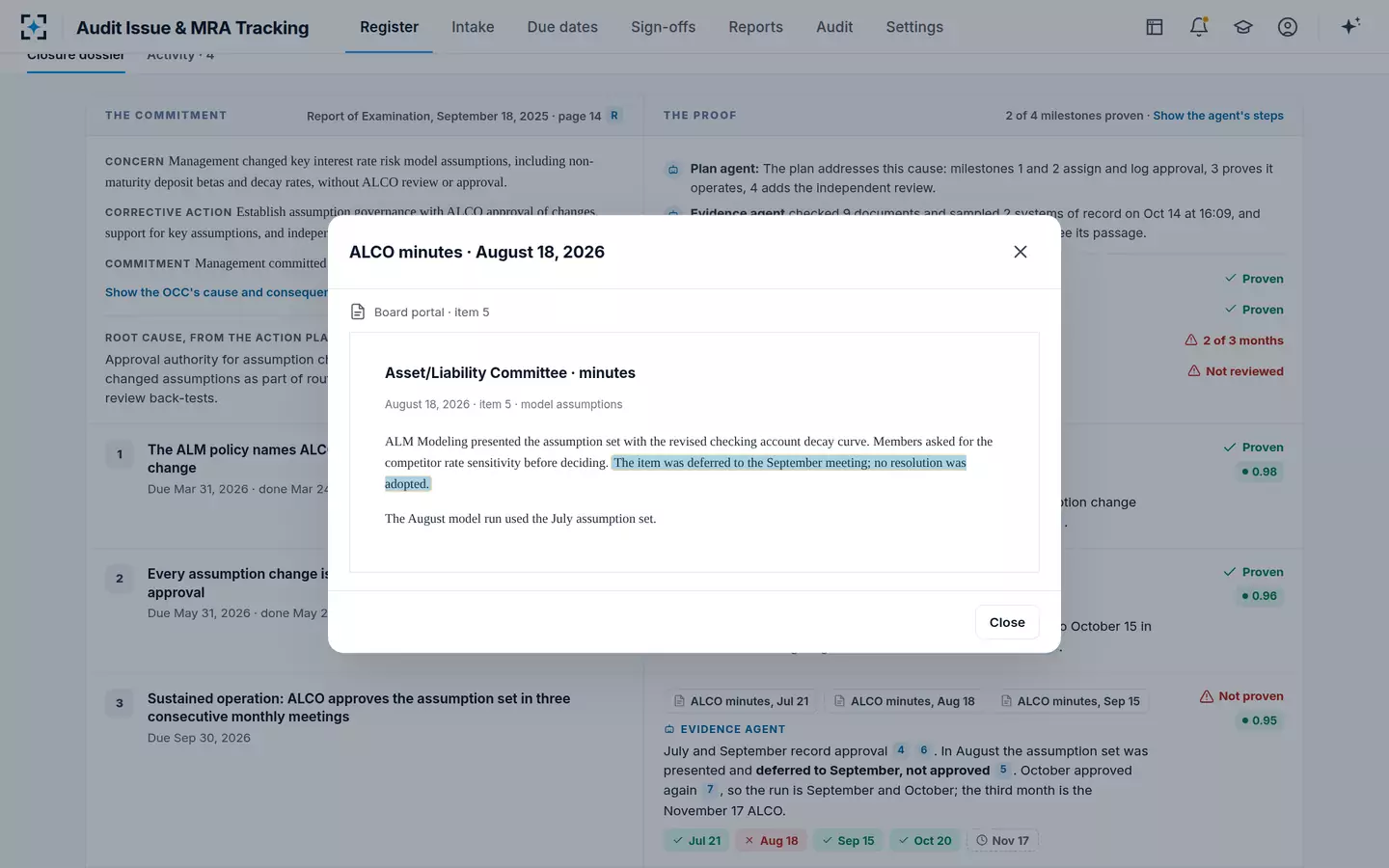
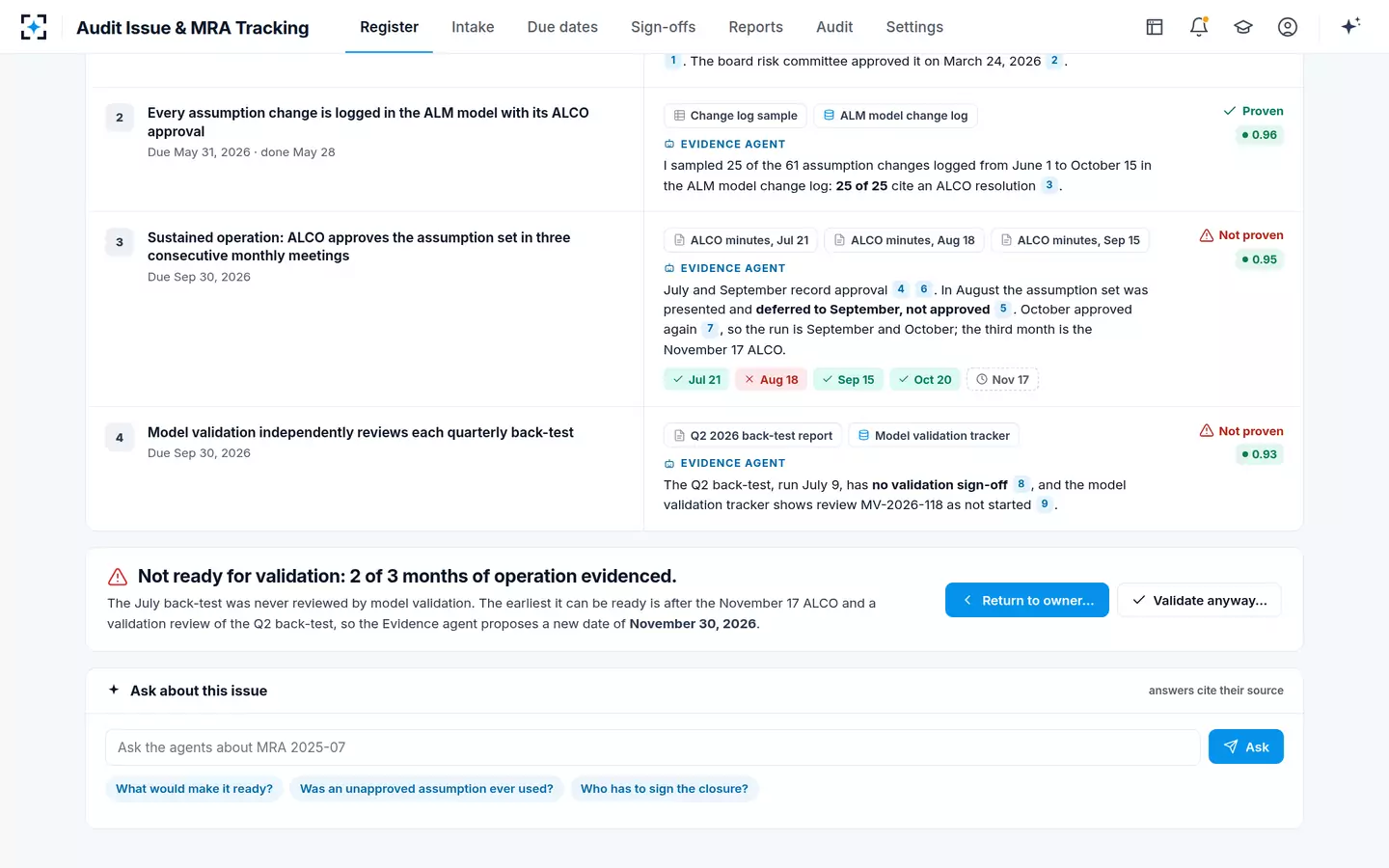
The sample bank's MRA 2025-07 shows how a run breaks. The fix required ALCO to approve the interest rate risk model's assumption set every month. ALCO approved in July, deferred in August, then approved in September and October. The fix had not failed, and the August model run even used the approved July set, but August was not a month of approval, and the rule counts approvals. The run restarted in September; the third month can only be the November 17 meeting.
The month that broke the run: one deferred decision
Do examiners still test sustainability?
At the Federal Reserve, no longer as a condition of closing an MRA. Its 2026 operating principles tell examiners not to delay termination once the underlying deficiency is fully remediated, and add a sentence aimed squarely at sustainability testing.
Nor should they test whether the remediation is sustainable over a period of time.
Federal Reserve, Updated Statement of Supervisory Operating Principles (April 2026, updated September 2026)
The principles do not say sustainability stops mattering. They tell examiners to "issue a new MRA or MRIA, or take more forceful action, if the remediation turns out not to be sustainable" (Federal Reserve). The risk has moved, not shrunk: a fix that fails after closure now comes back as a new finding rather than an old one kept open. For the bank, the cheaper place to find a fix that does not last is its own validation.
Consent orders are a different matter. The OCC's 2020 order against Citibank, for example, provides that the bank will not be deemed in compliance until the OCC has verified and validated the corrective actions, and that "An assessment of the effectiveness of the corrective actions requires sufficient passage of time for the Bank to demonstrate the sustained effectiveness of the corrective actions" (OCC Consent Order AA-EC-2020-64, Article XVI). Under an order, the agency still tests sustainability itself. The Citi record is followed in the OCC consent order on Citi, 2020.
Who tests that a fix lasts: an enforcement order and an MRA in 2026
Under a consent order: The agency verifies and validates corrective actions itself.
Under an MRA at the Federal Reserve, 2026: Examiners do not; they assess internal audit's validation and rely on it if satisfactory.
Under a consent order: After sufficient time has passed to show sustained effectiveness.
Under an MRA at the Federal Reserve, 2026: As promptly as possible once each deficiency is fully remediated.
Under a consent order: Continued noncompliance; penalties for violating the order are possible.
Under an MRA at the Federal Reserve, 2026: A new MRA or MRIA, or stronger action.
Under a consent order: In the bank's reports to the agency, tested by the agency.
Under an MRA at the Federal Reserve, 2026: In internal audit's validation file, which is what examiners read.
Why were MRAs kept open after remediation?
Because examiners wanted to see the fix work over time before closing them, and the agencies themselves have now called that a problem. In the preamble to their MRA rule, the OCC and the FDIC wrote that MRAs had often stayed outstanding long after a bank finished remediating, while examiners waited to see sustainability demonstrated, and that the practice could distract boards, management and examiners by inflating MRA counts (91 FR 56004). They left suggestions on closure timing for later, outside the rule, which takes effect November 2, 2026; the OCC and FDIC MRA final rule guide covers the rule itself.
The preamble's criticism and the Federal Reserve's instruction point the same way: close remediated MRAs promptly and let the bank's own validation carry the sustainability question. That makes the validation rule the bank writes, months of operation by rating, samples per period, the line between a pass and a return, the most important sustainability standard in the process. It is worth writing carefully.
How long should a fix operate before closure?
Long enough to cover enough cycles of the control to tell a working fix from a lucky one, which depends on how often the control runs. No regulator sets a number of months. A monthly control tested for three months has run three times; a quarterly control would need most of a year to show the same thing; a control that runs on every transaction may show a hundred cycles in a week. Rating matters too, because the cost of closing a failed fix rises with the finding's severity.
Matching the proof period to how often the control runs
| How often the control runs | What to count | A reasonable proof period for a High rating |
|---|---|---|
| Every transaction (call-backs, approvals, edits) | A random sample per period from the system of record | Several months, each sampled separately |
| Daily or weekly (reconciliations, reviews) | Each occurrence, or a sample across the period | Two to three months |
| Monthly (committee approvals, monthly reconciliations) | Every occurrence | Three consecutive months |
| Quarterly (back-tests, access recertifications) | Every occurrence, with its sign-off | Two consecutive quarters, or one plus a full-population test |
| Annual (policy reviews, model validations) | The occurrence and its evidence | One cycle, plus a check of the control that triggers it |
Write the rule before the request arrives. A validator who decides the proof period per closure request is applying judgment where she should be applying a methodology, and an owner cannot plan a remediation without knowing how long the proof must run. The OCC and FDIC rule makes a related point about scale: as a bank's risk rises, "The requirements under the action or matter relating to remediation, and the expectations regarding prudent operation, increase" (91 FR 56004). A larger, more complex bank should expect its proof periods to be longer, not shorter.
What sample size proves sustained operation?
A sample in each period, large enough that a clean result is informative, drawn at random by someone other than the owner. Pooling three months into one sample of 25 can hide a bad month; sampling each month separately shows it. At 95% confidence, a clean random sample of 25 still allows a true exception rate of up to about 11%, and a clean 10 up to about 26%, which is why the MRA closure report guide sets out the full table and why period-by-period counting matters as much as size.
Where the system allows it, a full-population test beats any sample: every assumption change in a change log against every ALCO resolution, every wire above a threshold against its call-back. The sample bank's Evidence agent sampled 25 of the 61 assumption changes logged from June 1 to October 15 and found all 25 cited an ALCO resolution, with the seed kept so the validator can redraw them.
Sustained operation counted in Audit Issue & MRA Tracking, with a realistic date
What happens if remediation is not sustained?
The finding comes back, and the cost is higher the later it is found. Found by the validator before closure, a broken run means a return and a new date. Found by the bank after closure, it is a reopened or repeat finding, and the OCC's audit booklet expects repeat audit issues to be reported to the board or audit committee and to prompt further root cause analysis. Found by an examiner at the Federal Reserve, it is a new MRA or stronger action. A fix that does not last is also strong evidence that the plan treated a symptom, the subject of examples of root cause in audit findings.
A sustainability test plan for one finding, written before the fix goes live
- The control that must keep operating
Named precisely: who does what, in which system, how often.
- The periods and how many
Months or quarters by rating and control frequency, consecutive, with what restarts the run.
- What counts as an occurrence
Approved, not presented; signed, not prepared. Write the verb down.
- The population and the sample per period
Where the records live, how many to draw, how they are drawn, and the seed.
- The exception rule
How many exceptions fail a period, and how an explained exception is treated.
- Who draws and who decides
Someone independent of the owner draws; the validator decides; a different person signs.
- What is monitored after closure
The indicator that would show the fix failing, and who watches it.
Who decides an issue is sustainably fixed?
Internal audit's validator, under rules the bank has approved, with a second signature for regulatory issues. The owner's view that the fix works is evidence, not a decision. At the sample bank the validation lead validates or returns with a reason code, may override the agents' verdict with a reason code of her own, and the Chief Risk Officer signs every MRA closure. The rules themselves change only by proposal from the Issue Management Office, approved by the Internal Audit Director, and every version is kept.
The agents' part is counting, not deciding. The Evidence agent reads the evidence for each milestone, samples the system of record read-only with the seed recorded, counts the periods, and writes the verdict line with the gap and the earliest realistic date. It never validates or closes; below a confidence of 0.80 a person decides. The IIA's Standard 15.2 asks internal auditors to confirm implementation "following an established methodology" (IIA, 2024); written proof periods, per-period samples and kept seeds are what make the methodology established. To see the months counted on your own closure requests, start from Audit Issue & MRA Tracking.
Questions people ask
What is the audit findings remediation process?
Diagnose the root cause, agree an action plan with dates and owners, carry it out, show the control operating over a period, and have internal audit validate it independently before closure. Regulatory findings add a senior sign-off and reporting to the examiner. The weakest step is usually the period of operation.
Is sustainability testing required by regulation?
Not as a fixed rule. The OCC's audit booklet expects testing over an appropriate period for higher-risk issues, and consent orders often require sustained effectiveness before compliance. The Federal Reserve's 2026 principles stopped examiners testing sustainability before closing MRAs, which leaves the test to the bank's own validation.
How many months of evidence are enough?
Enough cycles of the control to tell a lasting fix from a lucky one. For monthly controls on serious findings, three consecutive months is a common choice; the sample bank uses three, two and one months for High, Moderate and Low ratings. Quarterly and annual controls need rules of their own.
Can an issue be closed before the proof period ends?
It should not be validated before the period the bank's rules require, because that is the test. The validator can propose a realistic date instead, as the sample bank's verdict does for MRA 2025-07, and the date change goes to a second signer.
What if a remediated control fails a year later?
Treat it as a repeat finding: log it, link it to the original, and analyse why the fix did not hold. The OCC expects repeat audit issues in reports to the board or audit committee. At the Federal Reserve, an unsustained remediation can bring a new MRA or stronger action.