Internal audit follow up procedures are the steps internal auditors take after an audit report to confirm that management has carried out its action plans: asking owners about progress, testing completed actions to a depth that matches the finding's significance, keeping a tracking system up to date, and, when a date is missed, getting a documented explanation and taking it to the chief audit executive. Since January 9, 2025 they are set by Standard 15.2 of the Institute of Internal Auditors' Global Internal Audit Standards. The hard part in a bank is volume and pace: hundreds of open issues, each with milestones that fall due at different times, and evidence that lives in many different systems. Botminds' Audit Issue & MRA Tracking runs that follow-up continuously: its agents read every open issue each morning, flag slips before the date and test each closure request against its evidence, while internal audit keeps every decision.
Examples come from a fictional sample bank as it runs through the solution: Corvane National Bank, an OCC-supervised regional bank with 640 open issues, 410 of them from internal audit.
Standard 15.2 as a sequence, with the escalation branch
A person decides
Inquire about progressAsk the owner where each action stands against its completion date. The first of the three steps 15.2 names.
A person decides
Update the tracking systemRecord the status of management's actions, so open and past-due plans are visible to the board and senior management.
A person decides
Perform a risk-based follow-up assessmentTest completed actions to a depth that matches the finding's significance, from inquiry for low-risk items to re-performance for high-risk ones.
A person decides
If a date is missed: explanation, then the CAEObtain and document management's explanation and discuss the issue with the chief audit executive.
A person decides
CAE decides on accepted riskDetermine whether senior management, by delay or inaction, has accepted a risk beyond tolerance; if so, Standard 11.5 applies: senior management first, then the board.
What are internal audit follow up procedures?
They are the part of internal audit's work that starts when the report is issued and ends when internal audit confirms the finding is resolved. The OCC's audit booklet describes the same arc for banks: "Follow-up activities should allow internal auditors to determine the disposition of any agreed-on actions and provide information for future audit activities," and "The auditors should perform follow-up activities promptly and report the results to the bank board or its audit committee" (OCC, Internal and External Audits). Disposition is the key word: implemented, implemented differently, delayed with an explanation, or not implemented and accepted as a risk by someone with the authority to accept it.
Follow-up is different from validation, although the two overlap. Follow-up is the whole monitoring cycle across every open action; validation is the test, at the end, that a completed action works. Issue validation in internal audit covers that final test and the seat that performs it.
What does IIA Standard 15.2 require?
An established methodology for confirming that management has implemented the recommendations or action plans, with three named elements, a depth that depends on the finding, and an escalation path when dates are missed. The requirement opens with the sentence that sets the obligation.
Internal auditors must confirm that management has implemented internal auditors' recommendations or management's action plans following an established methodology
The IIA, Global Internal Audit Standards, Standard 15.2 Confirming the Implementation of Recommendations or Action Plans
The methodology, the standard says, includes "Inquiring about progress on the implementation", "Performing follow-up assessments using a risk-based approach" and "Updating the status of management's actions in a tracking system", and "The extent of these procedures must consider the significance of the finding." The second paragraph governs missed dates: "If management has not progressed in implementing the actions according to the established completion dates, internal auditors must obtain and document an explanation from management and discuss the issue with the chief audit executive. The chief audit executive is responsible for determining whether senior management, by delay or inaction, has accepted a risk that exceeds the risk tolerance" (IIA, 2024).
The considerations for implementation add two practical points. A methodology "should include criteria for determining when to perform follow-up assessments", so selective testing is a documented choice, not an omission. And plans change: "If management decides on an alternative action plan and internal auditors agree that the alternative plan is satisfactory or better than the original action plan, then progress on the alternative plan should be tracked until completion."
When did the Global Internal Audit Standards take effect?
On January 9, 2025, a year after the IIA released them in January 2024. The IIA's announcement put it simply: "After having a year to begin implementing the new Standards, they became effective on January 9 of this year" (IIA, January 16, 2025). For follow-up the substance is familiar; what is new is the precision: a named methodology with three elements, a documented explanation for every missed date, and an explicit role for the chief audit executive in deciding whether delay has become accepted risk.
What is a risk-based follow-up?
A follow-up whose depth depends on the finding's significance: a low-rated finding may be closed on inquiry and a document, a high-rated one only after re-performance and months of operation. The IIA's guidance allows follow-up assessments of completed plans to be done "selectively, depending on the risk's significance", provided the criteria are set in advance. The OCC's booklet asks for the same scaling, with substantive testing for higher-risk issues.
Risk-based follow-up in practice: one bank's rules by rating
| Rating | Months of sustained operation | Records sampled | Reminders before the date | Date changes before the board sees it |
|---|---|---|---|---|
| High | 3 consecutive | 25 | 30, 14 and 7 days | 2; the third goes to the board risk committee |
| Moderate | 2 consecutive | 15 | 30, 14 and 7 days | 2; the third goes to the board risk committee |
| Low | 1 | 10 | 30, 14 and 7 days | 2; the third goes to the board risk committee |
Writing the rules down is the point. A follow-up methodology that lives in each auditor's judgment cannot be shown to an examiner or applied consistently across 400 audit issues. At the sample bank the rules are settings, versioned, and changed only by a proposal from the Issue Management Office approved by the Internal Audit Director.
How often should audit issues be followed up?
Standard 15.2 sets no calendar; the frequency follows the dates in the action plans and the significance of each finding. In practice a bank needs two rhythms: a frequent one that watches milestones approach, and a periodic one that reports status to the board. Without the first, the second reports slips after they happen.
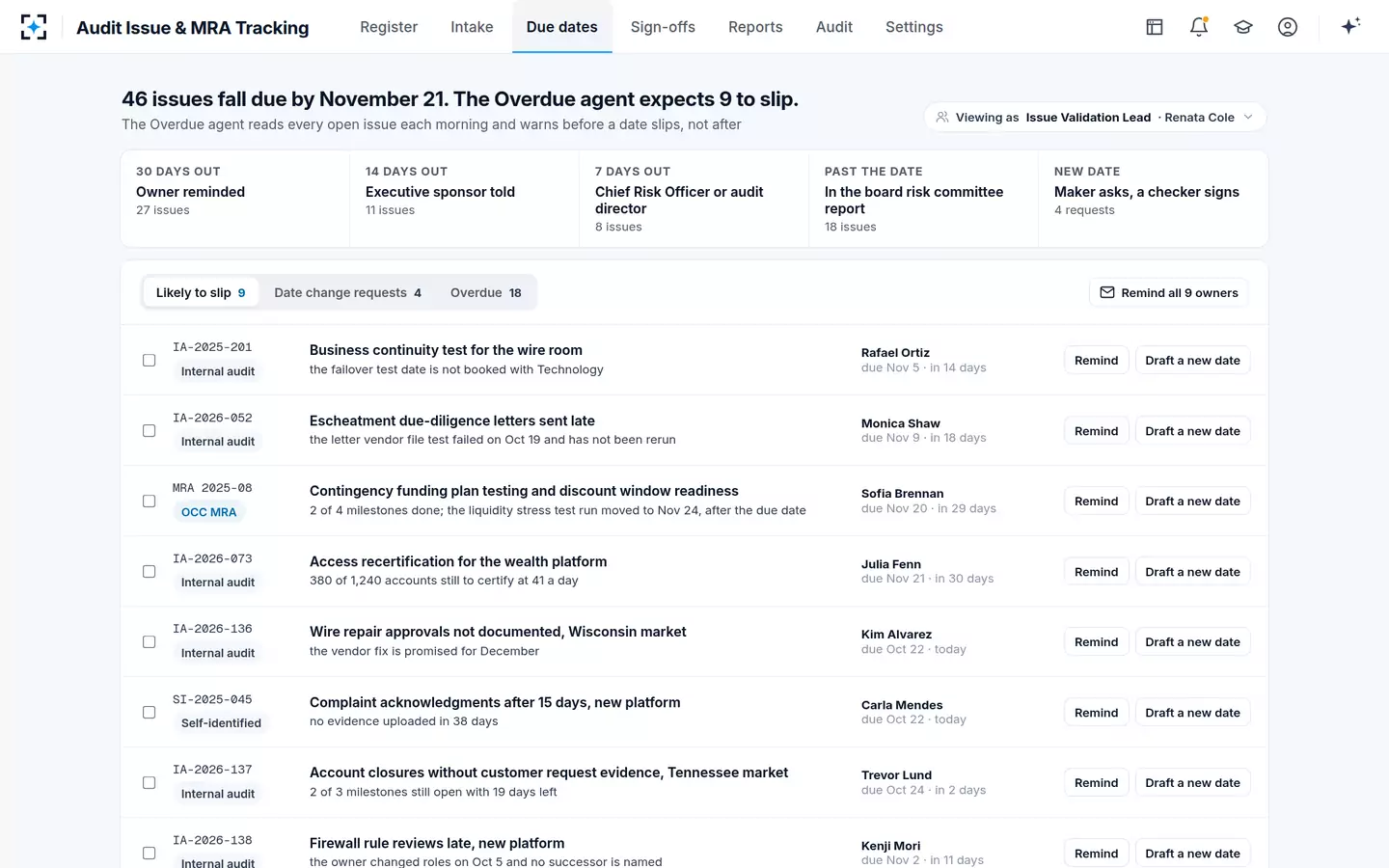
The sample bank's Overdue agent reads every open issue's milestones, evidence pace and dependencies each morning at 06:00 and flags likely slips with the reason. On the sample's October 22, 2026 it counted 46 issues falling due by November 21 and expected 9 to slip, each with a reason an owner could act on: a failover test not yet booked with Technology, a stress test run moved past its due date, 380 accounts still to certify at 41 a day.
Follow-up as a daily reading in Audit Issue & MRA Tracking: who is reminded, and why
What if management misses an action plan date?
Internal audit obtains and documents management's explanation and discusses it with the chief audit executive; that is the requirement. What usually goes wrong is the order of events: the date passes, then the explanation is sought, then a new date appears in the tracker without anyone deciding it. The OCC's booklet expects dates to be agreed rather than imposed: "Internal audit and the responsible bank management should discuss and agree to an appropriate resolution date, based on the level of work necessary to complete remediation processes" (OCC, Internal and External Audits). A new date deserves the same discipline as the first one.
At the sample bank a date change is a request: a reason code, a realistic date, a maker and a different checker, the Internal Audit Director for audit issues and the Chief Risk Officer for MRAs. The explanation 15.2 asks for is the reason code and its note, kept in the history. A third change to the same issue goes to the board risk committee.
When must the chief audit executive escalate?
When the chief audit executive concludes that management has accepted a level of risk beyond the organisation's risk tolerance. Standard 11.5 sets the path: the matter must be discussed with senior management; "If the chief audit executive determines that the matter has not been resolved by senior management, the matter must be escalated to the board." The standard is careful about the limit of the role: "It is not the responsibility of the chief audit executive to resolve the risk" (IIA, 2024, Standard 11.5).
Repeated slips are the usual route to that conclusion. A plan whose dates move twice, then three times, is a plan management is not resourcing; at some point, by the standard's own words, delay or inaction has become acceptance. A tracking system that keeps the full date history, with reasons, makers and checkers, is what lets the chief audit executive make that call on evidence rather than impression.
What the bank regulators add to Standard 15.2
Standard 15.2 is the profession's floor; bank supervisors build on it. The four overlays below are the ones a US bank's follow-up methodology most often has to answer to.
Four regulatory overlays on internal audit follow-up in a US bank
OCC, Internal and External Audits booklet
Follow up promptly and report the results to the board or audit committee; agree resolution dates with management; give every issue an owner; validate before treating an issue as closed, with substantive testing for higher-risk issues.
Applies toNational banks and federal savings associations supervised by the OCC.
OCC heightened standards, 12 CFR part 30, appendix D
Internal audit's reports to the audit committee identify the root cause of material issues, whether it reaches more than one unit, and how effectively the first and second lines identify and resolve issues on time.
Applies toCovered banks, generally $50 billion and above.
Federal Reserve operating principles, 2026
Examiners assess internal audit's validation of MRA remediation and rely on it if satisfactory, instead of repeating it.
Applies toBanking organisations the Federal Reserve supervises.
OCC and FDIC MRA rule, effective November 2, 2026
Narrows when an MRA may be issued; leaves closure practice outside the rule. Follow-up of MRAs remains the bank's methodology.
Applies toBanks the OCC and FDIC supervise.
The Federal Reserve overlay changes the weight of follow-up most. If examiners rely on internal audit's validation of MRA remediation instead of repeating it, internal audit's follow-up methodology becomes part of the supervisory record. The OCC and FDIC rule on MRAs, effective November 2, 2026, does not set closure practice; the OCC and FDIC MRA final rule guide covers what it does change, and who proves the fix lasts after 2026 what moved to the bank.
An internal audit follow-up report template
The IIA lists, as evidence of conformance with 15.2, a routinely updated tracking system and "Corrective action status reports prepared for the board and senior management." A follow-up report that serves both the standard and a bank's audit committee needs the fields below, and it needs them as history, not as a snapshot.
An internal audit follow-up report: what each line should carry
- The finding and its rating
As issued, with the engagement it came from.
- The action plan and its owner
Including any alternative plan internal audit agreed, tracked to completion in its place.
- Status, in three states
Open; complete per management; confirmed by internal audit. A report that merges the last two overstates progress.
- Original and current completion dates
With the number of changes and the reason for each.
- Follow-up performed
Inquiry only, document review, or re-performance with sample size: the risk-based choice, made visible.
- Explanations for missed dates
Documented, as 15.2 requires, with the date the chief audit executive discussed them.
- Accepted-risk decisions
Where the CAE concluded risk was accepted beyond tolerance, and what senior management or the board did.
- Repeat findings
Issues that recur after closure, the strongest signal that a follow-up methodology is not working.
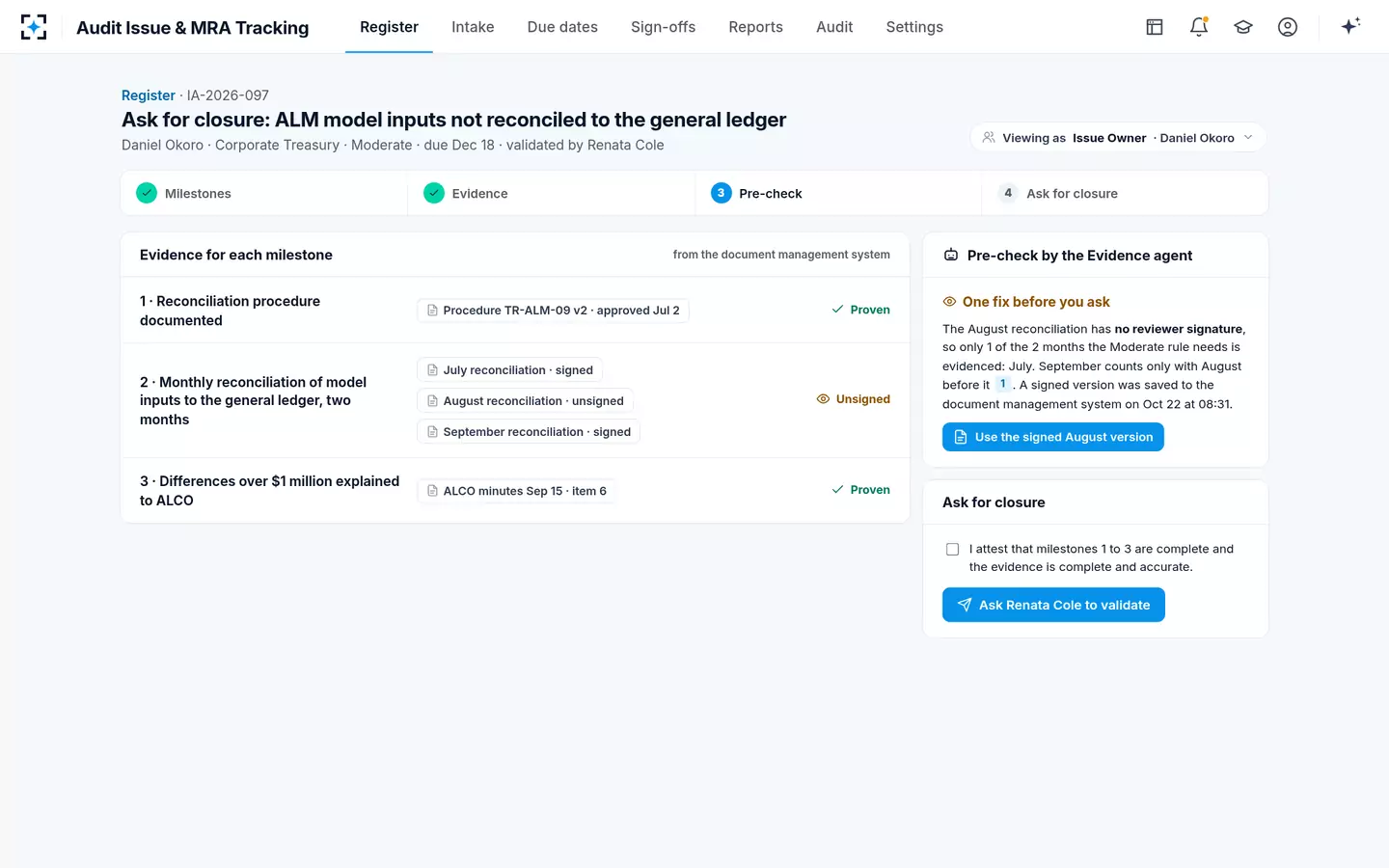
The owner's side of follow-up matters as much as the auditor's. At the sample bank an owner runs the same test validation will run before asking for closure, so the follow-up assessment rarely finds what the owner could have found. On IA-2026-097 the pre-check found an unsigned August reconciliation while it was still a one-click fix; root causes for the returns that do happen are traced in examples of root cause in audit findings.
The owner's pre-check in Audit Issue & MRA Tracking: follow-up before the follow-up
To see the daily follow-up, the date discipline and the reports on your own register, start from Audit Issue & MRA Tracking.
Questions people ask
Does Standard 15.2 require internal audit to retest every completed action?
No. It requires a methodology with risk-based follow-up assessments whose extent considers the significance of the finding, and the IIA's guidance allows completed plans to be assessed selectively. The criteria for when to test must be set in the methodology, not decided case by case.
What tracking system does the IIA expect?
Any that works: the IIA says internal auditors may use a software program, spreadsheet or system. Its evidence of conformance is a routinely updated tracking system holding each finding, its corrective action plan, status and internal audit's confirmation, plus status reports to the board and senior management.
Who explains a missed action plan date?
Management does; internal auditors must obtain and document the explanation and discuss it with the chief audit executive. The CAE then decides whether the delay amounts to accepting a risk beyond tolerance, which under Standard 11.5 goes to senior management and, if unresolved, the board.
Can management change the action plan after the report?
Yes, if internal auditors agree the alternative is satisfactory or better than the original; the standard then asks that progress on the alternative plan be tracked until completion. The change, and internal audit's agreement, belong in the follow-up history.
Do regulators rely on internal audit's follow-up?
Increasingly. Since 2026 the Federal Reserve tells its examiners to assess internal audit's validation of MRA remediation and rely on it if satisfactory. The OCC expects internal audit to validate issues before treating them as closed and to report follow-up results to the board or audit committee.