An MRA closure report is the file a bank assembles to show that a matter requiring attention has been fully remediated: the examiner's finding, the root cause, each milestone in the action plan, the evidence that each was met, internal audit's independent validation and the sign-off, sent with the bank's request that the examiner close the matter. It survives a second look when each milestone's evidence shows the cause was changed and the control has kept operating, sampled from the system of record rather than chosen by the owner. It fails, most often, because "done" was evidenced by a policy and a set of minutes. Botminds' Audit Issue & MRA Tracking builds the file as a closure dossier from the start, commitment on one side and proof on the other, and its agents test each closure request against its evidence and the system of record before the validator decides and the Chief Risk Officer signs.
The examples come from a fictional sample bank as it runs through the solution: Corvane National Bank, an OCC-supervised regional bank with 12 open OCC MRAs and about 85 closure requests a month across all its issues.
What an MRA closure report must hold, and why each part is there
- The finding as the examiner wrote it, with its citation
Report of examination or letter, date and page. The closure is tested against those words, not the bank's summary of them.
- The root cause, in one sentence
From the action plan. A milestone that does not trace to it cannot prove the matter is fixed.
- Each milestone and what it promised
With its due date and the date it was done. A milestone without a stated proof is a milestone nobody can validate.
- Design evidence for each milestone, with the passage
The policy section, the configuration change, the approval. Cited to the page or entry, not attached as a bundle.
- Operating evidence: population, sample and exceptions
How many items existed, how many were drawn, how they were chosen (with the seed), and what each showed.
- Sustained operation, month by month
Which months count, which broke the run and why. This is the part that fails most often.
- Internal audit's validation and who did it
An independent conclusion by someone who did not do the work and does not report to the owner.
- Every date change, with reason and signer
The history of the commitment, not just today's date.
- The sign-off, maker and checker
Who asked, who validated, who signed. A senior officer signs before anything is reported as closed.
- What stays monitored after closure
The key indicator or periodic test that would show the fix failing, so a relapse is found by the bank first.
What goes in an MRA closure report?
The finding, the root cause, the plan, the proof for every milestone, the validation and the signatures, in that order, so that a reader can follow one thread from what the examiner said to what now shows it fixed. The expectations sit in several places, an audit booklet, the Federal Reserve's operating principles, the bank's own methodology, and the ten parts above are what they amount to when laid side by side. The parts that are usually missing are the second half of the list: the sample with its population and seed, the months of operation, the date history and what will be watched after closure.
Order matters because the most common weakness of a closure file is evidence that answers a different question. A file that opens with the new policy invites the reader to ask whether the policy is good. A file that opens with the examiner's words and the root cause invites the right question: did this cause stop producing this condition? The sample bank's dossier for MRA 2025-07 opens with the examiner's sentence from the September 18, 2025 report of examination, page 14: management "changed key interest rate risk model assumptions, including non-maturity deposit betas and decay rates, without ALCO review or approval."
How do you close an MRA?
The bank remediates, validates and reports; the examiner decides. In sequence: the owner completes the milestones and asks for closure; internal audit validates the remediation independently; a senior officer signs; the bank reports the matter as remediated in its next update to the examiner, with the file available; and the examiner confirms and closes it, often at the next examination or visitation. The Federal Reserve's 2026 principles tell its examiners to close promptly once the work is done, directing them to "terminate the MRA, MRIA or requirement in an enforcement action as promptly as possible after each deficiency underlying the MRA, MRIA or requirement has been fully remediated" (Federal Reserve, Updated Statement of Supervisory Operating Principles).
An MRA closure in Audit Issue & MRA Tracking: tested before it is asked for, signed before it is reported
Agent
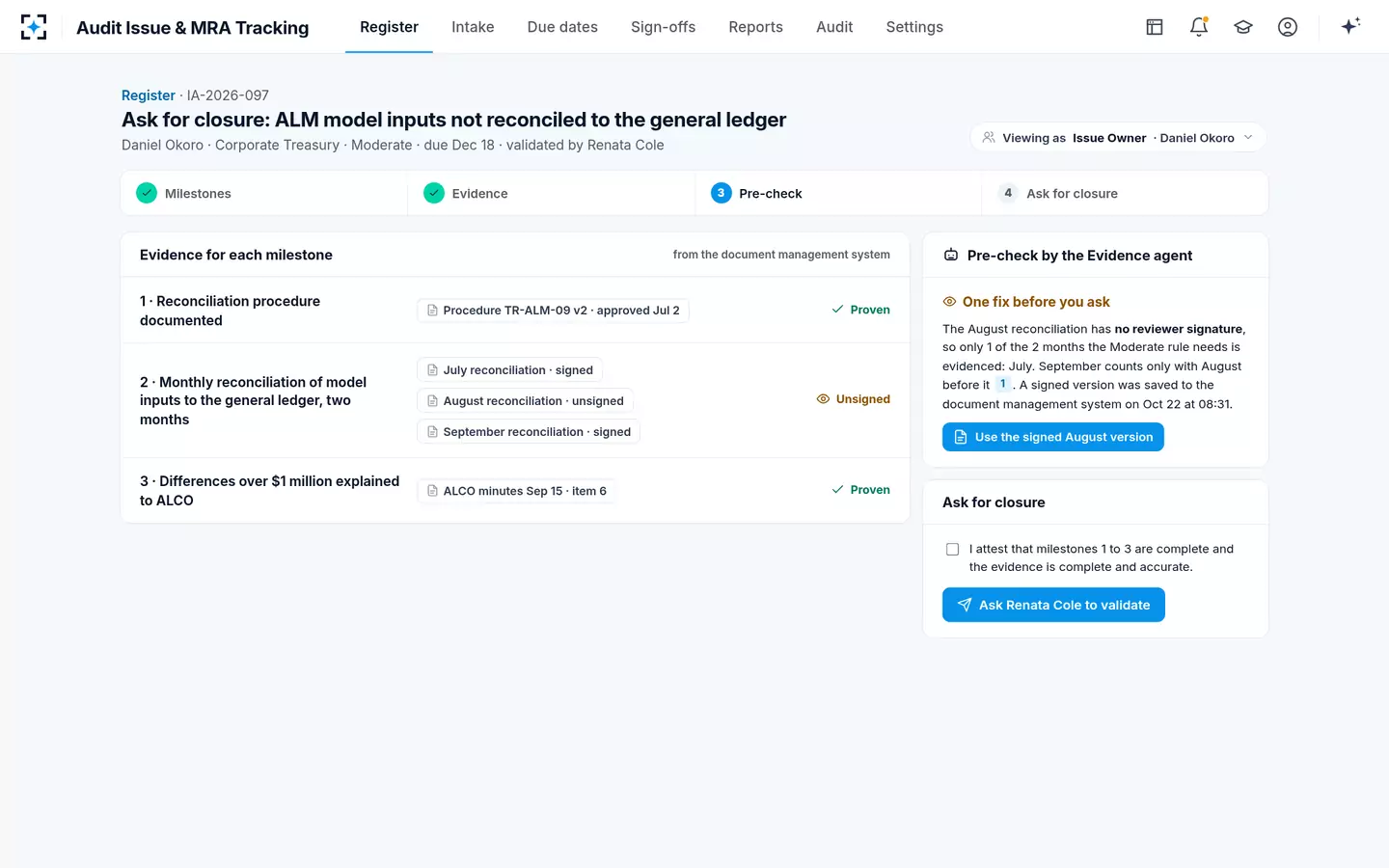
Owner's pre-checkBefore the owner asks, the Evidence agent runs the test validation will run and names what is missing, such as an unsigned month.
A person decides
Owner asks for closureAttests the milestones are complete and the evidence accurate.
Never: Cannot validate their own issue.
Agent
Evidence agent testsReads each document against its milestone, samples the system of record read-only, counts the months, writes the verdict line and the earliest realistic date.
Never: Never validates or closes.
A person decides
Validation lead decidesValidates, or returns with a reason code and a new date; may override the agent with a reason code of her own.
A person decides
Chief Risk Officer signsSigns the closure or the date change, seeing maker, reason and evidence; then the OCC update carries it.
Which examiners rely on what varies by agency. At the Federal Reserve, an effective internal audit's validation is now relied on rather than repeated, and in its first-phase review of open MR(I)As in early 2026, "Supervisors closed a number of outstanding supervisory matters that had been fully remediated" (Supervision and Regulation Report, June 2026). The OCC and FDIC rule effective November 2, 2026 governs when an MRA may be issued and leaves closure practice outside the rulemaking; the OCC and FDIC MRA final rule guide covers what it changes.
What evidence do examiners want to close an MRA?
Evidence that the deficiency the examiner described no longer exists, and the bank's own independent confirmation of it. That means evidence about outcomes, not activity: the control operating in the system of record, not a training log that says people were told to operate it. The OCC's audit booklet adds a requirement on the method itself: "The bank's approach to validating issue remediation should be clearly defined in its policies and procedures to promote consistency" (OCC, Internal and External Audits). An examiner reading a closure file is reading the bank's methodology as much as the result.
The Federal Reserve's own review of Silicon Valley Bank describes the trap from the examiner's side: "in some instances, supervisors saw progress on remediation of supervisory findings or risk-management gaps as positive developments on a relative basis, rather than citing the gap that continued to exist relative to baseline expectations" (Federal Reserve, April 2023). A closure report built around progress, how much better than last year, invites the same mistake. One built around the baseline, the non-deficient state the finding implied, does not.
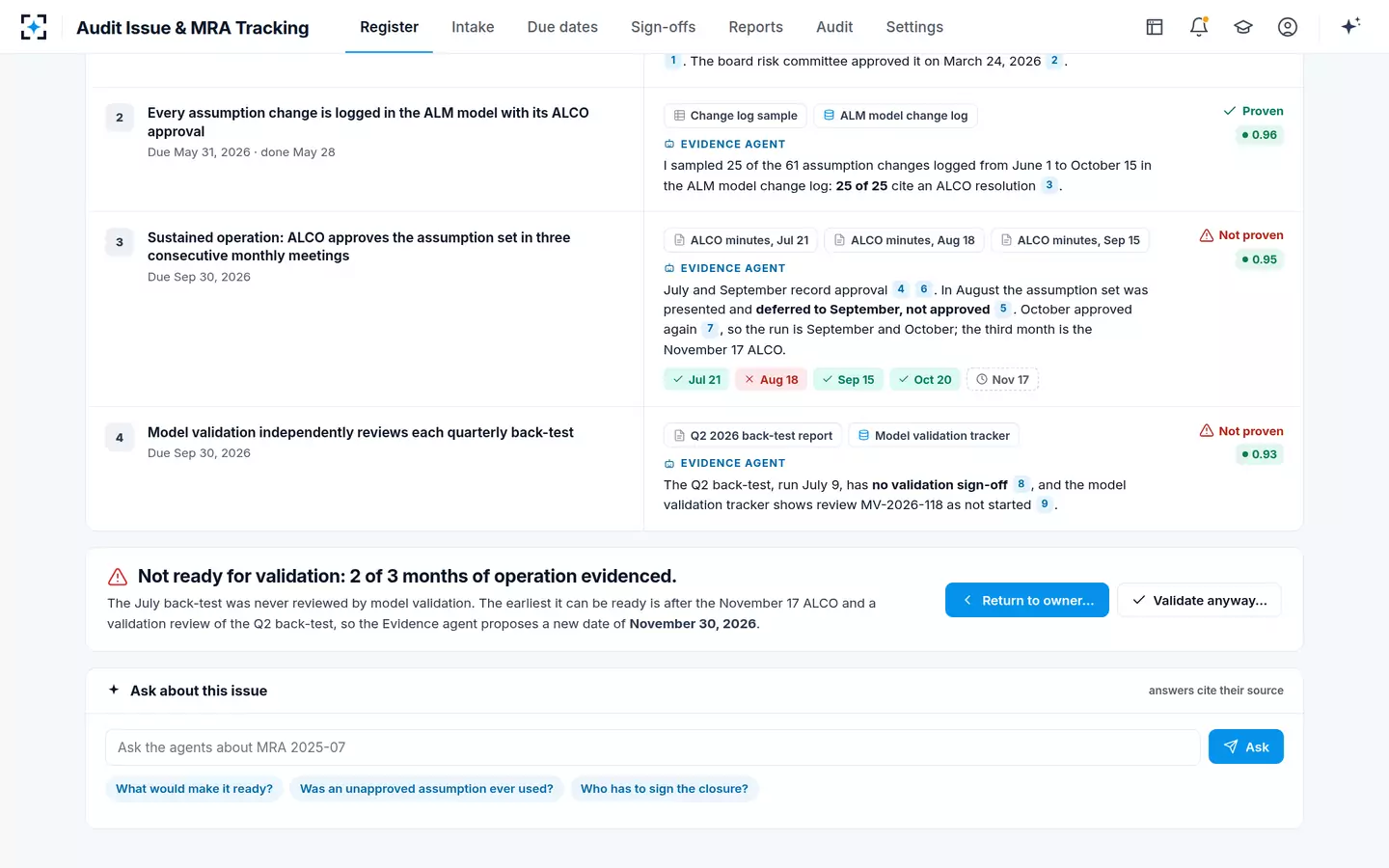
One verdict line in Audit Issue & MRA Tracking: what is missing, and the earliest date
What is sustained operation evidence?
Evidence that the control worked in each of a run of consecutive periods after the fix, typically months, counted from the records the control leaves behind. It answers the question a single sample cannot: did the fix last, or did it work the week it was tested? The sample bank sets the run by rating, three consecutive months for High, two for Moderate and one for Low, and counts approvals, not presentations. In MRA 2025-07, ALCO approved the assumption set in July, deferred it in August and approved it in September and October; the run restarted in September, so the third month can only be the November 17 meeting.
Sustained operation is also where the supervisory picture changed most in 2026. The Federal Reserve told its examiners to stop testing whether remediation is sustainable over time, and the OCC and FDIC criticised MRAs held open to watch it. The test has not disappeared; it has moved to the bank's own validators, as who proves the fix lasts after 2026 explains.
What sample size should validation use?
Large enough that a clean result means something, and stated in the bank's methodology rather than chosen per request. The arithmetic is unforgiving. If a validator draws n items at random and finds no exception, the most she can say at 95% confidence is that the true exception rate is below 1 − 0.051/n, roughly 3 ÷ n, the "rule of three" described by Hanley and Lippman-Hand in "If nothing goes wrong, is everything all right? Interpreting zero numerators" (JAMA, 1983).
What a clean sample proves: the highest exception rate still consistent with what was found
| Items sampled | No exceptions found | One exception found | Two exceptions found |
|---|---|---|---|
| 10 | up to 25.9% | up to 39.4% | up to 50.7% |
| 15 | up to 18.1% | up to 27.9% | up to 36.3% |
| 25 | up to 11.3% | up to 17.6% | up to 23.1% |
| 30 | up to 9.5% | up to 14.9% | up to 19.5% |
| 40 | up to 7.2% | up to 11.3% | up to 14.9% |
| 60 | up to 4.9% | up to 7.7% | up to 10.1% |
Read the table against the finding. A clean 25 says the exception rate is probably under about 11%; it does not say the control is perfect. For a control whose failure is costly, a validator can widen the sample, test several months separately, or combine a sample with a full-population check where the system allows it, such as every assumption change in a change log compared with every ALCO resolution. The sample bank's MRA 2025-07 drew 25 of 61 changes, all citing a resolution; comparing all 61 with the minutes would be the stronger test, and the log is small enough to allow it. The sample size itself belongs in the methodology the OCC expects to be written down.
What makes a closure request fail?
Usually missing proof rather than a missing fix. At the sample bank, 14 of 86 closure requests in September 2026 came back at first validation, and 8 of those for the same reason: sustained operation not evidenced. The others fail for evidence that does not match the milestone, a sample the owner chose, a dependency on another team's sign-off, or a plan that changed the symptom and left the cause, which is the subject of examples of root cause in audit findings.
A weak closure file and a defensible one, for the same MRA
Weak: The new ALM policy, version 7.2.
Defensible: The examiner's sentence, the report page and the root cause from the action plan.
Weak: "ALCO now approves all assumption changes."
Defensible: 25 of the 61 changes logged June 1 to October 15, drawn at random with the seed kept: all 25 cite an ALCO resolution.
Weak: "Operating since July."
Defensible: Approved in July, deferred in August, approved in September and October: two consecutive months of three; third month November 17.
Weak: Not mentioned.
Defensible: The Q2 back-test has no validation sign-off; review not started. Milestone not met.
Weak: Close now.
Defensible: Not ready; new date November 30, 2026, signed by the Chief Risk Officer before the OCC hears it.
Weak: Whether the policy reads well.
Defensible: Whether the condition is gone, by re-drawing the same sample.
The owner's pre-check: the same test, run before the request is made
How long after remediation is an MRA closed?
Two clocks run, the bank's and the examiner's. The bank's is its own proof period plus its validation clock: at the sample bank, a High-rated MRA needs three consecutive months of operation after the fix and then up to 15 business days for validation, so roughly three and three-quarter months from a fix that works first time. The examiner's clock depends on the agency. The Federal Reserve now tells its examiners to terminate an MRA as promptly as possible once each deficiency is fully remediated and not to wait to test sustainability. The OCC and FDIC set no closure timeline in their new rule, although its preamble criticised MRAs kept open long after remediation.
The practical consequence is that the bank's clock is the one it controls, and the one a weak file lengthens. Every return restarts part of it: a missing month of evidence found at validation can cost a month or more, because the proof cannot be created retroactively. The sample bank's MRA 2025-07 was committed for October 31, 2026; one deferred committee meeting moved the earliest realistic date to November 30.
Who submits the MRA closure to the regulator?
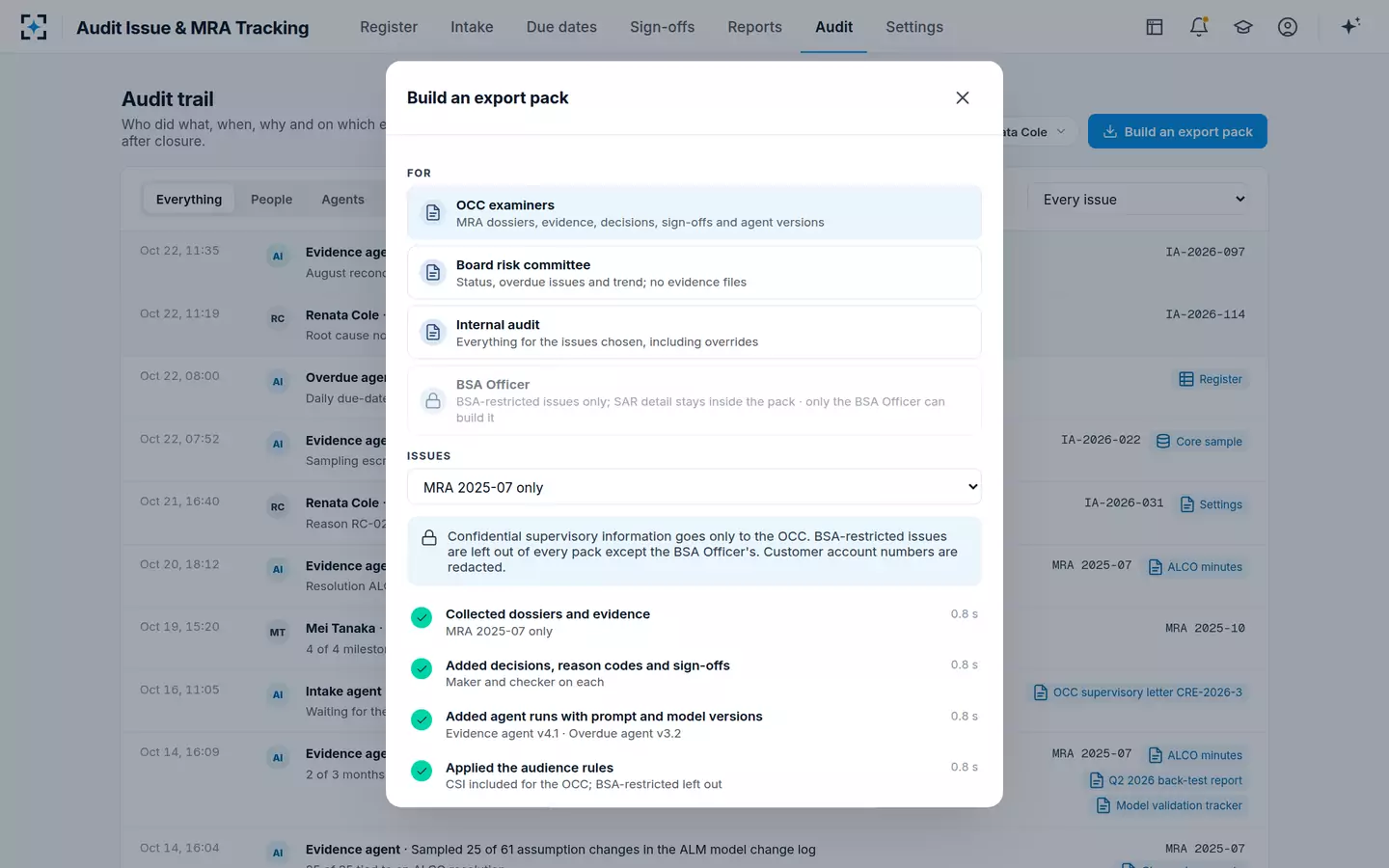
The bank does, through whatever channel its supervisor uses, and the signer should be a senior officer who did not do the work. At the sample bank the Chief Risk Officer signs every MRA closure and MRA date change, and the quarterly MRA update to the OCC carries the result only after his signature. The file behind it is built as an export pack for the examiners: the dossier, the evidence files, the decisions with their reason codes, the sign-offs and the agents' runs with their prompt and model versions, under a manifest of SHA-256 file hashes, so an examiner can check that nothing changed after it was signed.
An examiner pack for one MRA, with the audience rules applied
The bank's work does not end at the signature. A matter closed on a control that later stops operating comes back, and at the Federal Reserve the 2026 principles say a remediation that turns out not to be sustainable can bring a new MRA. Naming in the closure report what stays monitored, and who watches it, is the cheapest insurance a bank can buy. For the validator who builds these files, issue validation in internal audit describes the seat; to see a dossier tested end to end, start from Audit Issue & MRA Tracking.
Questions people ask
What format should an MRA closure report take?
Whatever the supervisor's instructions and the bank's own methodology require. What examiners look for is consistent: the finding, the root cause, evidence for each milestone, independent validation and senior sign-off. The OCC expects the validation approach to be defined in the bank's policies.
Who should keep the MRA closure file?
Internal audit owns the validation and its workpapers; at the sample bank the Issue Management Office keeps the register and the Export agent assembles what goes to the examiner. What matters is that the file is fixed once signed: the sample bank builds its examiner pack with a manifest of file hashes, so any later change would show.
Can an MRA be closed if one milestone slipped?
Only once every milestone is met; a slipped milestone means a revised date, not a partial closure. The request for a new date should carry a reason and be signed by someone other than its maker. At the sample bank a third date change on the same issue goes to the board risk committee.
Should the closure report include exceptions found in the sample?
Yes, with how each was resolved. One exception in 25 random items is consistent with a true exception rate of up to about 18% at 95% confidence, so an unexplained exception weakens the file. Explaining it, or widening the sample, is better than leaving it out.
What happens if a closed MRA's control fails later?
The bank should find it first through the monitoring named in the closure report and treat it as a new issue. At the Federal Reserve, the 2026 principles provide for a new MRA or stronger action if remediation proves unsustainable. The original file then shows what was tested, and when.