MRA tracking is a bank's running account of every matter requiring attention (MRA) its examiners have issued: the finding as written, the root cause, the action plan and its milestones, the owner, the commitment date, the evidence and the status, kept until the examiner closes the matter. Banks typically keep MRAs in a GRC system or a spreadsheet, and the list itself is rarely the problem. The problem is that the same people who did the remediation often mark it done, move its date and report it to the board, so the list says what the owners believe. Botminds' Audit Issue & MRA Tracking is built around the opposite rule: every closure, date change and rating change has a maker and a different checker, MRA closures and MRA date changes are signed by the Chief Risk Officer, and the agents that read, sample and draft are never allowed to validate, sign, send or move a date.
The examples come from a fictional sample bank as it runs through the solution: Corvane National Bank, an OCC-supervised regional bank with 640 open issues, 12 of them OCC MRAs.
One MRA closure in Audit Issue & MRA Tracking: who makes, who checks, who signs
A person decides
Issue owner · makerDoes the remediation, attaches evidence to each milestone, runs the pre-check, attests the work is complete and asks for closure.
Never: Cannot validate or sign anything on their own issue.
Agent
Evidence agentReads each document against its milestone, samples the system of record read-only with the seed kept, and writes one verdict line with the earliest realistic date.
Never: Never validates, closes, signs or moves a date.
A person decides
Issue Validation Lead · checkerOpens the dossier, checks the passages that decide it, validates or returns with a reason code, proposes a new date when the request is not ready.
Never: Cannot sign a date change she made herself.
A person decides
Chief Risk Officer · signerSigns every MRA closure and every MRA date change, seeing the maker, the reason code and the evidence.
Never: Does not sign a change he made.
Agent
Reporting agentDrafts the board risk committee report and the OCC quarterly MRA update from the register, every sentence traced to an issue.
Never: Never sends; nothing leaves before the Chief Risk Officer approves it.
What is MRA tracking?
MRA tracking is keeping each examiner finding visible, owned and dated from the day it arrives to the day the examiner closes it. The weight comes from what an MRA is. In the preamble to their new rule, the OCC and the FDIC write: "The agencies characterize MRAs as concerns that, in the agencies' judgment, rise to the level of requiring presentation to the board of directors and for which an institution must take corrective action" (91 FR 56004). The rule, effective November 2, 2026, narrows when the two agencies may issue one; the OCC and FDIC MRA final rule guide covers what qualifies, and this guide covers what happens after one arrives.
In practice an MRA tracker holds more than MRAs. Banks run the examiners' findings beside internal audit findings and issues the business found itself, because the same people remediate all three and the same validators close them. The sample bank's register holds 410 internal audit issues, 190 self-identified ones and 40 regulatory ones, of which 12 are OCC MRAs. What sets the MRAs apart is the signature: at the sample bank the Chief Risk Officer signs every MRA closure and MRA date change, and the OCC hears about both in a quarterly update.
How do banks track MRAs today?
The usual arrangement is a register owned by an issue management office, inside a GRC system or a controlled spreadsheet, with owners updating status and internal audit validating closures. The register is reported to the board or its committees, and the examiners receive periodic progress updates. What separates a good register from a weak one is less the tool than what it shows. The OCC's audit booklet, writing about audit issues, asks that the status report to the board or audit committee show the history, not only the current state: "The audit issue status report should also include any changes in issue ownership, target remediation dates, remediation plans, or repeat audit issues" (OCC, Internal and External Audits). A tracker that overwrites a date when it moves loses exactly what that sentence asks for.
The board's interest is spelled out where enforcement has followed slow remediation. The Federal Reserve's 2020 order against Citigroup required the board to set out "actions that the board of directors will take to hold senior management accountable for executing effective and sustainable remediation plans by committed deadlines" (Federal Reserve, Docket No. 20-019-B-HC). Committed deadlines, accountable owners and effective plans are the three things an MRA tracker exists to show, and the Citi orders show what follows when the record cannot show them.
Who can close an MRA?
Only the examiner closes an MRA; inside the bank, the question is who may declare it ready to be closed. The usual answer has three layers: the owner attests the work is done, internal audit validates that it was done and works, and a senior officer signs the closure before it is reported to the examiner as complete. At the Federal Reserve, examiners are now told to terminate an MRA promptly once the deficiency is fully remediated and to rely on an effective internal audit's validation rather than repeat it (Federal Reserve, Updated Statement of Supervisory Operating Principles). That makes the bank's own validation and sign-off the last independent step at many Fed-supervised banks.
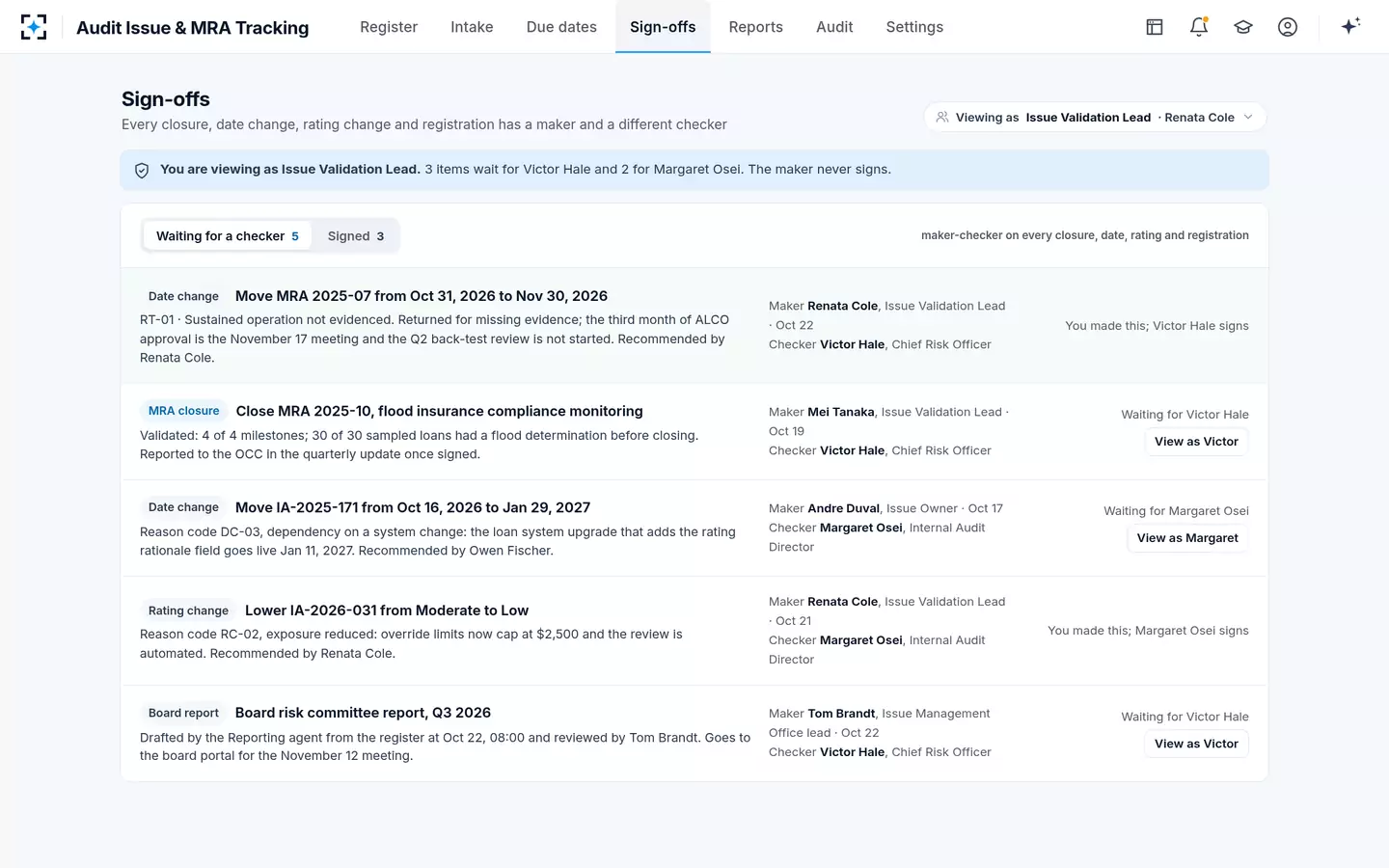
At the sample bank the layers map to named people. The owner, Daniel Okoro, asked for closure of MRA 2025-07 on October 14. The validation lead, Renata Cole, returned it on October 22 with reason code RT-01, sustained operation not evidenced, and proposed a new date of November 30, 2026. Because she proposed the date, she is its maker, and the date waits for Victor Hale, the Chief Risk Officer, as checker. Nothing about the date is reported to the OCC until he signs.
Sign-offs in Audit Issue & MRA Tracking: five changes, each with a maker and a different checker
What is separation of duties in issue management?
Separation of duties in issue management means no one person can both make a change to an issue and approve it: the owner cannot validate, the validator cannot sign her own date change, the drafter of the board report cannot approve it. It is the maker-checker discipline banks already apply to payments and journal entries, applied to the promises a bank makes its examiners. The table sets out how the sample bank divides each action, and what the agents are barred from.
Separation of duties in Audit Issue & MRA Tracking: every action, its maker, its checker
| Action | Who makes it | Who checks or signs it | What the agents may do |
|---|---|---|---|
| Register a new issue from an exam letter | Issue Management Office lead | Chief Risk Officer confirms a new MRA | Propose the issue, its label, owner, root cause, rating and date, citing the words that decide them |
| Approve an action plan | Issue owner | Validation lead reviews the plan against the root cause | Label each action as fixing the cause, treating a symptom or monitoring |
| Ask for closure | Issue owner, with an attestation | Validation lead | Run the owner's pre-check, the same test validation will run |
| Validate or return | Validation lead, with a reason code | Chief Risk Officer signs an MRA closure | Read, sample and write the verdict line; never validate |
| Change a commitment date | Owner or validation lead, with a reason code | Chief Risk Officer (MRA) or Internal Audit Director (audit issue); a third change goes to the board risk committee | Forecast the slip and draft the request; never move a date |
| Change a rating | Validation lead, with a reason code | Internal Audit Director | None |
| Report to the board and the OCC | Issue Management Office lead | Chief Risk Officer approves | Draft from the register; never send |
| Change the validation rules | Issue Management Office | Internal Audit Director; each version kept | None |
Can AI validate remediation?
It can do the reading and counting a validation rests on; it should not be the one that validates. The reason is accountability, not accuracy. Validation is a judgment someone answers for to the audit committee and, increasingly, to examiners who rely on it, and an agent cannot answer for anything. The Financial Stability Board's final sound practices on AI, published in October 2026, list among agentic risks "Unauthorised actions", where agents pursue their goals in ways that may be inconsistent with delegated authority, and they set a test for oversight that is easy to fail (FSB, October 2026).
Effective oversight is meaningful, i.e. it involves humans having sufficient ability, authority and incentive to intervene, as opposed to oversight that is nominal or driven by ‘tick-the-box’ compliance.
Financial Stability Board, Sound Practices for Responsible Adoption of AI, final report, 15 October 2026
Meaningful oversight is a design property, not a policy line. In the solution it shows in four places: the agents have no permission to validate, sign, send or move a date; every agent sentence cites the passage, sample or system entry behind it, so the validator can check it in one click; below a confidence of 0.80 a person decides; and a validator may validate against a not-ready verdict, with a reason code, which is logged and counted so the bank can see where its people and its agents disagree.
Self-checked remediation and independently checked remediation look the same on a register
Owner marks it done: What the owner chose to attach: usually the new policy and a set of minutes.
Independent check, then signature: The owner's evidence plus a random sample from the system of record, with the seed kept.
Owner marks it done: Asserted: "operating since June".
Independent check, then signature: Counted month by month; one deferred meeting breaks the run.
Owner marks it done: Overwritten when the owner sees a slip, often after it.
Independent check, then signature: Requested with a reason code, signed by a different person, kept in the history.
Owner marks it done: Assembled by hand from exports; status as reported by owners.
Independent check, then signature: Drafted from the register, every sentence traced to an issue, approved before it leaves.
Owner marks it done: The owner's word and a document.
Independent check, then signature: The decision, its maker and checker, the reason code and the evidence behind it.
How do you track MRA commitment dates?
Track the date and the pace toward it, and escalate before it passes rather than after. A commitment date is the one figure every reader of an MRA report looks at, and it is usually missed for a reason visible weeks earlier: a dependency on another team, a meeting that has not been held, evidence arriving slower than milestones fall due. The sample bank's Overdue agent reads every open issue's milestones, evidence pace and dependencies each morning at 06:00 and flags likely slips with the reason. Reminders go to the owner at 30 days, the executive sponsor at 14 and the Chief Risk Officer or audit director at 7.
Slips flagged before the date: 46 issues due, 9 expected to slip
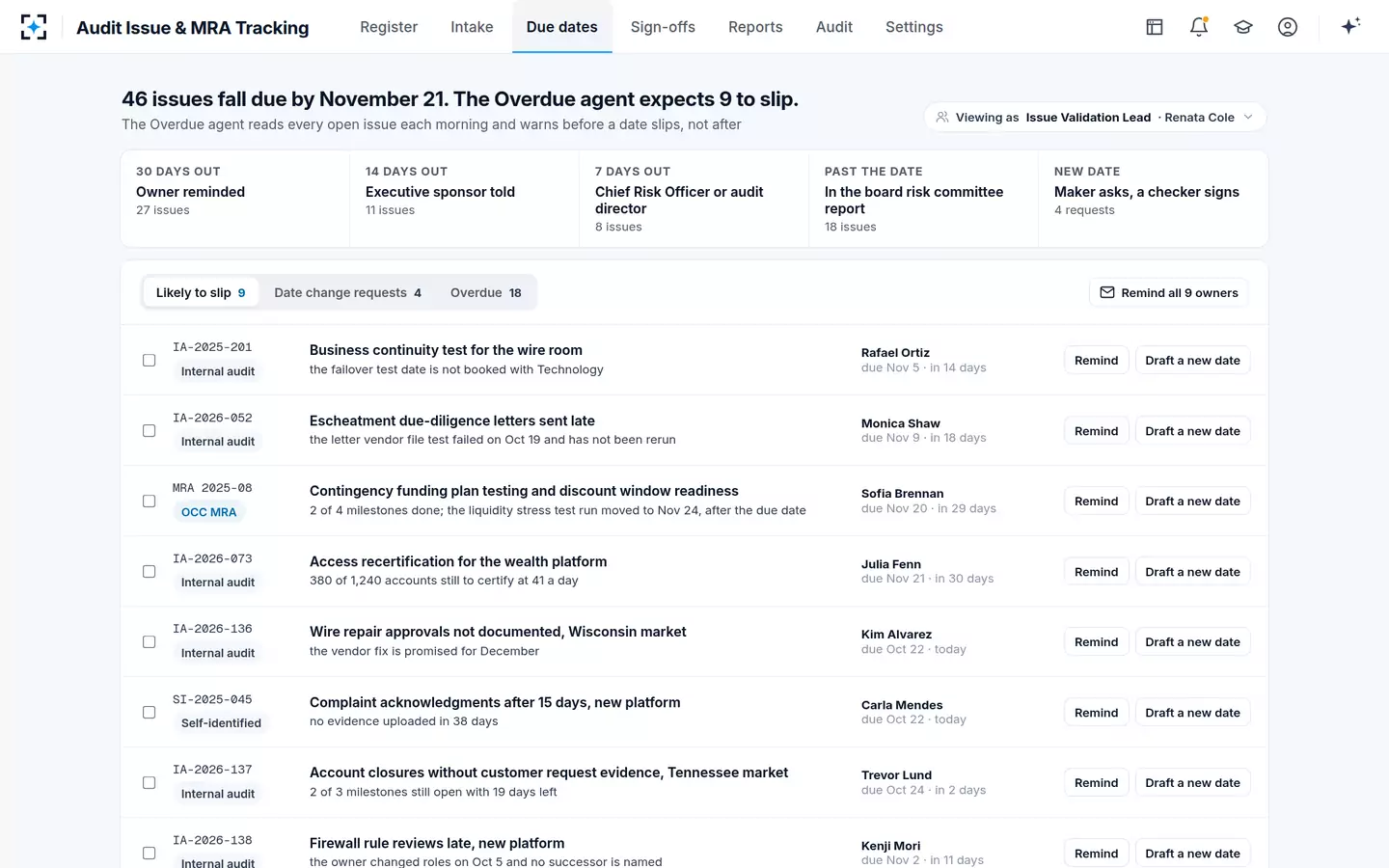
When a date has to move, it moves as a request: a reason code, a realistic new date and a different person's signature. The sample bank allows two date changes per issue; a third goes to the board risk committee. The OCC quarterly update then carries the revised date with its reason, so the examiner hears it from the bank first. Long-dated issues deserve particular attention. In its review of Silicon Valley Bank the Federal Reserve wrote that "Supervisors could also systematically elevate focus on long-dated, material issues to promote more rapid remediation" (Federal Reserve, April 2023); a bank can apply the same discipline to its own register by reporting age and date changes, not only status.
What reports go to the board on MRAs?
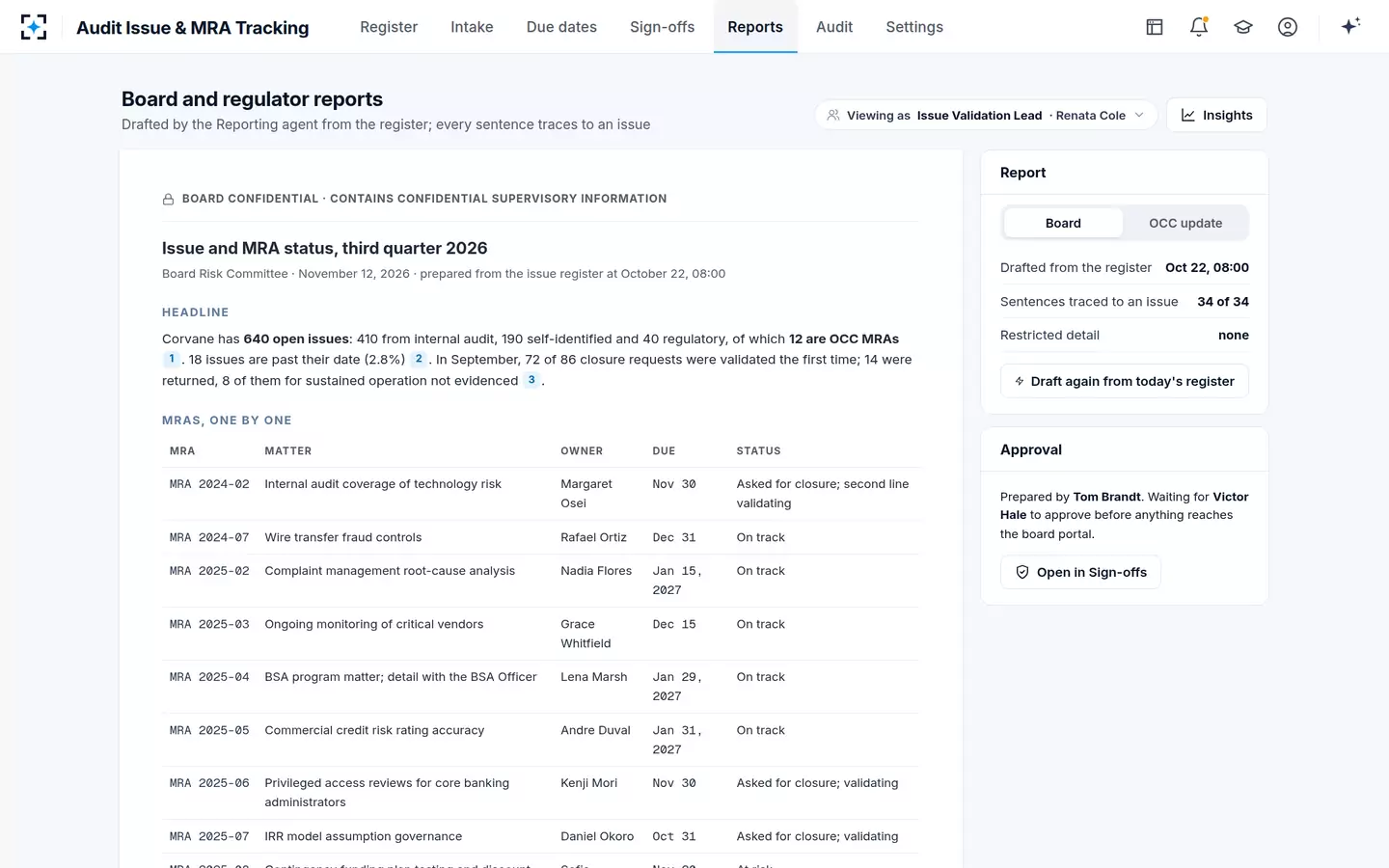
Typically a periodic status report to the board or its risk or audit committee covering every open MRA, its owner, due date and status, with what changed since the last report; and, separately, the bank's progress updates to its examiners. At the sample bank both are drafted by the Reporting agent from the register at a cut-off time, in the board template, with every sentence traced to the issue it describes and confidential supervisory information marked. The Q3 2026 board risk committee report, drafted October 22 at 08:00 for the November 12 meeting, traces 34 of 34 sentences. The Chief Risk Officer approves both before anything reaches the board portal or the examiner.
The board risk committee report, drafted from the register and waiting for approval
An MRA tracking template: the fields that matter
An MRA tracking template needs fewer columns than most have and more history than most keep. The checklist below is the minimum we would expect a register to hold for each MRA, whether it lives in a GRC system, a spreadsheet or the solution. The fields in the second half are the ones that separate a tracker from a to-do list.
An MRA tracking template: twelve fields, and why each is there
- Source and citation
The report of examination or supervisory letter, its date and page, so the finding is tested as the examiner wrote it.
- Label
MRA, MRIA, supervisory observation, other violation, internal audit finding or self-identified issue: each closes differently.
- Finding, verbatim
The examiner's words, not a paraphrase. Paraphrases drift toward what was easiest to fix.
- Root cause
One sentence, from the action plan. Every milestone should trace to it.
- Owner and executive sponsor
A named person at each level, so the escalation ladder has someone to reach.
- Milestones with the evidence each needs
Not "policy updated" but what document, which sample and how many months prove it.
- Commitment date and its history
Every change with its reason code, maker and signer. A date that is overwritten erases the record an examiner asks for.
- Independent validator
Someone who did not do the work and does not report to the owner.
- Three statuses, not one
Complete per the owner, validated by internal audit, closed by the examiner.
- Validation result and reason code
Validated, returned with a code, or validated over the agents' verdict with a reason.
- Confidentiality marking
Confidential supervisory information marked; SAR-related detail restricted to the BSA team.
- Reporting trail
Which board report and which examiner update carried each status and each date change.
What to ask before you buy MRA tracking software
Ask what the software proves, not what it lists. Almost any issue management system will hold the fields above; the differences are in who can do what, and in whether anyone other than the owner has tested the evidence. Six questions separate the approaches quickly, and registers, workflows and evidence agents compared runs one closure request through each kind of product.
First, can a maker ever approve their own change, including administrators? Second, are date changes kept as history with a reason and a signer, or overwritten? Third, does the system keep three statuses (owner-complete, validated, examiner-closed), or one? Fourth, if there are agents, what are they barred from doing, and is the bar a permission or a policy? Fifth, does every agent statement cite its source, and can a validator see the sample, its population and its seed? Sixth, can it be tested on your own closed issues before you commit: a 30-day pilot on last quarter's closure requests sets out how.
Where the solution fits, and where it does not. It fits a bank whose remediation evidence lives in systems an agent can read: a document management system, a board portal, a core banking system, a model change log. It works with the bank's existing issue management or GRC system two-way rather than replacing it. It earns least at a bank with a handful of findings and one auditor who knows each one; there, a well-kept register with an independent validator and a second signature may be enough, and the professional standard allows exactly that. To see the maker-checker rules at work on a closure, start from Audit Issue & MRA Tracking.
Questions people ask
What does MRA stand for in banking?
Matter requiring attention: a finding in an examination report that the bank must correct, with the board informed. The Federal Reserve also uses MRIA, matter requiring immediate attention, for the most urgent. Under the OCC and FDIC rule effective November 2, 2026, those two agencies may issue an MRA only for a material financial risk or an actual violation of a banking law.
Who signs an MRA closure inside the bank?
Practice varies, but the signer should be senior and independent of the remediation. At the sample bank, internal audit's validation lead validates and the Chief Risk Officer signs every MRA closure and MRA date change before the OCC is told. The examiner still decides whether the MRA is closed.
Can an agent move an MRA commitment date?
Not in this design. The Overdue agent forecasts slips and drafts the extension request with a reason code and a realistic date, but a person makes the request and a different person signs it. A third date change on the same issue goes to the board risk committee.
How often should MRA status go to the board?
No single rule sets the frequency for every bank; quarterly reporting to the board or its risk committee is common, and orders often require it. Under its 2020 order, Citigroup's board had to send the Reserve Bank written progress reports within 45 days after the end of each quarter. Report what changed, not only what is open.
Is a spreadsheet good enough for MRA tracking?
It can be, if it keeps date history, separates maker from checker and records internal audit's validation. Its weaknesses are overwritten dates, one status column and no control over who edits what. Those, rather than the number of MRAs, are what usually push a bank to a system.