Issue management software is the system a bank uses to track internal audit findings, regulatory findings such as MRAs, and self-identified issues to validated closure: who owns each, what the plan is, when it is due, what proves it, and who has signed off. Three kinds of product answer that description. A register, often a controlled spreadsheet, records the promises. A GRC or workflow system routes them, with permissions, reminders and reports. Evidence agents go further and test the promises, reading each closure request against its evidence and sampling the system of record. All three can hold the same issue; they differ in what they can tell a validator about it. Botminds' Audit Issue & MRA Tracking is the third kind, and works with a bank's existing register or GRC system rather than replacing it.
The comparison uses one closure request from a fictional sample bank as it runs through the solution: MRA 2025-07 at Corvane National Bank, an OCC-supervised regional bank, asked for closure on October 14, 2026.
Business days to a defensible verdict on one High-rated MRA closure request, by approach
What is issue management software?
Software that keeps a bank's open issues, from every source, visible, owned, dated and evidenced until internal audit validates them and they close. In banking the term covers what other industries split into audit issue tracking, regulatory findings management and remediation tracking. The minimum it must do is set by supervisors' expectations of the register itself. The OCC's audit booklet, for one, says: "All audit issues should be assigned an individual owner with an appropriate level of accountability in the bank" (OCC, Internal and External Audits), and expects status reports that separate management's view of closure from internal audit's.
Beyond that minimum, the products divide by what they do with an issue between "owner says done" and "validated". That interval is where validators spend most of their time, and it is where the three approaches differ most.
Issue management vs audit management: what is the difference?
Audit management software runs internal audit's own work: the audit plan, engagements, workpapers, testing and reports. Issue management starts where a report, an exam letter or a self-assessment ends: it tracks each finding through the owner's action plan to validation and closure. Many GRC suites include both. The distinction matters in a purchase because the users differ: audit management serves auditors; issue management serves owners across the bank, the issue management office, validators, the Chief Risk Officer and the board.
Can Excel be used for issue management?
Yes, and the professional standard says so. Among the IIA's examples of evidence of conformance with Standard 15.2 is a tracking system of any kind.
A routinely updated tracking system (for example, a spreadsheet, database, or other tool) that contains the finding, associated corrective action plan, status, and internal audit's confirmation.
The IIA, Global Internal Audit Standards, Standard 15.2, Examples of Evidence of Conformance
A spreadsheet's limits are not legal but practical. Dates are overwritten rather than kept as history; one status column merges owner-complete with validated; anyone with edit rights can change anything, so maker and checker are a convention, not a control; and the evidence lives elsewhere, so the register says what was claimed, not what was proved. At a bank with a few dozen issues and one experienced validator, those limits may be manageable. At the sample bank's 640, they are the problem.
Can GRC software track MRAs?
Yes: tracking MRAs is a core use of GRC issue modules, and a good one fixes most of the spreadsheet's weaknesses. It enforces roles, so an owner cannot validate; it keeps an audit trail of changes; it sends reminders; it produces board reports from live data. What a workflow does not do, by design, is read the evidence. A GRC workflow routes the closure request to the validator with its attachments; the validator still opens each document, requests the extract, draws the sample, counts the months and writes the memo. The workflow makes the process orderly; the test is still done by hand.
That matters more after 2026. The Federal Reserve's operating principles tell examiners to rely on an effective internal audit's validation of MRA remediation instead of repeating it (Federal Reserve), and the OCC and FDIC rule effective November 2, 2026 leaves closure practice outside its scope (91 FR 56004; the OCC and FDIC MRA final rule guide covers the rule). The test a tool helps or does not help with is increasingly the test examiners rely on.
What should issue management software do?
Hold the register, enforce who may do what, keep history, and help the validator answer the only question that closes an issue: did the fix work, and is it still working? The table compares the three kinds of product against that list. Treat it as a map of what to test in a demonstration, not as a verdict on any one product.
What each kind of issue management software does for one closure request
| Capability | Register (spreadsheet) | GRC workflow | Evidence agents |
|---|---|---|---|
| Holds every issue with owner, plan, dates | Yes | Yes | Yes, or reads them from the bank's register two-way |
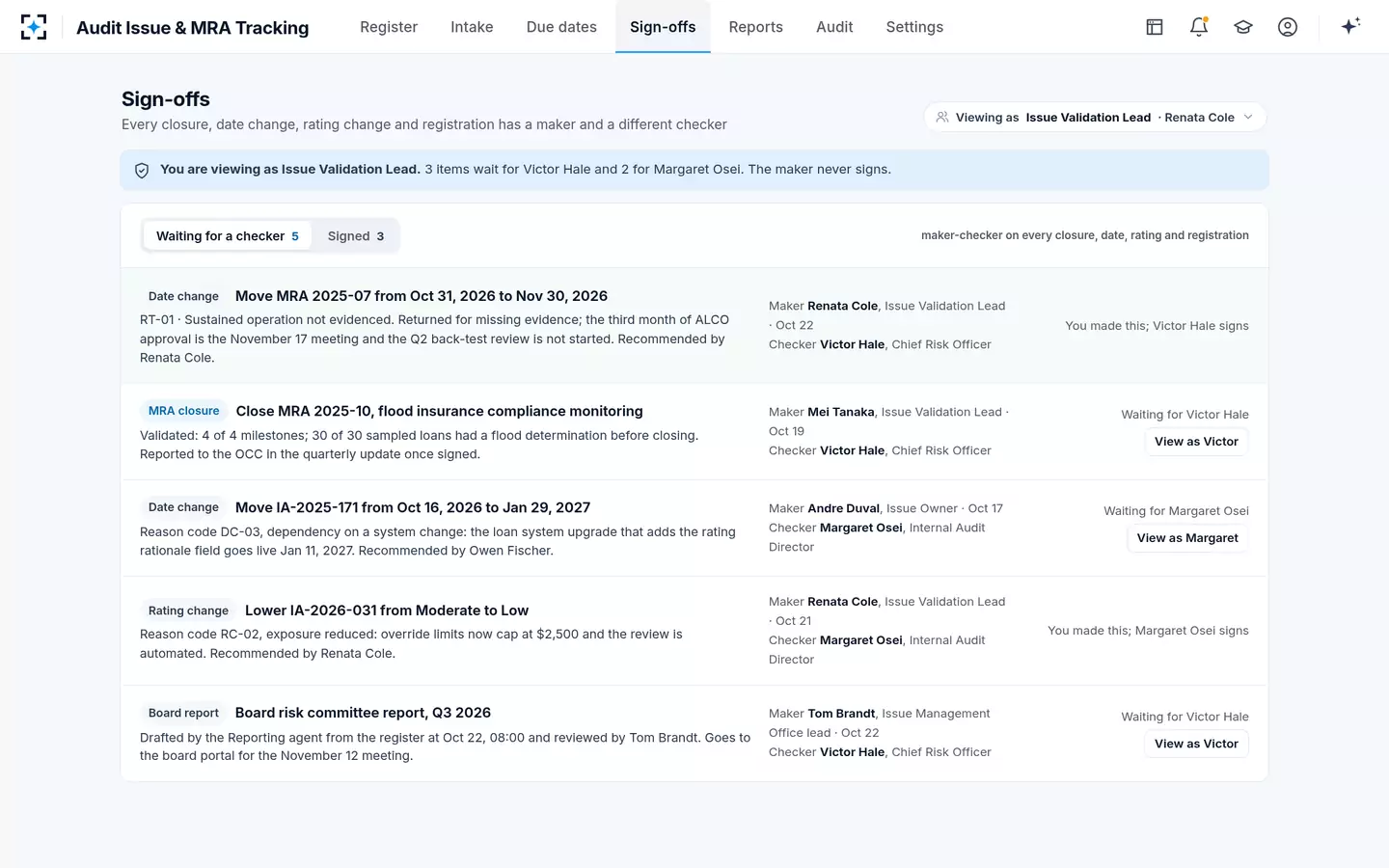
| Separates maker, checker and signer | By convention only | Yes, by role | Yes, by role; agents barred from validating, signing, sending or moving dates |
| Keeps date and plan history with reasons | Rarely | Usually | Yes, with reason codes and both signatures |
| Reminds before a date | Manually | On a schedule | From the pace of evidence and dependencies, with the reason for each likely slip |
| Reads the evidence against each milestone | No | No; attachments are routed | Yes, one sentence per milestone with the passage |
| Samples the system of record | No | No | Yes, read-only, seed kept, redrawable |
| Counts months of sustained operation | No | No | Yes, per period, against the bank's rule |
| Drafts board and examiner reports | By hand from exports | From live data | From the register, every sentence traced to an issue |
One closure request, three approaches
Take MRA 2025-07: interest rate risk model assumptions changed without ALCO approval, four milestones, owner Daniel Okoro, asked for closure on October 14. His evidence: the revised ALM policy naming ALCO as approver, the change log, ALCO minutes for July, August and September, and the Q2 back-test report.
In a register, the validator receives a row marked "complete" and a folder. She reads the policy, requests an extract of the model change log, draws a sample, matches each change to a resolution, reads three sets of minutes, checks the back-test for a validation sign-off, and writes her memo. If she reads the August minutes closely she finds the deferral; if she is rushed, "presented to ALCO in August" can pass for approval. In a GRC workflow the same steps happen, routed, reminded and logged, by the same person, by hand.
With evidence agents, the request arrives as a dossier already tested: milestone 1 proven at 0.98 against the policy and the board risk committee minutes; milestone 2 proven at 0.96 from a random sample of 25 of the 61 logged changes, all citing a resolution; milestone 3 not proven, because August's minutes record a deferral; milestone 4 not proven, because the back-test has no validation sign-off and review MV-2026-118 has not started. The verdict line says not ready, 2 of 3 months evidenced, and proposes November 30, 2026. The validator opens the August passage, agrees, and returns the request with reason code RT-01.
The same closure request as a tested dossier in Audit Issue & MRA Tracking
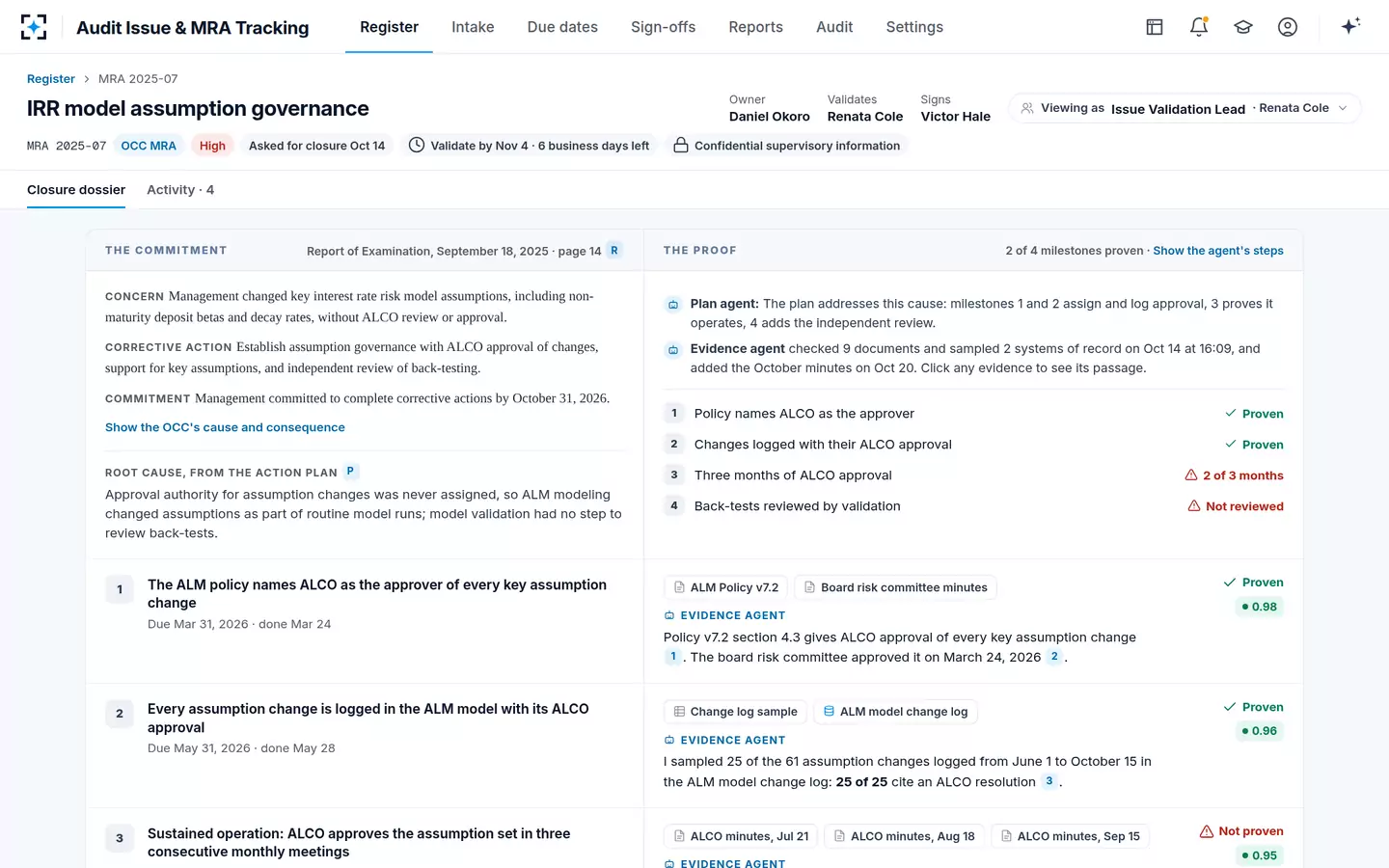
None of the three approaches changes who decides. In all three, Renata Cole, the validation lead, returns the request and the Chief Risk Officer signs the new date. What changes is how long the decision takes and how likely it is to rest on the August minutes rather than on an owner's summary of them.
How do you compare issue management tools?
On your own data, against questions that separate the approaches, with the pass lines written down first. A replay of last quarter's closure requests is the most direct test, set out in audit findings tracking software: test it on last quarter first. Before that, the questions below narrow the field.
Questions to put to any issue management software
- Can anyone, including an administrator, approve their own change?
If yes, maker-checker is a policy, not a control.
- Are date changes kept with reason, maker and signer?
Overwritten dates erase what the OCC expects status reports to show.
- How many statuses does an issue have?
At least owner-complete, validated and closed. One status column overstates progress.
- What does the tool know about the evidence?
That a file is attached, or what the file proves, with the passage?
- Can it test a control in the system of record?
Read-only, with the population, sample size and seed shown and redrawable.
- How does it count sustained operation?
Against the bank's rule by rating, period by period, with what breaks a run.
- What are any agents barred from doing?
Validating, signing, sending and moving dates should be impossible, not discouraged.
- How is confidential supervisory and SAR information handled?
Marked, restricted by audience, and excluded from packs that should not carry it.
- Does it replace the bank's register, or work with it?
Two-way integration avoids a second system of record.
Maker and checker as permissions, not policy
What does issue management software cost?
The licence is the smaller part. Most of the cost of issue management is people's time: owners assembling evidence, validators re-performing tests, the issue management office building reports, and, when closures fail, the time to do it all again. This guide does not compare licence prices; the comparison a buyer can make for itself is the work each approach removes. In the estimate above, evidence agents take the validator's share of one High-rated closure request from roughly 15 business days to about 3, mostly by doing the reading and sampling; a workflow saves the routing.
The larger cost is the closure that should not have happened, or the one that takes a year longer than it should. The OCC's analysis of its 2026 MRA rule lists what MRAs cost banks, including consultants at up to $1,200 an hour for top-tier firms and the time internal audit spends verifying the fix (91 FR 56004). The full list, and the record of what slow remediation can cost under an enforcement order, are read in the OCC consent order on Citi, 2020.
Issue management best practices for banks
Keep one register for every source, separate the statuses, keep the history, make the validation rules settings rather than habits, and report to the board what changed, not only what is open. Volume is itself a signal. The Federal Reserve's review of Silicon Valley Bank found: "SVBFG had 31 open supervisory findings when it failed in March 2023, about triple the number observed at peer firms" (Federal Reserve, April 2023). A register that shows count, age and repeat findings by area gives a board the same early view.
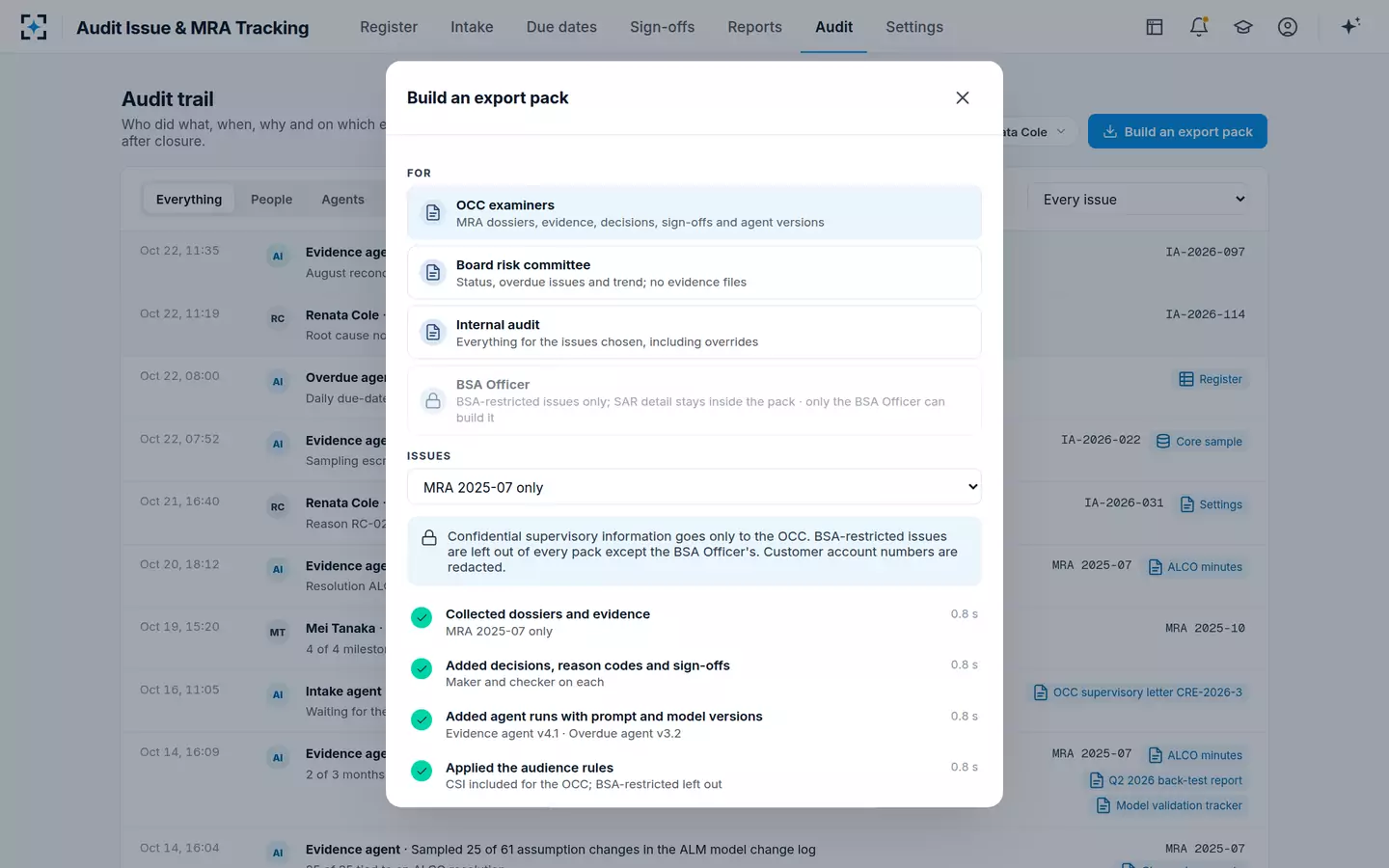
Three practices are worth adding because tools now make them cheap. Have owners run the validation test before asking for closure, so returns are for judgment, not for missing signatures. Check every action plan against its root cause when it is drafted, as the validator's seat benefits most from plans that can pass. And build examiner packs from the audit trail rather than assembling them afterwards, with confidential supervisory information routed only where it belongs.
An examiner pack built from the audit trail, with audience rules applied
Where Audit Issue & MRA Tracking fits, and where it does not
It fits a bank whose validators spend most of their time re-performing tests, whose closure evidence lives in systems an agent can read (document management, the board portal, the core banking system, the payments hub, a model change log), and whose returns are mostly for proof that was missing rather than fixes that were wrong. It works two-way with the bank's existing issue management or GRC system and read-only with every system of record. It does not replace the validators' judgment or the Chief Risk Officer's signature; its agents read, sample, draft and propose, and never validate, sign, send, register an issue or move a date. At a small bank with few findings and one validator who knows each, a well-kept register or GRC module may be all that is needed. To compare the approaches on one of your own closure requests, start from Audit Issue & MRA Tracking; for how the maker-checker rules work in detail, see MRA tracking: maker, checker and the signature no agent gives.
Questions people ask
What is the best issue management software for banks?
The one that passes a test on your own closed issues. Check whether it separates maker and checker by permission, keeps date history, distinguishes owner-complete from validated, and helps the validator test operation rather than only route documents. A replay of last quarter's closure requests answers the question better than any feature list.
Is issue management the same as GRC?
Issue management is one module of most GRC suites, alongside risk assessment, controls and policy management. A bank can run issue management inside its GRC suite, in a separate tool, or with evidence agents working on top of the GRC register; the register should stay single either way.
Do examiners require a particular issue tracking system?
No. Supervisors look at what the system shows: owners, dates, history, repeat issues and internal audit's validation. The IIA accepts a spreadsheet, database or other tool as a tracking system, provided it holds the finding, the plan, the status and internal audit's confirmation.
Can issue management software close an MRA?
No software should, and only the examiner closes an MRA. Inside the bank, a person validates and a different person signs. In Audit Issue & MRA Tracking the agents are barred from validating, signing, sending reports or moving dates; the Chief Risk Officer signs every MRA closure at the sample bank.
How long does it take to move issue management to a new tool?
It depends on whether the register moves. Evidence agents that work with the existing register two-way avoid a migration and can be tested on one quarter's closure requests in about a month on the plan we suggest; replacing a GRC system is a larger project with its own data conversion and testing.