A root cause in an audit finding is the underlying reason the condition differs from the criteria: not "staff did not perform the call-back" but why they did not, such as a system that stopped prompting for it. Examples of root cause in audit findings fall into a handful of families: a system configured to allow the failure, a process step that does not exist, an owner who was never assigned, data that arrives wrong, a third party outside the bank's control, or, less often than plans assume, people who did not know what to do. The distinction decides whether a fix lasts. Action plans built on training and reminder memos treat the symptom, pass a document review and then fail validation months later when the condition is still there. Botminds' Audit Issue & MRA Tracking checks every action plan against its root cause as it is drafted, labelling each action as fixing the cause, treating a symptom or monitoring, so the plan that would fail is caught before anyone works on it.
The case below comes from a fictional sample bank as it runs through the solution: Corvane National Bank, an OCC-supervised regional bank. Its finding, IA-2026-114, came from internal audit report 2026-R27.
At the sample bank, plans with only training came back three times as often
What are examples of root cause in audit findings?
The Institute of Internal Auditors defines a root cause as the "Core issue or underlying reason for the difference between the criteria and the condition of an activity under review" (IIA, Global Internal Audit Standards, 2024, glossary). In bank audit findings the core issues group into a few recurring categories, and each points to a different kind of fix. The examples below are illustrations of each family, written the way a finding should state them.
Root cause categories in bank audit findings, with an example of each
| Category | Condition found | Root cause, stated properly | What a fix looks like |
|---|---|---|---|
| System configuration | Wires sent to changed beneficiary details without a call-back | The payments hub marks a beneficiary verified permanently, so the call-back prompt never reappears | Change the configuration: verification expires on any detail change |
| Missing process step | Model assumptions changed without committee approval | Approval authority for assumption changes was never assigned; changes happened in routine model runs | Assign the authority, and build the approval into the change log |
| Ownership and governance | Firewall rule reviews late after a platform change | The owner changed roles and no successor was named | Name an owner and a successor rule; report vacancies |
| Segregation of duties | Limit overrides approved by the person who requested them | The system allows the requester to be the approver | Block self-approval in the system; sample to prove it |
| Data and inputs | Model inputs did not reconcile to the general ledger | The reconciliation had no reviewer step, so differences went unexplained | Add the reviewer sign-off and an escalation threshold |
| Third party | Vendor SOC reports reviewed late | Reports arrive on the vendor's schedule with no trigger to the reviewer | Contract and calendar triggers, with an exception report |
| Knowledge or skill | New staff mis-code a transaction type | The procedure changed and new staff were trained on the old one | Training, the one category where it fixes the cause, plus a system edit |
The table makes one pattern plain: training is the right fix in one family out of seven, and even there it works best beside a system control. Lists of internal audit root cause categories can run much longer; the useful test is shorter. Ask of each candidate cause whether fixing it would make the condition stop on its own. If the condition could recur the day after the fix, the cause has not been found.
How do you write a root cause for an audit finding?
State the criteria, the condition, the cause and the effect, in that order, and make the cause something an action can change. The IIA's Standard 14.3 lists those elements for documenting findings and gives the method in one line: "At its simplest, determining the root cause involves asking a series of questions about why the difference exists" (IIA, Standard 14.3). It also asks auditors to work it out with management, who often know why better than anyone.
IA-2026-114 written as a finding: from the criteria to the evidence that will close it
Criteria
The bank's wire procedure: a call-back before sending to a beneficiary whose account details have changed.
Condition
7 of 30 sampled repeat-beneficiary wires went out with changed details and no call-back.
Root cause
The payments hub marks a beneficiary verified permanently after the first call-back, so the prompt never appears again, even after the details change.
Effect
Payments can be redirected to changed account details without the verification the procedure requires.
Action that fixes the cause
Expire verification after 180 days or on any change of account details, in the payments hub.
Evidence that will prove it
The configuration change record, and a sample of 25 repeat-beneficiary wires each showing a call-back.
The series of questions for this finding is short. Why was there no call-back? The prompt did not appear. Why not? The beneficiary was marked verified. Why was a beneficiary with new account details still verified? Because verification, once given, never expires and the hub does not treat a change of details as a new beneficiary. That last answer is the root cause: it names something in a system that someone can change, and if it is changed, the condition stops whether or not anyone remembers the procedure.
Symptom or root cause: what is the difference?
A symptom is the condition restated as a failing ("staff skipped call-backs"); a root cause is the mechanism that produced it ("the system stopped asking"). A useful check is to read the cause aloud with "because" in front of it. "Because staff skipped call-backs" explains nothing about why 7 of 30 wires went out unverified; "because the hub stops prompting once a beneficiary is verified" explains all seven, and predicts the next one.
Symptom-shaped causes produce symptom-shaped plans. If the cause is "staff did not follow the procedure", the natural actions are to retrain staff and remind them of the procedure. Both are reasonable steps; neither changes the mechanism. That is the trap the case fell into.
The case: a wire call-back plan that only retrained and reminded
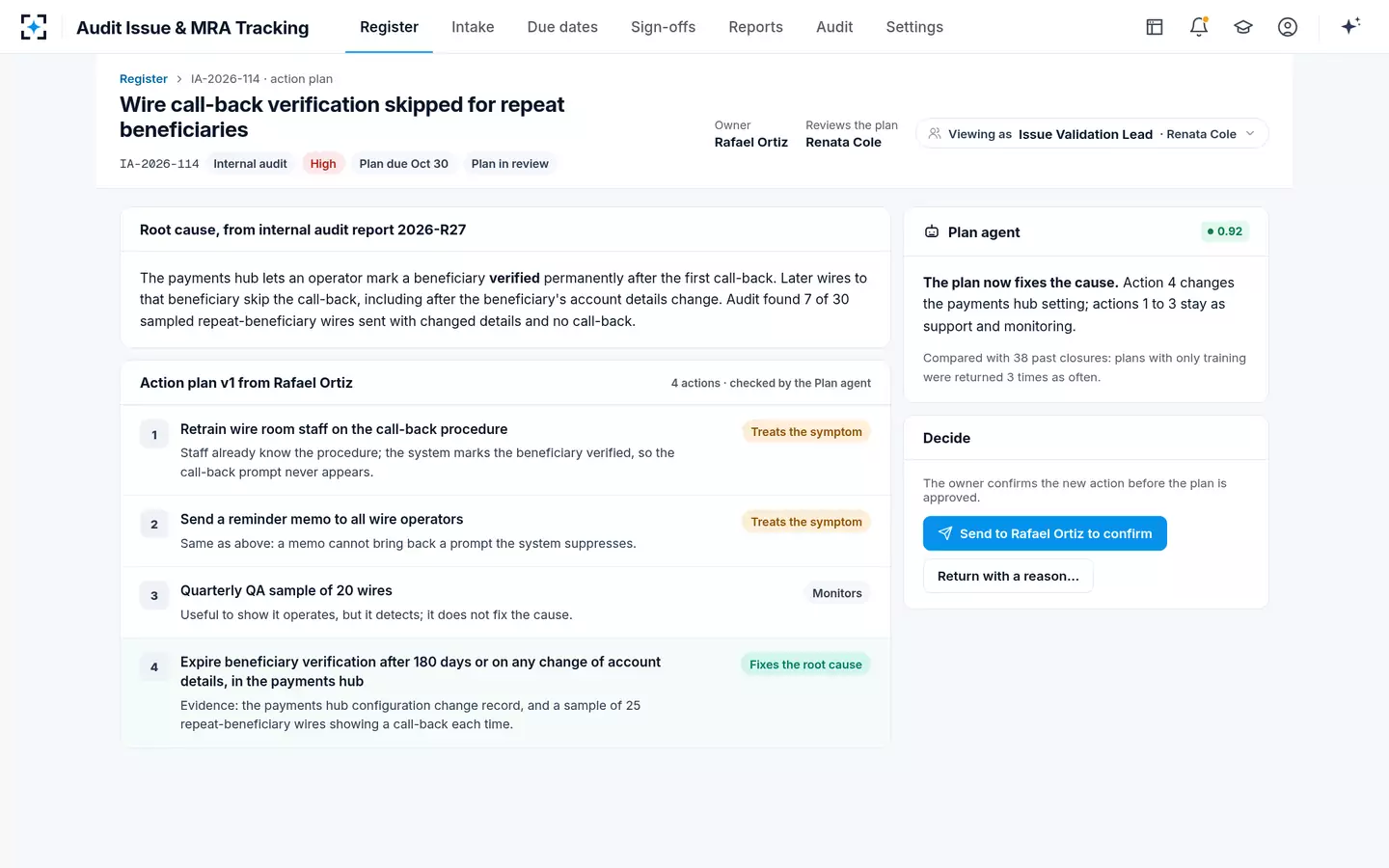
Rafael Ortiz, of the sample bank's payments operations, owns IA-2026-114, rated High, with the plan due October 30, 2026. His first plan had three actions: retrain the wire room on the call-back procedure; send a reminder memo to all wire operators; and run a quarterly quality assurance sample of 20 wires. Read quickly, it looks thorough. It names training, communication and monitoring, the three things a plan is expected to contain.
Read against the root cause, it changes nothing. The Plan agent labelled the first two actions as treating the symptom, with the reason: staff already know the procedure; the system marks the beneficiary verified, so the call-back prompt never appears, and a memo cannot bring back a prompt the system suppresses. It labelled the third as monitoring: useful to show the control operating, but it detects; it does not fix. And it proposed the missing action: expire beneficiary verification after 180 days or on any change of account details, in the payments hub, proven by the configuration change record and a sample of 25 repeat-beneficiary wires each showing a call-back.
The action plan checked against its root cause in Audit Issue & MRA Tracking
Is training a root cause fix?
Only when the cause is that people did not know what to do. In IA-2026-114 they knew; the system stopped asking. Training is the default remediation because it is quick to arrange and easy to evidence, a sign-in sheet and a slide deck, and that is exactly why it passes a document review and fails an operating test. A validator who samples wires after the training will find the same condition, because nothing about the mechanism has changed.
That is not an argument against training in plans. It is an argument against plans in which training is the only action that touches the condition. The sample bank keeps actions 1 to 3 as support and monitoring; action 4 carries the fix.
Why do action plans fail validation?
Mostly because the plan was completed and the condition was not removed. Validation tests the condition, by sampling the records the control leaves behind; a plan whose actions were all done can still fail it if none of them changed what produced the condition. The other common reason is missing proof of sustained operation, the subject of who proves the fix lasts after 2026.
The first plan and the plan with action 4, at validation
Plan v1: retrain, remind, monitor: Training records and the memo: complete.
Plan with action 4: change the hub: The payments hub configuration change record.
Plan v1: retrain, remind, monitor: A sample of repeat-beneficiary wires with changed details: the prompt still does not appear, so call-backs still depend on memory.
Plan with action 4: change the hub: A sample of 25 repeat-beneficiary wires: each shows a call-back, because the hub requires one.
Plan v1: retrain, remind, monitor: Not ready: the condition persists.
Plan with action 4: change the hub: Ready once the months of operation the High rating needs are evidenced.
Plan v1: retrain, remind, monitor: A return, a new date with a second signature, months lost, and a repeat finding if it was closed anyway.
Plan with action 4: change the hub: None from the plan; the remaining risk is execution.
How does internal audit test root cause?
By testing whether the condition still occurs after the fix, and whether the fix touched the mechanism the finding named. The first is a sample of the population where the condition lived; the second is evidence of the change itself, a configuration record, a new approval step, a named owner. Repetition is the warning sign. The OCC's audit booklet asks that issue status reports to the board or audit committee show changes in dates and plans and repeat issues, and adds: "Multiple changes and repeat audit issues should trigger additional root cause analysis of management's ability and willingness to correct deficiencies and manage risks" (OCC, Internal and External Audits).
That sentence takes root cause analysis one level up. When the same issue returns, or its date moves again and again, the root cause may no longer be in the payments hub but in the organisation: no owner with authority, no budget, no priority. The question becomes whether management can and will fix it, which is a finding of its own.
Questions that test a root cause before the plan is approved
- Does it explain every instance?
All seven unverified wires, not most of them. An exception the cause cannot explain points to a second cause.
- Is it something an action can change?
"Human error" is not; "the system allows self-approval" is.
- Would fixing it stop the condition by itself?
If the condition could recur the day after, keep asking why.
- Does it reach other units?
The same hub setting may serve other payment types; a cause with wider reach needs wider actions.
- Has this cause appeared before?
A repeat cause is a finding about management's ability to fix it.
- Does at least one action change it?
Label each action: fixes the cause, treats a symptom, or monitors. A plan with no action in the first group is not ready.
What is a corrective action plan?
The owner's commitment to resolve a finding: the actions, who does each, by when, and what evidence will show each was done and worked. The IIA's Standard 14.4 says recommendations or action plans should, among other things, "Address the root cause of the finding", alongside resolving the difference between criteria and condition and reducing risk to an acceptable level (IIA, Standard 14.4). Searches for an audit finding corrective action plan template usually want columns; the columns that matter most are the root cause each action addresses and the evidence that will prove it.
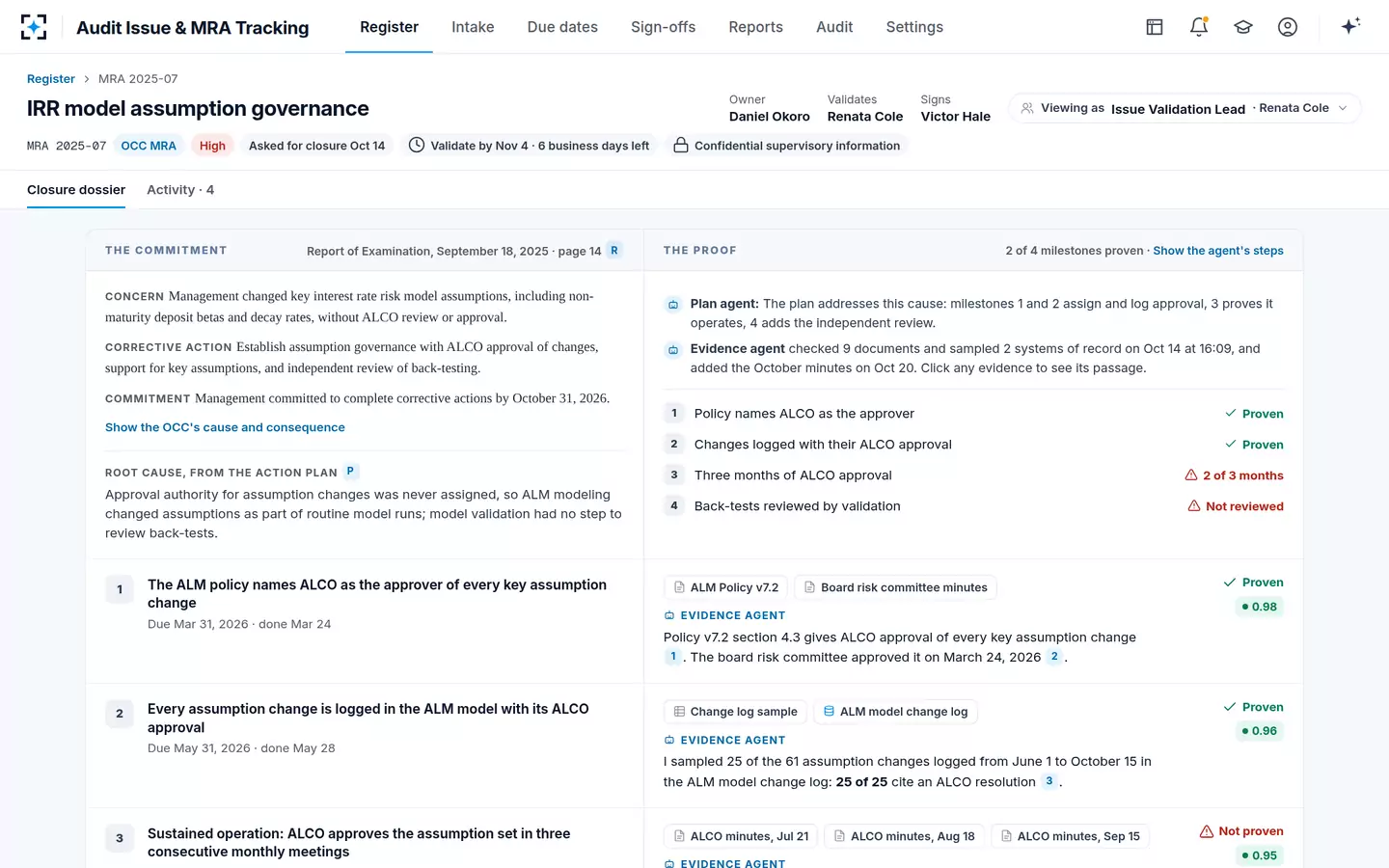
At the sample bank every milestone in a plan names its evidence in advance, and the Plan agent proposes a sample size from the validation rules: 25 records for a High rating. When the plan reaches validation, the validator tests what the plan said would prove it. The same discipline applies to examiner findings; in the sample MRA 2025-07, the root cause written in the action plan, approval authority for assumption changes never assigned, is printed beside the examiner's words in the closure dossier, and each milestone traces to it.
The root cause beside the examiner's words in Audit Issue & MRA Tracking
What the OCC heightened standards say about root cause
For banks with $50 billion or more in assets, root cause is a reporting duty. "Internal audit's reports to the audit committee should also identify the root cause of any material issues", the OCC's heightened standards say, with a determination of whether that cause affects one organisational unit or several (12 CFR part 30, appendix D). The second half matters as much as the first: a cause found in one unit is a question about every unit that shares the system or the process.
Enforcement shows the same expectation at scale. The OCC's 2020 consent order against Citibank required processes for the business lines to "diagnose the root cause(s) of the underlying issues that led to internal control related concerns identified by internal audit and/or federal regulators since 2017", to develop action plans to remediate those causes, and to assess whether the causes affected other lines of business (OCC Consent Order AA-EC-2020-64, Article IX). The Citi orders show what followed when remediation fell behind. For MRAs, the OCC and FDIC rule effective November 2, 2026 changes when one may be issued, not what a good plan looks like; the OCC and FDIC MRA final rule guide covers the rule. For the file a fixed cause should produce, see the MRA closure report guide, and to see plans checked as they are drafted, start from Audit Issue & MRA Tracking.
Questions people ask
What is an example of a root cause in an audit finding?
"The payments hub marks a beneficiary verified permanently after the first call-back, so the prompt never reappears when account details change." It explains why 7 of 30 sampled wires in the fictional sample bank went out without a call-back, and it names something an action can change. "Staff did not perform call-backs" is the condition, not the cause.
Is human error a root cause?
Rarely, on its own. Errors happen in every process; the root cause is usually what let an error through: a missing system control, an approval step that does not exist, a design that relies on memory. A cause that ends at "human error" leaves the plan with nothing to change except people.
How many root causes can one finding have?
More than one, and the plan should address each. The sample bank's MRA 2025-07 had two: approval authority for assumption changes never assigned, and no step for model validation to review back-tests. Its plan has milestones for both.
Who writes the root cause, the auditor or management?
Both. The IIA's Standard 14.3 asks internal auditors to collaborate with management to identify root causes when possible, because management often understands the underlying cause best. The auditor remains responsible for the finding as issued.
What does root cause analysis in internal audit look like for repeat findings?
It moves up a level. The OCC expects repeat issues and repeated date or plan changes to trigger further root cause analysis of management's ability and willingness to correct deficiencies, so the question becomes ownership, resourcing and priority, not just the control.