The OCC's consent order against Citibank, N.A., dated October 7, 2020 (docket AA-EC-2020-64), is a cease and desist order for long-standing deficiencies in enterprise-wide risk management, compliance risk management, data governance and internal controls, issued the same day as a $400 million civil money penalty and a parallel Federal Reserve order against Citigroup Inc. It required a board compliance committee, a comprehensive action plan with milestones, quarterly progress reports and supervisory consent for significant acquisitions. In July 2024 both agencies penalised the company again, $75 million from the OCC and $60.6 million from the Federal Reserve, because remediation under the 2020 orders had fallen behind its milestones. For a risk or audit team, the second set of penalties is the useful one: it prices slow remediation in primary text. Botminds' Audit Issue & MRA Tracking was built for the same problem at the scale of a single MRA: it tests every closure request against its evidence and warns of slipping commitments before the date.
Everything below is read from the agencies' own orders and releases, linked where it is used. Product examples come from a fictional sample bank, Corvane National Bank, and are labelled as such.
Three civil money penalties tied to the October 2020 Citi orders
What was the OCC consent order against Citi in 2020?
It was a cease and desist order, issued with the bank's consent under section 8(b) of the Federal Deposit Insurance Act, requiring Citibank to correct deficiencies the OCC found in risk management, data governance and internal controls. The order's findings, which the bank neither admitted nor denied, said that for several years the bank had not maintained enterprise-wide risk management, compliance risk management, internal controls or data governance programmes commensurate with its size, complexity and risk profile (OCC Consent Order AA-EC-2020-64). Among the specific failings: front-line units and independent risk management that did not meet the OCC's heightened standards for large banks, and an "inability to develop and execute on a comprehensive plan to address data governance deficiencies".
The order also found that the conduct "contributed to violations of law and regulation", listing civil money penalties the OCC had already assessed in 2019 and 2020 under the Fair Housing Act, the holding-period rules for other real estate owned and the Flood Disaster Protection Act. And it found the oversight itself inadequate: board and senior management oversight was not enough "to ensure timely, appropriate actions to correct the serious and longstanding deficiencies". The order, in other words, was about the bank's capacity to fix things.
Why was Citi fined $400 million?
The OCC said the penalty was for unsafe or unsound practices: the bank's "long-standing failure to establish effective risk management and data governance programs and internal controls", which also resulted in a violation of the heightened standards in 12 CFR part 30, appendix D (OCC NR 2020-132). The $400 million was not a penalty for slow remediation of the 2020 order, which had not yet begun; it was for the deficiencies that led to the order.
The Federal Reserve's parallel order against Citigroup put the remediation history at the centre. Its release said the firm "has not taken prompt and effective actions to correct practices previously identified by the Board in the areas of compliance risk management, data quality management, and internal controls" (Federal Reserve, October 7, 2020), and the order itself recites that Citigroup had not adequately remediated deficiencies addressed by earlier orders of March 2013 (anti-money laundering) and May 2015 (foreign exchange and market activities) (Docket No. 20-019-B-HC). Unremediated findings were, in effect, part of the case.
What did the order require, and by when?
Structure and deadlines: a committee to watch compliance, a plan with milestones and named owners, reports every quarter, internal audit's annual view of progress, and the OCC's consent before significant acquisitions. The table lists the provisions that matter most to anyone running a remediation programme.
What the October 2020 OCC order required of Citibank's remediation programme
| Article | Requirement | Deadline |
|---|---|---|
| III Compliance Committee | At least five members, a majority of them directors who are not employees or officers, meeting at least quarterly with minutes, to monitor and oversee compliance | Appointed within 15 days |
| III Progress report | Written report to the board on corrective actions needed, actions taken and their milestones, and results; board forwards it with comments to the Examiner-in-Charge | Within 120 days, then quarterly; to the OCC within 45 days of quarter-end |
| IV Comprehensive Action Plan | Corrective actions for each article, "reasonable and well-supported timelines" with milestones, and the persons responsible; no significant deviation without OCC non-objection | Submitted with the data governance plan |
| IV(5) MRAs | On request, modify the plan to address MRA deficiencies that substantially relate to the order's articles | When requested |
| IV(6) Plan progress report | Actions taken, results, "a listing of all changes made to the Plans since the last progress report", and what remains with its owners | Within 90 days of non-objection, then quarterly |
| IV(7) Internal audit assessment | Internal audit assesses progress against the plan, with root causes and thematic analysis of significant deficiencies | Within 120 days of non-objection, then annually |
| V Data governance | Gap analysis of data quality, aggregation and regulatory reporting processes, then a data governance plan | 120 days; plan 90 days after |
| XI Acquisitions | OCC non-objection before any significant new acquisition | While the order is in force |
Two provisions deserve a remediation team's attention. Article IV(6)(c) asks for a list of every change to the plan since the last report, so a slipped milestone cannot quietly become a new baseline. And Article XVI(5) defines compliance as effectiveness verified by the regulator over time, not as tasks completed. Both are standards a bank can apply to its own MRAs without waiting for an order.
Why did the OCC amend the Citi consent order in 2024?
Because, in the OCC's finding, the bank had not made enough progress, and it had fallen short on the very provisions that manage remediation. The July 2024 civil money penalty order found that the bank "has nevertheless failed to make sufficient and sustainable progress towards achieving compliance with the 2020 Consent Order", that it "has failed to comply with certain requirements of Articles III and IV", the compliance committee and progress reporting, and the comprehensive action plan, and, in addition, that it had no processes to track how data quality problems affected its regulatory reports (OCC order AA-ENF-2024-51).
The amendment is based on the bank's failure to meet remediation milestones and make sufficient and sustainable progress towards compliance with the 2020 Order.
OCC, news release 2024-76, July 10, 2024
The amendment itself added Article XVII, "Prioritization of Expenditure on Remediation". Within 30 days the bank had to submit a board-approved Resource Review Plan, a process to decide, before any dividend or capital distribution, "whether sufficient resources are being appropriately allocated towards achieving timely and sustainable compliance with this Order" (Amendment to the October 7, 2020 Consent Order). Until the OCC did not object to that plan, each proposed dividend or distribution needed the Examiner-in-Charge's prior non-objection, with carve-outs so the parent could meet its debt service and other non-discretionary obligations. Slow remediation was made a question for the dividend.
How much did the Fed fine Citigroup in 2024?
$60.6 million, for violating the Federal Reserve's 2020 order. The order says a 2023 examination of Citigroup's execution of the 2020 order found that progress on its data quality management plan, and on compensating controls, had not been adequate, and that Citigroup "violated the 2020 Order through delays in completing milestones included in its approved plan" and through inadequate measures to control its data quality risks in the meantime (Federal Reserve, Docket No. 24-017-CMP-HC). The Federal Reserve's release put the two agencies' 2024 penalties at "approximately $135.6 million" together (Federal Reserve, July 10, 2024).
The Federal Reserve's order also warned that a "material failure to remediate the violations described herein may require additional and escalated formal actions", including further penalties. A milestone, in an order, is a legal obligation; the record from 2024 shows that both agencies count them.
How long orders run: the Fed's 2013 AML order and the OCC's 2020 order, to scale
- In force until terminated September 26, 2024138 mo
- Order in force45 mo
- 2024 amendment17 mo
- Amendment ended10
What does slow remediation cost a bank?
Far more than the penalty, and the cost rises with who finds the failure. Found by the owner before asking for closure, a missing month of evidence costs an afternoon. Found by internal audit, it costs a return, a new date and a line in the board report. Found by the examiner, it keeps an MRA open. Found by the agency under an order, it costs penalties and, at Citibank, a say over dividends.
The same slipped milestone, priced by who finds it
The owner, before asking
A re-sample or a missing signature found while it is a one-click fix.
Internal audit, at validation
A return with a reason code, a new date with a second signature, a line in the board report.
The examiner, at the next review
The MRA stays open; at the Federal Reserve, an unsustained fix can bring a new MRA or stronger action.
The agency, by formal action
A consent order: a board compliance committee, plans needing supervisory non-objection, quarterly reports, limits on acquisitions.
The agency, enforcing its own order
Civil money penalties for missed milestones, and at Citibank in 2024, dividends tied to whether remediation was resourced.
The OCC's own economic analysis of its 2026 MRA rule lists what MRAs and enforcement actions cost banks even before any penalty. External consultants, at hourly rates the OCC put at "$300 to $1,200 an hour for top-tier firms"; hiring and training; management and board time; "time conducting internal audit verification"; technology; and, for banks that fall behind, more: "If institutions do not appropriately address MRAs and enforcement actions in a timely fashion, they may also incur additional fines and penalties on top of the costs to remediate the issue itself" (91 FR 56004). The rule takes effect November 2, 2026; the OCC and FDIC MRA final rule guide covers what it changes.
What is a cease and desist order, and how does one end?
A cease and desist order is a formal enforcement action under 12 U.S.C. 1818(b) requiring a bank to stop an unsafe or unsound practice or a violation and to take corrective action; a consent order is one the bank agrees to rather than contests. Unlike an MRA, it is enforceable: violating it can itself bring civil money penalties under section 1818(i), which is exactly what the 2024 Citi orders did.
It ends when the agency terminates it. "The OCC terminates enforcement actions when a bank has demonstrated compliance with all articles of an enforcement action", or when articles still out of compliance have become outdated or are folded into a new action, the OCC explains in its monthly releases (OCC NR 2025-131). The timeline above shows how long that can take: the Federal Reserve's 2013 anti-money laundering order against Citigroup, one of the orders its 2020 action said had not been adequately remediated, was terminated in September 2024.
Is the Citi consent order still in effect?
The 2024 amendment is not: the OCC terminated it by an order signed December 11, 2025, which says the OCC no longer considered the amendment necessary for the bank's safety and soundness or its compliance with law (OCC AA-ENF-2025-64). That order terminated the amendment only; the amendment had described the 2020 order as remaining in full force. None of the OCC's monthly enforcement releases for January to October 2026, and none of the Federal Reserve's enforcement releases for 2025 and 2026, announces the termination of either 2020 order. Check the agencies' enforcement databases for the current position before relying on it.
The supervisory climate has also moved. Under the OCC and FDIC rule effective November 2, 2026, "mere failure to remediate an MRA does not constitute an unsafe or unsound practice" (91 FR 56004). That changes the status of an unremediated MRA, not of an order. The 2024 OCC order found the bank's "continuing noncompliance with and violation of the 2020 Consent Order constitute unsafe or unsound practices", and an order remains enforceable until it is terminated.
What a remediation programme can take from the Citi record
Four practices, each visible in the orders, apply to any bank's MRAs long before an order is in prospect. Treat milestones as commitments with dates that move only by a signed request. Report every change to the plan, not only its current state. Have internal audit assess progress, with root causes, not just status. And resource remediation explicitly, because an agency can, as the 2024 amendment shows. For the root-cause half of that list, examples of root cause in audit findings follows one plan from drafting to a failed validation.
Milestones watched before the date in Audit Issue & MRA Tracking
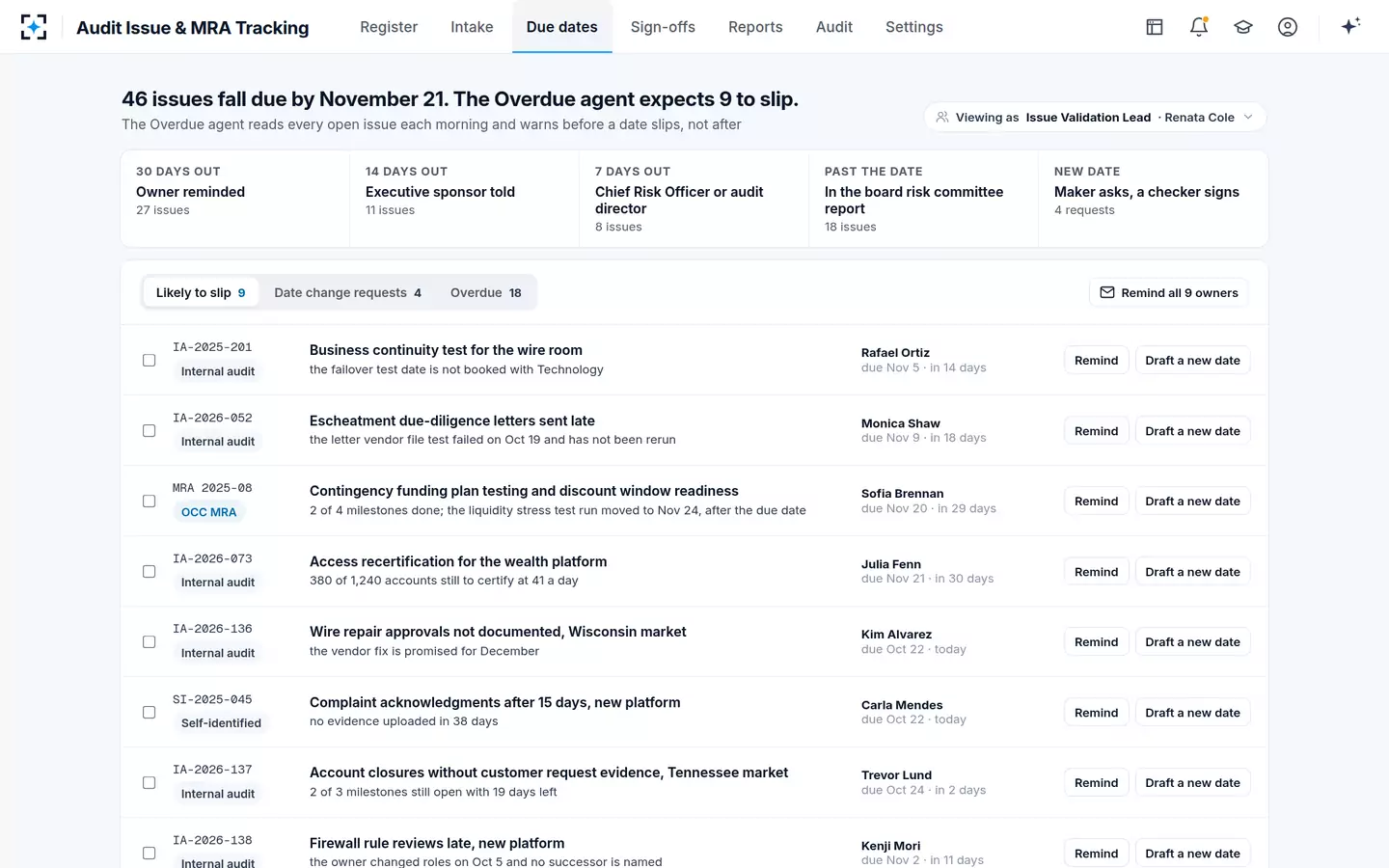
Where the solution fits, and where it does not. It cannot fix a data governance programme or write a bank's action plan. What it does is make the record of remediation honest and early: it reads every open issue each morning, flags likely slips with their reasons at 30, 14 and 7 days, keeps every date change with its reason code, maker and checker, and drafts the board and examiner reports from that record with every sentence traced. At the sample bank, the target is 30 days of warning before a commitment date slips. A slip seen a month early is a conversation; seen at the next examination, MRA tracking with separate makers and checkers is no longer the question. To see the warnings and the reports on your own open MRAs, start from Audit Issue & MRA Tracking.
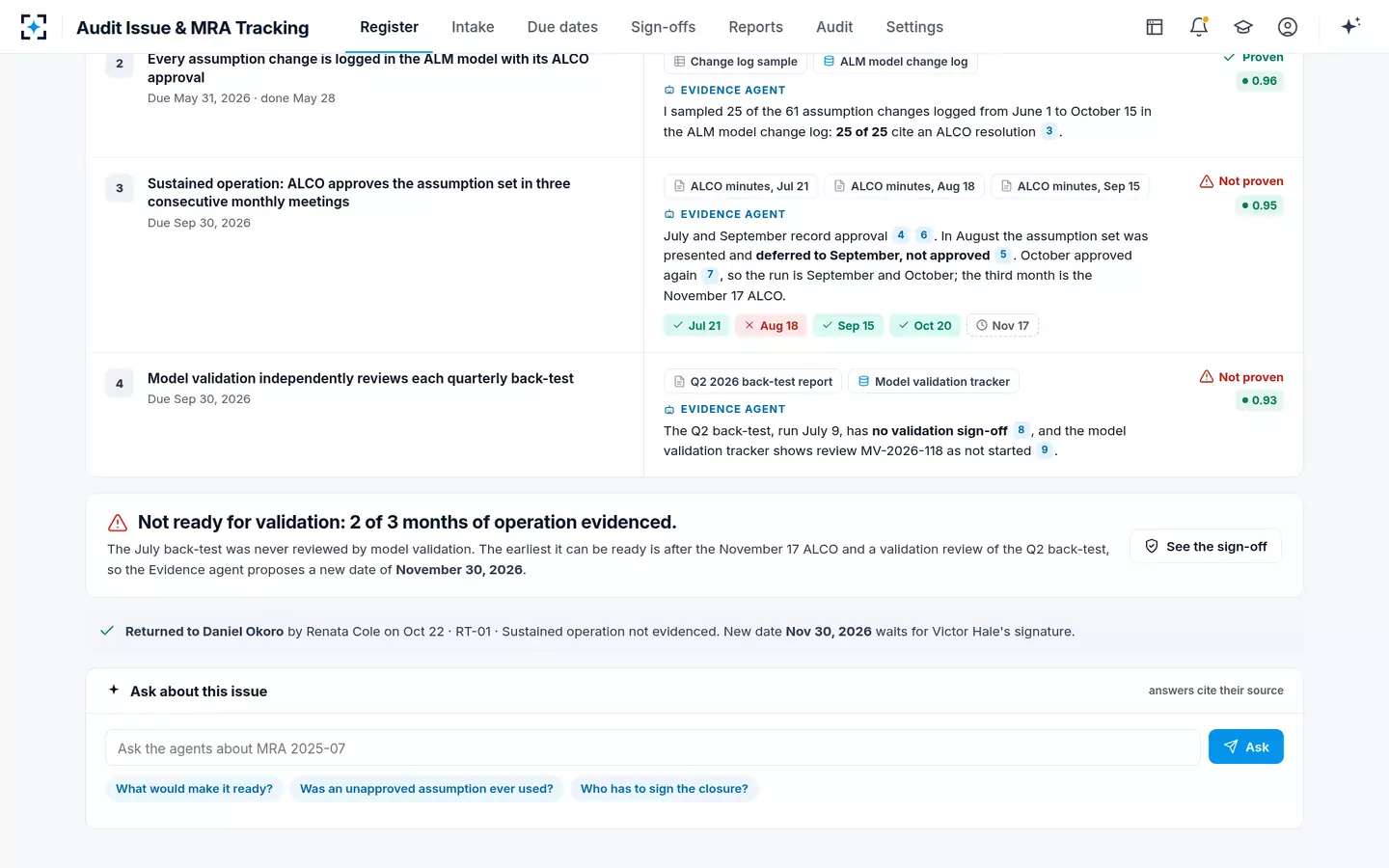
In Audit Issue & MRA Tracking, a date moves only with a reason and a second signature
Questions people ask
What is the difference between an MRA and a consent order?
An MRA is a supervisory finding in an examination report that the bank must correct; it is not itself an enforcement action. A consent order is a formal, enforceable action under 12 U.S.C. 1818 that the bank agrees to, and violating it can bring civil money penalties, as Citi's 2024 penalties did. Unremediated findings can feed an order: the Fed's 2020 action against Citigroup cited practices the Board had identified earlier and the firm had not corrected.
Did the OCC's 2024 action replace the 2020 order?
No. The July 2024 amendment supplemented the 2020 order by adding Article XVII on resourcing remediation, and said the 2020 order remained in full force. A separate consent order assessed the $75 million penalty. The OCC terminated the amendment in December 2025.
What did the 2024 amendment do about dividends?
It required a board-approved Resource Review Plan to decide, before any dividend or capital distribution, whether enough resources were going to remediation. Until the OCC did not object to that plan, each proposed dividend or distribution needed the Examiner-in-Charge's prior non-objection, with carve-outs for the parent's non-discretionary obligations.
Is $536 million the total Citi paid for slow remediation?
No; adding the three penalties mixes two different reasons. The $400 million in 2020 was for the underlying risk management, data governance and control deficiencies. Only the 2024 penalties, $75 million and $60.6 million, about $135.6 million together, were for violating the 2020 orders through slow progress and missed milestones.
Does the 2026 MRA rule make missed remediation dates less risky?
For MRAs, partly: under the OCC and FDIC rule effective November 2, 2026, mere failure to remediate an MRA is not itself an unsafe or unsound practice. For orders, no: violating an order remains grounds for penalties. And the Federal Reserve's 2026 principles provide for a new MRA or stronger action if remediation proves unsustainable.