RCSA questions are the prompts a process owner answers to rate one operational risk: what could go wrong and how often, how bad it would be, which controls stand in the way, how she knows they work, what happened in the past year, and what has changed since. A questionnaire asks all of them of every risk; a good RCSA interview asks only the ones the evidence leaves open, because the incidents, loss postings, control tests, audit findings and key risk indicators already answer most of them. The hard part is that this evidence sits in five or six systems, so owners answer from memory and the questions become a form. Botminds' Risk & Control Self-Assessment (RCSA) reverses the order: its agents read the year's evidence first, propose a rating with every figure cited, and put a question to the owner only where the evidence is thin, contradictory or late.
The examples come from a fictional sample credit union as it runs through the solution: Norrell Federal Credit Union, whose 2026 cycle rates 186 risks across 14 business units.
Propose, ask or hold: what the agent does with each risk's evidence
Propose
When
The evidence for the window is complete and the agent's confidence is 0.70 or higher.
The agent
Opens with last year's rating, what happened since and a proposed rating, every figure cited.
"Accept, change it with a reason, or ask."
Ask
When
Confidence is below 0.70: too few incidents, a control never tested, or evidence that points both ways.
The agent
Proposes nothing. Shows what it found and asks the owner the question the evidence cannot answer.
"The velocity rule has no test in the window. Has it been tested since?"
Hold
When
A source is late or incomplete, for example a card processor feed that has not caught up.
The agent
Shows a delay banner naming the late source and retries the feed, so nobody rates on part of the year without knowing it.
"Chargeback recoveries are not complete. Rate now with reason R2, or wait for the feed?"
What questions are asked in an RCSA? The six every rating needs
Every RCSA asks six questions per risk, whatever the template calls them: how likely, how severe, which controls, how effective, what happened, and what changed. The Basel Committee's description of a self-assessment is the test of whether they were answered well: the assessments should "contain sufficiently detailed information on the business environment, operational risks, underlying causes, controls and evaluation of control effectiveness to enable an independent reviewer to determine how the bank reached its ratings" (BCBS, 2021). An answer that a reviewer cannot trace back is not an answer.
The six RCSA questions, and the evidence that answers each one
| Question | Evidence that answers it | Feeds |
|---|---|---|
| How often could this happen? | Incident count for the window and the year before; external events where the unit has none | Inherent likelihood |
| How bad would it be? | Gross loss postings, the largest single event, recoveries kept separate | Inherent impact |
| Which controls stand in the way? | The control library for the risk, with each control's key or non-key status | Control effectiveness |
| How do you know they work? | Control test results in the window, open audit and exam findings against the control | Control effectiveness |
| What happened this year? | Key risk indicator months in amber or red, the largest incidents, losses over the trigger amount | All three ratings |
| What changed? | New products, volume, process or system changes, controls added after the window closed | Reason for any change |
The first four questions build the ratings. The last two decide whether last year's ratings still hold, and they are the ones a questionnaire handles worst, because a blank box for "what changed?" invites "nothing". On debit card fraud at the sample credit union, the evidence answers it without asking: 214 incidents against 151 the year before, gross losses of $389,400 against $176,200, one red indicator month in August, one failed control test and one open audit finding.
What are good RCSA questions for process owners?
A good RCSA question for a process owner asks for something only she knows, about evidence she can see. "Rate the likelihood of debit card fraud from 1 to 5" asks her to do arithmetic the data could do. "Losses more than doubled while the incident count rose by 42%; what made each loss larger?" asks for judgment about the business, which is what the first line is for.
Questionnaire questions and interview questions on the same risk
Questionnaire item: How likely is debit card fraud? (1–5)
Interview question, asked against the evidence: 214 incidents this window, 151 last year. Anything in that count that does not belong to this risk?
Questionnaire item: Is the monthly velocity rule review effective? (Y/N)
Interview question, asked against the evidence: The July test failed: April and May were not evidenced. What has changed since?
Questionnaire item: Any changes in the past year?
Interview question, asked against the evidence: A new rule went live on September 18, after the window. Has it been tested?
Questionnaire item: Rate residual risk.
Interview question, asked against the evidence: Residual comes out High against an appetite of Moderate or lower. Do you accept that, or is there evidence the proposal missed?
The right-hand column also changes who carries the burden. In the questionnaire, the owner must prove the risk is high before it is rated high. In the interview, the evidence has already made the case and the owner must say why it is wrong. That is the right way round for a self-assessment, because self-assessment leans optimistic: a review of the research in Psychological Science in the Public Interest found that "self-assessments of skill and character are often flawed in substantive and systematic ways" (Dunning, Heath and Suls, 2004). No study has measured RCSA ratings the same way, so the finding is a caution, not a statistic about banks.
Why last year's rating should never be asked alone
Showing an owner last year's rating and asking whether it still holds is the most common RCSA question and the weakest one, because it hands her an anchor. Tversky and Kahneman's account of judgment under uncertainty names "adjustment from an anchor, which is usually employed in numerical prediction when a relevant value is available", and warns that such heuristics "lead to systematic and predictable errors" (Tversky and Kahneman, Science, 1974). Last year's Low is a relevant value, and adjustment from it tends to be too small.
The interview keeps last year's rating on the screen, because the change is the story, but never on its own. The agent opens with three things at once: last year's rating, what happened since, and its proposal. On debit card fraud that reads as Moderate, Effective and Low last year; 214 incidents, $389,400 in gross losses, a red indicator, a failed test and an audit finding since; and a proposal of High inherent risk, a control that needs improvement, and High residual risk, above appetite.
The RCSA as an interview: the agent speaks first, with its sources
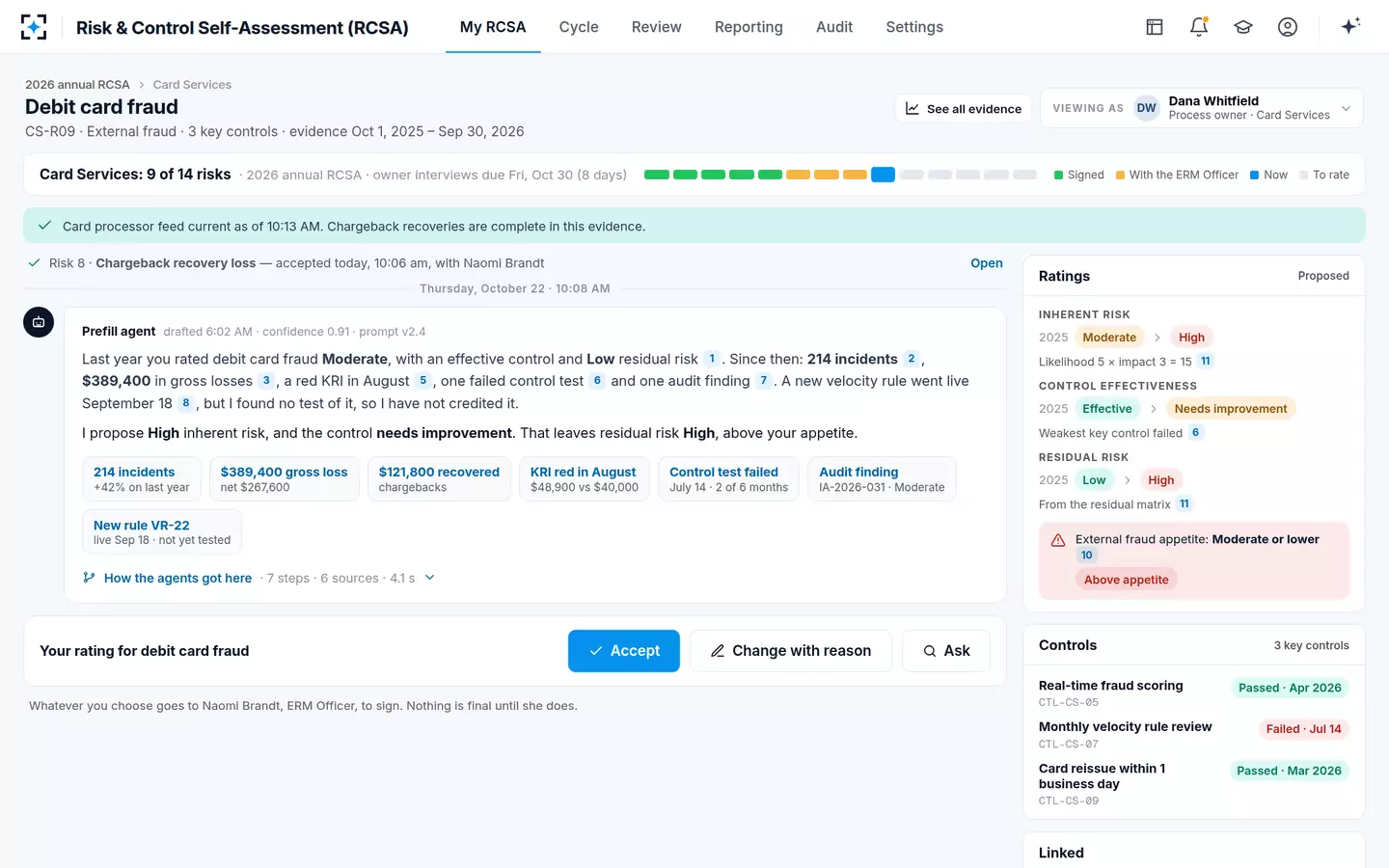
Can AI pre-fill an RCSA, and what should it never answer?
AI can pre-fill an RCSA as a proposal: reading the evidence, scoring likelihood and impact on the institution's own scale, rating controls from their tests, applying the residual matrix and citing each figure. It should never submit, sign or change a rating itself, and it should never treat another unit's rating as evidence. The Financial Stability Board's final sound practices on AI ask for "appropriate and effective human oversight relevant to the materiality, risk, autonomy, complexity and explainability of different AI use cases", and warn that over-reliance on AI and automation bias can weaken that oversight (FSB, October 2026).
The interview, step by step, with each agent's limits
Agent
Evidence agentGathers the window's incidents, losses, recoveries, tests, findings and indicators for one risk.
Never: edits a source system, or lists suspicious activity report material outside the BSA team
Agent
Prefill agentScores the three ratings on the institution's scale and cites every figure.
Never: proposes under 0.70 confidence, or uses peer ratings as evidence
Agent
Interview agentRuns the conversation one risk at a time and answers the owner's questions with citations.
Never: changes a rating itself
A person decides
Process ownerAccepts, changes a rating with a reason code, a note and evidence, or asks.
Agent
Challenger agentChecks the rating against seven second-line rules before anyone signs.
Never: overrides a rating
A person decides
ERM OfficerSigns as the checker, returns with a reason, or escalates.
Automation bias is the specific risk of a pre-filled RCSA: an owner who accepts every proposal has stopped assessing. Two design choices push against it. The agent proposes nothing below its threshold, so a weak proposal never arrives looking strong. And overrides are counted per agent, so an ERM Officer can see a unit where owners accept everything and look at whether the proposals deserved it. Whether the agents themselves fall under model risk guidance is a separate question: the April 2026 revised interagency guidance leaves generative and agentic AI outside its scope, as the guide on customer risk rating models explains, so governance of an RCSA agent rests on the institution's own controls.
What happens when there is not enough evidence to rate a risk?
When there is not enough evidence to rate a risk, the agent should say so and ask, not guess. Below 0.70 confidence the sample credit union's Prefill agent proposes nothing; it shows what it found and asks the owner the question the evidence cannot answer. A thin file is common and legitimate: a risk with no incidents in the window, a control tested only every other year, a new product with no history.
The question that follows is specific to what is missing. No incidents at all: is the risk real, or has it moved to another unit's incident type? No test in the window: when was the control last tested, and by whom? Evidence that contradicts itself: which of the two systems is right? The answer goes into the trail with the evidence the owner points to, and the second line has a rule for the case where none arrives: the sample credit union's evidence-gap rule raised two challenges this cycle.
Who changes an AI-proposed rating, and how is the reason kept?
Only the process owner changes an AI-proposed rating, and only with a reason code, a note in her own words and the evidence attached. The sample credit union uses five codes: a new or improved control since the evidence window, evidence incomplete or delayed, evidence attributed to the wrong risk, a business change, and other, explained in the note. The note is kept verbatim.
Writing the reason down is not bureaucracy; it is what makes a qualitative rating reproducible. NIST's guide to risk assessment puts it plainly: "The repeatability and reproducibility of qualitative assessments are increased by the annotation of assessed values (e.g., this value is high because of the following reasons)" (NIST SP 800-30 Rev. 1). The psychology review cited above lists the same remedy among those that work against flawed self-assessment: "requiring people to justify their decisions in front of their peers".
Change a rating with a reason code, a note and evidence
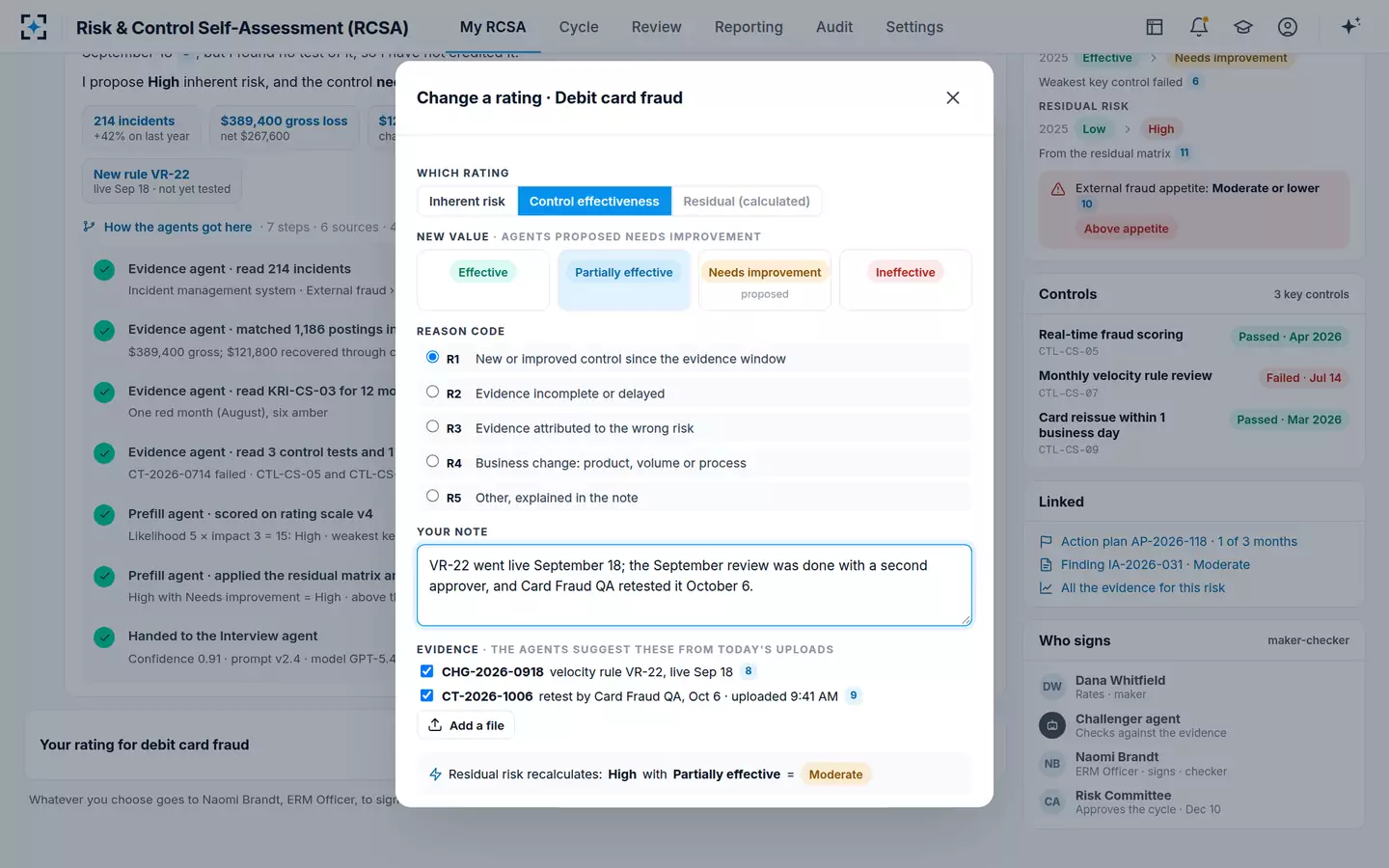
On debit card fraud the owner knew something the proposal could not credit: the new velocity rule had been retested on October 6, after the evidence window closed. She changed control effectiveness from Needs improvement to Partially effective with reason R1 and attached the change ticket and the retest. The Challenger agent then checked her claim against the rule that applies: one clean retest after a failure supports Partially effective but not Effective, which needs two clean quarters. Residual risk moved from High to Moderate, within appetite, with a retest due on January 8, 2027.
Can AI sign an RCSA? No, and the questions the second line asks next
AI should not sign an RCSA. A signature is a person accepting accountability for a rating, and the Basel test is that an independent reviewer can see how the rating was reached; an agent that proposed the rating cannot also be the person who accepts it. In the solution the owner is the maker, the ERM Officer is the checker, nobody signs a rating they made, and the Risk Committee approves the cycle only when every rating is signed. How that maker-checker chain looks on screen is followed in an RCSA example, one risk through a year.
After the owner answers, the second line has questions of its own, and they are best written as rules. The sample credit union's seven Challenger rules turn the usual challenge-session questions into checks that run on every proposal and every change.
The second line's questions, written as rules: 23 challenges this cycle
How many questions should an RCSA interview have?
An RCSA interview should have as many questions per risk as the evidence leaves open, which for most risks is none or one. A risk whose evidence is unchanged from last year, accepted as proposed and unchallenged needs a confirmation, not a conversation. A risk with a failed test, a red indicator and a loss over the trigger amount needs several, and they should be about those events.
That is why the sample credit union's target is set in minutes, not questions: about 20 minutes per risk of the owner's and the second line's time together, against the solution's own estimate of about 145 by hand, half of which goes on finding and reading the evidence. Fixed questionnaires invert that, spending the same effort on a quiet risk as on a loud one. Choosing the rating scale those answers are scored on is its own decision, covered in the likelihood and impact matrix guide. The interview itself is part of Risk & Control Self-Assessment (RCSA).
Questions people ask
What is an RCSA questionnaire?
An RCSA questionnaire is the form a process owner fills in to rate each risk: likelihood, impact, controls, control effectiveness and residual risk, usually with free-text boxes for the rationale. It works when the owner has the evidence at hand. Where the evidence sits in other systems, the questionnaire tends to collect opinions, which is the problem an evidence-first interview is designed to solve.
What RCSA questions come up in a job interview?
Expect questions on the concepts: the difference between inherent and residual risk, design versus operating effectiveness of a control, the three lines of defence, how a key risk indicator differs from a key performance indicator, and how to challenge a rating. A strong answer uses an example with evidence: a failed test, a loss, and what the rating did as a result.
Should every business unit get the same RCSA questions?
The structure should be the same, so ratings can be compared across units, but the evidence behind each question differs. A payments unit answers "how often" from transaction incidents; an IT unit from outages and change failures. The Basel principles ask for a common taxonomy of risk terms so that ratings mean the same thing everywhere.
What if the owner disagrees with the evidence itself?
Then the evidence, not the rating, is the first thing to fix. The sample credit union has a reason code for evidence attributed to the wrong risk; the owner says which items do not belong and why, the second line checks the mapping, and the rating is recalculated on the corrected set.
Can an owner ask the agent questions back?
Yes, and the answers should be cited. In the sample cycle an owner can ask why a risk is rated High and not Critical; the answer gives the scores (likelihood 5, impact 3, a score of 15) and the threshold for Critical (20 or more, meaning annual gross loss over $1 million or a single event over $100,000) with the largest event, $22,860, as the reason.